
Botanical Identity & Classification
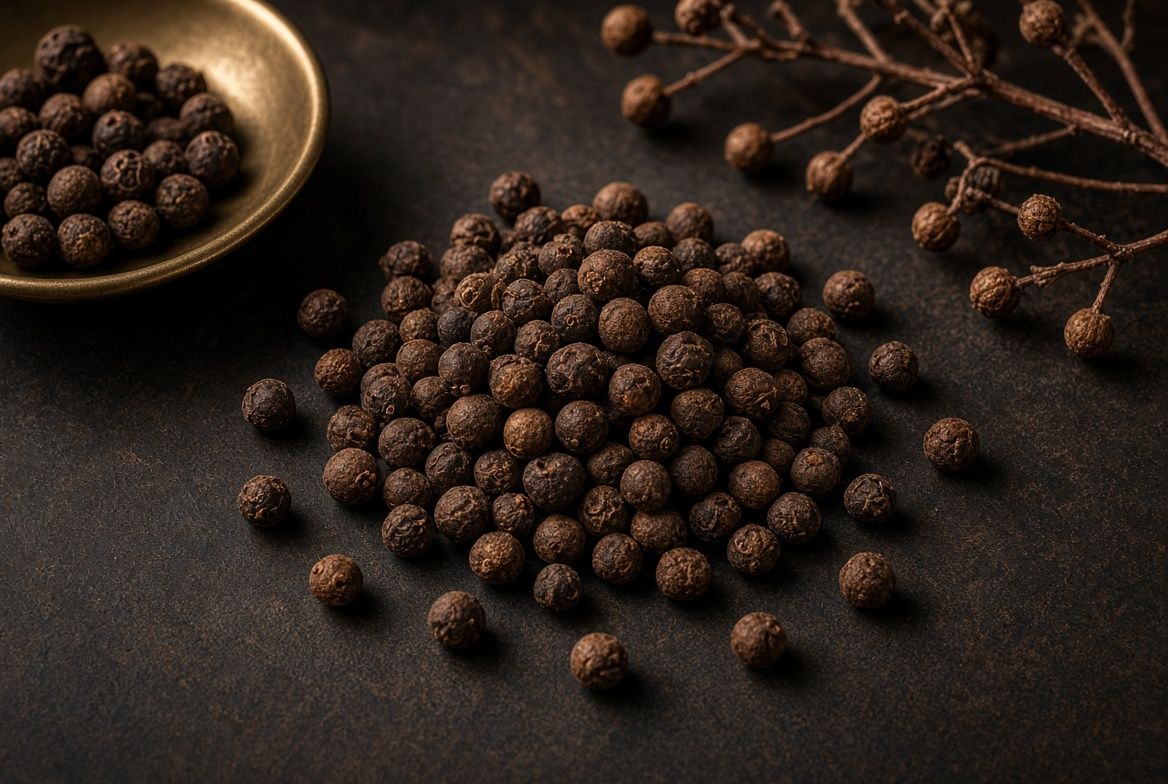
Inventory scope: Pimenta dioica · Myrtaceae · dried unripe fruits.
Nomenclatural check: Pimenta dioica (L.) Merr. is accepted in this treatment (family Myrtaceae). A synonym listed there is Evanesca crassifolia Raf. The stated native range is S. Mexico to Central America, Caribbean (Kew, Plants of the World Online: Pimenta dioica (L.) Merr.).
Inventory decision: Allspice is one botanical, not a mixture. Separate whole culinary berries, leaf material and concentrated berry or leaf oil; document supplier origin instead of assuming Jamaica.
The page identifies the pimento tree as Pimenta dioica, formerly Pimenta officinalis, Lindl., in the family Myrtaceae (Jamaican Pimento - The Department of Chemistry, UWI, Mona, Jamaica).
The Plant Finder profile identifies Pimenta dioica as a small evergreen tree in the Myrtaceae family, commonly called allspice or Jamaica pepper (Pimenta dioica - Plant Finder).
Botanical & Scientific Profile
The fruits are the subject, not a premixed seasoning and not the leaves or their oil. Trade references should specify Jamaica or another documented origin rather than treating the common name as a geographical guarantee.
The page describes Pimenta dioica as an evergreen, medium-sized tree that can reach 6–15 m in favourable locations. It says both male and female varieties produce blossoms, but only female blossoms are believed to mature into berries (Jamaican Pimento - The Department of Chemistry, UWI, Mona, Jamaica).
The Plant Finder profile states that Pimenta dioica typically grows 20–40 feet tall; its oblong, leathery leaves are 3–6 inches long, its flowers are creamy white, and its small green fruits mature to reddish-brown (Pimenta dioica - Plant Finder).
The page states that Jamaican pimento contains about 4% volatile oil and that its eugenol content varies from 30–90%. It also states that the methyleugenol-to-eugenol ratio in pimento leaf extracts is generally 15:85 (Jamaican Pimento - The Department of Chemistry, UWI, Mona, Jamaica).
Cultural History & Traditional Herbalism
The page says early Spanish explorers found pimento growing in Jamaica and that Jamaica has been in continuous production since the tree was identified around 1509 (Jamaican Pimento - The Department of Chemistry, UWI, Mona, Jamaica).
The Plant Finder profile describes allspice from Pimenta dioica as perhaps the most important spice in Caribbean cuisine and lists its use in jerk seasoning, mole sauces, marinades, pickling, meats, stews, and sausages; it identifies pimento dram as a Jamaican rum-based liqueur made with allspice (Pimenta dioica - Plant Finder).
The article’s abstract reports that fieldwork focused on Totonaca Indigenous communities in the Sierra Norte de Puebla, México, where allspice (Pimenta dioica) is used medicinally and as a food condiment; it also records other technological and cultural uses (The allspice Pimenta dioica (L.) Merrill, Myrtaceae in the Sierra Norte de Puebla (México)).
The record says Spanish explorers discovered pimento’s use as a spice in the Caribbean Islands in the 16th century; it identifies the spice as the dried green-mature fruit of Pimenta dioica. In Jamaica, families harvest the mature but still green fruits, normally from July to September and 3–4 months after flowering, by breaking off small fruiting branches and picking the fruits individually. Leaves from broken branches are collected separately for oil distillation (Pimenta dioica (L.) Merrill).
Tradition, Folklore & Symbolism
The page says the name “allspice” originated from the popular notion that the pimento berry combines the characteristic flavour and aroma of cloves, nutmeg, cinnamon, and pepper (Jamaican Pimento - The Department of Chemistry, UWI, Mona, Jamaica).
The Plant Finder profile says the British gave allspice its common name because its smell suggested a blend of cinnamon, nutmeg, black pepper, and cloves, and notes that the British took Jamaica from the Spanish in 1655 (Pimenta dioica - Plant Finder).
Herbal Energetics
Insufficient documented evidence for a traditional energetic classification. No temperature, direction or channel is inferred from the flavor of a cup.
InfiniTea sensory metaphor: Many notes, one fruit. This is original editorial language, not a measured physiological action or a translation of a traditional diagnostic category.
Sensory Profile & Tea Applications
The page says early Spanish explorers were impressed by the taste and aroma of pimento berries and leaves. It describes the popular notion that the pimento berry combines the characteristic flavour and aroma of cloves, nutmeg, cinnamon, and pepper (Jamaican Pimento - The Department of Chemistry, UWI, Mona, Jamaica).
The Plant Finder profile says the allspice made from dried unripe fruits of Pimenta dioica smelled enough like a blend of cinnamon, nutmeg, black pepper, and cloves to inspire its common name; it describes the tree’s leaves as aromatic (Pimenta dioica - Plant Finder).
Sensory notebook: Smell a whole and a freshly split berry, noting whether clove, cinnamon or pepper comparisons fit. These comparisons describe aroma, not the ingredients actually present.
Proposed comparison, not a completed trial: Compare a whole berry with a freshly cracked berry from the same food-grade lot. Record the contribution of the seed and fruit wall visually before discussing the aroma.
For ordinary dried herbal or fruit infusions, the German Federal Institute for Risk Assessment advises using boiling water and not leaving the prepared infusion standing for hours. Cooling a hot infusion and steeping untreated dry material in cold water are different processes; this report does not validate the latter (Boiling water a must for herbal teas).
Safety & Responsible Use
21 CFR § 182.10 lists allspice (Pimenta officinalis Lindl.) among spices and other natural seasonings and flavorings generally recognized as safe for their intended use. Section 182.20 also lists allspice among essential oils, solvent-free oleoresins, and natural extractives generally recognized as safe for their intended use (21 CFR Part 182—Substances Generally Recognized as Safe).
Preparation and exposure boundary: This review does not establish a safe medicinal dose in pregnancy, lactation or childhood, or rule out interactions or allergy. Do not substitute essential oil or a concentrated extract for the documented food or herb.
For U.S. food use, the relevant safety determination concerns the intended conditions of use. The existence of a traditional preparation or herbal medicine monograph does not establish that this ingredient, dose and beverage are cleared for sale (Understanding How the FDA Regulates Food Additives and GRAS Ingredients).
Historical Trade, Ecology & Sustainability
UWI Mona researchers report that pimento (Pimenta dioica) has functional dioecy, with male and female flowers on separate trees. Their floral-biology study found that flowers were insect-pollinated; unbagged flowers set fruit, while flowers isolated with bridal tulle or plastic bags aborted (Pollination Ecology of Pimenta dioica (L.) (Merr.)).
The Plant Finder profile states that Pimenta dioica fruits are picked green and dried in the sun, and that Jamaica is the primary exporter of allspice, with Mexico and Honduras also producing it commercially (Pimenta dioica - Plant Finder).
The article’s abstract states that most allspice (Pimenta dioica) harvest comes from trees growing wild in tropical forests, while domestication and cultivation have lately been trending upward. Its dried fruits are sold in Mexican national markets and exported to Germany, the United States, Jamaica, and Great Britain (The allspice Pimenta dioica (L.) Merrill, Myrtaceae in the Sierra Norte de Puebla (México)).
The page identifies allspice as the dried, mature but unripe fruit of Pimenta dioica; the berries are picked green and dried for use as a spice. It reports that Spanish explorers and settlers in Jamaica harvested the leaves and berries, and that berry production there has continued almost continuously from around 1509 to the present (Pimenta dioica (allspice) | CABI Compendium).
Sourcing record: Require berry rather than leaf and protect the distinction between Jamaican pimento and allspice from another documented origin.
InfiniTea Herb Lore & Ritualpreliminary draft
Energetics (original InfiniTea metaphor): Many notes, one fruit. Use this as a private writing image, not a health statement.
Tradition & Folklore: The page says the name “allspice” originated from the popular notion that the pimento berry combines the characteristic flavour and aroma of cloves, nutmeg, cinnamon, and pepper (Jamaican Pimento - The Department of Chemistry, UWI, Mona, Jamaica).
Ritual Cue (original contemporary InfiniTea interpretation): Choose three words for the same memory. Keep all three rather than forcing one to replace the others.
Private preliminary draft; not approved for publication.
Scholarly References & Research Verification
Research limitations
Seek harvest maturity, drying practice and geographic origin. Treat concentrated pimento oil as a different exposure.
References below identify the evidence used, not additional endorsements. A botanical authority establishes nomenclature, not the identity of a physical lot. Published study samples, traditional descriptions and InfiniTea proposals are distinguished in the text.
- Kew, Plants of the World Online: Pimenta dioica (L.) Merr. | Taxonomic backbone
- Jamaican Pimento - The Department of Chemistry, UWI, Mona, Jamaica | Informational webpage covering botanical identity, history, and chemistry
- Pimenta dioica - Plant Finder | horticultural plant profile
- The allspice Pimenta dioica (L.) Merrill, Myrtaceae in the Sierra Norte de Puebla (México) | Ethnobotanical fieldwork article with a review of a historical monograph
- 21 CFR Part 182—Substances Generally Recognized as Safe | Federal regulation (eCFR)
- Pollination Ecology of Pimenta dioica (L.) (Merr.) | research poster/study
- Pimenta dioica (allspice) | CABI Compendium | Secondary reference datasheet
- Pimenta dioica (L.) Merrill | PROSEA botanical and agricultural handbook database record
- Boiling water a must for herbal teas | BfR press release providing general food-safety guidance for preparing herbal and fruit infusions.
- Understanding How the FDA Regulates Food Additives and GRAS Ingredients | U.S. FDA consumer-information webpage describing food-additive and GRAS ingredient oversight.
Final Botanical Summary
Jamaican pimento has its own agricultural and culinary history. A resemblance to other spices explains a name but not interchangeability.
Editorial disposition: Lot unverified. The report is a private reference, not a clinical recommendation, approval for sale or authenticated sensory trial.
Verification Status (November 2026)
Phase II source audit, claim by claim
- Claims checked
- 17
- Corrected
- 3
- Withheld
- 1
- Sources
- 10
Material: Lot unverified. No physical sample has been examined.
Citation check: All 2 Safety & Use citations were re-read against their sources in November 2026 and confirmed.
A private research reference, not a clinical recommendation or product claim. Checked to the Grimoire's research standards →