
Botanical Identity & Classification
Inventory scope: Piper nigrum · Piperaceae · peppercorns, dried fruit.
Nomenclatural check: Piper nigrum L. is accepted in this treatment (family Piperaceae). A synonym listed there is Piper aromaticum Lam. The stated native range is Sri Lanka (Kew, Plants of the World Online: Piper nigrum L.).
Inventory decision: Separate culinary black pepper from isolated piperine added to supplements to alter absorption. Identify processing before comparing black, white or green peppercorns.
The article identifies Piper nigrum L. (Piperaceae) as the source of black pepper. It discusses black pepper fruits but does not specify a more precise fruit part or a processing method (Population genetics and phylogenomic insights into the origin of economically important black pepper (Piper nigrum)).
Black pepper is Piper nigrum, a perennial climbing vine in the family Piperaceae and genus Piper; it is also called pepper (Black pepper | History, Physical Description, Cultivation, Use, & Facts | Britannica).
Botanical & Scientific Profile
Distinguish piperine in a measured study intervention from the variable amount in a peppercorn infusion. A bioavailability experiment is not a basis for adding pepper to intensify a medicine.
The article reports population-genetic and phylogenomic analyses of Piper nigrum and related species; it does not describe human studies of black pepper preparation, consumption, or physiological effects (Population genetics and phylogenomic insights into the origin of economically important black pepper (Piper nigrum)).
The article discusses black pepper extract (piperine; “Piper nigrum extract” is also listed as a possible supplement-label term); it does not specify a plant part or community. In human pharmacokinetic studies, 20 mg of piperine with 2 g of curcumin was reported to increase serum curcumin exposure by about 2,000%, although curcumin alone was near the assay’s limit of detection. Three later curcumin-formulation trials without involvement of the piperine-ingredient manufacturer found no significant enhancement versus native curcumin or standard extract. In a resveratrol pharmacokinetic subset of six participants, a single 20 mg dose of piperine did not change plasma resveratrol or its metabolites (Enhancement without a rationale? Black pepper extract (piperine) in dietary supplements and the future of formulation: a perspective from Japan).
Genetic analyses indicated that most cultivated Piper nigrum accessions are autotetraploid, while anonymous accessions appeared diploid. The study found no evidence that P. galeatum or P. trichostachyon is a parental species of cultivated P. nigrum (Population genetics and phylogenomic insights into the origin of economically important black pepper (Piper nigrum)).
Cultural History & Traditional Herbalism
The article states that nearly all traded black pepper came from Peninsular India until the thirteenth century. It describes Admiral Zheng He's inaugural state-sponsored trading mission in 1405 as facilitating the introduction of Indian pepper plants to northern Sumatra and marking the start of the Southeast Asian commercial era (Population genetics and phylogenomic insights into the origin of economically important black pepper (Piper nigrum)).
In early historic times, black pepper (Piper nigrum) was widely cultivated in tropical Southeast Asia and valued as a condiment. It became an important overland trade item between India and Europe and often served as a medium of exchange (Black pepper | History, Physical Description, Cultivation, Use, & Facts | Britannica).
The review describes black pepper (Piper nigrum L.) as an integral part of global cuisine and traditional medicine systems, including Ayurveda, Traditional Chinese Medicine, and Unani (Black pepper (Piper nigrum L.): ethnomedicinal heritage, phytochemical richness, and nutraceutical promise in human health).
Archaeobotanical research at Berenike on Egypt’s Red Sea coast identified about 60 cultivated plant species. The researchers found considerable quantities of black pepper (Piper nigrum); this is direct material evidence of pepper at the site, which the chapter says confirms large-scale trade previously known from historical sources. The chapter describes foods traded between Rome and, especially, Sudan and India, but the provided page does not specify the pepper remains’ plant part or archaeological context (Trade and Subsistence at the Roman Port of Berenike, Red Sea Coast, Egypt).
Tradition, Folklore & Symbolism
The review says black pepper (Piper nigrum L.) is commonly known as the “King of Spices.” (Black pepper (Piper nigrum L.): ethnomedicinal heritage, phytochemical richness, and nutraceutical promise in human health).
Herbal Energetics
Botanical name: Piper nigrum L. Plant part: dried near-mature or mature fruit. Traditional properties stated under 性味: 辛,熱 (pungent, hot). The source does not state rasa, virya, or vipaka. It lists traditional functions and uses, but provides no actual clinical evidence (胡椒(Hujiao)— Black Pepper Fruit).
These are categories within the named tradition. They are not measurements of body temperature, pharmacological action or clinical efficacy.
InfiniTea sensory metaphor: A point of emphasis. This is original editorial language, not a measured physiological action or a translation of a traditional diagnostic category.
Sensory Profile & Tea Applications
The article identifies piperine as the pungent component of black pepper and says Sri Lankan pepper is reputed to have high levels of piperine (Population genetics and phylogenomic insights into the origin of economically important black pepper (Piper nigrum)).
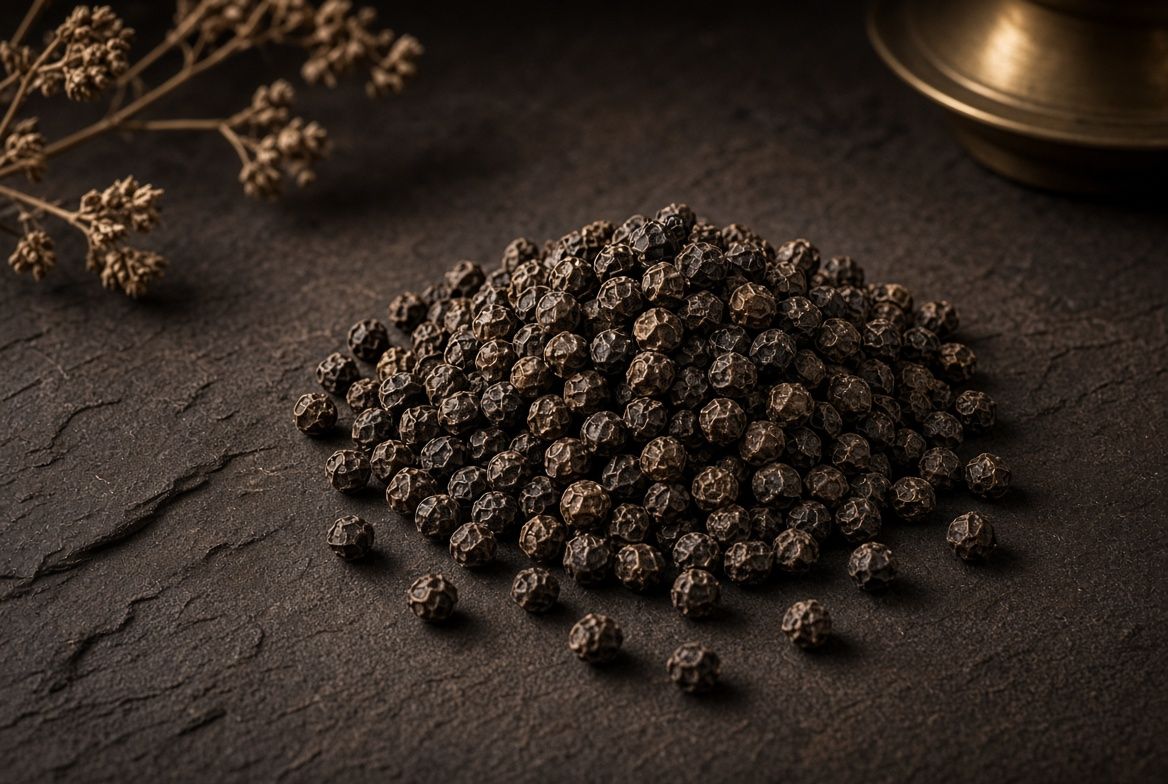
The fruits of black pepper (Piper nigrum), sometimes called peppercorns, have a penetrating, aromatic odor and a hot, biting, very pungent taste. Pepper is widely used as a spice around the world (Black pepper | History, Physical Description, Cultivation, Use, & Facts | Britannica).
Sensory notebook: Smell newly cracked pepper before assessing pungency. Note whether the first aroma disappears before the warming sensation does.
Proposed comparison, not a completed trial: Compare intact and just-cracked peppercorns from the same lot. Describe aroma above the cup separately from oral pungency; no concentrated extract is needed.
For ordinary dried herbal or fruit infusions, the German Federal Institute for Risk Assessment advises using boiling water and not leaving the prepared infusion standing for hours. Cooling a hot infusion and steeping untreated dry material in cold water are different processes; this report does not validate the latter (Boiling water a must for herbal teas).
Safety & Responsible Use
Human pharmacokinetic studies report that piperine can alter exposure to medicines, including carbamazepine. The article distinguishes concentrated, isolated piperine taken as a daily supplement bolus from culinary amounts of black pepper; whether culinary amounts cause clinically significant interactions remains unclear. One small crossover study found increased phenytoin absorption and exposure after a pepper-containing meal, but the clinical relevance is unknown (Enhancement without a rationale? Black pepper extract (piperine) in dietary supplements and the future of formulation: a perspective from Japan).
Reports associate turmeric-containing products that also contain piperine with liver injury, but the evidence described does not establish that piperine caused an individual event or determine the causal contribution of either ingredient (Enhancement without a rationale? Black pepper extract (piperine) in dietary supplements and the future of formulation: a perspective from Japan).
Human studies reported increased blood concentrations or exposure (Cmax and/or AUC) for propranolol, theophylline, phenytoin, carbamazepine, nevirapine, chlorzoxazone, diclofenac and fexofenadine when taken with piperine; a study with rifampicin also reported increased Cmax and AUC, and piperine followed by midazolam was associated with prolonged sedation and more amnesia. Animal studies reported reproductive effects, including impaired spermatogenesis in rats and reduced fertility or implantation and interrupted pregnancies in mice; BfR advised pregnant women to abstain from supplements containing isolated piperine. These findings concern concentrated supplement piperine and the cited study conditions, not ordinary black pepper consumption (Risk Assessment Approaches and Methodology – an Overview).
Preparation and exposure boundary: This review does not establish a safe medicinal dose in pregnancy, lactation or childhood, or rule out interactions or allergy. Do not substitute essential oil or a concentrated extract for the documented food or herb.
For U.S. food use, the relevant safety determination concerns the intended conditions of use. The existence of a traditional preparation or herbal medicine monograph does not establish that this ingredient, dose and beverage are cleared for sale (Understanding How the FDA Regulates Food Additives and GRAS Ingredients).
Historical Trade, Ecology & Sustainability
The article says Piper nigrum is grown commercially in many countries and reports these 2020 export quantities: Vietnam, 250,000 tons; India, 104,071 tons; Brazil, 78,000 tons; Indonesia, 78,000 tons; Malaysia, 24,000 tons; and Sri Lanka, 21,800 tons (Population genetics and phylogenomic insights into the origin of economically important black pepper (Piper nigrum)).
The article says Piper nigrum was hypothesized to have originated in the humid tropical evergreen forests of the Malabar Coast in the Western Ghats. The study instead found it in a clade otherwise comprising Sri Lankan endemics and suggested that it may have originated in Sri Lanka. The authors caution that limited access to Indian species and insufficient Indian sampling weaken this conclusion (Population genetics and phylogenomic insights into the origin of economically important black pepper (Piper nigrum)).
Black pepper (Piper nigrum) is native to India’s Malabar Coast, is widely cultivated throughout Indonesia, and has been introduced into tropical areas of Africa and the Western Hemisphere (Black pepper | History, Physical Description, Cultivation, Use, & Facts | Britannica).
Sourcing record: Ask how the fruit was harvested, dried and graded and whether the lot is black, white or green pepper, rather than assigning processing by species.
InfiniTea Herb Lore & Ritualpreliminary draft
Energetics (original InfiniTea metaphor): A point of emphasis. Use this as a private writing image, not a health statement.
For the separately attributed traditional material, see Herbal Energetics; the original sensory image is not a translation of that classification.
Tradition & Folklore: The review says black pepper (Piper nigrum L.) is commonly known as the “King of Spices.” (Black pepper (Piper nigrum L.): ethnomedicinal heritage, phytochemical richness, and nutraceutical promise in human health).
Ritual Cue (original contemporary InfiniTea interpretation): Add a single dot beside the most important word on a page. Ask whether another sentence could make that word clearer.
Private preliminary draft; not approved for publication.
Scholarly References & Research Verification
Research limitations
Record the form and amount of piperine actually studied. Clinical interaction magnitude for a household cup remains a different question.
The page provides only the chapter abstract and metadata, not detailed evidence about the pepper finds, their dating, or how quantities were determined (Trade and Subsistence at the Roman Port of Berenike, Red Sea Coast, Egypt).
References below identify the evidence used, not additional endorsements. A botanical authority establishes nomenclature, not the identity of a physical lot. Published study samples, traditional descriptions and InfiniTea proposals are distinguished in the text.
- Kew, Plants of the World Online: Piper nigrum L. | Taxonomic backbone
- Population genetics and phylogenomic insights into the origin of economically important black pepper (Piper nigrum) | peer-reviewed population-genetics and phylogenomics research article
- Black pepper | History, Physical Description, Cultivation, Use, & Facts | Britannica | encyclopedia article
- Enhancement without a rationale? Black pepper extract (piperine) in dietary supplements and the future of formulation: a perspective from Japan | Perspective article with a structured summary of human pharmacokinetic studies; not a primary study
- Black pepper (Piper nigrum L.): ethnomedicinal heritage, phytochemical richness, and nutraceutical promise in human health | review article
- Trade and Subsistence at the Roman Port of Berenike, Red Sea Coast, Egypt | Scholarly book chapter reporting archaeobotanical research at the Roman port of Berenike, Egypt.
- Risk Assessment Approaches and Methodology – an Overview | A BfR presentation by Karen I. Hirsch-Ernst at the BfR-BVL Joint Meeting on 1 July 2022. The piperine section concerns concentrated, isolated piperine in food supplements, including human studies of drug interactions after bolus intake and animal studies of reproductive effects; it identifies black pepper (Piper nigrum L.) as one natural source of piperine.
- 胡椒(Hujiao)— Black Pepper Fruit | Hong Kong Baptist University Chinese Medicinal Material Image Database entry; no specific classical text or named tradition is identified.
- Boiling water a must for herbal teas | BfR press release providing general food-safety guidance for preparing herbal and fruit infusions.
- Understanding How the FDA Regulates Food Additives and GRAS Ingredients | U.S. FDA consumer-information webpage describing food-additive and GRAS ingredient oversight.
Final Botanical Summary
Black pepper is both fruit and traded spice. Its trade history and piperine research are relevant, but neither supplies a therapeutic tea claim.
Editorial disposition: Lot unverified. The report is a private reference, not a clinical recommendation, approval for sale or authenticated sensory trial.
Verification Status (November 2026)
Phase II source audit, claim by claim
- Claims checked
- 16
- Corrected
- 2
- Withheld
- 0
- Sources
- 10
Material: Lot unverified. No physical sample has been examined.
Citation check: All 4 Safety & Use citations were re-read against their sources in November 2026 and confirmed.
A private research reference, not a clinical recommendation or product claim. Checked to the Grimoire's research standards →