Botanical Identity & Classification
Inventory scope: Calendula officinalis · Asteraceae · flower heads or separated ray florets.
Nomenclatural check: Calendula officinalis L. is accepted in this treatment (family Asteraceae). A synonym listed there is Caltha officinalis (L.) Moench. The stated native range is W. Medit (Kew, Plants of the World Online: Calendula officinalis L.).
Inventory decision: Pot marigold is the scope; do not import Tagetes traditions or treat an ointment, mouth rinse and swallowed infusion as equivalent. Record whether the purchased material includes green bases.
Calendula officinalis, or common marigold, is an Asteraceae. Its flowers and petals are described as food and medicinal material, as sources of yellow-to-orange dyes and tinctures, and as sources of reported phytochemicals (The Mediterranean Species Calendula officinalis and Foeniculum vulgare as Valuable Source of Bioactive Compounds).
The plant is Calendula officinalis L., known as marigold; the article specifically describes a variety with yellow-orange flowers (Herbs in History: Calendula).
Botanical & Scientific Profile
Separate ray florets from composite heads in both the botanical description and the tasting record. “Marigold” on a nursery label is not enough identification for this file.
For preparations made from the flowers of Calendula officinalis L., the HMPC accepts traditional use for minor skin inflammation, minor wounds, and minor mouth or throat inflammation. Clinical-trial evidence was insufficient; the conclusions rely on long-standing use (Calendulae flos - herbal medicinal product).
A preclinical study found that aqueous calendula flower extract relaxed endothelium-denuded rat aortic rings in a concentration-dependent manner, an effect attributed to quercetin. In vitro flower-extract studies reported activity against Herpes simplex, Influenza A2, Influenza APR8, and HIV-1; the antiviral phytochemicals were not identified. The page describes no human efficacy trial (The Mediterranean Species Calendula officinalis and Foeniculum vulgare as Valuable Source of Bioactive Compounds).
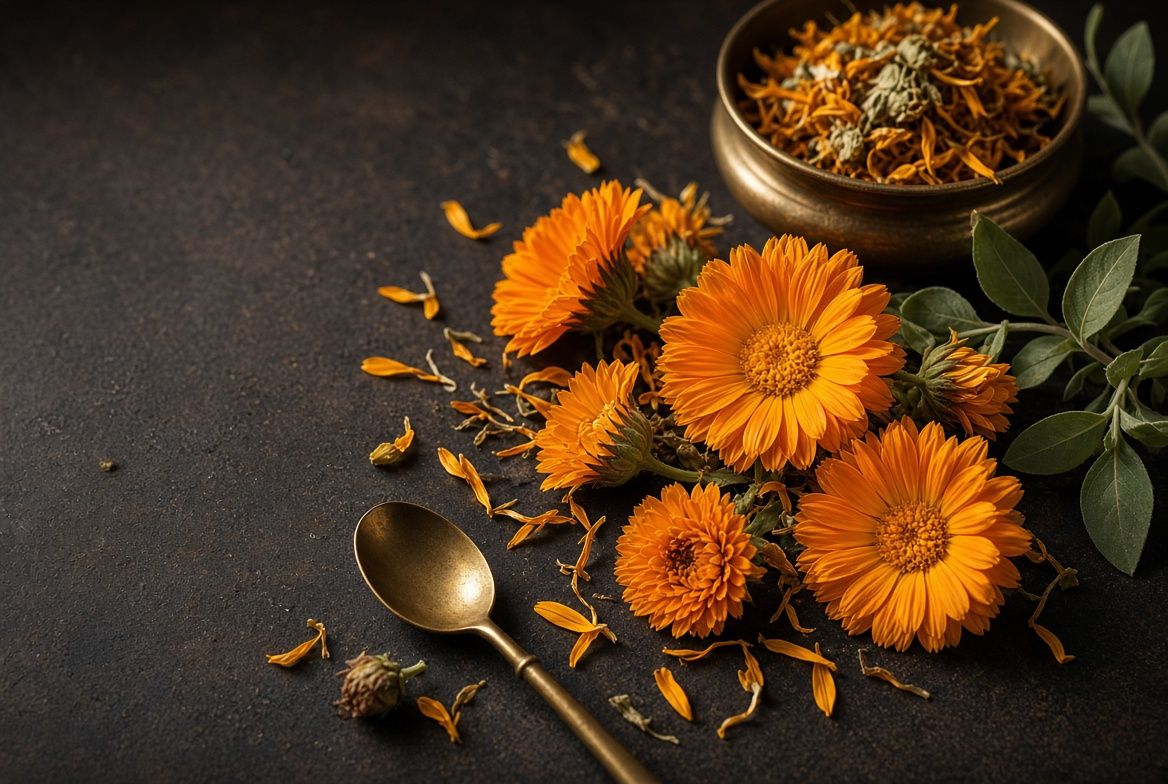
Calendula flower heads are 4–7 cm in diameter and range from bright yellow to orange. Reported flower compounds include flavonoids such as quercetin and luteolin, terpenes, and carotenoids including lutein, lycopene, and β-carotene (The Mediterranean Species Calendula officinalis and Foeniculum vulgare as Valuable Source of Bioactive Compounds).
Cultural History & Traditional Herbalism
The review says calendula was first described in the third century B.C. and that ancient Romans and Greeks used its flowers in rituals and ceremonies, including to make crowns and garlands (The Mediterranean Species Calendula officinalis and Foeniculum vulgare as Valuable Source of Bioactive Compounds).
In his 1597 Herbal, John Gerard described marigold flowers as warming, especially when dry, and discussed historical uses including treatment of amenorrhea and toothache (Herbs in History: Calendula).
Petals of Calendula officinalis have a history of medicinal use and use as a dye (Calendula - UF/IFAS Gardening Solutions).
The review reports that Calendula officinalis flowers were used by ancient Romans and Greeks in rituals and ceremonies, including to make crowns and garlands; it says the plant was first described in the third century B.C. It also reports medicinal use beginning in the 12th century and use in the Middle Ages for hepatic disorders, poisoning, and cardiac tonicity; by around the 18th century, doctors recognized its use to stop bleeding and promote wound healing. These are historical-use accounts in the review, not evidence drawn from identified European herbal manuscripts (The Mediterranean Species Calendula officinalis and Foeniculum vulgare as Valuable Source of Bioactive Compounds).
Tradition, Folklore & Symbolism
The flowers of Calendula officinalis were associated with the Virgin Mary in medieval culture; the thirteenth-century poem Die Goldene Schmiede includes calendula among twelve flowers symbolizing Mary. The sixteenth-century Grete Herbal says maidens wore the flowers to feasts or bridals (Calendar Girl | The Medieval Garden Enclosed).
In the Roman tradition, Calendula was derived from Kalendae, and marigold was believed to flower at the start of each month. The article relates its morning opening and evening closing to Janus’s symbolism of transitions and beginnings and endings (Herbs in History: Calendula).
Herbal Energetics
Dioscorides described marigold as cooling and astringent; Leonhart Fuchs described it as warming and drying (Herbs in History: Calendula).
These are categories within the named tradition. They are not measurements of body temperature, pharmacological action or clinical efficacy.
InfiniTea sensory metaphor: Light gathered in small pieces. This is original editorial language, not a measured physiological action or a translation of a traditional diagnostic category.
Sensory Profile & Tea Applications
The review attributes the odor of calendula flowers to monoterpenes and sesquiterpenes (The Mediterranean Species Calendula officinalis and Foeniculum vulgare as Valuable Source of Bioactive Compounds).
The article describes marigold’s dense flowers as pungently scented and notes the bright yellow-orange flowers of the variety discussed (Herbs in History: Calendula).
Sensory notebook: Compare intact heads with ray florets alone for visible gold, green material and bitterness. Do not promise saffron flavor on the strength of a historical color comparison.
Proposed comparison, not a completed trial: Photograph equal masses of ray florets and whole heads and note how much green tissue accompanies the petals. Compare appearance before drawing conclusions about taste.
For ordinary dried herbal or fruit infusions, the German Federal Institute for Risk Assessment advises using boiling water and not leaving the prepared infusion standing for hours. Cooling a hot infusion and steeping untreated dry material in cold water are different processes; this report does not validate the latter (Boiling water a must for herbal teas).
Safety & Responsible Use
Calendula flower medicines are contraindicated for people hypersensitive to Asteraceae plants. Skin sensitisation has been reported, but its frequency is unknown (Calendulae flos - herbal medicinal product).
The page describes infusions applied to the lining of the mouth or to the skin, and liquid or semi-solid preparations applied to the skin. It gives use for patients over 6 years for skin inflammation and minor wounds, and over 12 years for mouth or throat inflammation (Calendulae flos - herbal medicinal product).
The source concerns flowers (flos) of Calendula officinalis L.; the preparations assessed are dried and comminuted flowers or extracts made using a solvent. The HMPC supports traditional use for minor skin inflammation and wounds and minor mouth or throat inflammation, based on safe use for at least 30 years, including at least 15 years in the EU. Skin sensitisation has been reported, but its frequency is unknown; calendula flower medicines must not be used by people hypersensitive to plants in the Asteraceae family (Calendulae flos - herbal medicinal product).
The report lists hypersensitivity to Calendula and to other Asteraceae (Compositae) plants as a contraindication; cross-sensitivity cannot be excluded, though it had not been reported. Skin sensitization has been reported, with frequency unknown: literature describes weak sensitization, while one report found positive reactions in 2% of 443 patients tested with whole Calendula aerial parts, not ray florets; one case of anaphylactic shock after gargling with Calendula tincture is cited without details, and clinical trials reported no adverse events with Calendula preparations. No data establish safety during pregnancy or lactation: an aqueous flower infusion had a uterotonic effect ex vivo in isolated rabbit and guinea-pig uterine horns, and an ethanolic flower extract caused maternal toxicity in rats when given during the fetal period; the report does not recommend use during pregnancy or lactation, and reports no interaction data (Assessment report on Calendula officinalis L., flos — Final).
Preparation and exposure boundary: This review does not establish a safe medicinal dose in pregnancy, lactation or childhood, or rule out interactions or allergy. Do not substitute essential oil or a concentrated extract for the documented food or herb.
For U.S. food use, the relevant safety determination concerns the intended conditions of use. The existence of a traditional preparation or herbal medicine monograph does not establish that this ingredient, dose and beverage are cleared for sale (Understanding How the FDA Regulates Food Additives and GRAS Ingredients).
Historical Trade, Ecology & Sustainability
Marigold is described as growing in sunny positions and poor, well-drained soils, and as common in gardens and pots. Though annual, it self-sows (Herbs in History: Calendula).
Calendula flowers attract butterflies (Calendula - UF/IFAS Gardening Solutions).
The article says marigold’s dense, pungently scented flowers attract hoverflies and butterflies (Herbs in History: Calendula).
Sourcing record: Specify ray florets versus whole heads and ask about food-use growing practices; ornamental quality does not document edible-flower handling.
InfiniTea Herb Lore & Ritualpreliminary draft
Energetics (original InfiniTea metaphor): Light gathered in small pieces. Use this as a private writing image, not a health statement.
For the separately attributed traditional material, see Herbal Energetics; the original sensory image is not a translation of that classification.
Tradition & Folklore: The flowers of Calendula officinalis were associated with the Virgin Mary in medieval culture; the thirteenth-century poem Die Goldene Schmiede includes calendula among twelve flowers symbolizing Mary. The sixteenth-century Grete Herbal says maidens wore the flowers to feasts or bridals (Calendar Girl | The Medieval Garden Enclosed).
Ritual Cue (original contemporary InfiniTea interpretation): Sketch a flower head as a circle of separate marks. Name one small contribution beside each mark.
Private preliminary draft; not approved for publication.
Scholarly References & Research Verification
Research limitations
Check Calendula versus Tagetes and document food-use cultivation. Keep skin and mouth preparations separate from evidence for a swallowed drink.
References below identify the evidence used, not additional endorsements. A botanical authority establishes nomenclature, not the identity of a physical lot. Published study samples, traditional descriptions and InfiniTea proposals are distinguished in the text.
- Kew, Plants of the World Online: Calendula officinalis L. | Taxonomic backbone
- The Mediterranean Species Calendula officinalis and Foeniculum vulgare as Valuable Source of Bioactive Compounds | review article
- Herbs in History: Calendula | online historical and botanical article
- Calendulae flos - herbal medicinal product | EMA herbal medicinal product page presenting a summary of the HMPC’s scientific conclusions
- Calendula - UF/IFAS Gardening Solutions | UF/IFAS gardening information webpage
- Calendar Girl | The Medieval Garden Enclosed | Museum blog post
- Assessment report on Calendula officinalis L., flos — Final | European Medicines Agency/HMPC assessment of Calendula officinalis L. flowers (flos), including clinical safety and pharmacovigilance, special-population precautions, and non-clinical reproductive and developmental toxicity evidence.
- Boiling water a must for herbal teas | BfR press release providing general food-safety guidance for preparing herbal and fruit infusions.
- Understanding How the FDA Regulates Food Additives and GRAS Ingredients | U.S. FDA consumer-information webpage describing food-additive and GRAS ingredient oversight.
Final Botanical Summary
Kitchen use as a colorant, medieval religious symbolism and external medicinal preparations deserve three separate entries, not one generalized healing claim.
Editorial disposition: Lot unverified. The report is a private reference, not a clinical recommendation, approval for sale or authenticated sensory trial.
Verification Status (November 2026)
Phase II source audit, claim by claim
- Claims checked
- 18
- Corrected
- 1
- Withheld
- 0
- Sources
- 9
Material: Lot unverified. No physical sample has been examined.
Citation check: All 5 Safety & Use citations were re-read against their sources in November 2026 and confirmed.
A private research reference, not a clinical recommendation or product claim. Checked to the Grimoire's research standards →