
Botanical Identity & Classification
Inventory scope: Sambucus nigra and related commercial elder taxa · Viburnaceae (also treated as Adoxaceae) · ripe fruits.
Nomenclatural check: Sambucus nigra L. is accepted in this treatment (family Viburnaceae). A synonym listed there is Sambucus florida Salisb. The stated native range is Azores, Europe to W. Iran (Kew, Plants of the World Online: Sambucus nigra L.).
Inventory decision: Verify species, ripeness, absence of stems and validated food processing. A brief steep of raw, unripe or unidentified material is not a substitute for a safe processing method.
The article identifies elderberry as belonging to the genus Sambucus and focuses on native Sambucus nigra ssp. canadensis, also called elderberry or elder, while contrasting it with non-native Sambucus nigra ssp. nigra (Elderberry in the Garden and the Kitchen).
The article identifies black elder as Sambucus nigra L. in the family Adoxaceae and reports fläder as its common Swedish name and hylle as its traditional name in southern Sweden (From Supernatural to Ornamental: Black Elder (Sambucus nigra L., Family Adoxaceae) in Sweden).
Some older sources use Adoxaceae for elder. This edition uses Viburnaceae as in the cited Kew treatment; the difference in family names does not identify a different berry.
Botanical & Scientific Profile
Ripe berries, seeds within processed fruit, unripe fruits, stalks and leaves are not equivalent test materials. A negative measurement in one processed product is not proof that every homemade preparation is free of risk.
For European elder (Sambucus nigra) berries, the page says there is no good evidence for COVID-19 use and not enough information to establish benefit for other health purposes (Elderberry: Usefulness and Safety).
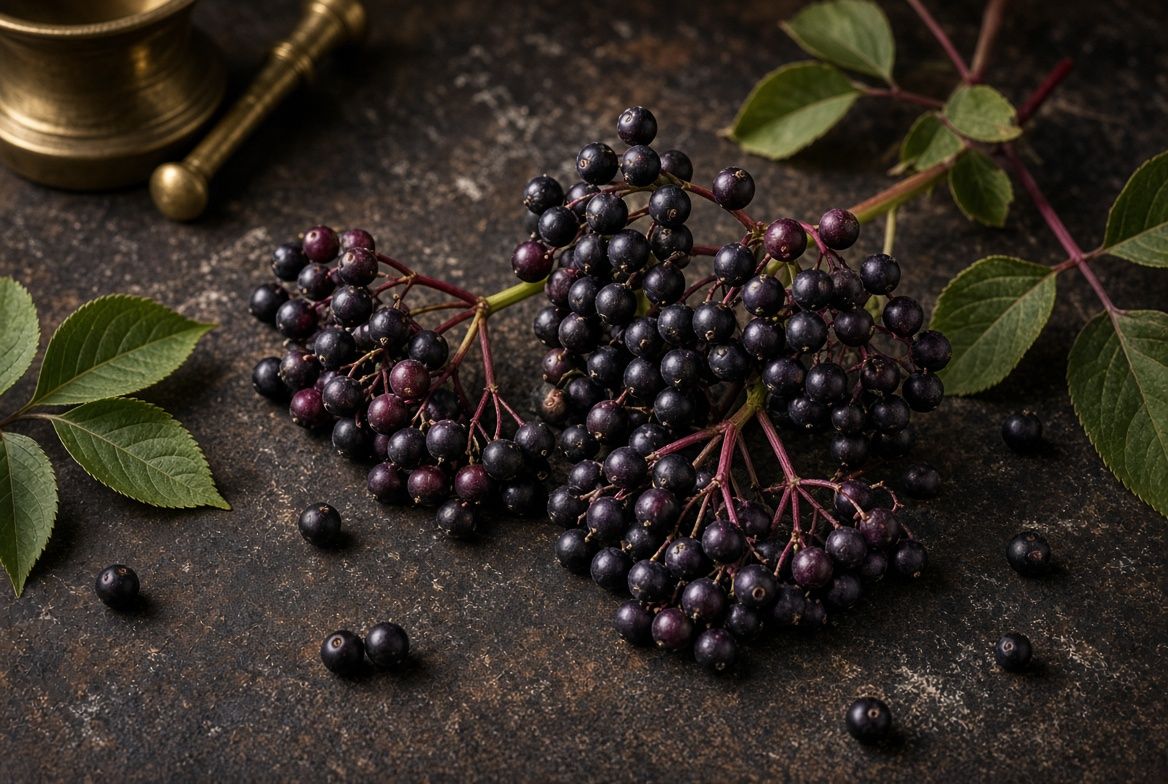
The article describes native Sambucus nigra ssp. canadensis as a deciduous, multi-stemmed shrub reaching up to 12 feet in height and width, with opposite pinnately compound leaves bearing five to eleven toothed leaflets, white flower clusters, and deep-purple ripe fruit (Elderberry in the Garden and the Kitchen).
The article’s botanical description characterizes Sambucus nigra as a deciduous large shrub, more rarely a small tree reaching 4–5 m; in Sweden, it mostly remains a shrub because of the colder climate (From Supernatural to Ornamental: Black Elder (Sambucus nigra L., Family Adoxaceae) in Sweden).
Cultural History & Traditional Herbalism
Evidence of elderberry cultivation has been found at Stone Age sites in Italy and Switzerland; accounts by Greeks and Romans describe the plant as useful for food and medicine (Elderberry in the Garden and the Kitchen).
Historical accounts in the article describe Swedish peasants cultivating single Sambucus nigra bushes near homes, chiefly for medicinal use of the berries; the article also reports that ripe elderberries were used to dye linen dark brown (From Supernatural to Ornamental: Black Elder (Sambucus nigra L., Family Adoxaceae) in Sweden).
The review reports that the British Pharmacopoeia of 1788 described syrup prepared from ripe fruits of Sambucus nigra (elderberry) as effective against coughs, colds, and constipation (Elderberry (Sambucus nigra L.): an ethnopharmacological, phytochemical and biological review for a prospective nutraceutical plant).
Medieval black elder (Sambucus nigra L.) seeds found in gardens in Lund, Skåne, are direct archaeological evidence of cultivation; separately, written sources describe medicinal uses, including remedies mentioned by Christian Petersen in Lund in 1533 and Henrick Smid in Malmö in 1546. In pre-industrial Sweden, peasants kept bushes near homes chiefly for medicinal berries; an eighteenth-century account by Johan Fischerström reports that berries around villages and farms were made into mash for domestic use. Elderflower tea was used in Swedish homes, while the modern practice of making non-alcoholic cordial from flowers spread after a recipe appeared in Britta Olsson’s 1972 book; the study also reports contemporary flower gathering and uses from an 81-response questionnaire conducted in 2019 (From Supernatural to Ornamental: Black Elder (Sambucus nigra L., Family Adoxaceae) in Sweden).
Tradition, Folklore & Symbolism
Swedish folklore accounts reported in the article describe hyllefrun, the ‘elderberry lady,’ as a protective spirit believed to inhabit elder bushes; people made offerings to her on special occasions, including Christmas (From Supernatural to Ornamental: Black Elder (Sambucus nigra L., Family Adoxaceae) in Sweden).
The article traces the common name elderberry or elder to the word “aeld,” meaning “to kindle” or “fire,” because hollowed stems were used to blow on kindling from a safe distance; it traces Sambucus to Greek “sambuce,” an ancient flute-like instrument (Elderberry in the Garden and the Kitchen).
Herbal Energetics
Insufficient documented evidence for a traditional energetic classification. No temperature, direction or channel is inferred from the flavor of a cup.
InfiniTea sensory metaphor: The weight of a cluster. This is original editorial language, not a measured physiological action or a translation of a traditional diagnostic category.
Sensory Profile & Tea Applications
The article describes elderflowers as delicate and sweet with a floral flavor, and lists their uses in syrup, liqueur, seltzer drinks, cakes, yogurt, cocktails, sorbets, and flavored ice cream (Elderberry in the Garden and the Kitchen).
The article’s botanical description states that Sambucus nigra flowers have a sweet and spicy scent (From Supernatural to Ornamental: Black Elder (Sambucus nigra L., Family Adoxaceae) in Sweden).
Sensory notebook: Use only properly processed food material for sensory evaluation. Separate the flavor of the fruit from sugar or other ingredients in a commercial syrup.
Proposed comparison, not a completed trial: Compare only finished, commercially processed fruit preparations visually. Record concentration and whether another juice or sugar was added before interpreting color.
For ordinary dried herbal or fruit infusions, the German Federal Institute for Risk Assessment advises using boiling water and not leaving the prepared infusion standing for hours. Cooling a hot infusion and steeping untreated dry material in cold water are different processes; this report does not validate the latter (Boiling water a must for herbal teas).
Safety & Responsible Use
Raw or unripe Sambucus nigra berries, leaves, and stems contain poisonous cyanide-producing substances that can cause nausea, vomiting, and severe diarrhea; cooking eliminates the toxin, while large quantities of the toxin may cause serious illness (Elderberry: Usefulness and Safety).
The article says elderberries must not be eaten raw: process only ripe, deep-purple fruit, remove as many stems as possible, and cook the berries to destroy toxins in the seeds. It warns that elderberries cannot be safely canned in boiling-water canners, says research on safe pressure canning has not been completed, and advises against traditional recipes (Elderberry in the Garden and the Kitchen).
The page says little is known about the safety of elderberry for health purposes during pregnancy or breastfeeding (Elderberry: Usefulness and Safety).
The study measured intact cyanogenic glycosides by UHPLC-MS/MS and total cyanogenic potential by a picrate-paper method in American elderberry (Sambucus nigra subsp. canadensis), including fruit tissues, pressed juice, and commercial juice. In the tested cultivars, cyanogenic glycosides in fruit tissues ranged from 0.12 to 6.38 µg/g and in pressed juice from 0.29 to 2.36 µg/mL; commercial elderberry juice had no quantifiable cyanogenic glycosides. The authors reported higher total cyanogenic potential in stems and green berries than in ripe berries and advised excluding stems and green berries during product preparation (Cyanogenic Glycoside Analysis in American Elderberry).
For Sambucus nigra, raw or unripe berries and other elder-tree parts, including leaves and stems, contain poisonous cyanide-producing substances that can cause nausea, vomiting, and severe diarrhea; large quantities may cause serious illness, and the page says cooking eliminates the toxin. The page gives no specific human safety observations or allergy findings; it advises people taking medicines to consult a health care provider because some herbs and medicines interact harmfully. It says little is known about safety for health purposes during pregnancy or breastfeeding (Elderberry: Usefulness and Safety).
Preparation and exposure boundary: This review does not establish a safe medicinal dose in pregnancy, lactation or childhood, or rule out interactions or allergy. Do not substitute essential oil or a concentrated extract for the documented food or herb.
For U.S. food use, the relevant safety determination concerns the intended conditions of use. The existence of a traditional preparation or herbal medicine monograph does not establish that this ingredient, dose and beverage are cleared for sale (Understanding How the FDA Regulates Food Additives and GRAS Ingredients).
Historical Trade, Ecology & Sustainability
The article reports that birds effectively spread Sambucus nigra berries and documents small-scale Swedish flower production: Flädergården in Vinslöv harvests 300 kg yearly, and Lasätter fläder near Nyköping harvests 250 kg yearly (From Supernatural to Ornamental: Black Elder (Sambucus nigra L., Family Adoxaceae) in Sweden).
The article says elderberry fruit feeds more than 120 bird species, which also find shelter among its branches; examples include bluebirds, tanagers, catbirds, phoebes, robins, and cardinals. It also says native bees rely on elderberry for nesting material and flowers attract pollinators with their nectar (Elderberry in the Garden and the Kitchen).
The article describes Sambucus nigra as introduced and now naturalized in Sweden; it is typically found in southwestern woodlands and, as a relic of earlier cultivation, farther north up to central Sweden and southern Norrland (From Supernatural to Ornamental: Black Elder (Sambucus nigra L., Family Adoxaceae) in Sweden).
Sourcing record: Ask for species and ripeness controls, de-stemming and the validated food-processing step, not merely a label saying “dried berries.”
InfiniTea Herb Lore & Ritualpreliminary draft
Energetics (original InfiniTea metaphor): The weight of a cluster. Use this as a private writing image, not a health statement.
Tradition & Folklore: Swedish folklore accounts reported in the article describe hyllefrun, the ‘elderberry lady,’ as a protective spirit believed to inhabit elder bushes; people made offerings to her on special occasions, including Christmas (From Supernatural to Ornamental: Black Elder (Sambucus nigra L., Family Adoxaceae) in Sweden).
Ritual Cue (original contemporary InfiniTea interpretation): Draw a cluster of dots and label three with people who helped a project ripen. Leave the rest as room for unnamed contributions.
Private preliminary draft; not approved for publication.
Scholarly References & Research Verification
Research limitations
Require a supplier-validated food process for fruit; reject material with unresolved identity or extraneous green parts. Do not offer an unvalidated cold extraction as a safety workaround.
Detailed intact-glycoside measurements covered tissues from only two genotypes, Ozark and Ozone; samples were harvested at one Missouri study site in 2016 (Cyanogenic Glycoside Analysis in American Elderberry).
References below identify the evidence used, not additional endorsements. A botanical authority establishes nomenclature, not the identity of a physical lot. Published study samples, traditional descriptions and InfiniTea proposals are distinguished in the text.
- Kew, Plants of the World Online: Sambucus nigra L. | Taxonomic backbone
- Elderberry in the Garden and the Kitchen | Penn State Extension article
- From Supernatural to Ornamental: Black Elder (Sambucus nigra L., Family Adoxaceae) in Sweden | Diachronic qualitative ethnobiological and historical study using historical sources, newspaper materials, literature, questionnaires, and participant observation
- Elderberry: Usefulness and Safety | NCCIH health-information webpage
- Elderberry (Sambucus nigra L.): an ethnopharmacological, phytochemical and biological review for a prospective nutraceutical plant | review article
- Cyanogenic Glycoside Analysis in American Elderberry | laboratory study
- Boiling water a must for herbal teas | BfR press release providing general food-safety guidance for preparing herbal and fruit infusions.
- Understanding How the FDA Regulates Food Additives and GRAS Ingredients | U.S. FDA consumer-information webpage describing food-additive and GRAS ingredient oversight.
Final Botanical Summary
Food processing belongs in the identity record for elderberries. Neither flower use nor syrup trials establish that a raw berry infusion is safe.
Editorial disposition: Lot unverified. The report is a private reference, not a clinical recommendation, approval for sale or authenticated sensory trial.
Verification Status (November 2026)
Phase II source audit, claim by claim
- Claims checked
- 18
- Corrected
- 4
- Withheld
- 0
- Sources
- 8
Material: Lot unverified. No physical sample has been examined.
Citation check: All 6 Safety & Use citations were re-read against their sources in November 2026 and confirmed.
A private research reference, not a clinical recommendation or product claim. Checked to the Grimoire's research standards →