
Botanical Identity & Classification
Inventory scope: Foeniculum vulgare · Apiaceae · ripe dried fruits.
Nomenclatural check: Foeniculum vulgare Mill. is accepted in this treatment (family Apiaceae). A synonym listed there is Anethum foeniculum L. The stated native range is Medit. to Ethiopia and W. Nepal (Kew, Plants of the World Online: Foeniculum vulgare Mill.).
Inventory decision: Specify sweet or bitter fennel and fruit rather than leaf, bulb or essential oil. Do not recommend fennel tea for infants or assume repeated medicinal exposure equals seasoning food.
Foeniculum vulgare Mill., commonly called fennel, is classified in the Apiaceae family, also known as Umbelliferae (Foeniculum vulgare Mill: A Review of Its Botany, Phytochemistry, Pharmacology, Contemporary Application, and Toxicology).
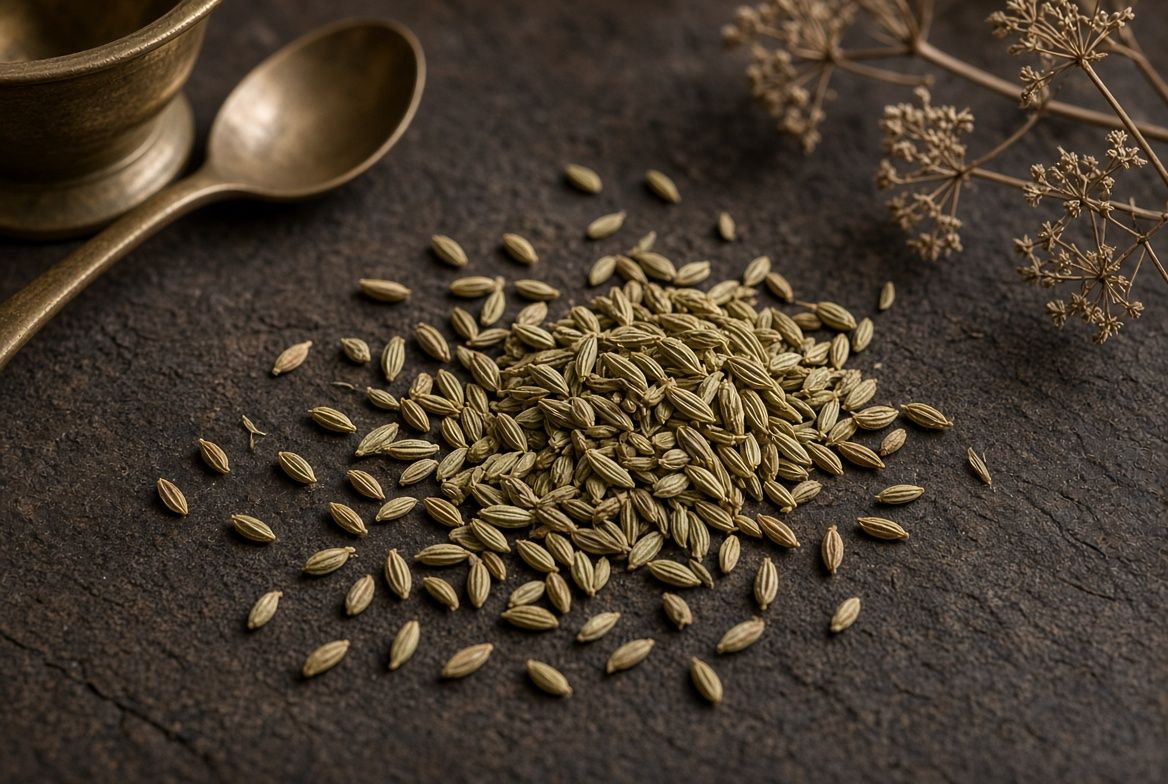
Fennel (Foeniculum vulgare Mill.) is a species in the carrot family. Its fruit is a dry schizocarp 4–10 mm long; because the seed is attached to the pericarp, the whole fruit is often mistakenly called a “seed.” (Foeniculum vulgare Mill.).
Botanical & Scientific Profile
Keep sweet and bitter fennel fruit distinct where the source does. Human experience with the spice is not the same evidence as an exposure assessment of estragole or fennel oil.
In a study summarized by the review, 45 women aged 16–53 with mild to moderate idiopathic hirsutism received creams containing 1% or 2% fennel seed extract or placebo. Mean hair-diameter reductions were 7.8% with the 1% cream, 18.3% with the 2% cream, and −0.5% with placebo (Foeniculum vulgare Mill: A Review of Its Botany, Phytochemistry, Pharmacology, Contemporary Application, and Toxicology).
For Foeniculum vulgare fruit, the assessment report describes a small, unblinded study of 30 people with moderate-to-severe primary dysmenorrhoea: oral fennel fruit oil reduced menstrual pain compared with an untreated cycle, while mefenamic acid was more active; five participants withdrew because of the oil’s odour. The report also describes a randomised, placebo-controlled study of 121 infants aged 2–12 weeks in which seven days of oral fennel-seed-oil emulsion significantly reduced infantile-colic symptoms. The report characterises the available human evidence for both uses as preliminary (Assessment Report on Foeniculum vulgare Miller (bitter fennel, sweet fennel)).
A GC and GC/MS analysis of fennel oil reported trans-anethole (68.53%), estragole (10.42%), limonene (6.24%), and fenchone (5.45%) among its principal components; the cited study concerns Foeniculum vulgare seed oil (Foeniculum vulgare Mill: A Review of Its Botany, Phytochemistry, Pharmacology, Contemporary Application, and Toxicology).
Cultural History & Traditional Herbalism
The review says fennel was known to ancient Egyptians, Romans, Indians, and Chinese; Romans grew it for its aromatic seeds, and edible fleshy shoots were a common vegetable in southern Italy (Foeniculum vulgare Mill: A Review of Its Botany, Phytochemistry, Pharmacology, Contemporary Application, and Toxicology).
Fennel fruit is described as a common traditional spice in Scandinavian brännvin, a loosely defined group of distilled spirits that includes akvavit (Foeniculum vulgare Mill.).
The assessment report states that Foeniculum vulgare fruit, called Xiaohuixiang, has been used for many centuries in Traditional Chinese Medicine, generally as a decoction with other herbs. It reports that the English edition of the Pharmacopoeia of the People’s Republic of China (2005) describes the fruit’s actions and indications, including relieving pain and dysmenorrhoea and treating certain abdominal and digestive complaints (Assessment Report on Foeniculum vulgare Miller (bitter fennel, sweet fennel)).
The review reports that Romans cultivated Foeniculum vulgare for its aromatic seeds and that its edible fleshy shoots remain a common vegetable in southern Italy. Published food-use reports cited for Campania, Italy, describe stems used to flavor pickled olives and seeds used in salted meats; reports from Spain describe tender leaves and stems eaten raw as snacks or in salads, or stewed. These are accounts compiled from cited literature, not new field observations (Foeniculum vulgare Mill: A Review of Its Botany, Phytochemistry, Pharmacology, Contemporary Application, and Toxicology).
Tradition, Folklore & Symbolism
The review reports that roasted fennel seeds are consumed as mukhwa (mukhwas), an after-meal mouth freshener, in many parts of India and Pakistan; it also describes sugar-coated and uncoated fennel seeds used for mukhwas (Foeniculum vulgare Mill: A Review of Its Botany, Phytochemistry, Pharmacology, Contemporary Application, and Toxicology).
Herbal Energetics
The page identifies Foeniculi Fructus as the dried ripe fruit of Foeniculum vulgare Mill. (Umbelliferae). It states the properties as warm and pungent, with affinity for the Liver, kidney, spleen, and stomach meridians (Foeniculi Fructus — Identification of Tiny Seed and Fruit Types of Chinese Materia Medica).
These are categories within the named tradition. They are not measurements of body temperature, pharmacological action or clinical efficacy.
InfiniTea sensory metaphor: A fan opening. This is original editorial language, not a measured physiological action or a translation of a traditional diagnostic category.
Sensory Profile & Tea Applications
The review describes fennel fruit as sweet and dry and attributes fennel’s characteristic anise odor to its essential oil (Foeniculum vulgare Mill: A Review of Its Botany, Phytochemistry, Pharmacology, Contemporary Application, and Toxicology).
Fennel fruits are aromatic and anise-flavored. Their volatile oils include trans-anethole and estragole, associated with liquorice, fenchone, associated with mint and camphor, and 1-octen-3-ol, associated with mushroom aroma (Foeniculum vulgare Mill.).
Sensory notebook: Compare intact and broken fruits for anise-like aroma. Keep fennel, aniseed and star anise in separate labeled dishes.
Proposed comparison, not a completed trial: Compare intact and lightly broken authenticated fruits; record what remains suspended after straining. Do not spike a test cup with fennel essential oil.
For ordinary dried herbal or fruit infusions, the German Federal Institute for Risk Assessment advises using boiling water and not leaving the prepared infusion standing for hours. Cooling a hot infusion and steeping untreated dry material in cold water are different processes; this report does not validate the latter (Boiling water a must for herbal teas).
Safety & Responsible Use
The EMA/HMPC assessment summary for sweet fennel fruit (Foeniculum vulgare Miller subsp. vulgare var. dulce) states that these medicines are not recommended for children under 4 years because there is not enough information on their safe use in this age group (Foeniculi dulcis fructus - herbal medicinal product).
For bitter and sweet fennel fruit (Foeniculum vulgare Miller subsp. vulgare var. vulgare and var. dulce), estragole exposure from herbal tea varies with the product and preparation, including extraction. The report advises keeping exposure as low as possible, selecting the lowest traditional dose, and limiting use to no more than 14 days for adults and adolescents (Assessment report on Foeniculum vulgare Miller subsp. vulgare var. vulgare, fructus and Foeniculum vulgare Miller subsp. vulgare var. dulce (Mill.) Batt. & Trab., fructus).
The report states that safety during pregnancy and lactation has not been established and that fennel use is not recommended during pregnancy or lactation in the absence of sufficient data. In an observational study of 630 pregnant women, 94 (15.7%) reported fennel use; regular consumption was associated with shorter gestational age than non-use (38.8 ± 2.2 versus 39.1 ± 1.6 weeks; p<0.05), while the other evaluated outcomes were not significantly affected. The report also notes that estragole is a carcinogenicity concern based on animal evidence and possible metabolic activation in humans, and recommends keeping exposure as low as possible (Assessment report on Foeniculum vulgare Miller subsp. vulgare var. vulgare, fructus and Foeniculum vulgare Miller subsp. vulgare var. dulce (Mill.) Batt. & Trab., fructus).
The report says fennel constituents’ excretion into human breast milk is unknown and that data are unavailable for fennel use during pregnancy or lactation at recommended dosages; as a precaution, it does not recommend fennel oil or alcoholic extracts during pregnancy and lactation, and cites the HMPC advice to minimise estragole exposure in breastfeeding women. In the retrospective series of 86 consultations, multisystem failure occurred among patients who had taken Ruta alone or with parsley and fennel, and four deaths occurred among patients who had taken Ruta alone or with parsley and fennel; this report does not establish fennel as the cause (Assessment Report on Foeniculum vulgare Miller (bitter fennel, sweet fennel)).
Preparation and exposure boundary: This review does not establish a safe medicinal dose in pregnancy, lactation or childhood, or rule out interactions or allergy. Do not substitute essential oil or a concentrated extract for the documented food or herb.
For U.S. food use, the relevant safety determination concerns the intended conditions of use. The existence of a traditional preparation or herbal medicine monograph does not establish that this ingredient, dose and beverage are cleared for sale (Understanding How the FDA Regulates Food Additives and GRAS Ingredients).
Historical Trade, Ecology & Sustainability
The review states that fennel originated in the southern Mediterranean region and, through naturalization and cultivation, grows wild across the Northern, Eastern, and Western hemispheres, specifically in Asia, North America, and Europe (Foeniculum vulgare Mill: A Review of Its Botany, Phytochemistry, Pharmacology, Contemporary Application, and Toxicology).
Fennel is indigenous to the shores of the Mediterranean and has become naturalized in many parts of the world. The page describes it on dry soils near sea coasts and riverbanks, and as naturalized along roadsides, in pastures, and in other open sites in many regions (Foeniculum vulgare Mill.).
A stakeholder comment reports that PHARMAPLANT GmbH in Artern, Germany, conducted a screening and breeding programme from 2010 to 2021 to identify bitter fennel (Foeniculum vulgare) lines with lower estragole content while meeting the other European Pharmacopoeia requirements. The comment reports a strong correlation between estragole and anethole content and year-to-year variability in essential-oil content and composition; it cites an internal 2021 report and data from 20 clones (Overview of comments received on European Union herbal monographs on Foeniculum vulgare Miller subsp. vulgare var. vulgare, fructus and Foeniculum vulgare Miller subsp. vulgare var. dulce (Mill.) Batt. & Trab., fructus).
Sourcing record: Distinguish sweet and bitter fruit and record grinding and storage; specify botanical fruit rather than bulb, leaf or oil.
InfiniTea Herb Lore & Ritualpreliminary draft
Energetics (original InfiniTea metaphor): A fan opening. Use this as a private writing image, not a health statement.
For the separately attributed traditional material, see Herbal Energetics; the original sensory image is not a translation of that classification.
Tradition & Folklore: The review reports that roasted fennel seeds are consumed as mukhwa (mukhwas), an after-meal mouth freshener, in many parts of India and Pakistan; it also describes sugar-coated and uncoated fennel seeds used for mukhwas (Foeniculum vulgare Mill: A Review of Its Botany, Phytochemistry, Pharmacology, Contemporary Application, and Toxicology).
Ritual Cue (original contemporary InfiniTea interpretation): Draw several short lines from the same point. Beside each, write a different way to approach the same question.
Private preliminary draft; not approved for publication.
Scholarly References & Research Verification
Research limitations
Review the specific preparation and vulnerable population rather than assigning an across-the-board infant, pregnancy or nursing dose.
References below identify the evidence used, not additional endorsements. A botanical authority establishes nomenclature, not the identity of a physical lot. Published study samples, traditional descriptions and InfiniTea proposals are distinguished in the text.
- Kew, Plants of the World Online: Foeniculum vulgare Mill. | Taxonomic backbone
- Foeniculum vulgare Mill: A Review of Its Botany, Phytochemistry, Pharmacology, Contemporary Application, and Toxicology | review article
- Foeniculum vulgare Mill. | GBIF species page incorporating English Wikipedia species-page content
- Assessment Report on Foeniculum vulgare Miller (bitter fennel, sweet fennel) | Regulatory scientific assessment report
- Foeniculi dulcis fructus - herbal medicinal product | EMA/HMPC summary of an assessment report on a traditional herbal medicinal product
- Assessment report on Foeniculum vulgare Miller subsp. vulgare var. vulgare, fructus and Foeniculum vulgare Miller subsp. vulgare var. dulce (Mill.) Batt. & Trab., fructus | EMA Committee on Herbal Medicinal Products final assessment report, Revision 1
- Overview of comments received on European Union herbal monographs on Foeniculum vulgare Miller subsp. vulgare var. vulgare, fructus and Foeniculum vulgare Miller subsp. vulgare var. dulce (Mill.) Batt. & Trab., fructus | Regulatory overview of comments received on draft European Union herbal monographs; the programme details are reported in a stakeholder comment, not presented as an original study in this source.
- Foeniculum vulgare Mill: A Review of Its Botany, Phytochemistry, Pharmacology, Contemporary Application, and Toxicology | 2014 open-access review article synthesizing published botanical, historical, and ethnobotanical literature.
- Foeniculi Fructus — Identification of Tiny Seed and Fruit Types of Chinese Materia Medica | Government Chinese Medicines Testing Institute, Department of Health; Chinese materia medica identification pamphlet.
- Boiling water a must for herbal teas | BfR press release providing general food-safety guidance for preparing herbal and fruit infusions.
- Understanding How the FDA Regulates Food Additives and GRAS Ingredients | U.S. FDA consumer-information webpage describing food-additive and GRAS ingredient oversight.
Final Botanical Summary
Fennel’s culinary name hides a fruit, and its pleasant aroma cannot resolve questions about estragole exposure or use in children.
Editorial disposition: Lot unverified. The report is a private reference, not a clinical recommendation, approval for sale or authenticated sensory trial.
Verification Status (November 2026)
Phase II source audit, claim by claim
- Claims checked
- 16
- Corrected
- 4
- Withheld
- 0
- Sources
- 11
Material: Lot unverified. No physical sample has been examined.
Citation check: All 5 Safety & Use citations were re-read against their sources in November 2026 and confirmed.
A private research reference, not a clinical recommendation or product claim. Checked to the Grimoire's research standards →