
Botanical Identity & Classification
Inventory scope: Jasminum sambac · Oleaceae · flowers, provisional research identity.
Nomenclatural check: Jasminum sambac (L.) Aiton is accepted in this treatment (family Oleaceae). A synonym listed there is Mogorium sambac (L.) Lam. The stated native range is Bhutan to India (Kew, Plants of the World Online: Jasminum sambac (L.) Aiton).
Inventory decision: The word jasmine does not authenticate loose blossoms. Exclude ornamental look-alikes and perfumery oils; keep a flower infusion distinct from tea leaf scented with fresh jasmine.
Arabian jasmine is Jasminum sambac, a broadleaf evergreen in the Oleaceae family (Jasminum sambac - Plant Finder - Missouri Botanical Garden).
Botanical & Scientific Profile
Fresh blossoms used to scent tea, dried blossoms remaining in a blend, and a drink made only from flowers are three different materials. A Fuzhou scenting experiment can answer how the tea leaf acquires fragrance; it cannot establish the safety or efficacy of a concentrated flower infusion.
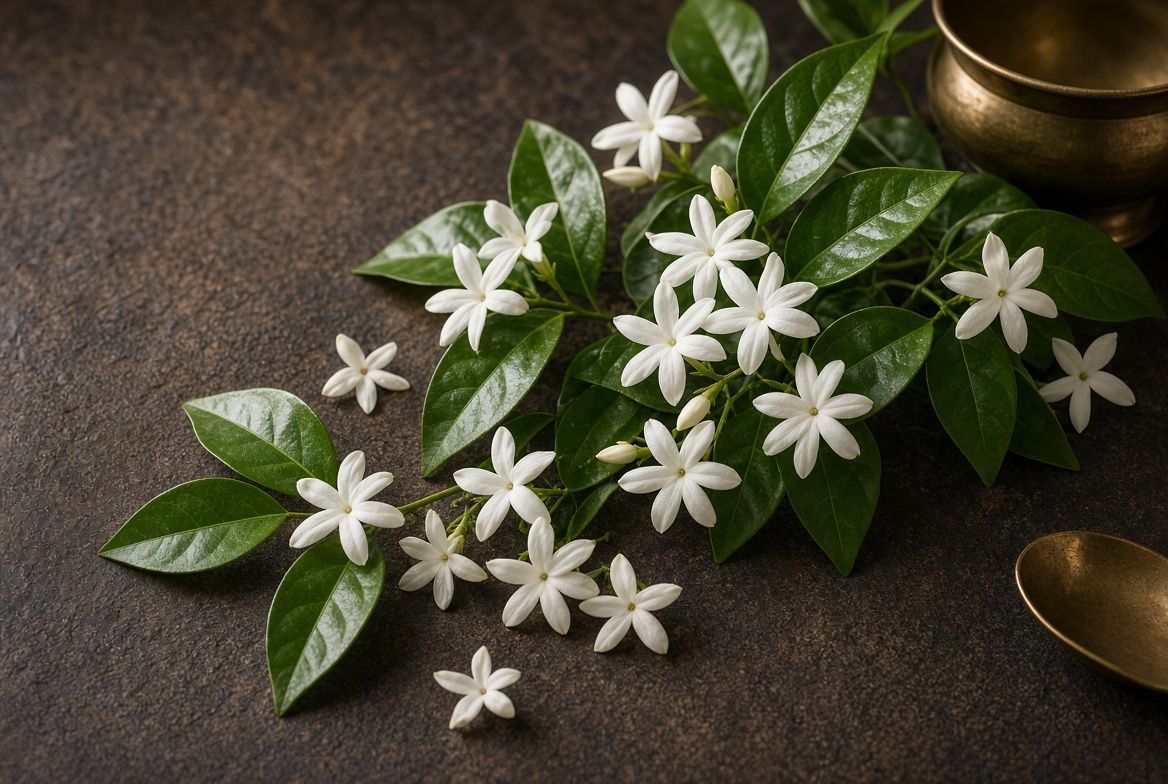
Jasminum sambac flowers are about 1 inch in diameter and occur in clusters of 3–12 blooms (Jasminum sambac - Plant Finder - Missouri Botanical Garden).
The review reports that Jasminum sambac flowers are mostly used to extract essential oils and names methyl benzoate, linalool, α-farnesene, β-ocimene, and indole among the volatile-oil constituents (Jasminum sambac: Progress in research on ethnopharmacology, phytochemistry, pharmacological actions and other applications).
Arabian jasmine (Jasminum sambac) has waxy flowers that are normally five- to seven-parted; the flowers of the cultivar ‘Grand Duke of Tuscany’ are fully double and resemble small gardenias (Jasmines, a diversity of plants with fragrant flowers).
Cultural History & Traditional Herbalism
Arabian jasmine (Jasminum sambac) is native to southern Asia and has been cultivated in the Middle East for centuries (Jasmines, a diversity of plants with fragrant flowers).
The article identifies Jasminum sambac as Sampaguita and states that Governor-General Frank Murphy declared it the Philippines’ national flower in 1934; its white flower is said to symbolize purity, fidelity, and hope. It says Sampaguita is not native to the Philippines and is not considered naturalized there, but is commonly cultivated for ornament; its flowers are used for garlands and perfumery. The article describes a local association with offering Sampaguita to saints and its use as an ornament on public vehicles, and notes Sampaguita-inspired attire worn by Miss Globe 2021 and by Catriona Gray at her 2019 homecoming (Philippine National Flower- Sampaguita).
The proposal lists Jasminum sambac among the botanical species recorded in the tea and jasmine plantations of Fuzhou. It describes Fuzhou jasmine tea as made by blending ready-to-bloom jasmine buds with baked green tea; the mixture is aired to release heat, re-piled and re-scented, and the spent flowers are removed, with rounds repeated as needed. The proposal says farmers pick buds between 10 a.m. and 5 p.m.; flower piles are kept at an optimal 32–37°C, and sifting is done when 80% of the buds have bloomed. It attributes the first jasmine-tea scenting to Fuzhou in the Northern Song Dynasty (960–1127) (Jasmine and Tea Culture System of Fuzhou City. GIAHS Proposal for the Globally Important Agricultural Heritage Systems (GIAHS) Initiative).
Tradition, Folklore & Symbolism
The National Museum article says that Jasminum sambac was declared the Philippine national flower by Governor-General Frank Murphy in 1934. It also describes Sampaguita garlands placed in the tombs of departed loved ones on All Souls’ Day and says the flower has a lasting impression of being offered solely to saints (Philippine National Flower- Sampaguita).
The profile identifies Jasminum sambac as the national flower of the Philippine Islands (Jasminum sambac - Plant Finder - Missouri Botanical Garden).
The article identifies Jasminum sambac, commonly known as Sampaguita, as the Philippines’ national flower, declared in 1934 by Governor-General Frank Murphy. Its sweet-smelling flowers are often made into garlands and perfumery. The article says it is unusual to give Sampaguita to another person as a gift or sign of adoration because it has a lasting impression of being offered solely to saints (Philippine National Flower- Sampaguita).
The Philippine museum account concerns sampaguita in social and devotional life. The Fuzhou investigation concerned aroma transfer from fresh flowers to tea leaf. Neither source identifies the contents of an unvouchered retail bag.
Herbal Energetics
Insufficient documented evidence for a traditional energetic classification. No temperature, direction or channel is inferred from the flavor of a cup.
InfiniTea sensory metaphor: The trace left behind. This is original editorial language, not a measured physiological action or a translation of a traditional diagnostic category.
Sensory Profile & Tea Applications
The review describes Jasminum sambac flowers as white and fragrant, and says their aromatic essential oils are used in the perfume and cosmetic industries, including high-grade perfumes and aromatherapy products (Jasminum sambac: Progress in research on ethnopharmacology, phytochemistry, pharmacological actions and other applications).
The profile describes Jasminum sambac flowers as exceptionally fragrant (Jasminum sambac - Plant Finder - Missouri Botanical Garden).
The study used fresh double-petalled Jasminum sambac flowers grown in Fuzhou, Fujian, to scent Yin Hao Jasmine tea made with traditional and modern techniques, repeating each technique for six rounds. Laboratory analyses of tea samples found that volatile compounds and the jasmine tea flavor index generally increased with additional scenting rounds, while measured chemical-component changes were less than 15%; DPPH antioxidant activity fell during the first two rounds and then increased, and finished tea had lower antioxidant activity than base tea (Changes in the volatiles, chemical components, and antioxidant activities of Chinese jasmine tea during the scenting processes).
Sensory notebook: Smell dry flowers and a separately identified jasmine-scented green tea side by side. In the notebook attribute aroma to the sample, not to visible petal count.
Proposed comparison, not a completed trial: Set the base tea, scented tea and identified blossoms in three separate covered vessels. Uncover each in turn and record where fragrance remains even when no blossom is visible.
For ordinary dried herbal or fruit infusions, the German Federal Institute for Risk Assessment advises using boiling water and not leaving the prepared infusion standing for hours. Cooling a hot infusion and steeping untreated dry material in cold water are different processes; this report does not validate the latter (Boiling water a must for herbal teas).
Safety & Responsible Use
This encyclopedia entry identifies Gelsemium sempervirens as yellow jasmine and states that all parts of the plant contain toxic alkaloids; it warns that ingestion warrants emergency treatment (Gelsemium).
For edible flowers, Colorado State University Extension advises positively identifying the plant and using flowers grown without pesticides; it also says not to eat flowers from florists, garden centers, or nurseries because they are not grown for consumption and may have been treated with unsafe chemicals (Edible Flowers).
Occasional allergic reactions to jasmine have been reported, but the page gives no further details. No data were found on jasmine-component excretion into breastmilk, maternal or infant levels, or effects in breastfed infants; the page says typical intake such as small amounts of jasmine tea is unlikely to be harmful during nursing. The page provides no pregnancy findings (Jasmine - Drugs and Lactation Database (LactMed®)).
Preparation and exposure boundary: This review does not establish a safe medicinal dose in pregnancy, lactation or childhood, or rule out interactions or allergy. Do not substitute essential oil or a concentrated extract for the documented food or herb.
For U.S. food use, the relevant safety determination concerns the intended conditions of use. The existence of a traditional preparation or herbal medicine monograph does not establish that this ingredient, dose and beverage are cleared for sale (Understanding How the FDA Regulates Food Additives and GRAS Ingredients).
Historical Trade, Ecology & Sustainability
The profile lists Jasminum sambac’s native range as Tropical Asia and says it is probably native to India or Southeast Asia (Jasminum sambac - Plant Finder - Missouri Botanical Garden).
The review describes Jasminum sambac as native to tropical and subtropical regions and cultivated in India, Iran, Egypt, Turkey, and China (Jasminum sambac: Progress in research on ethnopharmacology, phytochemistry, pharmacological actions and other applications).
Sourcing record: Trace food-grade flowers separately from perfumery and garland supply; ask whether they are used for scent transfer or remain in the final drink.
InfiniTea Herb Lore & Ritualpreliminary draft
Energetics (original InfiniTea metaphor): The trace left behind. Use this as a private writing image, not a health statement.
Tradition & Folklore: The National Museum article says that Jasminum sambac was declared the Philippine national flower by Governor-General Frank Murphy in 1934. It also describes Sampaguita garlands placed in the tombs of departed loved ones on All Souls’ Day and says the flower has a lasting impression of being offered solely to saints (Philippine National Flower- Sampaguita).
Ritual Cue (original contemporary InfiniTea interpretation): Describe a familiar place by its scent without naming it. Return later and see whether the description still leads you there.
Private preliminary draft; not approved for publication.
Scholarly References & Research Verification
Research limitations
Authenticate the flower separately from the tea base. Garland, nursery and perfumery stocks are not evidence of food-use handling.
The study examined one named jasmine tea product from one Fuzhou tea company; antioxidant activity was assessed in vitro using a DPPH assay (Changes in the volatiles, chemical components, and antioxidant activities of Chinese jasmine tea during the scenting processes).
References below identify the evidence used, not additional endorsements. A botanical authority establishes nomenclature, not the identity of a physical lot. Published study samples, traditional descriptions and InfiniTea proposals are distinguished in the text.
- Kew, Plants of the World Online: Jasminum sambac (L.) Aiton | Taxonomic backbone
- Jasminum sambac - Plant Finder - Missouri Botanical Garden | Botanical garden plant-finder profile
- Jasminum sambac: Progress in research on ethnopharmacology, phytochemistry, pharmacological actions and other applications | review article
- Jasmines, a diversity of plants with fragrant flowers | Horticultural and botanical circular
- Philippine National Flower- Sampaguita | National Museum of the Philippines informational article
- Gelsemium | encyclopedia entry
- Edible Flowers | peer-reviewed university Extension publication
- Changes in the volatiles, chemical components, and antioxidant activities of Chinese jasmine tea during the scenting processes | laboratory study
- Philippine National Flower- Sampaguita | National Museum of the Philippines webpage article, posted November 10, 2021
- Jasmine and Tea Culture System of Fuzhou City. GIAHS Proposal for the Globally Important Agricultural Heritage Systems (GIAHS) Initiative | Fuzhou Municipal Government GIAHS proposal, dated February 20, 2014
- Jasmine - Drugs and Lactation Database (LactMed®) | The page describes a randomized crossover trial of compounded hydro-alcoholic Jasminum sambac flower extract used as nasal drops in nonlactating women with antipsychotic-associated elevated prolactin; the mean prolactin reduction was not statistically significant. It also describes a nonrandomized, unblinded study comparing topical Jasminum sambac flowers applied to the breasts with oral bromocriptine in postpartum women in India; there was no placebo group.
- Boiling water a must for herbal teas | BfR press release providing general food-safety guidance for preparing herbal and fruit infusions.
- Understanding How the FDA Regulates Food Additives and GRAS Ingredients | U.S. FDA consumer-information webpage describing food-additive and GRAS ingredient oversight.
Final Botanical Summary
A flower can be a scenting material without being present in the finished tea. This report does not authenticate any unlabeled blossom for drinking.
Editorial disposition: Identity hold. The report is a private reference, not a clinical recommendation, approval for sale or authenticated sensory trial.
Verification Status (November 2026)
Phase II source audit, claim by claim
- Claims checked
- 17
- Corrected
- 1
- Withheld
- 4
- Sources
- 13
Identity hold: the species, plant part or market name still needs confirming before any product decision. See Identity and the research limitations.
Citation check: All 4 Safety & Use citations were re-read against their sources in November 2026 and confirmed.
A private research reference, not a clinical recommendation or product claim. Checked to the Grimoire's research standards →