
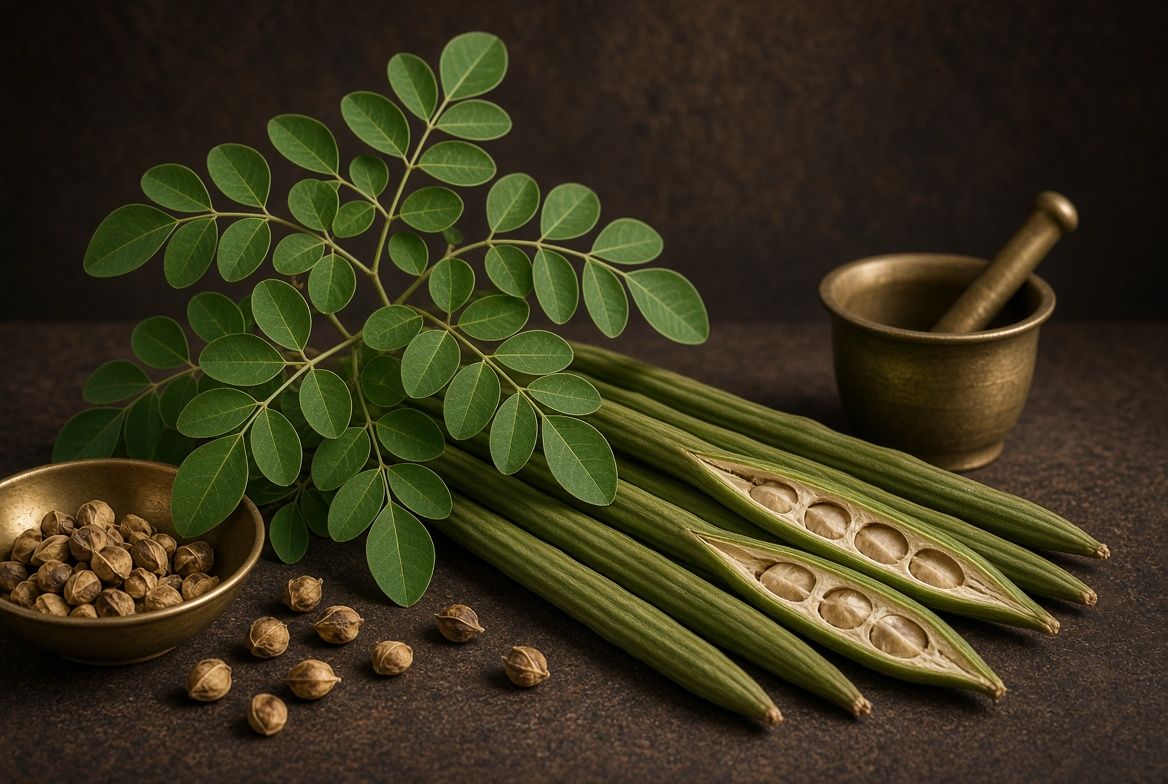
Botanical Identity & Classification
Inventory scope: Moringa oleifera · Moringaceae · leaf as provisional scope.
Nomenclatural check: Moringa oleifera Lam. is accepted in this treatment (family Moringaceae). A synonym listed there is Guilandina moringa L. in Sp. Pl.: 381 (1753). The stated native range is NE. Pakistan to NW. India (Kew, Plants of the World Online: Moringa oleifera Lam.).
Inventory decision: Specify leaf versus pod, seed, root or bark. Eating cooked leaves, consuming powdered leaf and drinking filtered tea deliver different fractions; no nutrient claim without data on the beverage.
The page’s nomenclature section classifies Moringa oleifera in the family Moringaceae, and its nutrition discussion says the leaves are eaten in salads or soups (Moringa oleifera: Domestication Histories and Emerging Deviations from Indian Origin).
The review identifies Moringa oleifera Lam as a member of the Moringaceae family and describes its leaves. It reports that The Plant List recognizes M. oleifera as the only acceptable name and reports no synonyms (Moringa oleifera: a systematic review of its botany, traditional uses, phytochemistry, pharmacology and toxicity).
Botanical & Scientific Profile
Scope this record to the leaf unless the lot and source explicitly identify another part. A food composition table for leaves is not a toxicology assessment for root, bark or concentrated preparations.
The review reports that a clinical trial in an Indian population found lower serum glucose and low-density lipoprotein levels in people with type II diabetes given Moringa oleifera leaf powder; it says a larger trial with a more diverse ethnic population is needed (Moringa oleifera: a systematic review of its botany, traditional uses, phytochemistry, pharmacology and toxicity).
The page describes Moringa oleifera leaves as alternate and 7–60 cm long, tripinnately compound, with each pinna bearing 4–6 pairs of dark-green, elliptical-to-obovate leaflets that are 1–2 cm long (Moringa oleifera: Domestication Histories and Emerging Deviations from Indian Origin).
The botanical description in the review states that Moringa oleifera has three-pinnate compound leaves with leaflets 12–18 mm long. Its leaf constituents are listed as flavonoids, carbamates, phenols, glucosinolates, carotenoids, terpenoids, steroids, organic acids, volatile oil and alkaloids (Moringa oleifera: a systematic review of its botany, traditional uses, phytochemistry, pharmacology and toxicity).
Cultural History & Traditional Herbalism
The page quotes Tamilian writer N. Venugopal describing Moringa oleifera leaves as cooking down into a slightly bitter, spinach-like stir-fry; the page also identifies the pod as a vegetable in South Indian cuisine (Moringa oleifera: Domestication Histories and Emerging Deviations from Indian Origin).
The review says Moringa oleifera has been consumed as food or folk medicine in Oriental countries since ancient times. It reports leaves, fruits, flowers and immature pods used as food in India, Pakistan, the Philippines, Hawaii and African countries including Nigeria; it gives no specific date for these practices (Moringa oleifera: a systematic review of its botany, traditional uses, phytochemistry, pharmacology and toxicity).
Field observations and interview comments indicate that people from all surveyed communities in French Guiana sometimes cook and eat Moringa oleifera leaves as a green; the leaves are also dried and ground into powder for soups and sauces (The Consumption of Edible Leaves by Afro-Descendants in French Guiana and Suriname: An Overview of a Constantly Evolving Ethno-Culinary Practice).
The review states that Moringa oleifera is native to the sub-Himalayan regions of India, Pakistan, Bangladesh, and Afghanistan, where it was described around 2000 BC as a medicinal herb; it does not give evidence for food use there at that time. It reports that Moringa leaves are used to prepare dishes in Ghana, Nigeria, Ethiopia, East Africa, and Malawi, citing Agbogidi and Ilondu (2012); for Cameroon, it says the plant is eaten as a vegetable and used in soup and dishes with meat and fish, based on personal communication. The review describes fresh leaves being used like spinach or in salads, sauces, and soups, and dried leaves being milled into powder for dishes; these preparation details are not assigned to particular communities (Investigation of medicinal plants traditionally used as dietary supplements: A review on Moringa oleifera).
Tradition, Folklore & Symbolism
The page lists shobhanjana as an Indigenous name for Moringa oleifera in South Asia and glosses it as “the auspicious plant” because of its superfood benefits; it also calls the species “The Miracle Tree.” (Moringa oleifera: Domestication Histories and Emerging Deviations from Indian Origin).
Herbal Energetics
Insufficient documented evidence for a traditional energetic classification. No temperature, direction or channel is inferred from the flavor of a cup.
InfiniTea sensory metaphor: A green page. This is original editorial language, not a measured physiological action or a translation of a traditional diagnostic category.
Sensory Profile & Tea Applications
The review reports that Moringa oleifera leaves are used in salads, vegetable curries, seasonings and soups. It does not describe their taste or aroma (Moringa oleifera: a systematic review of its botany, traditional uses, phytochemistry, pharmacology and toxicity).
Moringa oleifera leaves are used as food, and decoctions of various plant parts are taken as tea. The leaves, bark, and roots are described as acrid and pungent (Moringa).
Sensory notebook: Compare the appearance of strained tea and a suspension of leaf powder. Record sediment rather than treating it as dissolved nutrition.
Proposed comparison, not a completed trial: Compare leaf flakes and powder by appearance. Record sediment before interpreting an opaque drink as more concentrated or more nutritious.
For ordinary dried herbal or fruit infusions, the German Federal Institute for Risk Assessment advises using boiling water and not leaving the prepared infusion standing for hours. Cooling a hot infusion and steeping untreated dry material in cold water are different processes; this report does not validate the latter (Boiling water a must for herbal teas).
Safety & Responsible Use
The page states that Moringa’s safety during pregnancy and lactation has not been established and advises avoiding it during those periods. It reports abortifacient action in laboratory animals from extracts of the root, leaves, and bark (Moringa).
The review describes pharmacological and toxicological findings for different Moringa oleifera plant parts and preparations, including extracts and leaf powder, and says appropriate dosages require further evaluation. It does not compare concentrated-extract doses with ordinary culinary servings (Moringa oleifera: a systematic review of its botany, traditional uses, phytochemistry, pharmacology and toxicity).
The monograph describes Moringa oleifera leaves as traditionally used as a galactagogue in Asia, particularly in the Philippines, where the plant is called malunggay. It reports that a meta-analysis of 14 studies involving 865 subjects found increased serum prolactin and milk volume and quality; in a Kenyan cluster-randomized study, mothers consuming 20 grams of leaf powder daily expressed a mean 947 mL of milk at 3 months, compared with 618 mL in controls, with no observed effect on infant growth (Moringa - Drugs and Lactation Database (LactMed®)).
The review states that none of the studies it analyzed reported contraindications to Moringa use during pregnancy or lactation; it does not provide specific allergy findings. It cites a separate safety review reporting no adverse effects from oral Moringa leaf or leaf-extract ingestion at achievable doses in human or in vitro studies, or from animal studies extrapolated to humans. The article also notes that some studies suggest possible medication interactions or adverse effects on blood sugar, but it gives no specific interaction or blood-sugar safety results for the pregnancy and lactation studies reviewed (The Impact of Moringa oleifera Supplementation on Anemia and other Variables during Pregnancy and Breastfeeding: A Narrative Review).
Preparation and exposure boundary: This review does not establish a safe medicinal dose in pregnancy, lactation or childhood, or rule out interactions or allergy. Do not substitute essential oil or a concentrated extract for the documented food or herb.
For U.S. food use, the relevant safety determination concerns the intended conditions of use. The existence of a traditional preparation or herbal medicine monograph does not establish that this ingredient, dose and beverage are cleared for sale (Understanding How the FDA Regulates Food Additives and GRAS Ingredients).
Historical Trade, Ecology & Sustainability
The study’s species inventory records Moringa oleifera as not sold in markets in French Guiana (The Consumption of Edible Leaves by Afro-Descendants in French Guiana and Suriname: An Overview of a Constantly Evolving Ethno-Culinary Practice).
The page says Moringa oleifera grows best in semiarid, tropical, and subtropical areas and describes the trees as able to withstand severe drought (Moringa oleifera: Domestication Histories and Emerging Deviations from Indian Origin).
The review identifies the Himalayas of north-western India as the native range of Moringa oleifera and reports its distribution in India, the Philippines, Ceylon, Thailand, Malaysia, Myanmar, Pakistan, Singapore, the West Indies, Cuba, Jamaica and Nigeria (Moringa oleifera: a systematic review of its botany, traditional uses, phytochemistry, pharmacology and toxicity).
Sourcing record: Ask how leaves are dried and handled, whether powder is eaten or filtered out, and how microbial quality is checked.
InfiniTea Herb Lore & Ritualpreliminary draft
Energetics (original InfiniTea metaphor): A green page. Use this as a private writing image, not a health statement.
Tradition & Folklore: The page lists shobhanjana as an Indigenous name for Moringa oleifera in South Asia and glosses it as “the auspicious plant” because of its superfood benefits; it also calls the species “The Miracle Tree.” (Moringa oleifera: Domestication Histories and Emerging Deviations from Indian Origin).
Ritual Cue (original contemporary InfiniTea interpretation): Write down one thing learned from preparing a meal rather than from reading a label.
Private preliminary draft; not approved for publication.
Scholarly References & Research Verification
Research limitations
Check whose product was studied, whether it was leaf powder, and whether the endpoint measured milk volume rather than infant outcomes. Do not promise increased milk supply.
Long-term benefits to breastfed infants have not been well studied (Moringa - Drugs and Lactation Database (LactMed®)).
References below identify the evidence used, not additional endorsements. A botanical authority establishes nomenclature, not the identity of a physical lot. Published study samples, traditional descriptions and InfiniTea proposals are distinguished in the text.
- Kew, Plants of the World Online: Moringa oleifera Lam. | Taxonomic backbone
- Moringa oleifera: Domestication Histories and Emerging Deviations from Indian Origin | educational botanical and cultural-history project page
- Moringa oleifera: a systematic review of its botany, traditional uses, phytochemistry, pharmacology and toxicity | systematic review
- The Consumption of Edible Leaves by Afro-Descendants in French Guiana and Suriname: An Overview of a Constantly Evolving Ethno-Culinary Practice | Qualitative ethnobotanical study using field observations and interviews
- Moringa | herbal safety fact sheet
- Moringa - Drugs and Lactation Database (LactMed®) | official monograph summarizing human clinical evidence
- Investigation of medicinal plants traditionally used as dietary supplements: A review on Moringa oleifera | Narrative review of literature on Moringa oleifera’s traditional food and medicinal uses, nutritional properties, and proposed health effects.
- The Impact of Moringa oleifera Supplementation on Anemia and other Variables during Pregnancy and Breastfeeding: A Narrative Review | A narrative review using a systematic search of PubMed and EMBASE for human research published from January 1, 2018, through March 31, 2023. Twelve studies were included; they examined Moringa during pregnancy or breastfeeding, including leaf powder, leaf extract, and food preparations, and all were conducted in Southeast Asia (Indonesia and the Philippines).
- Boiling water a must for herbal teas | BfR press release providing general food-safety guidance for preparing herbal and fruit infusions.
- Understanding How the FDA Regulates Food Additives and GRAS Ingredients | U.S. FDA consumer-information webpage describing food-additive and GRAS ingredient oversight.
Final Botanical Summary
The leaves have a food history, but neither that history nor nutrient tables for dry powder validate a therapeutic or nutritional claim for tea.
Editorial disposition: Lot unverified. The report is a private reference, not a clinical recommendation, approval for sale or authenticated sensory trial.
Verification Status (November 2026)
Phase II source audit, claim by claim
- Claims checked
- 16
- Corrected
- 2
- Withheld
- 0
- Sources
- 10
Material: Lot unverified. No physical sample has been examined.
Citation check: 4 of 5 Safety & Use citations confirmed against their sources in November 2026; 1 partly confirmed from the article's abstract.
A private research reference, not a clinical recommendation or product claim. Checked to the Grimoire's research standards →