
Botanical Identity & Classification
Inventory scope: Aspalathus linearis · Fabaceae · cut leaf and fine stems.
Nomenclatural check: Aspalathus linearis (Burm.f.) R.Dahlgren is accepted in this treatment (family Fabaceae). A synonym listed there is Lebeckia linearis (Burm.f.) DC. The stated native range is Cape Provinces (Kew, Plants of the World Online: Aspalathus linearis (Burm.f.) R.Dahlgren).
Inventory decision: Specify oxidized red versus unoxidized green rooibos and cultivated versus wild origin. Do not erase Khoi and San knowledge holders in a generic account of discovery.
Aspalathus linearis is rooibos, described as one of South Africa’s few indigenous crops. Aspalathus is a genus in the Papilionaceae family; the article places it among the Cape Group of the Crotalarieae (The flower visitors and pollinators of Aspalathus: Refreshment for Humans, Bees and Wasps).
Aspalathus linearis is commonly known as the rooibos tea plant and belongs to the Fabaceae family; the page specifies no synonym or plant part (Aspalathus).
Papilionaceae in older accounts and Fabaceae in the contemporary backbone reflect naming and family circumscription. Neither name authenticates material sold as rooibos.
Botanical & Scientific Profile
A geographical origin and a benefit-sharing agreement answer different questions. Report who was named in a particular agreement, when it was made, and what payment it covered rather than claiming all retail lots confer a benefit.
The article reports no human studies, study preparations, or study results (Aspalathus).
Rooibos is described as caffeine-free, low in tannins, and rich in anti-oxidants (Aspalathus).
In vitro investigations of rooibos tea made from Aspalathus linearis plant material report antioxidative and anti-mutagenic features and an ability to modulate microsomal enzymes (The toxic contaminants of Aspalathus linearis plant material as well as herb–drug interactions may constitute the health risk factors in daily rooibos tea consumers).
Cultural History & Traditional Herbalism
The article says the Indigenous inhabitants of the Cederberg first discovered the pleasure of drinking an infusion made from Aspalathus linearis leaves (The flower visitors and pollinators of Aspalathus: Refreshment for Humans, Bees and Wasps).
The article states that Indigenous people of the Cederberg area used rooibos as a beverage long before European settlers arrived (Aspalathus).
The South African government statement says the rooibos traditional-knowledge benefit-sharing agreement between the rooibos industry and the Khoi and San communities was signed in November 2019 after a nine-year negotiation process (Foresty, Fisheries and the Environment on payment of benefits from rooibos to San and Khoi communities a milestone for industrywide collaboration).
The statement reports that an industrywide benefit-sharing agreement between the rooibos industry and San and Khoi communities was signed in November 2019 after a nine-year negotiation process. Under its one-year pilot, 10 rooibos processors pay an annual levy of 1.5% of the farmgate price; the first year generated just over R12.2 million, shared equally between the Khoi-Khoi Peoples Biodiversity and Rooibos Trust and the Andries Steenkamp ABS Trust (Foresty, Fisheries and the Environment on payment of benefits from rooibos to San and Khoi communities a milestone for industrywide collaboration).
Tradition, Folklore & Symbolism
No separate inherited symbolic or ceremonial use of this identified part was established here. A documented food, trade or medicinal practice should remain under its own description rather than being relabeled as ritual.
Herbal Energetics
Insufficient documented evidence for a traditional energetic classification. No temperature, direction or channel is inferred from the flavor of a cup.
InfiniTea sensory metaphor: A place named carefully. This is original editorial language, not a measured physiological action or a translation of a traditional diagnostic category.
Sensory Profile & Tea Applications
The ARC says rooibos and honeybush sensory wheels are quality-control and communication tools that help industry role players understand the characteristic aroma and taste of these South African herbal teas (Sensory wheels for rooibos and honeybush tea).
Aspalathus linearis plant material is used to brew rooibos tea; the accessible page does not specify its aroma or taste characteristics (The toxic contaminants of Aspalathus linearis plant material as well as herb–drug interactions may constitute the health risk factors in daily rooibos tea consumers).
Sensory notebook: Compare red and green rooibos from documented sources for dry aroma, liquor color and lingering sweetness. Do not use color as a health ranking.
Proposed comparison, not a completed trial: Compare labeled green and oxidized rooibos by dry color and liquor color. Record production method rather than calling two processing styles separate plants.
For ordinary dried herbal or fruit infusions, the German Federal Institute for Risk Assessment advises using boiling water and not leaving the prepared infusion standing for hours. Cooling a hot infusion and steeping untreated dry material in cold water are different processes; this report does not validate the latter (Boiling water a must for herbal teas).
Safety & Responsible Use
The review reports several human case reports suggesting possible acute hepatic damage and identifies possible herb–drug interactions related to effects on CYPs (The toxic contaminants of Aspalathus linearis plant material as well as herb–drug interactions may constitute the health risk factors in daily rooibos tea consumers).
The review identifies contamination of Aspalathus linearis plant material as a possible contributor to herb-induced liver injury and CYP effects as a possible basis for interactions with co-administered medicines (The toxic contaminants of Aspalathus linearis plant material as well as herb–drug interactions may constitute the health risk factors in daily rooibos tea consumers).
A human case report describes jaundice and marked liver-enzyme abnormalities after a rooibos-and-buchu tea; liver tests improved after it was stopped. A mixed-product case cannot establish how often an effect occurs or prove that authenticated rooibos alone caused it (Tea not Tincture: Hepatotoxicity Associated with Rooibos Herbal Tea).
Preparation and exposure boundary: This review does not establish a safe medicinal dose in pregnancy, lactation or childhood, or rule out interactions or allergy. Do not substitute essential oil or a concentrated extract for the documented food or herb.
For U.S. food use, the relevant safety determination concerns the intended conditions of use. The existence of a traditional preparation or herbal medicine monograph does not establish that this ingredient, dose and beverage are cleared for sale (Understanding How the FDA Regulates Food Additives and GRAS Ingredients).
Historical Trade, Ecology & Sustainability
The South African government statement reports that implementation of the rooibos industrywide benefit-sharing agreement signed in November 2019 included a payment of just over R12.2 million to the San and Khoi communities (Foresty, Fisheries and the Environment on payment of benefits from rooibos to San and Khoi communities a milestone for industrywide collaboration).
The government statement says rooibos has a long history of commercialisation in South Africa and that pilot data included market and trade information on rooibos sales locally and internationally (Foresty, Fisheries and the Environment on payment of benefits from rooibos to San and Khoi communities a milestone for industrywide collaboration).
A photograph caption identifies cultivated Aspalathus linearis near Graafwater, and the article identifies the Clanwilliam–Graafwater districts as the center of rooibos production (The flower visitors and pollinators of Aspalathus: Refreshment for Humans, Bees and Wasps).
The statement reports that a 2019 industrywide agreement provides for a one-year pilot in which the San and Khoi communities receive 1.5% of the farmgate price paid by 10 rooibos processors, as an annual levy linked to traditional knowledge benefit-sharing. It says just over R12.2 million from the first year’s farmgate purchases was split equally between the Khoi-Khoi Peoples Biodiversity and Rooibos Trust and the Andries Steenkamp ABS Trust, each receiving R6,138,961.25. This is a report on the agreement and payment, not a human study; it does not specify a scientific species name, plant part, or preparation (Foresty, Fisheries and the Environment on payment of benefits from rooibos to San and Khoi communities a milestone for industrywide collaboration).
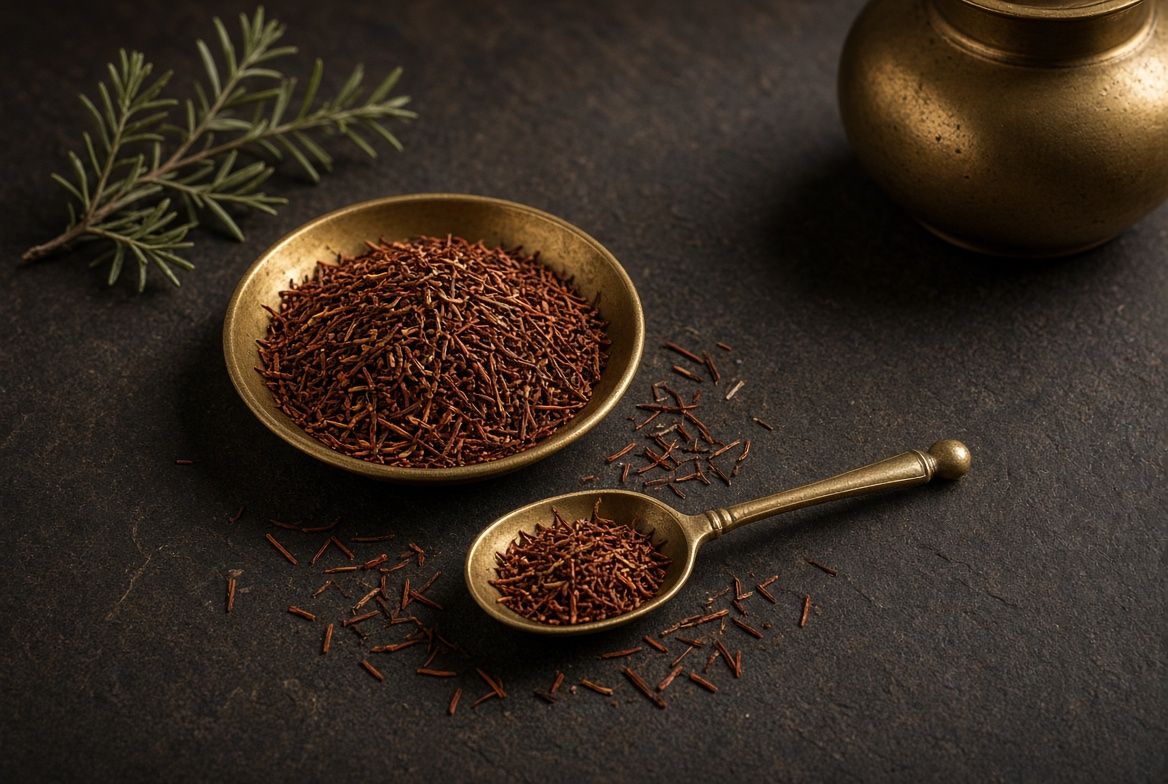
The PDO applies to dried leaves and stems of 100% pure Aspalathus linearis, cultivated or wild-harvested in the production, drying and oxidation area comprising the Western Cape local municipalities of Bergrivier, Breede Valley, Cape Agulhas, Cederberg, City of Cape Town, Drakenstein, Langeberg, Matzikamma, Overstrand, Saldanha Bay, Stellenbosch, Swartland, Swellendam, Theewaterskloof and Witzenberg, and the Northern Cape local municipality of Hantam. The product is presented as oxidised or green (unoxidised): oxidised leaves and stems range from light brown and yellow to shiny brick-red and have moisture below 10%, while green leaves and stems have no sign of browning or oxidation, are dominantly light green with reddish-brown thin stems and white woody pieces, and have moisture below 5%; the described traditional processing includes cutting and bruising, sweating or curing in heaps, and sun-drying, while the production account describes wetting, bruising and regularly turning the heaps for oxidised Rooibos and spreading green Rooibos thinly on the tea court after cutting. Flavour and taste are assessed by a trained human tester, with listed flavour descriptors of sweet—honey and caramel; fruity—citrus, berry and apricot jam; woody—bushy/stemmy and smokey/burnt; floral—fynbos and perfume; and spicy—cinnamon, and listed taste or mouthfeel descriptors of sweet, bitter, sour, soft and smooth, and astringent (Commission Implementing Regulation (EU) 2021/865 of 28 May 2021 entering ‘Rooibos’/‘Red Bush’ in the register of protected designations of origin (PDO)).
Sourcing record: Record the producing area and whether the lot is cultivated or wild, and ask what evidence connects the purchase to knowledge-holder benefits.
InfiniTea Herb Lore & Ritualpreliminary draft
Energetics (original InfiniTea metaphor): A place named carefully. Use this as a private writing image, not a health statement.
Tradition & Folklore: The statement reports that an industrywide benefit-sharing agreement between the rooibos industry and San and Khoi communities was signed in November 2019 after a nine-year negotiation process. Under its one-year pilot, 10 rooibos processors pay an annual levy of 1.5% of the farmgate price; the first year generated just over R12.2 million, shared equally between the Khoi-Khoi Peoples Biodiversity and Rooibos Trust and the Andries Steenkamp ABS Trust (Foresty, Fisheries and the Environment on payment of benefits from rooibos to San and Khoi communities a milestone for industrywide collaboration). This is a record of use, not a claim of inherited ritual.
Ritual Cue (original contemporary InfiniTea interpretation): Write the name of the place on the label. Beneath it, note whose work or knowledge the label identifies, and whose it leaves unnamed.
Private preliminary draft; not approved for publication.
Scholarly References & Research Verification
Research limitations
Seek traceability and current benefit-sharing documentation for a particular supply chain. A historical national payment is not proof of this vendor's participation.
References below identify the evidence used, not additional endorsements. A botanical authority establishes nomenclature, not the identity of a physical lot. Published study samples, traditional descriptions and InfiniTea proposals are distinguished in the text.
- Kew, Plants of the World Online: Aspalathus linearis (Burm.f.) R.Dahlgren | Taxonomic backbone
- The flower visitors and pollinators of Aspalathus: Refreshment for Humans, Bees and Wasps | magazine article on flower visitors and pollinators
- Aspalathus | botanical profile article
- The toxic contaminants of Aspalathus linearis plant material as well as herb–drug interactions may constitute the health risk factors in daily rooibos tea consumers | review article
- Foresty, Fisheries and the Environment on payment of benefits from rooibos to San and Khoi communities a milestone for industrywide collaboration | government media statement
- Sensory wheels for rooibos and honeybush tea | institutional informational webpage
- Commission Implementing Regulation (EU) 2021/865 of 28 May 2021 entering ‘Rooibos’/‘Red Bush’ in the register of protected designations of origin (PDO) | EU Commission Implementing Regulation and consolidated single document for the South African Rooibos/Red Bush PDO.
- Tea not Tincture: Hepatotoxicity Associated with Rooibos Herbal Tea | A human case report of a 52-year-old man who developed acute hepatitis and liver failure after daily consumption for one month of a South African herbal tea containing rooibos and buchu. The article identifies rooibos as dried needles of Aspalathus linearis and describes the tea as an herbal tea; it does not give a preparation recipe or dose.
- Boiling water a must for herbal teas | BfR press release providing general food-safety guidance for preparing herbal and fruit infusions.
- Understanding How the FDA Regulates Food Additives and GRAS Ingredients | U.S. FDA consumer-information webpage describing food-additive and GRAS ingredient oversight.
Final Botanical Summary
A serious rooibos entry connects processing and place with the rights of knowledge holders. A benefit-sharing agreement is not proof about every individual supplier.
Editorial disposition: Lot unverified. The report is a private reference, not a clinical recommendation, approval for sale or authenticated sensory trial.
Verification Status (November 2026)
Phase II source audit, claim by claim
- Claims checked
- 15
- Corrected
- 3
- Withheld
- 0
- Sources
- 10
Material: Lot unverified. No physical sample has been examined.
Citation check: All 4 Safety & Use citations were re-read against their sources in November 2026 and confirmed.
A private research reference, not a clinical recommendation or product claim. Checked to the Grimoire's research standards →