
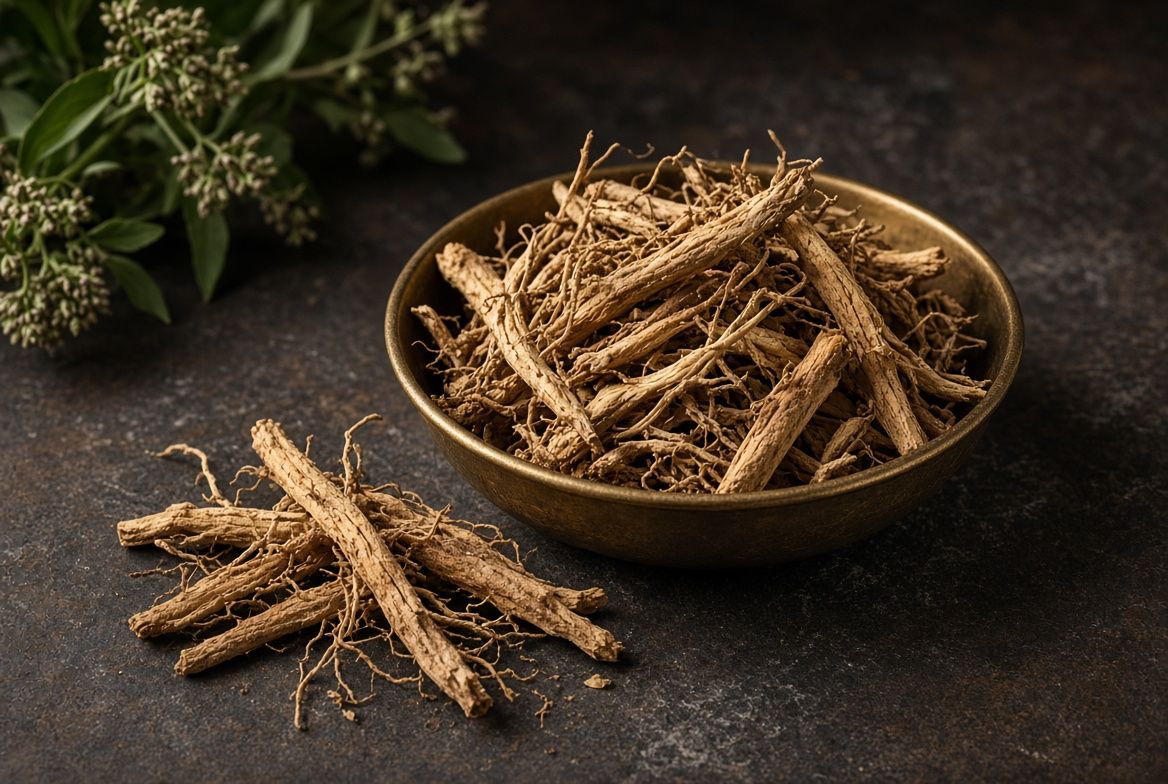
Botanical Identity & Classification
Inventory scope: Valeriana officinalis · Caprifoliaceae · underground parts.
Nomenclatural check: Valeriana officinalis L. is accepted in this treatment (family Caprifoliaceae). The stated native range is Europe to NW. Iran (Kew, Plants of the World Online: Valeriana officinalis L.).
Inventory decision: Check whether roots, rhizomes and stolons are included. Distinguish aqueous tea from extracts in sleep trials; do not combine with alcohol or sedative products on the assumption it is merely a bedtime flavor.
Valeriana officinalis is discussed as a member of the family Caprifoliaceae; the part used in medicine is its dried, ground root (Oxford University Plants 400: Valeriana species).
The article identifies valerian as Valeriana officinalis L., in the family Caprifoliaceae, and gives Valerianaceae as a synonym for the family (Herbs in History: Valerian).
Valerianaceae in older literature and Caprifoliaceae in the cited contemporary classification are different family circumscriptions, not permission to substitute another medicinal root.
Botanical & Scientific Profile
Distinguish comminuted root or underground parts from solvent extracts. A historical sleep use, clinical sleep endpoint and warning about driving are three separate kinds of evidence.
The European Medicines Agency has approved Valeriana officinalis for nervous tension and sleep disorders, although its effectiveness for these uses remains unclear (Oxford University Plants 400: Valeriana species).
Sedative effects of valerian have been demonstrated in mice, but studies of human insomniacs are too few and methodologically flawed to provide reliable conclusions; the chemistry and mechanisms of how valerian acts are unknown (Oxford University Plants 400: Valeriana species).
Cultural History & Traditional Herbalism
Valerian’s uses date back at least to Hippocrates (c. 460–370 BCE); Valeriana officinalis was mentioned in influential medical works between 1733 and 1936 and was one of the five most prescribed medicines during that period (Oxford University Plants 400: Valeriana species).
The authors state that the ancient Greek term stachus and classical Latin term spica, both meaning “spike,” referred to a drug made from a bunch of fibrous valerian roots; historical texts also confuse valerian with spikenard and other spike-shaped plants (Herbs in History: Valerian).
NCCIH states that Valeriana officinalis has been used medicinally since early Greece and Rome; its roots and rhizomes are used for medicinal purposes (Valerian: Usefulness and Safety).
The article reports that Greek physicians Hippocrates (circa 460–377 BCE) and Dioscorides (1st century CE) prescribed valerian as a sleep aid, and that Galen (circa 130–200 CE) prescribed it for insomnia. It does not identify which plant part those physicians used. The European Pharmacopoeia provides quality-standard monographs for valerian tincture, dry hydroalcoholic extract, and dry root; separately, the article says Germany’s Commission E approved internal use in 1985 for restlessness and sleeping disorders based on nervous conditions (Valerian).
Tradition, Folklore & Symbolism
The article reports that valerian root is burned as incense during religious ceremonies in India (Herbs in History: Valerian).
Herbal Energetics
In the article’s account of Avicenna’s Qanūn, sunbul combines information about Greek fou and nardos, reflecting confusion between valerian and spikenard; Avicenna describes sunbul as hot in the first degree and dry in the second according to the Galenic system (Herbs in History: Valerian).
Insufficient documented evidence for a traditional energetic classification. This limitation applies to the precise inventory part or species, not to the comparative or historically ambiguous material described here.
These are categories within the named tradition. They are not measurements of body temperature, pharmacological action or clinical efficacy.
InfiniTea sensory metaphor: Permission to stop. This is original editorial language, not a measured physiological action or a translation of a traditional diagnostic category.
Sensory Profile & Tea Applications
Dioscorides describes the root of Pontic “Wild Spikenard” as yellowish, formed of intertwined rootlets, pleasantly scented like spikenard, and heavy to the touch; the authors consider the plant likely to be a valerian species (Herbs in History: Valerian).
The dried, ground root of Valeriana officinalis has a peculiar, persistent smell that many people find unpleasant (Oxford University Plants 400: Valeriana species).
Sensory notebook: Record the dry root’s distinctive odor without tasting. Do not use odor strength as a proxy for sedation or clinical potency.
Proposed comparison, not a completed trial: Observe the dry material from its labeled container. Do not test a sedative effect, combine with alcohol or conduct a tasting before driving.
For ordinary dried herbal or fruit infusions, the German Federal Institute for Risk Assessment advises using boiling water and not leaving the prepared infusion standing for hours. Cooling a hot infusion and steeping untreated dry material in cold water are different processes; this report does not validate the latter (Boiling water a must for herbal teas).
Safety & Responsible Use
NCCIH advises that Valeriana officinalis (whose roots and rhizomes are used medicinally) should not be taken with alcohol or sedatives because a sleep-inducing effect is possible, though unproven. Its long-term safety is unknown, and little is known about safety during pregnancy or breastfeeding (Valerian: Usefulness and Safety).
NCCIH reports that research suggests Valeriana officinalis is generally safe for short-term use by most adults; it has been used with apparent safety at 300–600 milligrams daily for up to 6 weeks. Very rare liver-injury reports occurred, most often when valerian was taken with other herbals, and its long-term effect on liver function is unknown (Valerian: Usefulness and Safety).
The source concerns the underground root of Valeriana officinalis L.; it describes an ethanolic dry extract supported by clinical studies for relief of mild nervous tension and sleep disorders, and traditional use of juice, water extracts, methanolic extracts, and tinctures for mild symptoms of mental stress and to aid sleep. It says the traditional-use evidence includes at least 30 years of safe use, including at least 15 years in the EU. The source advises not to drive or operate machinery while using valerian root medicines because they may affect the ability to do so (Valerian root - summary for the public).
Research suggests valerian is generally safe for short-term use by most adults, but reported side effects include headache, stomach upset, mental dullness, excitability, uneasiness, and vivid dreams; withdrawal symptoms have been reported after abruptly stopping chronic use, and very rare liver injury has been reported, most often with other herbals. Because a sleep-inducing effect is possible but unproven, the page advises against taking valerian with alcohol or sedatives; little is known about safety during pregnancy or breastfeeding (Valerian: Usefulness and Safety).
Preparation and exposure boundary: This review does not establish a safe medicinal dose in pregnancy, lactation or childhood, or rule out interactions or allergy. Do not substitute essential oil or a concentrated extract for the documented food or herb.
For U.S. food use, the relevant safety determination concerns the intended conditions of use. The existence of a traditional preparation or herbal medicine monograph does not establish that this ingredient, dose and beverage are cleared for sale (Understanding How the FDA Regulates Food Additives and GRAS Ingredients).
Historical Trade, Ecology & Sustainability
NCCIH states that Valeriana officinalis is native to Europe and Asia and also grows in North America (Valerian: Usefulness and Safety).
Sourcing record: Request species and underground parts, cultivation origin and postharvest drying; root harvest is not equivalent to clipping an aerial herb.
InfiniTea Herb Lore & Ritualpreliminary draft
Energetics (original InfiniTea metaphor): Permission to stop. Use this as a private writing image, not a health statement.
For the separately attributed traditional material, see Herbal Energetics; the original sensory image is not a translation of that classification.
Tradition & Folklore: The article reports that valerian root is burned as incense during religious ceremonies in India (Herbs in History: Valerian).
Ritual Cue (original contemporary InfiniTea interpretation): Close the notebook after writing one unfinished task and when you will return to it. Drinking valerian is not part of the exercise.
Private preliminary draft; not approved for publication.
Scholarly References & Research Verification
Research limitations
Record species, underground organ and extract solvent. Sedating combinations and next-day impairment require individual review; this is not a sleep-treatment protocol.
References below identify the evidence used, not additional endorsements. A botanical authority establishes nomenclature, not the identity of a physical lot. Published study samples, traditional descriptions and InfiniTea proposals are distinguished in the text.
- Kew, Plants of the World Online: Valeriana officinalis L. | Taxonomic backbone
- Oxford University Plants 400: Valeriana species | botanical profile and historical/medicinal account
- Herbs in History: Valerian | historical review article
- Valerian: Usefulness and Safety | government health-information fact sheet
- Valerian root - summary for the public | official monograph summary
- Valerian | HerbalGram article providing a historical and research overview of Valeriana officinalis.
- Boiling water a must for herbal teas | BfR press release providing general food-safety guidance for preparing herbal and fruit infusions.
- Understanding How the FDA Regulates Food Additives and GRAS Ingredients | U.S. FDA consumer-information webpage describing food-additive and GRAS ingredient oversight.
Final Botanical Summary
Sleep is an outcome that requires evidence for a specific preparation. A sensory association with evening is not such evidence.
Editorial disposition: Lot unverified. The report is a private reference, not a clinical recommendation, approval for sale or authenticated sensory trial.
Verification Status (November 2026)
Phase II source audit, claim by claim
- Claims checked
- 14
- Corrected
- 1
- Withheld
- 0
- Sources
- 8
Material: Lot unverified. No physical sample has been examined.
Citation check: All 5 Safety & Use citations were re-read against their sources in November 2026 and confirmed.
A private research reference, not a clinical recommendation or product claim. Checked to the Grimoire's research standards →