
Botanical Identity & Classification
Inventory scope: Eysenhardtia polystachya · Fabaceae · wood or bark unresolved.
Nomenclatural check: Eysenhardtia polystachya (Ortega) Sarg. is accepted in this treatment (family Fabaceae). A synonym listed there is Amerimnon polystachyon (Ortega) Spreng. (Kew, Plants of the World Online: Eysenhardtia polystachya (Ortega) Sarg.).
Inventory decision: Require a species, plant part and source locality. Do not equate historic fluorescent wood, present-day bark and every product sold as palo azul; do not promote it for kidneys or drug-test evasion.
The article identifies Eysenhardtia polystachya (Ort.) Sarg. as a member of the Fabaceae family (Usos del palo dulce Eysenhardtia polystachya (Ort.) Sarg., en cuatro municipios del estado de Morelos, México).
The review classifies Eysenhardtia polystachya as one of the genus’s species in the Fabaceae family. It lists Palo azul among Mexican common names and Kidneywood and Mexican Kidneywood among English common names (Phytochemical and Pharmacological Study of the Eysenhardtia Genus).
Botanical & Scientific Profile
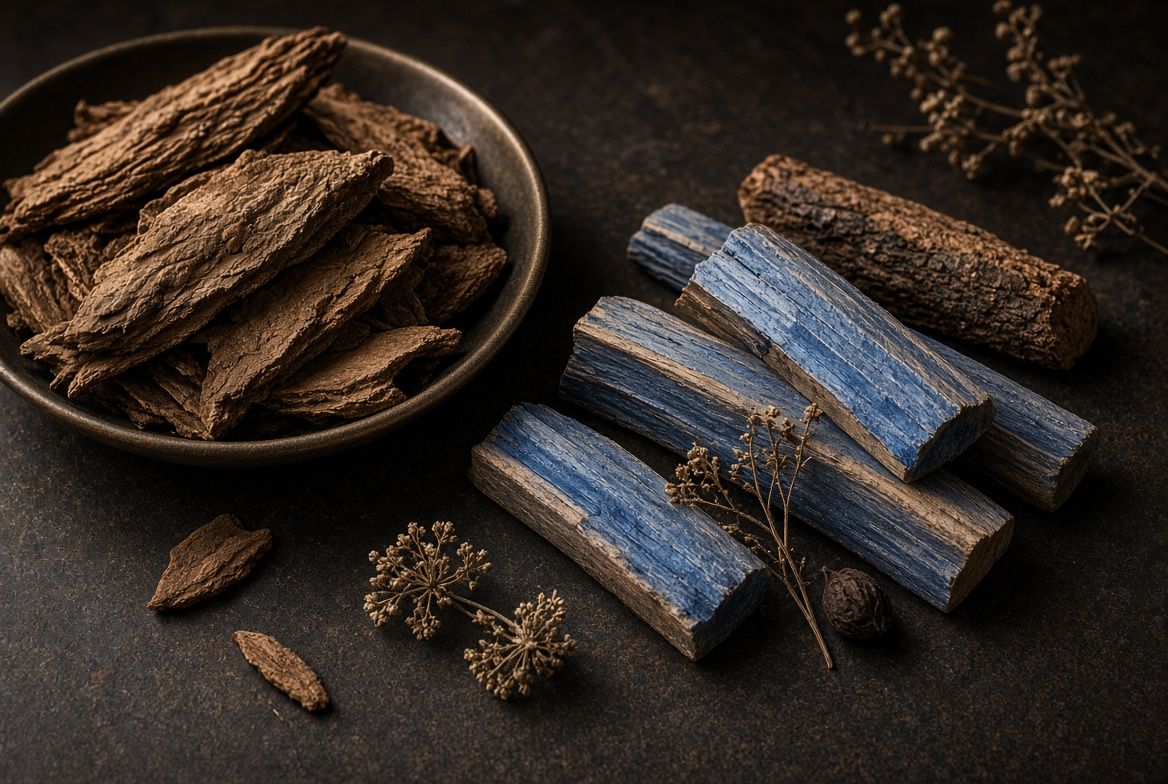
The blue sheen belongs first to a material and an optical observation, not to a clinical outcome. A wood experiment cannot authenticate an unidentified bag of bark.
Palo azul (Eysenhardtia polystachya) is described as a tree native to Mexico whose wood has been used in traditional medicine for kidney ailments. The article reports that its aqueous wood extract emits blue light because of matlalina, with a fluorescence yield near 100% (El Palo azul: su uso medicinal y las propiedades ópticas de sus compuestos.).
In a mixed-methods ethnobotanical study, researchers interviewed 300 people—75 in each of Tepoztlán, Tlayacapan, Cuautla, and Yecapixtla, Morelos, from January to May 2021. Interview respondents reported using Eysenhardtia polystachya mainly for kidney infections (68%); these are reported traditional uses, not clinical efficacy findings (Usos del palo dulce Eysenhardtia polystachya (Ort.) Sarg., en cuatro municipios del estado de Morelos, México).
The profile identifies Eysenhardtia polystachya as a shrub or small tree 2–6 metres tall, with slender branches, light-coloured bark, compound leaves with numerous small leaflets, and elongated spikes of white or pale-lilac flowers (Palo Dulce – Facultad de Estudios Superiores Zaragoza).
The abstract identifies Lignum nephriticum as Eysenhardtia polystachya and says its infusion has intense blue fluorescence, first observed in the sixteenth century. It attributes the fluorescence to a novel four-ring tetrahydromethanobenzofuro[2,3-d]oxacine that is not present in the plant, but forms through iterative spontaneous oxidation of at least one of the tree’s flavonoids (Structure and Formation of the Fluorescent Compound of Lignum nephriticum).
Cultural History & Traditional Herbalism
Semistructured interviews conducted from January to May 2021 documented local knowledge and reported uses of Eysenhardtia polystachya in Tepoztlán, Tlayacapan, Cuautla, and Yecapixtla, Morelos. The article gives no specific historical origin or first-use date for palo dulce or palo azul (Usos del palo dulce Eysenhardtia polystachya (Ort.) Sarg., en cuatro municipios del estado de Morelos, México).
The profile describes traditional use in various regions of central Mexico: bark and wood of Eysenhardtia polystachya are prepared as an infusion and used as diuretics for kidney ailments, urinary calculi, urinary-tract inflammation, and fluid retention; they are also used as a depurative and for mild muscle pain (Palo Dulce – Facultad de Estudios Superiores Zaragoza).
The review reports that Nicolás Monardes’s 1565 account described a tree, identified in the discussion with Eysenhardtia polystachya, used for kidney and urinary diseases; the account describes drinking a blue infusion made by placing thin slices of wood (bark) in water for a period of time (Phytochemical and Pharmacological Study of the Eysenhardtia Genus).
In 2021 researchers interviewed 300 residents in four municipalities of Morelos, Mexico, about Eysenhardtia polystachya. Stem material dominated the plant-part reports; the interviewees described soaking pieces in water and commonly associated the plant with urinary complaints. Interviews document local choices and knowledge transmission, not therapeutic outcomes or the safety of an unidentified retail lot (Usos del palo dulce Eysenhardtia polystachya (Ort.) Sarg., en cuatro municipios del estado de Morelos, México).
Tradition, Folklore & Symbolism
The profile gives Yztacquauitl as the Nahuatl name for Eysenhardtia polystachya and describes the plant as a symbol of the connection between tradition and community health (Palo Dulce – Facultad de Estudios Superiores Zaragoza).
Interview findings from the four Morelos municipalities report that knowledge of Eysenhardtia polystachya use is transmitted orally through family traditions and from generation to generation (Usos del palo dulce Eysenhardtia polystachya (Ort.) Sarg., en cuatro municipios del estado de Morelos, México).
Herbal Energetics
Insufficient documented evidence for a traditional energetic classification. No temperature, direction or channel is inferred from the flavor of a cup.
InfiniTea sensory metaphor: A change of angle. This is original editorial language, not a measured physiological action or a translation of a traditional diagnostic category.
Sensory Profile & Tea Applications
Interviewees in the four Morelos municipalities reported soaking Eysenhardtia polystachya stems to make a drink called “agua de uso,” or boiling the stems to make a drink called “té.” The article does not describe a specific aroma or taste (Usos del palo dulce Eysenhardtia polystachya (Ort.) Sarg., en cuatro municipios del estado de Morelos, México).
The review describes aromatic resins in the Eysenhardtia genus and recounts a historical account associated with Eysenhardtia polystachya in which thin slices of wood (bark) were placed in water to make a blue infusion. It does not report the infusion’s taste (Phytochemical and Pharmacological Study of the Eysenhardtia Genus).
Sensory notebook: For an identified reference material, document reflected versus transmitted light without ingestion. A blue appearance is not an authentication or purity test.
Proposed comparison, not a completed trial: Study a documented image or an authenticated non-consumption demonstration under changing light. Record viewing angle and background; a color change is not a purity assay.
Safety & Responsible Use
The UTEP herbal-safety fact sheet states that the safety of Eysenhardtia polystachya (kidneywood) during pregnancy and lactation has not been established. It reports traditional use in Mexico of the wood, branches, and leaves for kidney-related complaints; it does not state that this use is clinical clearance for kidney disease (Kidneywood).
The article states that there are no human toxicity studies for Eysenhardtia polystachya and advises against prolonged use because not all its components have been scientifically tested. It does not assess the safety of bark extracts or unidentified commercial chips (Usos del palo dulce Eysenhardtia polystachya (Ort.) Sarg., en cuatro municipios del estado de Morelos, México).
The page reports no human observations of adverse effects, allergies, or interactions. It states that safety during pregnancy and lactation has not been established. A phytochemical study of the plant reported moderate cytotoxic activity against KB cells; the page does not specify the plant part or preparation used in that study (Palo azul).
Preparation and exposure boundary: This review does not establish a safe medicinal dose in pregnancy, lactation or childhood, or rule out interactions or allergy. Do not substitute essential oil or a concentrated extract for the documented food or herb.
For U.S. food use, the relevant safety determination concerns the intended conditions of use. The existence of a traditional preparation or herbal medicine monograph does not establish that this ingredient, dose and beverage are cleared for sale (Understanding How the FDA Regulates Food Additives and GRAS Ingredients).
Historical Trade, Ecology & Sustainability
The study reports that local demand leads people to obtain Eysenhardtia polystachya directly from its natural habitat. It reports that herbalists collect and sell the plant in local markets, and cites studies stating that extracting its heartwood and sapwood causes the individual plant to die (Usos del palo dulce Eysenhardtia polystachya (Ort.) Sarg., en cuatro municipios del estado de Morelos, México).
Informants in the four Morelos municipalities reported low density of Eysenhardtia polystachya. The authors list overharvesting, land-use change, population growth, and habitat deterioration from forest fires as possible causes, while noting that further research is needed to determine the main causes. The article says the IUCN lists the species as Least Concern; it also cites studies suggesting it is highly vulnerable because of restricted distribution and recommending reconsideration of its status (Usos del palo dulce Eysenhardtia polystachya (Ort.) Sarg., en cuatro municipios del estado de Morelos, México).
The profile reports Eysenhardtia polystachya in scrubland, open forests, and dry slopes in central and northern Mexico, and says it adapts well to poor soils and drought (Palo Dulce – Facultad de Estudios Superiores Zaragoza).
Sourcing record: Ask whether chips are heartwood, other wood or bark and how the tree was harvested; do not treat a wood-sourcing claim as a bark sustainability assessment.
InfiniTea Herb Lore & Ritualpreliminary draft
Energetics (original InfiniTea metaphor): A change of angle. Use this as a private writing image, not a health statement.
Tradition & Folklore: The profile gives Yztacquauitl as the Nahuatl name for Eysenhardtia polystachya and describes the plant as a symbol of the connection between tradition and community health (Palo Dulce – Facultad de Estudios Superiores Zaragoza).
Ritual Cue (original contemporary InfiniTea interpretation): Look at the same object from two sides. Record which feature appeared only after you moved.
Private preliminary draft; not approved for publication.
Scholarly References & Research Verification
Research limitations
Require independent species and organ identification; do not approve ingestion based on fluorescence or the name kidneywood. Keep the source region and historical name attached to each account.
References below identify the evidence used, not additional endorsements. A botanical authority establishes nomenclature, not the identity of a physical lot. Published study samples, traditional descriptions and InfiniTea proposals are distinguished in the text.
- Kew, Plants of the World Online: Eysenhardtia polystachya (Ortega) Sarg. | Taxonomic backbone
- Usos del palo dulce Eysenhardtia polystachya (Ort.) Sarg., en cuatro municipios del estado de Morelos, México | mixed-methods ethnobotanical study
- Phytochemical and Pharmacological Study of the Eysenhardtia Genus | bibliographic review
- El Palo azul: su uso medicinal y las propiedades ópticas de sus compuestos. | journal article (article page with abstract)
- Palo Dulce – Facultad de Estudios Superiores Zaragoza | institutional medicinal-plant profile
- Kidneywood | herbal-safety fact sheet
- Usos del palo dulce Eysenhardtia polystachya (Ort.) Sarg., en cuatro municipios del estado de Morelos, México | Artículo científico de investigación etnobotánica, con entrevistas semiestructuradas y análisis cualitativo y cuantitativo.
- Structure and Formation of the Fluorescent Compound of Lignum nephriticum | ACS article abstract and supporting-information description
- Palo azul | The page describes traditional uses of Eysenhardtia polystachya wood, branches, and leaves, prepared as a cold-water maceration or hot-water tea/decoction. It cites a phytochemical study reporting moderate cytotoxic activity against KB cells, and a study in diabetic mice using a methanol-and-water extract; it does not describe a human safety study.
- Understanding How the FDA Regulates Food Additives and GRAS Ingredients | U.S. FDA consumer-information webpage describing food-additive and GRAS ingredient oversight.
Final Botanical Summary
The optical history is a better-grounded starting point than a detox claim. Neither the commercial identity nor oral safety of an unspecified wood is established here.
Editorial disposition: Identity hold. The report is a private reference, not a clinical recommendation, approval for sale or authenticated sensory trial.
Verification Status (November 2026)
Phase II source audit, claim by claim
- Claims checked
- 17
- Corrected
- 3
- Withheld
- 0
- Sources
- 10
Identity hold: the species, plant part or market name still needs confirming before any product decision. See Identity and the research limitations.
Citation check: All 4 Safety & Use citations were re-read against their sources in November 2026 and confirmed.
A private research reference, not a clinical recommendation or product claim. Checked to the Grimoire's research standards →