
Botanical Identity & Classification
Inventory scope: Rhodiola rosea · Crassulaceae · root and rhizome.
Nomenclatural check: Rhodiola rosea L. is accepted in this treatment (family Crassulaceae). A synonym listed there is Sedum rosea (L.) Scop. The stated native range is Subarctic & Subalpine Northern Hemisphere (Kew, Plants of the World Online: Rhodiola rosea L.).
Inventory decision: Request species authentication, cultivated or wild origin and traceability for traded root. Extract studies do not authenticate a shipment or establish the effect of a household brew.
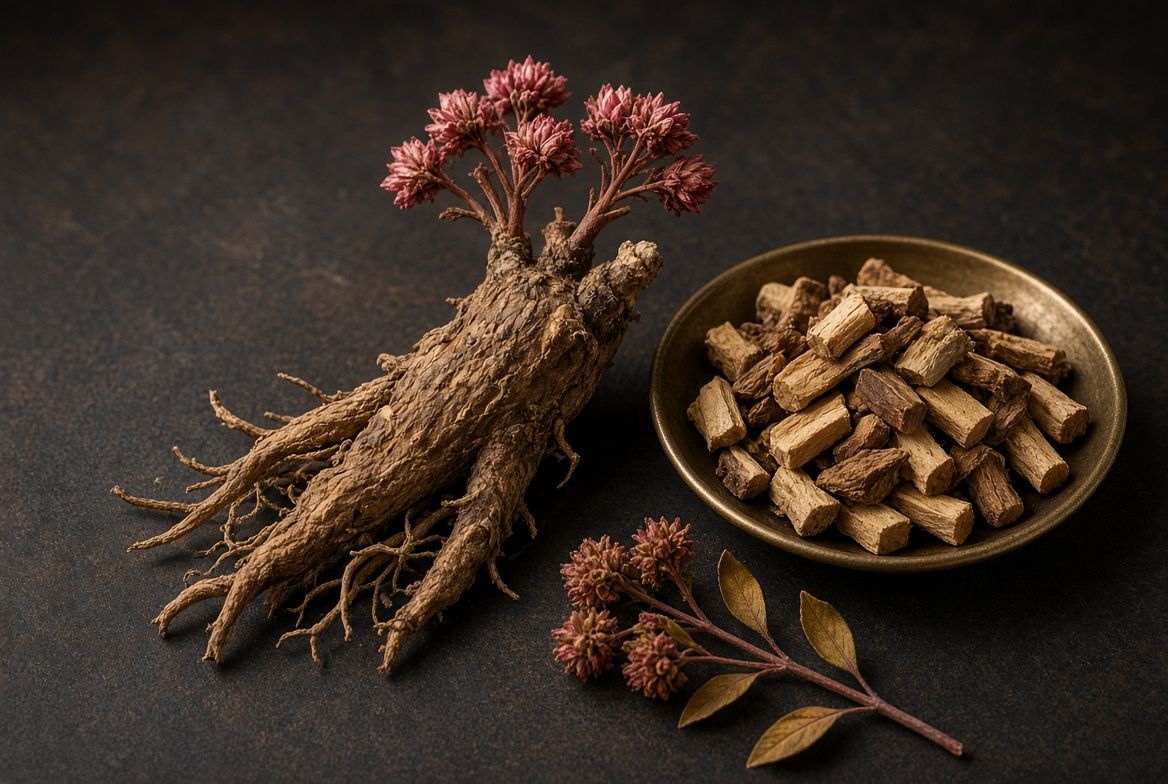
Rhodiola rosea is a perennial plant in the Crassulaceae family, commonly called “Golden root,” “Roseroot,” “Rosenrot,” or “Kalverot.” The assessment describes several stems growing from a thick rootstock and separately notes that harvesting the rhizome usually involves destructive harvesting of the whole plant (Scientific assessment of risk to the population of Rhodiola rosea listed by CITES as a result of export from Norway).
Botanical & Scientific Profile
Trade names can conceal substitution. Root and rhizome removal also raises a provenance question that an extract-standardization certificate cannot answer by itself.
The EMA summary reports that the HMPC concluded, on the basis of long-standing traditional use, that preparations from the underground rhizome and root of Rhodiola rosea L. can be used for temporary relief of stress symptoms such as fatigue and a sensation of weakness (Rhodiolae roseae rhizoma et radix - herbal medicinal product).
The assessment reports that a systematic review of randomized clinical trials of Rhodiola rosea found possible benefits for physical performance, mental performance, and certain mental health conditions; the review’s authors considered only 50% of the trials to be of acceptable quality. The assessment does not identify the plant parts or preparations studied (Scientific assessment of risk to the population of Rhodiola rosea listed by CITES as a result of export from Norway).
The Agroscope page reports no human-study methods or results for Rhodiola rosea (Rhodiola rosea: The challenges of domestication.).
Cultural History & Traditional Herbalism
Agroscope launched a domestication programme for Rhodiola rosea in Switzerland in 2005 (Rhodiola rosea: The challenges of domestication.).
The page states that the first written record of Rhodiola rosea dates to 77 BC, when the Greek physician Dioscorides described “rhodia radix” as a medicine in De Materia Medica (Rhodiola Rosea L. (roseroot) its Cultural history and pharmacological effects).
A survey prospected five Rhodiola rosea populations in the Swiss Alps; selected plants were used in a polycross to produce seeds of “Mattmark,” described as the species’ first synthetic cultivar (Rhodiola rosea: The challenges of domestication.).
The article states that Rhodiola rosea grows in dry, sandy ground at high altitudes in Arctic areas of Europe and Asia, and that it has been used for centuries in the traditional medicine of Russia and Scandinavia. It reports that medicinal applications appeared in scientific literature from Sweden, Norway, France, Germany, the Soviet Union, and Iceland between 1725 and 1960; Linnaeus described the plant as an astringent and for hernia, leucorrhoea, hysteria, and headache, and it entered the first Swedish Pharmacopoeia in 1755. The article does not tie these European historical uses specifically to Arctic communities or identify the root as the part used in those cited European records (Rhodiola rosea: A Phytomedicinal Overview).
Tradition, Folklore & Symbolism
The monograph’s botanical description of cultivated Rhodiola rosea L. says its dense terminal cyme of small yellow flowers above fleshy leaves gives the plant its garden name, “king’s crown.” (Rhodiola root).
Herbal Energetics
Insufficient documented evidence for a traditional energetic classification. No temperature, direction or channel is inferred from the flavor of a cup.
InfiniTea sensory metaphor: Endurance with limits. This is original editorial language, not a measured physiological action or a translation of a traditional diagnostic category.
Sensory Profile & Tea Applications
The page describes the Rhodiola rosea rhizome and root system as having an intense rose scent; it also says Finnish- and Komi-origin rhizomes contain phytosterols and that this explains why their fragrance is similar to that of the rose (Rhodiola Rosea L. (roseroot) its Cultural history and pharmacological effects).
Sensory notebook: Use a documented sample or supplier profile for any rose-like odor claim. A rose-like smell is not permission to substitute another Rhodiola species.
Proposed comparison, not a completed trial: Use a supplier-document comparison rather than tasting to assess authenticity. Record whether the two certificates even describe the same organ.
For ordinary dried herbal or fruit infusions, the German Federal Institute for Risk Assessment advises using boiling water and not leaving the prepared infusion standing for hours. Cooling a hot infusion and steeping untreated dry material in cold water are different processes; this report does not validate the latter (Boiling water a must for herbal teas).
Safety & Responsible Use
The HMPC summary concerns medicines containing preparations of the underground rhizome and root of Rhodiola rosea L.; it states that they should be used only by adults over 18 and that use beyond two weeks requires medical advice. The conclusion is based on traditional use (Rhodiolae roseae rhizoma et radix - herbal medicinal product).
For Rhodiola rosea root and rhizome, the monograph reports no published safety data for pregnancy or lactation and no clinical-trial safety data for children or adolescents under 18; it says the EU monograph does not recommend use in those circumstances. The reported concerns about combining rhodiola with antidepressants come from case reports and spontaneous reports, not established clinical effects. The source does not establish these findings specifically for brewed root (Rhodiola root).
NCCIH says rhodiola is possibly safe for up to 12 weeks and lists dizziness, headache, insomnia, dry mouth, and excessive saliva production as possible side effects; the page does not specify the preparation or the evidence behind these effects. Interactions with losartan, a drug for high blood pressure, have been reported, but details of the evidence are not provided. Little is known about safety during pregnancy or breastfeeding (Rhodiola: Usefulness and Safety | NCCIH - NIH).
Preparation and exposure boundary: This review does not establish a safe medicinal dose in pregnancy, lactation or childhood, or rule out interactions or allergy. Do not substitute essential oil or a concentrated extract for the documented food or herb.
For U.S. food use, the relevant safety determination concerns the intended conditions of use. The existence of a traditional preparation or herbal medicine monograph does not establish that this ingredient, dose and beverage are cleared for sale (Understanding How the FDA Regulates Food Additives and GRAS Ingredients).
Historical Trade, Ecology & Sustainability
The assessment says harvesting the rhizome of Rhodiola rosea usually involves destructive harvesting of the whole plant. It reports that plants in natural habitats seem to reach the mature generative phase with strong rhizome growth only after more than 20 years, whereas harvest of cultivated plants seems possible after 4–5 years (Scientific assessment of risk to the population of Rhodiola rosea listed by CITES as a result of export from Norway).
The page says that harvesting Rhodiola rosea roots is destructive, identifies wild harvests in the Altaj Mountains as the main supply source for commercial extracts, and reports that “Mattmark” has been grown in Switzerland and abroad for around ten years (Rhodiola rosea: The challenges of domestication.).
The page says controlled cultivation was developed to meet increased demand for plant material without exterminating wild-growing stocks, and that commercial cultivation of Rhodiola rosea rhizomes extends from the Urals to Alaska, including Canada and the Norwegian, Danish, and Austrian Alps (Rhodiola Rosea L. (roseroot) its Cultural history and pharmacological effects).
The proposal reports that Rhodiola rosea is traded mainly as dried roots and rhizomes and as extracts, with most traded material described as wild-sourced; harvesting of whole plants or large rhizomes is destructive and often targets reproductively mature individuals. It cites estimates including 500 tonnes of dry R. rosea rhizomes sold annually from four to five Xinjiang collection sites, and reports historical population declines of 90.5% in the Kuznetsky Alatau mountains from 1976 to 1987 and 76.4% in the Altai Region from 1974 to 1986, attributed primarily to commercial harvesting. The proposal characterizes the species as vulnerable to overexploitation because of slow growth, low dispersal, and low germination and seedling survival, while noting that recent numerical estimates of declines across its range are unavailable (Proposal to include Rhodiola rosea and Rhodiola crenulata in CITES Appendix II, and all other Rhodiola species because of similarity to the traded species).
Sourcing record: Ask for cultivated versus wild origin, harvest documentation and applicable CITES paperwork; do not equate controlled trade with a universal ban.
InfiniTea Herb Lore & Ritualpreliminary draft
Energetics (original InfiniTea metaphor): Endurance with limits. Use this as a private writing image, not a health statement.
Tradition & Folklore: The monograph’s botanical description of cultivated Rhodiola rosea L. says its dense terminal cyme of small yellow flowers above fleshy leaves gives the plant its garden name, “king’s crown.” (Rhodiola root).
Ritual Cue (original contemporary InfiniTea interpretation): Write down something worth sustaining and the limit that would keep it sustainable.
Private preliminary draft; not approved for publication.
Scholarly References & Research Verification
Research limitations
Request species-level authentication, cultivated or wild origin, and the applicable trade documents for that shipment; a conservation proposal is not itself an export permit.
Trade volumes are uncertain: the proposal states there are no known genus-specific harmonized tariff codes and that available shipment estimates can include mixed containers, making Rhodiola quantities difficult to determine (Proposal to include Rhodiola rosea and Rhodiola crenulata in CITES Appendix II, and all other Rhodiola species because of similarity to the traded species).
References below identify the evidence used, not additional endorsements. A botanical authority establishes nomenclature, not the identity of a physical lot. Published study samples, traditional descriptions and InfiniTea proposals are distinguished in the text.
- Kew, Plants of the World Online: Rhodiola rosea L. | Taxonomic backbone
- Scientific assessment of risk to the population of Rhodiola rosea listed by CITES as a result of export from Norway | Scientific assessment and non-detriment finding
- Rhodiolae roseae rhizoma et radix - herbal medicinal product | EMA public summary of the Committee on Herbal Medicinal Products (HMPC) conclusions
- Rhodiola rosea: The challenges of domestication. | Agroscope publication record for an eSymposium contribution
- Rhodiola Rosea L. (roseroot) its Cultural history and pharmacological effects | book section
- Rhodiola root | working-draft pharmacopoeial monograph and evidence review
- Proposal to include Rhodiola rosea and Rhodiola crenulata in CITES Appendix II, and all other Rhodiola species because of similarity to the traded species | Official CITES proposal and secondary synthesis of trade, population, and conservation evidence
- Rhodiola rosea: A Phytomedicinal Overview | Review article on the traditional uses, phytochemistry, and medicinal research of Rhodiola rosea.
- Rhodiola: Usefulness and Safety | NCCIH - NIH | The page concerns Rhodiola rosea and says there is not enough reliable evidence to determine whether rhodiola is useful for health-related purposes; most research in people is low-to-moderate quality. It does not describe the design of safety studies or identify a specific rhodiola preparation, plant part, or form.
- Boiling water a must for herbal teas | BfR press release providing general food-safety guidance for preparing herbal and fruit infusions.
- Understanding How the FDA Regulates Food Additives and GRAS Ingredients | U.S. FDA consumer-information webpage describing food-additive and GRAS ingredient oversight.
Final Botanical Summary
Root harvest and international trade make provenance a core research question, not a decorative sourcing note.
Editorial disposition: Lot unverified. The report is a private reference, not a clinical recommendation, approval for sale or authenticated sensory trial.
Verification Status (November 2026)
Phase II source audit, claim by claim
- Claims checked
- 15
- Corrected
- 3
- Withheld
- 1
- Sources
- 11
Material: Lot unverified. No physical sample has been examined.
Citation check: 3 of 4 Safety & Use citations confirmed against their sources in November 2026; 1 on a site that blocks automated reading, awaiting a check by hand.
A private research reference, not a clinical recommendation or product claim. Checked to the Grimoire's research standards →