
Botanical Identity & Classification
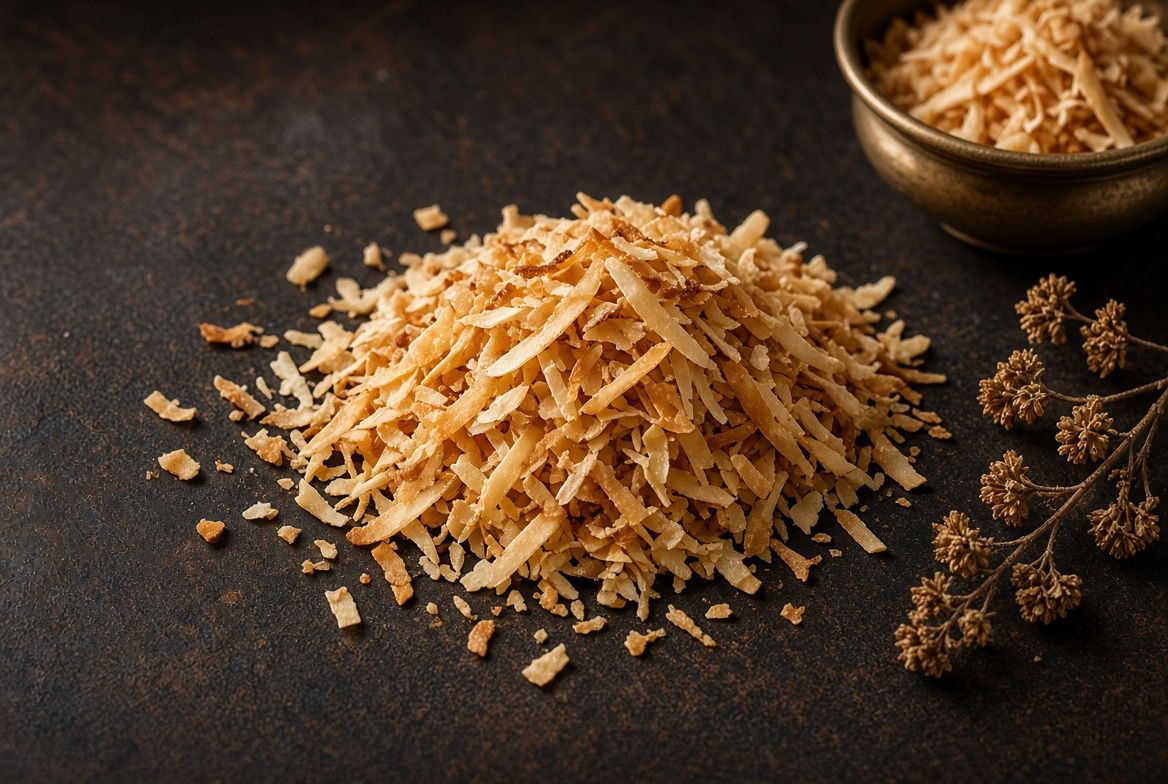
Inventory scope: Cocos nucifera · Arecaceae · toasted solid endosperm, or kernel.
Nomenclatural check: Cocos nucifera L. is accepted in this treatment (family Arecaceae). A synonym listed there is Calappa nucifera (L.) Kuntze in Revis. Gen. Pl. 2: 982 (1891). The stated native range is Central Malesia to SW. Pacific (Kew, Plants of the World Online: Cocos nucifera L.).
Inventory decision: Distinguish toasted flesh from coconut water, milk, oil and added coconut flavor. Verify sweetening, cross-contact, storage and allergen information for the actual flakes.
Cocos nucifera L. belongs to the Arecaceae family and is commonly called coconut (Cocos nucifera - Oxford University Plants 400).
The page identifies the coconut’s botanical name as Cocos nucifera (Traditional Pacific Island Crops: Coconut).
Botanical & Scientific Profile
The ingredient is toasted solid endosperm, not coconut water, milk, oil or shell. A favorable analysis of one fraction cannot be presented as evidence about the others.
The Cocos nucifera fruit has a waterproof outer layer, a fibrous middle layer, and a hard inner shell; its endosperm is initially sweetish liquid coconut water and later forms brilliant white, fat-rich edible flesh (Cocos nucifera - Oxford University Plants 400).
Scientific research papers reported that two people with walnut allergy reacted to coconut because of a cross-reacting protein; the factsheet does not specify how the coconut was prepared (Coconut allergy).
A scientific research paper described a person with coconut allergy who developed oral-allergy symptoms to several tree nuts; a cross-reacting protein in coconut and hazelnut was identified as the cause. The factsheet calls such cases rare exceptions and says no precise statistics are available for coconut allergy in the UK (Coconut allergy).
Cultural History & Traditional Herbalism
For millennia, coconuts were central to Polynesian and Asian peoples’ lives: the fruits served as portable food and drink, while the stems and leaves provided shelter, fuel, and transport (Cocos nucifera - Oxford University Plants 400).
The factsheet says coconut is widely used in South-East Asian cooking (Coconut allergy).
The page says that sixteenth-century English herbalist John Gerard described polished coconut shells traced with silver as novelties for the wealthy; coconut shies became commonplace fairground entertainment in Edwardian Britain; and coconut oil and coir became items of international commerce during the nineteenth century (Cocos nucifera - Oxford University Plants 400).
The researchers analyzed 1,322 coconut accessions at ten microsatellite loci and found strong genetic differentiation between Pacific and Indo-Atlantic populations; they interpret this as evidence for independent cultivation origins in island Southeast Asia and the southern Indian subcontinent. In the Pacific group, they identify dwarf habit, self-pollination, and “niu vai” fruit morphology as traits associated with human selection, and their results suggest that cultivated Dwarfs originated in Southeast Asia. They report that Melanesian and Polynesian coconuts have similar genetic composition, with more than half of individuals in those regions predominantly assigned to the South Pacific component; the outcrossing, compact-growth Polynesian ‘niu leka’ (‘Fiji Dwarf’) is described as a separate origin of dwarf habit. The proposed Austronesian introductions of Pacific coconuts to Madagascar and coastal East Africa are based on genetic admixture patterns and historical and ethnographic evidence, not direct archaeological evidence presented in this study (Independent Origins of Cultivated Coconut (Cocos nucifera L.) in the Old World Tropics).
Tradition, Folklore & Symbolism
The page calls the coconut the “prince of palms” and says that Cocos means “mask” or “monkey face,” referring to the shell’s three prominent eyes (Cocos nucifera - Oxford University Plants 400).
Herbal Energetics
Insufficient documented evidence for a traditional energetic classification. No temperature, direction or channel is inferred from the flavor of a cup.
InfiniTea sensory metaphor: Warmth made by craft. This is original editorial language, not a measured physiological action or a translation of a traditional diagnostic category.
Sensory Profile & Tea Applications
Gas chromatography and gas chromatography–mass spectrometry of steam-distilled volatiles from roasted and unroasted dried coconut meat identified saturated δ-lactones as key contributors to the mild, sweet coconut aroma. The roasted coconut volatiles also contained six pyrazines, two furans, and two pyrroles, which the authors considered contributors to its nut-like aroma (Aroma Constituents of Roasted Coconut).
The factsheet does not describe coconut’s aroma or taste (Coconut allergy).
Sensory notebook: Compare toasted and untoasted unsweetened flakes for aroma, oily surface and the flavor left in strained water. Coconut flesh does not behave like a dried leaf.
Proposed comparison, not a completed trial: Compare unsweetened toasted and untoasted kernel from documented food-grade lots. Record roast level, floating fat or particles, and added flavors before describing the beverage.
For ordinary dried herbal or fruit infusions, the German Federal Institute for Risk Assessment advises using boiling water and not leaving the prepared infusion standing for hours. Cooling a hot infusion and steeping untreated dry material in cold water are different processes; this report does not validate the latter (Boiling water a must for herbal teas).
Safety & Responsible Use
The factsheet says food allergies can sometimes cause life-threatening anaphylaxis and advises people who suspect coconut allergy to contact their GP for testing or referral to an allergy clinic. It says tree-nut allergy alone is not a general reason to avoid coconut (Coconut allergy).
The factsheet advises people with coconut allergy to read food labels carefully every time they shop and to contact the manufacturer if unsure about a product. When eating out, it advises telling staff that coconut must be avoided (Coconut allergy).
The CDC page concerns a 2018 Salmonella Typhimurium outbreak linked to dried coconut and identifies recalled products including Go Smile! Raw Coconut, Go Smiles Dried Coconut Raw, Natural Grocers Coconut Smiles Organic, and Healthy Nut Factory Organic Coconut Smiles. CDC advised consumers not to eat recalled dried coconut, to discard or return it, and to wash and sanitize places where it was stored; it also advised retailers to sanitize bins or containers (2018 Salmonella Typhimurium Infections Linked to Dried Coconut (Final Update) – Advice to Consumers and Retailers).
FDA no longer considers coconut a major food allergen, so coconut need not be declared in a product’s “Contains” statement. If coconut is an ingredient, it generally must still appear in the ingredient list by its common or usual name, unless an exemption applies; the page reports no human allergy observations or clinical evidence about reactions to coconut (Frequently Asked Questions: Food Allergen Labeling Guidance for Industry).
Preparation and exposure boundary: This review does not establish a safe medicinal dose in pregnancy, lactation or childhood, or rule out interactions or allergy. Do not substitute essential oil or a concentrated extract for the documented food or herb.
For U.S. food use, the relevant safety determination concerns the intended conditions of use. The existence of a traditional preparation or herbal medicine monograph does not establish that this ingredient, dose and beverage are cleared for sale (Understanding How the FDA Regulates Food Additives and GRAS Ingredients).
Historical Trade, Ecology & Sustainability
Microsatellite analysis of 1,322 coconut accessions supports independent cultivation origins in the Pacific and Indian Ocean basins. Genetic admixture patterns in the western Indian Ocean are consistent with human-mediated movement of Pacific coconuts along historical trade routes (Independent Origins of Cultivated Coconut (Cocos nucifera L.) in the Old World Tropics).
The page describes Cocos nucifera fruits as buoyant and salt-tolerant maritime voyagers and coastal colonizers that remain viable for about 110 days; it says the fibrous fruit wall provides buoyancy during travel and a moisture-retentive rooting medium for the seedling (Cocos nucifera - Oxford University Plants 400).
Sourcing record: Document kernel origin, toasting method, added sugar, shared equipment and storage; a packing-country label is not evidence of where palms were grown.
InfiniTea Herb Lore & Ritualpreliminary draft
Energetics (original InfiniTea metaphor): Warmth made by craft. Use this as a private writing image, not a health statement.
Tradition & Folklore: The page calls the coconut the “prince of palms” and says that Cocos means “mask” or “monkey face,” referring to the shell’s three prominent eyes (Cocos nucifera - Oxford University Plants 400).
Ritual Cue (original contemporary InfiniTea interpretation): Name one small change that turned a familiar ingredient into something new. Credit the person who taught you the method, if known.
Private preliminary draft; not approved for publication.
Scholarly References & Research Verification
Research limitations
Require a food-grade toasted-kernel specification, allergen review and validated processing records. “Dry” and “toasted” are not substitutes for lot-specific safety controls.
References below identify the evidence used, not additional endorsements. A botanical authority establishes nomenclature, not the identity of a physical lot. Published study samples, traditional descriptions and InfiniTea proposals are distinguished in the text.
- Kew, Plants of the World Online: Cocos nucifera L. | Taxonomic backbone
- Cocos nucifera - Oxford University Plants 400 | botanical profile
- Traditional Pacific Island Crops: Coconut | research guide
- Coconut allergy | allergy factsheet
- Aroma Constituents of Roasted Coconut | experimental study
- Independent Origins of Cultivated Coconut (Cocos nucifera L.) in the Old World Tropics | peer-reviewed population-genetic study
- 2018 Salmonella Typhimurium Infections Linked to Dried Coconut (Final Update) – Advice to Consumers and Retailers | official public health advisory
- Independent Origins of Cultivated Coconut (Cocos nucifera L.) in the Old World Tropics | Peer-reviewed population-genetic research article examining coconut cultivation history and human-mediated dispersal.
- Frequently Asked Questions: Food Allergen Labeling Guidance for Industry | FDA regulatory FAQ about food allergen labeling, including the agency’s interpretation of coconut and other tree nuts as major food allergens. FDA says its revised guidance reflects its review of scientific information and public comments, but this page does not describe a clinical study or provide study methods or participant data.
- Boiling water a must for herbal teas | BfR press release providing general food-safety guidance for preparing herbal and fruit infusions.
- Understanding How the FDA Regulates Food Additives and GRAS Ingredients | U.S. FDA consumer-information webpage describing food-additive and GRAS ingredient oversight.
Final Botanical Summary
Both the palm’s cultural history and the toasting step matter. Allergy, lot composition and storage should be considered for this specific food form.
Editorial disposition: Lot unverified. The report is a private reference, not a clinical recommendation, approval for sale or authenticated sensory trial.
Verification Status (November 2026)
Phase II source audit, claim by claim
- Claims checked
- 15
- Corrected
- 2
- Withheld
- 0
- Sources
- 11
Material: Lot unverified. No physical sample has been examined.
Citation check: All 5 Safety & Use citations were re-read against their sources in November 2026 and confirmed.
A private research reference, not a clinical recommendation or product claim. Checked to the Grimoire's research standards →