
Botanical Identity & Classification
Inventory scope: Taraxacum officinale aggregate · Asteraceae · root.
Nomenclatural check: Taraxacum officinale F.H.Wigg. is treated as a synonym of Taraxacum sect. Taraxacum (Kew, Plants of the World Online: Taraxacum officinale F.H.Wigg.).
Inventory decision: Specify root versus leaf and raw-dried versus roasted root. Do not substitute leaf diuretic claims for root evidence or recommend digging plants from sprayed sites.
Taraxacum officinale Weber, commonly known as dandelion, belongs to the Asteraceae family (A review on natural bioactive compounds of Taraxacum officinale Weber: a potential anticancer plant).
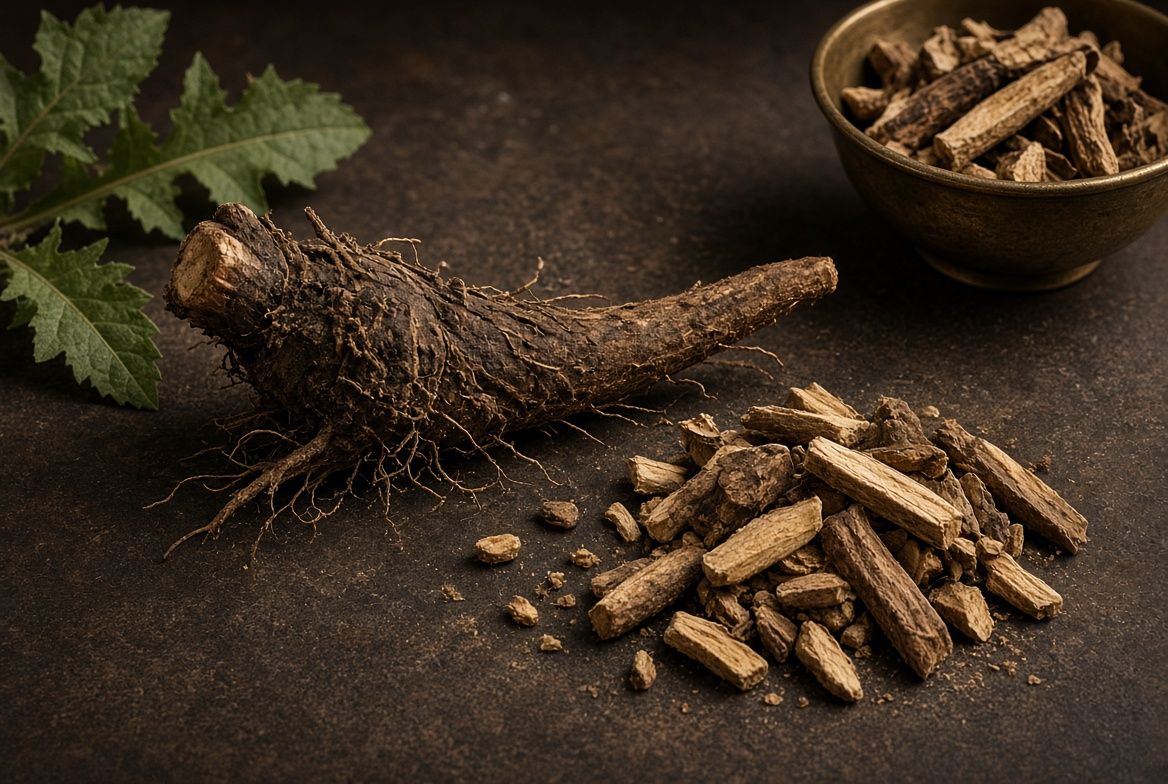
The preferred scientific name is Taraxacum officinale complex Weber ex Wigg. The datasheet describes its thick, branched taproot as reaching 2–3 cm in diameter and 1–2 m in length. It describes the complex as morphologically similar to other members of Asteraceae, rather than explicitly assigning it a family classification (Taraxacum officinale complex (dandelion)).
Here “aggregate” is a working scope for the inventory and the root drug, not a claim that the medicinal monograph or this report distinguishes every microspecies.
Botanical & Scientific Profile
Use root as the comparison unit. Roasting, cutting and grinding can change the beverage being documented even where the name dandelion is unchanged.
The University of California pest note reports no root-specific chemical analysis or human study, including a study describing a preparation, result, or limitation, for common dandelion (Taraxacum officinale) (Dandelions).
For Taraxacum officinale F.H. Wigg. root, the EMA report found no clinical pharmacodynamic, pharmacokinetic, efficacy, dose-response, or clinical-study data; it describes experimental evidence supporting the proposed traditional uses as very limited (Assessment report on Taraxacum officinale F.H. Wigg., radix).
The review reports that T. officinale roots contain the storage carbohydrate inulin, which is used in functional foods as a prebiotic and texture modifier, and that α- and β-amyrins have been isolated from the roots. Cycloartenol and lupeol are reported among compounds isolated from T. officinale, but the review does not specifically attribute them to the roots (A review on natural bioactive compounds of Taraxacum officinale Weber: a potential anticancer plant).
Cultural History & Traditional Herbalism
The datasheet reports that a health tonic sold as MATOL in Canada and Km in the USA contains an extract from the roots of T. officinale complex (Taraxacum officinale complex (dandelion)).
The note states that common dandelion (Taraxacum officinale) was introduced from Europe and has been used as a potherb and medicinal plant since Roman times; it says the roots are often used to make stronger tea than the leaves or dried for medicinal purposes, including as a mild diuretic (Dandelions).
For Taraxacum officinale F.H. Wigg. root, the Polish herbal reference by Oźarowski et al. (1978) documented traditional use for liver diseases with reduced bile production, biliary-tract disorders, renal failure, edema, achylia, and associated digestive disorders. The British Herbal Pharmacopoeia (1983) documented root preparations for cholecystitis, gallstones, jaundice, atonic dyspepsia with constipation, muscular rheumatism, and oliguria (Assessment report on Taraxacum officinale F.H. Wigg., radix).
The profile identifies Taraxacum officinale and reports that its root was dried and roasted as a coffee alternative during the Second World War. It also states that the plant has been used medicinally, but gives no specific medicinal practice (Dandelion - Taraxacum officinale).
Tradition, Folklore & Symbolism
The datasheet gives “dent de lion,” meaning “tooth of the lion,” as the source of the common name “dandelion” and offers as one possible explanation the strong white taproot: pulling it from a lawn is compared to extracting a lion’s tooth (Taraxacum officinale complex (dandelion)).
Herbal Energetics
Insufficient documented evidence for a traditional energetic classification. No temperature, direction or channel is inferred from the flavor of a cup.
InfiniTea sensory metaphor: Depth beneath the ordinary. This is original editorial language, not a measured physiological action or a translation of a traditional diagnostic category.
Sensory Profile & Tea Applications
The review reports that T. officinale roots are used in coffee, tea, tincture, and capsule products; it does not describe root-specific aroma or taste (A review on natural bioactive compounds of Taraxacum officinale Weber: a potential anticancer plant).
The note says common dandelion roots are often used to make stronger tea than tea made from the leaves, and gives no root-specific aroma or taste description (Dandelions).
Sensory notebook: Compare roasted and unroasted food-grade roots for bitterness, toasted aromas and liquor color. A coffee-like aroma does not imply coffee content.
Proposed comparison, not a completed trial: Compare an identified roasted root with an unroasted one visually and by aroma. Do not mistake a dark roast for a stronger medicinal preparation.
For ordinary dried herbal or fruit infusions, the German Federal Institute for Risk Assessment advises using boiling water and not leaving the prepared infusion standing for hours. Cooling a hot infusion and steeping untreated dry material in cold water are different processes; this report does not validate the latter (Boiling water a must for herbal teas).
Safety & Responsible Use
For medicinal preparations of Taraxacum officinale F.H. Wigg. root, the EMA monograph warning says use is not recommended in bile-duct obstruction, cholangitis, liver disease, gallstones, or other biliary diseases; it lists hypersensitivity to the active substance or to Asteraceae (Compositae) plants as a contraindication (Assessment report on Taraxacum officinale F.H. Wigg., radix).
For medicinal use of Taraxacum officinale F.H. Wigg. root, the EMA report says it is not recommended for people whose medical condition requires restricted fluid intake, and use during pregnancy or lactation is not recommended because data are insufficient. Use in children under 12 years is not recommended; it has not been established because adequate data are lacking (Assessment report on Taraxacum officinale F.H. Wigg., radix).
The report concerns Taraxaci officinalis radix (dandelion root) and concludes that its traditional-use indications include relief of symptoms of mild digestive disorders, temporary loss of appetite, and increasing urine to flush the urinary tract in minor urinary complaints. It states that, because of possible stimulation of bile secretion reported from traditional medicinal use, dandelion root is not recommended in cases of bile duct obstruction, cholangitis, liver disease, gallstones, or other biliary diseases (Assessment report on Taraxacum officinale F.H. Wigg., radix).
A human case report described a 52-year-old woman with a history of erythema multiforme who developed lesions after exposure to weeds; patch tests with fresh dandelion leaves were eczematous and photoaggravation to dandelion was observed. The report notes possible anaphylaxis or pseudoallergic contact dermatitis associated with sesquiterpene lactones, and lists hypersensitivity to Asteraceae or dandelion constituents, bile-duct obstruction, cholangitis, liver disease, gallstones, active peptic ulcer, and other biliary diseases as contraindications; it reports no serious adverse effects in the documented traditional EU use, but no clinical safety data for root-with-herb extracts. No interactions are known, although dehydration and lithium toxicity with diuretic preparations are described as a theoretical concern; pregnancy and lactation data are absent and use is not recommended, and use in children and adolescents under 12 is not recommended (Assessment report on Taraxacum officinale Weber ex Wigg., radix cum herba).
Preparation and exposure boundary: This review does not establish a safe medicinal dose in pregnancy, lactation or childhood, or rule out interactions or allergy. Do not substitute essential oil or a concentrated extract for the documented food or herb.
For U.S. food use, the relevant safety determination concerns the intended conditions of use. The existence of a traditional preparation or herbal medicine monograph does not establish that this ingredient, dose and beverage are cleared for sale (Understanding How the FDA Regulates Food Additives and GRAS Ingredients).
Historical Trade, Ecology & Sustainability
The review describes T. officinale as a common weed native to Europe, Asia, and North America that spreads worldwide. In India, it is distributed from the subtropical to alpine Himalaya, from Ladakh to Arunachal Pradesh (A review on natural bioactive compounds of Taraxacum officinale Weber: a potential anticancer plant).
The datasheet reports that T. officinale complex can regenerate shoots and roots from very small root fragments within 1–2 weeks, and says successful physical removal must include the entire root system (Taraxacum officinale complex (dandelion)).
The note states that common dandelion can regenerate from root sections as short as 1 inch and that hand-pulling or hoeing is usually futile unless repeated over a long period because established plants have extensive roots; it also says dandelion roots are attractive to gophers (Dandelions).
Sourcing record: Distinguish cultivated root from wild-dug root, ask about collection sites and processing, and note the roasting stage.
InfiniTea Herb Lore & Ritualpreliminary draft
Energetics (original InfiniTea metaphor): Depth beneath the ordinary. Use this as a private writing image, not a health statement.
Tradition & Folklore: The datasheet gives “dent de lion,” meaning “tooth of the lion,” as the source of the common name “dandelion” and offers as one possible explanation the strong white taproot: pulling it from a lawn is compared to extracting a lion’s tooth (Taraxacum officinale complex (dandelion)).
Ritual Cue (original contemporary InfiniTea interpretation): Choose something often dismissed as commonplace. Write what becomes visible when you give it another minute.
Private preliminary draft; not approved for publication.
Scholarly References & Research Verification
Research limitations
Distinguish root-only material from herb with root; investigate biliary restrictions under the applicable preparation. Record the taxonomic treatment of the dandelion aggregate.
References below identify the evidence used, not additional endorsements. A botanical authority establishes nomenclature, not the identity of a physical lot. Published study samples, traditional descriptions and InfiniTea proposals are distinguished in the text.
- Kew, Plants of the World Online: Taraxacum officinale F.H.Wigg. | Taxonomic backbone
- A review on natural bioactive compounds of Taraxacum officinale Weber: a potential anticancer plant | review article
- Taraxacum officinale complex (dandelion) | datasheet
- Dandelions | University of California integrated pest management publication for home gardeners and landscape professionals (Pest Note 7469)
- Assessment report on Taraxacum officinale F.H. Wigg., radix | official regulatory assessment report
- Dandelion - Taraxacum officinale | North Carolina Extension Gardener Plant Toolbox plant profile
- Assessment report on Taraxacum officinale Weber ex Wigg., radix cum herba | EMA final assessment report dated 12 November 2009 on dandelion root with herb. It reports no clinical studies; the safety evidence includes a human case report involving contact with fresh leaves, nonclinical studies of various extracts, and general precautionary information.
- Boiling water a must for herbal teas | BfR press release providing general food-safety guidance for preparing herbal and fruit infusions.
- Understanding How the FDA Regulates Food Additives and GRAS Ingredients | U.S. FDA consumer-information webpage describing food-additive and GRAS ingredient oversight.
Final Botanical Summary
Roasting is a defining culinary variable. It should be recorded as carefully as the plant part, rather than hidden behind the word dandelion.
Editorial disposition: Lot unverified. The report is a private reference, not a clinical recommendation, approval for sale or authenticated sensory trial.
Verification Status (November 2026)
Phase II source audit, claim by claim
- Claims checked
- 16
- Corrected
- 2
- Withheld
- 0
- Sources
- 9
Material: Lot unverified. No physical sample has been examined.
Citation check: All 5 Safety & Use citations were re-read against their sources in November 2026 and confirmed.
A private research reference, not a clinical recommendation or product claim. Checked to the Grimoire's research standards →