
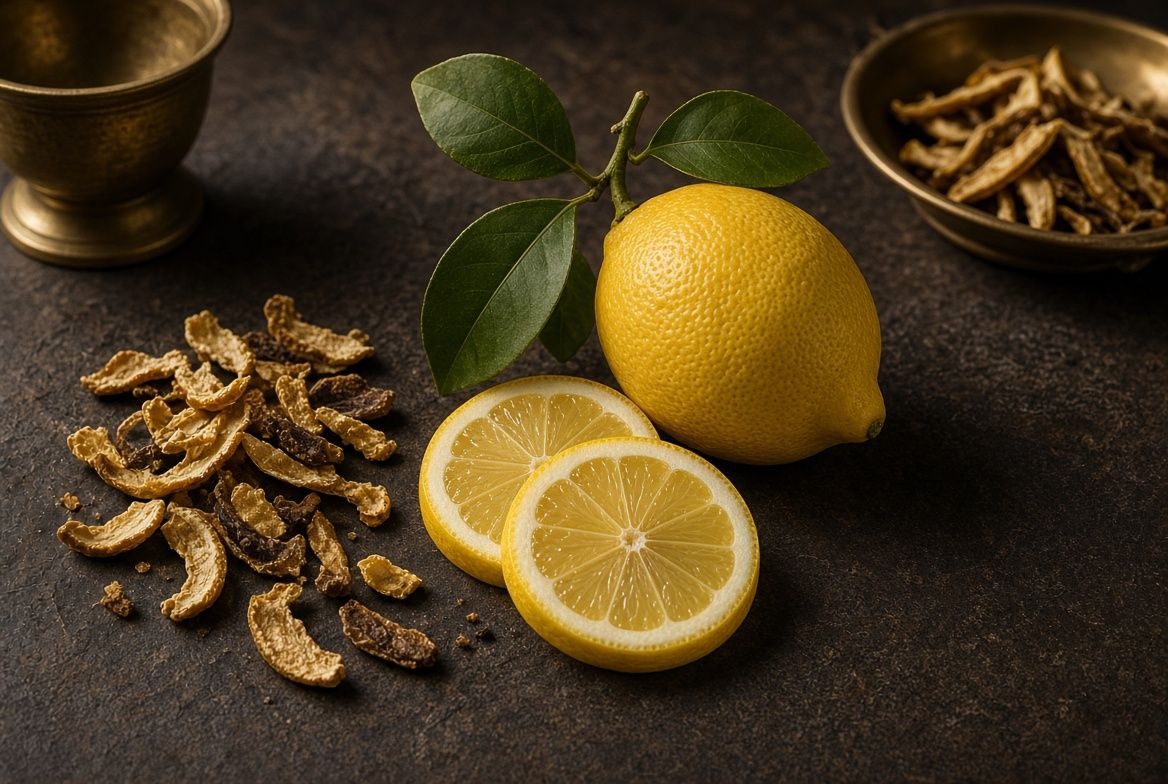
Botanical Identity & Classification
Inventory scope: Citrus × limon · Rutaceae · fruit, juice or peel.
Nomenclatural check: Citrus × limon (L.) Osbeck is accepted in this treatment (family Rutaceae). A synonym listed there is Citrus medica f. limon (L.) M.Hiroe. The stated native range is as a cultigen derived from artificial hybrids (Kew, Plants of the World Online: Citrus × limon (L.) Osbeck).
Inventory decision: The part is unspecified. Juice, colored zest, whole peel and expressed oil must not share a single sensory or safety description; record how peel was sourced for food use.
The profile identifies lemon as Citrus limon (L.) Osbeck in the Rutaceae family and notes that a container-grown Citrus limon 'Lunario' grows in the Oxford Botanic Garden (Citrus limon - Oxford University Plants 400).
The review identifies Citrus limon (L.) Burm. f. as an evergreen Rutaceae tree. Its fruit is a source of juice and essential oil, which is obtained by cold-pressing the fresh outer pericarp (Citrus limon (Lemon) Phenomenon—A Review of the Chemistry, Pharmacological Properties, Applications in the Modern Pharmaceutical, Food, and Cosmetics Industries, and Biotechnological Studies).
Botanical & Scientific Profile
Juice, zest and expressed peel oil are different materials. A dermatology or cosmetic safety study can inform a contact warning but it is not an oral dose assessment.
A historical account of James Lind’s 1747 trial reports that sailors with scurvy who received two oranges (Citrus × sinensis) and one lemon (Citrus × limon) daily recovered faster than sailors in a control group. The article notes that vitamin C was not identified until 1912 and provides no further trial details (Food as Medicine: Lemon (Citrus × limon, Rutaceae)).
The profile states that lemon trees can grow to over six metres tall, with dark green, leathery leaves and beautifully scented white flowers backed with purple; their yellow, pointed fruits take four to twelve months to ripen and are usually harvested from late summer into winter (Citrus limon - Oxford University Plants 400).
The lemon tree is described as about 2.5–3 m tall, with evergreen lanceolate leaves and elongated, pointed fruit that ripens from green to yellow. The fruit contains flavonoids and phenolic acids, and the essential oil is rich in monoterpenoids, particularly D-limonene (Citrus limon (Lemon) Phenomenon—A Review of the Chemistry, Pharmacological Properties, Applications in the Modern Pharmaceutical, Food, and Cosmetics Industries, and Biotechnological Studies).
Cultural History & Traditional Herbalism
The profile says Romans cultivated lemons in Italy in the first century AD and that a fresco found during excavations of Pompeii depicts what looks very much like a lemon tree. It states that Arabs spread lemon cultivation into the Mediterranean and that lemons arrived in the New World in the late fifteenth century (Citrus limon - Oxford University Plants 400).
The review reports cultivation in southern Italy from the 3rd century AD, Iraq and Egypt from 700 AD, and Spain from 1150; it says Marco Polo’s expeditions brought lemon to China in 1297 (Citrus limon (Lemon) Phenomenon—A Review of the Chemistry, Pharmacological Properties, Applications in the Modern Pharmaceutical, Food, and Cosmetics Industries, and Biotechnological Studies).
Historical evidence cited in the article places lemon (Citrus × limon) cultivation in northern India and suggests that the fruit spread west through Persia, reaching southern Italy around 200. The article reports that by 700 lemons were cultivated widely in Egypt and in areas that are now Iran and Iraq (Food as Medicine: Lemon (Citrus × limon, Rutaceae)).
The page cites a study reporting pollen morphology consistent with Citrus medica and Citrus × limon in a garden at Villa di Poppea, Oplontis, dated to the 1st century BC. The reported material evidence is pollen; its identification as Citrus × limon is based on pollen morphology. The page does not provide further details about the sampled material or the identification method (The History of Citron: Botanical Remains and Ancient Art and Texts).
Tradition, Folklore & Symbolism
No separate inherited symbolic or ceremonial use of this identified part was established here. A documented food, trade or medicinal practice should remain under its own description rather than being relabeled as ritual.
Herbal Energetics
Insufficient documented evidence for a traditional energetic classification. No temperature, direction or channel is inferred from the flavor of a cup.
InfiniTea sensory metaphor: A sharp outline. This is original editorial language, not a measured physiological action or a translation of a traditional diagnostic category.
Sensory Profile & Tea Applications
The profile describes lemon flowers as beautifully scented and says lemons are widely used in foods (Citrus limon - Oxford University Plants 400).
The oil is described as having a characteristic, strong lemon scent, and lemon juice is used to give foods and drinks an acidic or sour taste (Citrus limon (Lemon) Phenomenon—A Review of the Chemistry, Pharmacological Properties, Applications in the Modern Pharmaceutical, Food, and Cosmetics Industries, and Biotechnological Studies).
Sensory notebook: Compare the aroma of zest and the acidity of juice in separate glasses. A lemon-scented drink need not be sour and a sour drink need not contain peel.
Proposed comparison, not a completed trial: Prepare separate comparison cards for juice, zest and pith; note appearance and aroma before combining any components.
For ordinary dried herbal or fruit infusions, the German Federal Institute for Risk Assessment advises using boiling water and not leaving the prepared infusion standing for hours. Cooling a hot infusion and steeping untreated dry material in cold water are different processes; this report does not validate the latter (Boiling water a must for herbal teas).
Safety & Responsible Use
An in vitro laboratory study of extracted human permanent teeth found significant hard-tissue changes, including demineralization, after exposure to lemon juice; its prolonged laboratory exposures do not establish the clinical risk from a single diluted drink (Erosive Effect of Acidic Beverages and Dietary Preservatives on Extracted Human Teeth—An In Vitro Analysis).
The review reports chemical compositions for lemon fruit, juice, and essential oil separately. It warns against using fruit extracts or essential oil at high concentrations in baths or directly on skin, and says skin should not be exposed to sunlight after applying cosmetics containing lemon oil (Citrus limon (Lemon) Phenomenon—A Review of the Chemistry, Pharmacological Properties, Applications in the Modern Pharmaceutical, Food, and Cosmetics Industries, and Biotechnological Studies).
The report describes animal studies in which undiluted lemon peel juice caused phototoxic reactions after sunlight exposure; in one study, 2.5 minutes of exposure was sufficient, and sunscreen reduced but did not prevent the reaction. It also reviews phototoxicity testing of lemon oil: in guinea pigs, lemon oils from different regions varied in potency, and concentrations of 50% and 100% caused phototoxicity in most samples tested; a human study reported phototoxic reactions to lemon oil at 1% in 4 of 5 subjects (Safety Assessment of Citrus Peel-Derived Ingredients as Used in Cosmetics).
In a case of allergic contact dermatitis in a 54-year-old bartender who handled oranges, lemons, and limes, patch tests were positive to lemon, lime, and orange peel, but negative to the corresponding juices; tests were also positive to citral and negative to d-limonene. A separate pastry chef with suspected protein contact dermatitis attributed mainly to lime had a positive RAST to lemon among multiple positive results, but the report does not establish lemon as the cause. These are individual human case observations, not evidence establishing the frequency or general risk of lemon allergy (A spotlight on lime: a review about adverse reactions and clinical manifestations due to Citrus aurantiifolia).
Preparation and exposure boundary: This review does not establish a safe medicinal dose in pregnancy, lactation or childhood, or rule out interactions or allergy. Do not substitute essential oil or a concentrated extract for the documented food or herb.
For U.S. food use, the relevant safety determination concerns the intended conditions of use. The existence of a traditional preparation or herbal medicine monograph does not establish that this ingredient, dose and beverage are cleared for sale (Understanding How the FDA Regulates Food Additives and GRAS Ingredients).
Historical Trade, Ecology & Sustainability
The article reports that lemon (Citrus × limon) is cultivated commercially on a large scale in Mediterranean countries, the United States, and parts of Asia and South America, and states that there are currently no sustainability or conservation concerns (Food as Medicine: Lemon (Citrus × limon, Rutaceae)).
The profile says lemon is thought to originate in Southeast Asia, that cultivation continues in the Mediterranean, and that lemon production remains economically important in countries such as Argentina and Mexico (Citrus limon - Oxford University Plants 400).
The review says lemon’s original natural habitat is not accurately known, but considers the species native to northwestern or northeastern India (Citrus limon (Lemon) Phenomenon—A Review of the Chemistry, Pharmacological Properties, Applications in the Modern Pharmaceutical, Food, and Cosmetics Industries, and Biotechnological Studies).
Sourcing record: Verify food-grade peel and postharvest handling; record whether the fruit material would otherwise be a processing by-product rather than assuming a waste reduction.
InfiniTea Herb Lore & Ritualpreliminary draft
Energetics (original InfiniTea metaphor): A sharp outline. Use this as a private writing image, not a health statement.
Tradition & Folklore: The page cites a study reporting pollen morphology consistent with Citrus medica and Citrus × limon in a garden at Villa di Poppea, Oplontis, dated to the 1st century BC. The reported material evidence is pollen; its identification as Citrus × limon is based on pollen morphology. The page does not provide further details about the sampled material or the identification method (The History of Citron: Botanical Remains and Ancient Art and Texts). This is a record of use, not a claim of inherited ritual.
Ritual Cue (original contemporary InfiniTea interpretation): Describe something that seemed vague yesterday in one precise sentence. Underline only the word that made it clearer.
Private preliminary draft; not approved for publication.
Scholarly References & Research Verification
Research limitations
Confirm the edible fraction and peel treatment. Keep acidity of juice, contact with oil and the safety of concentrated products as separate questions.
The report notes that many studies do not provide enough information to determine how well the tested substance represents the cosmetic ingredient; the cited findings do not establish that the lemon oils tested were expressed or cold-pressed (Safety Assessment of Citrus Peel-Derived Ingredients as Used in Cosmetics). The chapter is available here only as a preview, and the cited Oplontis study’s full evidence and methods are not given (The History of Citron: Botanical Remains and Ancient Art and Texts).
References below identify the evidence used, not additional endorsements. A botanical authority establishes nomenclature, not the identity of a physical lot. Published study samples, traditional descriptions and InfiniTea proposals are distinguished in the text.
- Kew, Plants of the World Online: Citrus × limon (L.) Osbeck | Taxonomic backbone
- Citrus limon - Oxford University Plants 400 | botanical garden plant profile
- Citrus limon (Lemon) Phenomenon—A Review of the Chemistry, Pharmacological Properties, Applications in the Modern Pharmaceutical, Food, and Cosmetics Industries, and Biotechnological Studies | review article
- Food as Medicine: Lemon (Citrus × limon, Rutaceae) | HerbalEGram food-as-medicine article
- Erosive Effect of Acidic Beverages and Dietary Preservatives on Extracted Human Teeth—An In Vitro Analysis | in vitro laboratory study
- Safety Assessment of Citrus Peel-Derived Ingredients as Used in Cosmetics | Secondary review of published phototoxicity studies
- The History of Citron: Botanical Remains and Ancient Art and Texts | Scholarly book chapter preview on citron history, including a reference to archaeobotanical evidence for lemon at Oplontis.
- A spotlight on lime: a review about adverse reactions and clinical manifestations due to Citrus aurantiifolia | A Medline review of English-language case reports about adverse reactions to lime (Citrus aurantiifolia), published through May 2021. The search identified 31 articles describing 39 cases; the page also reports clinical and allergy-test findings involving lemon in a small number of cases.
- Boiling water a must for herbal teas | BfR press release providing general food-safety guidance for preparing herbal and fruit infusions.
- Understanding How the FDA Regulates Food Additives and GRAS Ingredients | U.S. FDA consumer-information webpage describing food-additive and GRAS ingredient oversight.
Final Botanical Summary
Lemon is best documented as several ingredients from one fruit. Identify the material before making a blending or safety judgment.
Editorial disposition: Lot unverified. The report is a private reference, not a clinical recommendation, approval for sale or authenticated sensory trial.
Verification Status (November 2026)
Phase II source audit, claim by claim
- Claims checked
- 15
- Corrected
- 1
- Withheld
- 0
- Sources
- 10
Material: Lot unverified. No physical sample has been examined.
Citation check: All 5 Safety & Use citations were re-read against their sources in November 2026 and confirmed.
A private research reference, not a clinical recommendation or product claim. Checked to the Grimoire's research standards →