
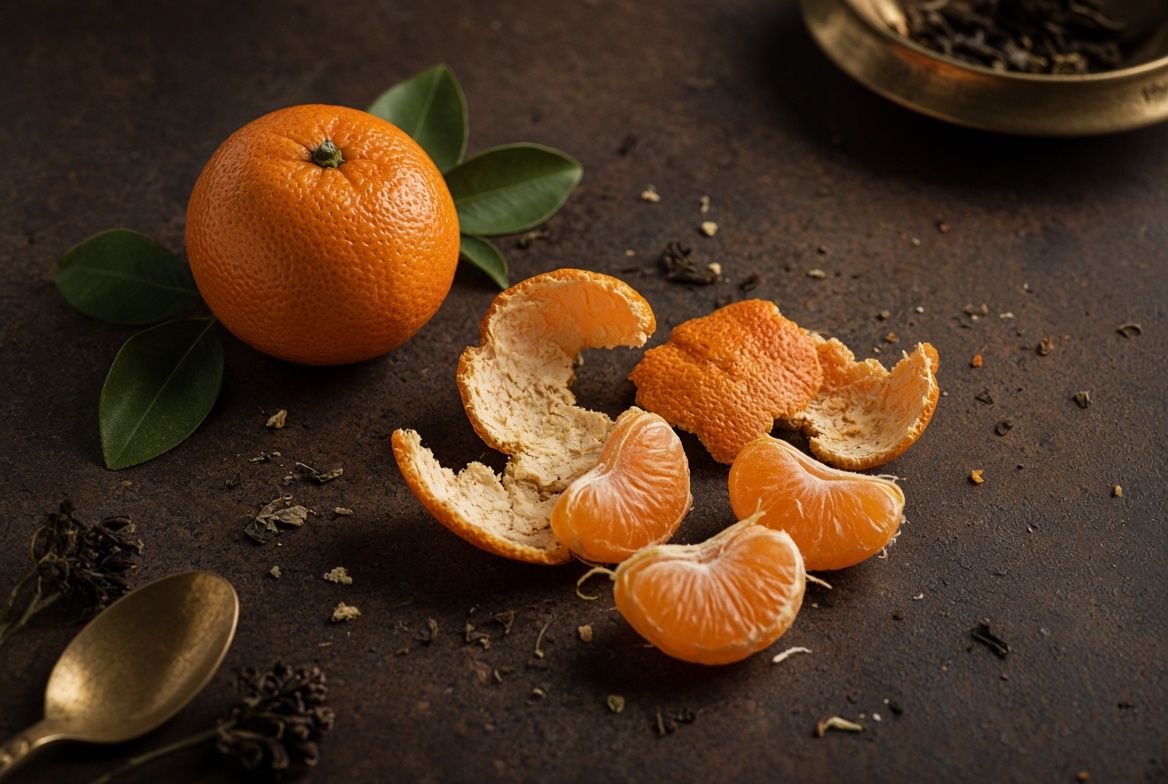
Botanical Identity & Classification
Inventory scope: Citrus reticulata group · Rutaceae · fruit or peel.
Nomenclatural check: Citrus reticulata Blanco is accepted in this treatment (family Rutaceae). A synonym listed there is Citrus × nobilis subf. reticulata (Blanco) M.Hiroe. The stated native range is China (Guangxi to Hunan and Jiangxi) (Kew, Plants of the World Online: Citrus reticulata Blanco).
Inventory decision: Record cultivar, peel versus juice, and whether the material was intentionally aged. Generic mandarin peel should not inherit the identity or traditional indications of a specified chenpi preparation.
The study identifies mandarin as Citrus reticulata (Genome of Wild Mandarin and Domestication History of Mandarin).
The source identifies Citrus reticulata as mandarin or tangerine, places it in the Rutaceae family, and uses the labels “C. reticulata 1” and “C. reticulata 2.” (Citrus reticulata - Useful Plants - An Introduction to Economic Botany).
Botanical & Scientific Profile
Fresh mandarin peel in a kitchen and a defined, prepared medicinal peel are not synonyms. Preserve the traditional drug name, maturity and processing whenever the source specifies them.
In a survey of 66 citrus accessions collected around the Nanling region and neighboring areas, wild mandarins had a mean citric acid level of 30.8 ± 8.1 mg/mL and cultivated mandarins 4.7 ± 1.8 mg/mL; their sugar levels were similar. For the fruit analyses, juice was squeezed and filtered, acidity was measured by titration with 0.1 M NaOH, and soluble sugars and organic acids were analyzed by gas chromatography (Genome of Wild Mandarin and Domestication History of Mandarin).
The source describes Citrus reticulata as a tree up to 8 m tall, with small elliptic or lanceolate leaves, narrowly winged petioles, and small white axillary flowers bearing about 20 stamens (Citrus reticulata - Useful Plants - An Introduction to Economic Botany).
HPLC analysis of the tested mandarin orange peel powder found 8.5 g hesperidin and 47 mg nobiletin per 100 g; non-sterilized peel contained 8.4 g hesperidin and 46 mg nobiletin per 100 g (Preliminary Safety Assessment for Mandarin Orange Peel Administration to Dogs Based on Physical Conditions and Blood Examination Parameters).
Cultural History & Traditional Herbalism
The review identifies Citri Reticulatae Pericarpium (CRP), commonly called dried tangerine peel, as a traditional Chinese medicine made from mature peels of citrus plants, particularly cultivated Citrus reticulata. It describes Chenpi as mature dried peel produced through prolonged natural aging and storage, and says CRP used as a foodstuff is stored for over three years (Recent Advances in the Health Benefits and Application of Tangerine Peel (Citri Reticulatae Pericarpium): A Review).
The article states that mandarin cultivation in South China dates back four millennia and that the earliest cited mention of mandarin was in a tribute-fruit list for the Emperor of Dayu, circa 2205–2197 BC, in the Chinese imperial encyclopedia Yu Kung (Genome of Wild Mandarin and Domestication History of Mandarin).
Citrus reticulata was probably domesticated in tropical Southeast Asia; it was known in China by 500 BC, commercially cultivated in central China by 300 BC, and grafting to clone favourable varieties was practiced by 400 AD (Citrus reticulata (Mandarin, Satsuma and Tangerine)).
The article identifies Citri Reticulatae Pericarpium as the dried, mature peel of Citrus reticulata Blanco and its cultivated varieties, and states that it has been used in China for over 2,000 years. It reports that in ancient China the peel was used for digestive complaints including spleen and stomach qi stagnation, abdominal distension, nausea, vomiting, and lack of appetite associated with cold and dampness in the gastric cavity, and for cough and excessive phlegm attributed to phlegm dampness obstructing the lungs; the article attributes these uses to its effects of regulating qi, strengthening the spleen, drying dampness, and resolving phlegm. The article gives no specific historical user, text, or date for these practices; it reports a modern plant specimen identified by Prof. Xiu-Wei Yang and deposited at the Scientific Research Institute of Beijing Tongrentang Co., Ltd. as voucher no. 202202 (Global profiling of α-glucosidase inhibitors from Citri Reticulatae Pericarpium based on affinity ultrafiltration screening coupled with UPLC-ESI-Orbitrap-MS method).
Tradition, Folklore & Symbolism
No separate inherited symbolic or ceremonial use of this identified part was established here. A documented food, trade or medicinal practice should remain under its own description rather than being relabeled as ritual.
Herbal Energetics
The Hong Kong Baptist University database entry describes chenpi as bitter, acrid, and warm, and identifies its origin as the dried mature pericarp of Citrus reticulate Blanco and its cultivars (Rutaceae) (Chinese Medicinal Material Images Database — 陳皮 (Chenpi)).
The entry identifies Chenpi (Tangerine Peel; Citri Reticulatae Pericarpium) as the dried mature pericarp of “Citrus reticulate” Blanco and its cultivars (Rutaceae). It describes the taste as acrid and bitter and lists the properties as bitter, acrid, and warm. It states that production is primarily in Sichuan, Chongqing, Guangdong, Fujian, and Jiangxi (Chinese Medicinal Material Images Database - 陳皮).
These are categories within the named tradition. They are not measurements of body temperature, pharmacological action or clinical efficacy.
InfiniTea sensory metaphor: Time in the rind. This is original editorial language, not a measured physiological action or a translation of a traditional diagnostic category.
Sensory Profile & Tea Applications
The article describes mandarin fruits as easy to peel and having an appetizing flavor. It characterizes the northern cultivated group MD1 as having orange-red fruit color, strong aroma, and moderate acidity; the southern group MD2 is characterized by low acidity and a greater reduction in acidity (Genome of Wild Mandarin and Domestication History of Mandarin).
The source describes the pulp of the Citrus reticulata fruit as sweet and juicy, with a characteristic flavour (Citrus reticulata - Useful Plants - An Introduction to Economic Botany).
Sensory notebook: Compare labeled dried peel with fresh zest for brightness, pith bitterness and any developed aroma. Do not infer aging from brown color alone.
Proposed comparison, not a completed trial: Compare freshly pared peel with labeled dried peel on separate cards. Record drying and any documented aging rather than inferring age from a dark color.
For ordinary dried herbal or fruit infusions, the German Federal Institute for Risk Assessment advises using boiling water and not leaving the prepared infusion standing for hours. Cooling a hot infusion and steeping untreated dry material in cold water are different processes; this report does not validate the latter (Boiling water a must for herbal teas).
Safety & Responsible Use
This preliminary study screened the tested mandarin orange peel preparation for 202 chemical analytes, including pesticide residues, and measured psoralen; it also assessed administration to four healthy Beagle dogs at 2, 6, and 10 g per dog per day for 3–4 weeks at each dose. It did not test human consumption (Preliminary Safety Assessment for Mandarin Orange Peel Administration to Dogs Based on Physical Conditions and Blood Examination Parameters).
The database entry identifies chenpi as the dried mature pericarp of Citrus reticulate Blanco and its cultivars (Rutaceae) (Chinese Medicinal Material Images Database — 陳皮 (Chenpi)).
A patient experienced anaphylaxis after consuming mandarin fruit, with findings supporting an IgE-mediated allergy. Specific IgE and immunodetection indicated sensitization to mandarin lipid transfer protein (Cit r 3), orange lipid transfer protein (Cit s 3), and germin-like allergen (Cit s 1); skin prick and basophil activation tests supported these sensitization findings. This is evidence from a single human case, with test results—not evidence about brewed preparations (Anaphylaxis from mandarin (Citrus reticulata): identification of potential responsible allergens).
Preparation and exposure boundary: This review does not establish a safe medicinal dose in pregnancy, lactation or childhood, or rule out interactions or allergy. Do not substitute essential oil or a concentrated extract for the documented food or herb.
For U.S. food use, the relevant safety determination concerns the intended conditions of use. The existence of a traditional preparation or herbal medicine monograph does not establish that this ingredient, dose and beverage are cleared for sale (Understanding How the FDA Regulates Food Additives and GRAS Ingredients).
Historical Trade, Ecology & Sustainability
The source states that Citrus reticulata is grown in most tropical and subtropical countries, with commercial cultivation mainly in Southern Europe and the southern United States (Citrus reticulata - Useful Plants - An Introduction to Economic Botany).
The article states that mandarin orange peel used for MOP is primarily derived from discarded mandarin peels; it provides no habitat, conservation, broader trade, or labor history (Preliminary Safety Assessment for Mandarin Orange Peel Administration to Dogs Based on Physical Conditions and Blood Examination Parameters).
The page says Citrus reticulata appears to have been, and remains, China’s most important citrus species, commercially and in people’s gardens (Citrus reticulata (Mandarin, Satsuma and Tangerine)).
Sourcing record: If an aged origin-specific peel is claimed, request cultivar, place of production, aging interval and its documentation.
InfiniTea Herb Lore & Ritualpreliminary draft
Energetics (original InfiniTea metaphor): Time in the rind. Use this as a private writing image, not a health statement.
For the separately attributed traditional material, see Herbal Energetics; the original sensory image is not a translation of that classification.
Tradition & Folklore: No separate inherited symbolic or ceremonial use of this identified part was established here. A documented food, trade or medicinal practice should remain under its own description rather than being relabeled as ritual.
Ritual Cue (original contemporary InfiniTea interpretation): Write a description of a familiar object today, then date it. Let a later description stand beside it rather than replacing it.
Private preliminary draft; not approved for publication.
Scholarly References & Research Verification
Research limitations
Verify cultivar and processing before using a chen pi classification. Do not assign it to fresh juice, fruit flesh or every commercial mandarin.
The entry does not state a meridian or channel association (Chinese Medicinal Material Images Database - 陳皮).
References below identify the evidence used, not additional endorsements. A botanical authority establishes nomenclature, not the identity of a physical lot. Published study samples, traditional descriptions and InfiniTea proposals are distinguished in the text.
- Kew, Plants of the World Online: Citrus reticulata Blanco | Taxonomic backbone
- Genome of Wild Mandarin and Domestication History of Mandarin | research article: citrus genome assembly and population-genomics study
- Citrus reticulata - Useful Plants - An Introduction to Economic Botany | Economic botany species-description webpage
- Preliminary Safety Assessment for Mandarin Orange Peel Administration to Dogs Based on Physical Conditions and Blood Examination Parameters | Preliminary compositional analysis and dose-escalation safety study in dogs
- Recent Advances in the Health Benefits and Application of Tangerine Peel (Citri Reticulatae Pericarpium): A Review | narrative review article
- Citrus reticulata (Mandarin, Satsuma and Tangerine) | species information webpage
- Chinese Medicinal Material Images Database — 陳皮 (Chenpi) | Chinese medicinal material database entry
- Global profiling of α-glucosidase inhibitors from Citri Reticulatae Pericarpium based on affinity ultrafiltration screening coupled with UPLC-ESI-Orbitrap-MS method | Experimental pharmacology research article with brief historical and botanical context.
- Chinese Medicinal Material Images Database - 陳皮 | Materia medica database entry
- Anaphylaxis from mandarin (Citrus reticulata): identification of potential responsible allergens | Case report of one patient with anaphylaxis associated with consuming mandarin fruit. The diagnosis was supported by the timing of consumption and positive mandarin-specific IgE, skin testing, and basophil activation testing; the mandarin lipid transfer protein allergen was isolated and characterized.
- Boiling water a must for herbal teas | BfR press release providing general food-safety guidance for preparing herbal and fruit infusions.
- Understanding How the FDA Regulates Food Additives and GRAS Ingredients | U.S. FDA consumer-information webpage describing food-additive and GRAS ingredient oversight.
Final Botanical Summary
Fresh mandarin, dried peel and a named Chinese materia medica are related but not synonymous. Document processing before assigning tradition.
Editorial disposition: Lot unverified. The report is a private reference, not a clinical recommendation, approval for sale or authenticated sensory trial.
Verification Status (November 2026)
Phase II source audit, claim by claim
- Claims checked
- 16
- Corrected
- 5
- Withheld
- 0
- Sources
- 12
Material: Lot unverified. No physical sample has been examined.
Citation check: 3 of 4 Safety & Use citations confirmed against their sources in November 2026; 1 on a site that blocks automated reading, awaiting a check by hand.
A private research reference, not a clinical recommendation or product claim. Checked to the Grimoire's research standards →