
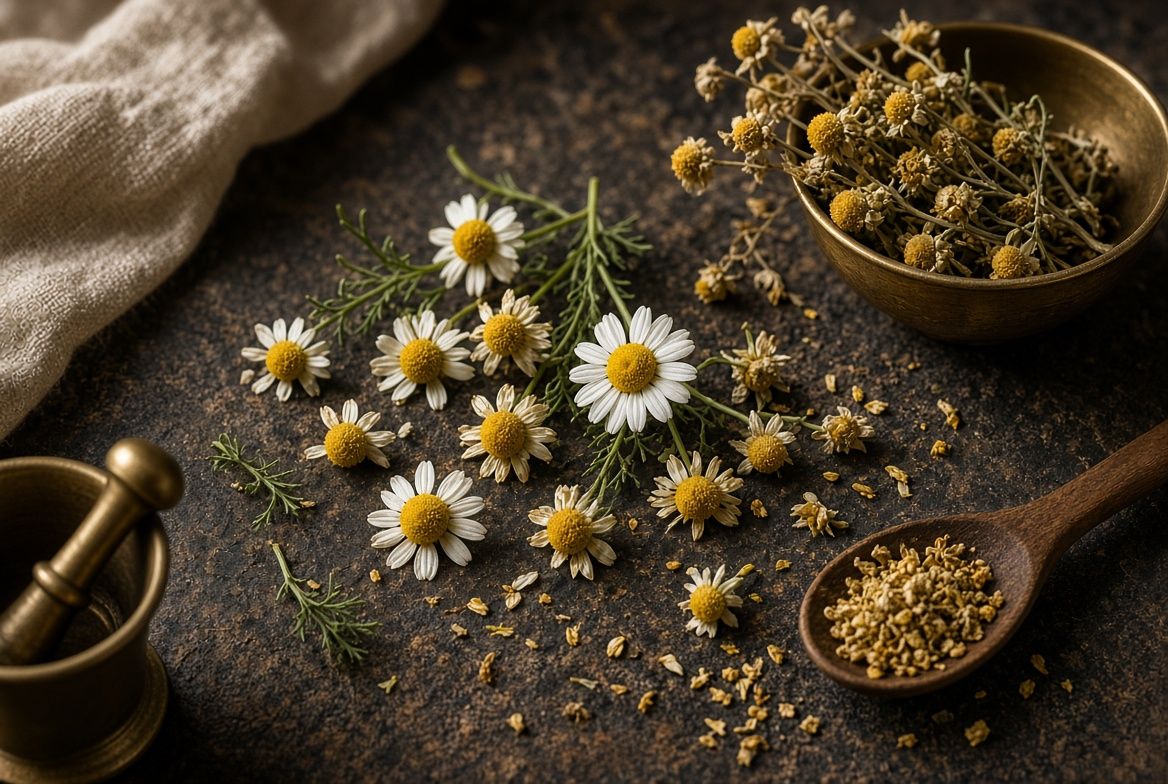
Botanical Identity & Classification
Inventory scope: Matricaria chamomilla (syn. M. recutita) and Chamaemelum nobile · Asteraceae · flower heads.
Nomenclatural check: Matricaria chamomilla L. is accepted in this treatment (family Asteraceae). A synonym listed there is Matricaria recutita L. The stated native range is Macaronesia, N. Africa, Temp. Eurasia to Indo-China (Kew, Plants of the World Online: Matricaria chamomilla L.).
Comparison taxon; not a substitute: Chamaemelum nobile (L.) All. is accepted in this treatment (family Asteraceae). A synonym listed there is Anthemis nobilis L. The stated native range is Azores, W. Europe to NW. Africa (Kew, Plants of the World Online: Chamaemelum nobile (L.) All.).
Inventory decision: The inventory does not say German or Roman. Preserve both possibilities, label every preparation by species and avoid transferring garden history or clinical findings between them.
The review identifies German chamomile as Matricaria chamomilla L. (syn. Matricaria recutita L.) and Roman chamomile as Chamaemelum nobile (L.) All.; it also names Roman chamomile as noble or English chamomile. Both species belong to the Asteraceae family (German and Roman Chamomile: Species-Specific Phytochemical Profiles, Bioactive Potential, and Relevance for Functional Foods and Nutraceutical Development).
The page lists Matricaria recutita and Chamaemelum nobile as scientific names, Roman/perennial and German/annual as the two chamomile types, and Manzanilla and Camomila as common names. It does not specify which scientific name corresponds to which type (Chamomile).
Botanical & Scientific Profile
A chamomile report needs two identities, not a single pooled description. Keep German and Roman flower heads, their preparations, and adverse-reaction reports separately indexed.
The review describes German chamomile (Matricaria chamomilla L.) flower heads as having a hollow, conical receptacle and downward-curving white ray florets, and Roman chamomile (Chamaemelum nobile (L.) All.) flower heads as having a solid, relatively flat receptacle. It characterises German chamomile by apigenin-related flavonoids, α-bisabolol and its oxides, and matricin-derived chamazulene; Roman chamomile is characterised by an essential oil rich in angelate and tiglate esters and by nobilin-related sesquiterpene lactones (German and Roman Chamomile: Species-Specific Phytochemical Profiles, Bioactive Potential, and Relevance for Functional Foods and Nutraceutical Development).
The page says Roman and German chamomile have similar therapeutic applications, though their chemical components are not entirely the same (Chamomile).
The page’s background account states that German chamomile flower oil is called “blue chamomile” because chamazulene forms during distillation; it describes distillation as difficult because of the oil’s high-boiling constituents, viscosity, and other properties (German Chamomile - Western Agricultural Research Center).
The report concerns Roman chamomile, Chamaemelum nobile (L.) All., flos (flower), and states that its long European medicinal tradition supports traditional-use registration for symptomatic treatment of mild, spasmodic gastrointestinal complaints. It documents at least 30 years of use since 1974 for dried flowerheads and a liquid extract (DER 1:1, ethanol 70% v/v); the cited posology is 1–4 g as an infusion or 1–4 ml of extract, three times daily. German chamomile (Matricaria recutita) data were excluded from the search, although the report says some activities are thought applicable to Roman chamomile because of similar chemical compositions (Assessment report on Chamaemelum nobile (L.) All., flos).
Cultural History & Traditional Herbalism
The review reports that German chamomile (Matricaria chamomilla L.) was used in ancient Greek, Roman, and Egyptian medicine and that its use has been described in Uyghur medicine since the tenth century (German and Roman Chamomile: Species-Specific Phytochemical Profiles, Bioactive Potential, and Relevance for Functional Foods and Nutraceutical Development).
The page’s background account states that German chamomile is native to Europe and has been cultivated in North America for many years as an herb or for essential oil; it gives no specific date or named historical culture (German Chamomile - Western Agricultural Research Center).
NCCIH’s fact sheet, which focuses on German chamomile but does not specify a species for this historical statement, reports that chamomile was described in ancient medical writings and was an important medicinal herb in ancient China, Egypt, Greece, and Rome (Chamomile: Usefulness and Safety).
In Aquismón, San Luis Potosí, Mexico, a 2012 study recorded traditional uses of Matricaria recutita and reported it as “the most used plant for combinations,” appearing in 5 of 19 reported herbal mixtures. A 2022 cross-sectional study (N = 9,905) reported chamomile use among 33.1% of Mexican parents who reported self-medicating their children. A 2025 ethnobotanical study in Guadalajara City identified manzanilla (Matricaria chamomilla) among the medicinal plant species most commonly used in the city’s five oldest neighborhoods (Matricaria chamomilla (syn. M. recutita, Chamomilla recutita): Traditional and Folk Use).
Tradition, Folklore & Symbolism
Kew says the cushiony feel and apple-like smell of chamomile (Chamaemelum nobile) made it popular for lawns and seats in Elizabethan times (Chamomile - Chamaemelum nobile | Plants - Kew Gardens).
Herbal Energetics
Insufficient documented evidence for a traditional energetic classification. No temperature, direction or channel is inferred from the flavor of a cup.
InfiniTea sensory metaphor: An orchard at dusk. This is original editorial language, not a measured physiological action or a translation of a traditional diagnostic category.
Sensory Profile & Tea Applications
The review describes German chamomile flower preparations as mildly herbal-floral and Roman chamomile (Chamaemelum nobile (L.) All.) as more intensely aromatic, fruity-herbal, and slightly bitter; it also describes Roman chamomile’s aroma as reminiscent of fresh apples (German and Roman Chamomile: Species-Specific Phytochemical Profiles, Bioactive Potential, and Relevance for Functional Foods and Nutraceutical Development).
The page says both Roman and German chamomile are usually used as tea (Chamomile).
Sensory notebook: Compare authenticated samples under the same cover; note apple-like aroma, herbal notes and bitterness separately. Smell is not species authentication.
Proposed comparison, not a completed trial: Set the two named flower-head samples on separate white cards. Record the label before smelling; use separate utensils rather than making a mixed “chamomile” baseline.
For ordinary dried herbal or fruit infusions, the German Federal Institute for Risk Assessment advises using boiling water and not leaving the prepared infusion standing for hours. Cooling a hot infusion and steeping untreated dry material in cold water are different processes; this report does not validate the latter (Boiling water a must for herbal teas).
Safety & Responsible Use
For chamomile, the NCCIH fact sheet says oral use in amounts commonly found in teas and other foods is likely safe. It also says allergic reactions can include severe hypersensitivity and anaphylaxis, and that reactions are more likely in people allergic to related plants such as ragweed, chrysanthemums, marigolds, or daisies. The fact sheet focuses on German chamomile (Chamomile: Usefulness and Safety).
The German-chamomile-focused NCCIH fact sheet reports interactions with warfarin and some drugs metabolized by the liver, and says there are theoretical reasons to suspect interactions with other drugs, such as sedatives. It describes oral use in amounts commonly found in teas and foods as likely safe, and certain short-term medicinal uses as possibly safe. It does not discuss concentrated extracts or eyewashes; Roman chamomile is outside the fact sheet’s stated focus (Chamomile: Usefulness and Safety).
The page says side effects are uncommon and may include nausea, dizziness, allergic reactions—including severe hypersensitivity and anaphylaxis—and eye irritation if chamomile is used near the eyes; allergy is more likely in people allergic to ragweed, chrysanthemums, marigolds, or daisies. It reports interactions with warfarin and some drugs metabolized by the liver, while interactions with other drugs such as sedatives are described as theoretically possible; preliminary studies suggest chamomile may reduce the effects of birth control pills, and it might worsen estrogen-sensitive conditions. Little is known about safety during pregnancy or breastfeeding (Chamomile: Usefulness and Safety).
Preparation and exposure boundary: This review does not establish a safe medicinal dose in pregnancy, lactation or childhood, or rule out interactions or allergy. Do not substitute essential oil or a concentrated extract for the documented food or herb.
For U.S. food use, the relevant safety determination concerns the intended conditions of use. The existence of a traditional preparation or herbal medicine monograph does not establish that this ingredient, dose and beverage are cleared for sale (Understanding How the FDA Regulates Food Additives and GRAS Ingredients).
Historical Trade, Ecology & Sustainability
In the research report’s discussion of hand harvesting German chamomile flowers, Western Agricultural Research Center plots were harvested at about 1.35 pounds of dry flowers, or 288 square feet, per hour. The report says growers should consider the labor required to harvest a field repeatedly, about every 10 days (German Chamomile - Western Agricultural Research Center).
The review states that German chamomile (Matricaria chamomilla L.) is native to southern and eastern Europe and western and central Asia, and is now cultivated and naturalised on all continents. It names Hungary, Germany, Argentina, Egypt, and Poland as major production areas (German and Roman Chamomile: Species-Specific Phytochemical Profiles, Bioactive Potential, and Relevance for Functional Foods and Nutraceutical Development).
The report states that German chamomile is well suited to the irrigated agriculture and climate of western Montana. Its background account also says the plant will reseed and may become weedy (German Chamomile - Western Agricultural Research Center).
Sourcing record: Require the flower-head grade, proportion of stem and the harvesting method; an identified garden lawn is not a source specification for medicinal flowers.
InfiniTea Herb Lore & Ritualpreliminary draft
Energetics (original InfiniTea metaphor): An orchard at dusk. Use this as a private writing image, not a health statement.
Tradition & Folklore: Kew says the cushiony feel and apple-like smell of chamomile (Chamaemelum nobile) made it popular for lawns and seats in Elizabethan times (Chamomile - Chamaemelum nobile | Plants - Kew Gardens).
Ritual Cue (original contemporary InfiniTea interpretation): Write down a sound that signals the end of the day. Let the description stand without asking it to put anyone to sleep.
Private preliminary draft; not approved for publication.
Scholarly References & Research Verification
Research limitations
Record which species and plant part each supplier and study used; do not infer tolerance of one species from prior use of the other.
Clinical efficacy is not documented to current scientific requirements; the report says the clinical research is very limited and does not propose a monograph for well-established use (Assessment report on Chamaemelum nobile (L.) All., flos).
References below identify the evidence used, not additional endorsements. A botanical authority establishes nomenclature, not the identity of a physical lot. Published study samples, traditional descriptions and InfiniTea proposals are distinguished in the text.
- Kew, Plants of the World Online: Matricaria chamomilla L. | Taxonomic backbone
- Kew, Plants of the World Online: Chamaemelum nobile (L.) All. | Taxonomic backbone
- German and Roman Chamomile: Species-Specific Phytochemical Profiles, Bioactive Potential, and Relevance for Functional Foods and Nutraceutical Development | narrative review
- Chamomile | herbal safety fact sheet
- German Chamomile - Western Agricultural Research Center | research report webpage
- Chamomile: Usefulness and Safety | health information fact sheet
- Chamomile - Chamaemelum nobile | Plants - Kew Gardens | Kew Gardens plant profile
- Assessment report on Chamaemelum nobile (L.) All., flos | Official EMA assessment report on a herbal substance and its preparations
- Matricaria chamomilla (syn. M. recutita, Chamomilla recutita): Traditional and Folk Use | HerbMedPro evidence-list page compiling summaries and citations of ethnobotanical and other human-use studies.
- Chamomile: Usefulness and Safety | The page focuses on German chamomile (listed as Matricaria recutita, Chamomilla recutita, and Matricaria chamomilla); it does not specify a plant part. Its safety statements include general use information, reported drug interactions, and preliminary findings, but it does not describe the study designs or provide preparation-specific safety results.
- Boiling water a must for herbal teas | BfR press release providing general food-safety guidance for preparing herbal and fruit infusions.
- Understanding How the FDA Regulates Food Additives and GRAS Ingredients | U.S. FDA consumer-information webpage describing food-additive and GRAS ingredient oversight.
Final Botanical Summary
A common name hides two different ingredients. Neither a garden anecdote nor an extract study establishes an insomnia treatment for an unspecified flower tea.
Editorial disposition: Lot unverified. The report is a private reference, not a clinical recommendation, approval for sale or authenticated sensory trial.
Verification Status (November 2026)
Phase II source audit, claim by claim
- Claims checked
- 16
- Corrected
- 3
- Withheld
- 0
- Sources
- 12
Material: Lot unverified. No physical sample has been examined.
Citation check: All 4 Safety & Use citations were re-read against their sources in November 2026 and confirmed.
A private research reference, not a clinical recommendation or product claim. Checked to the Grimoire's research standards →