
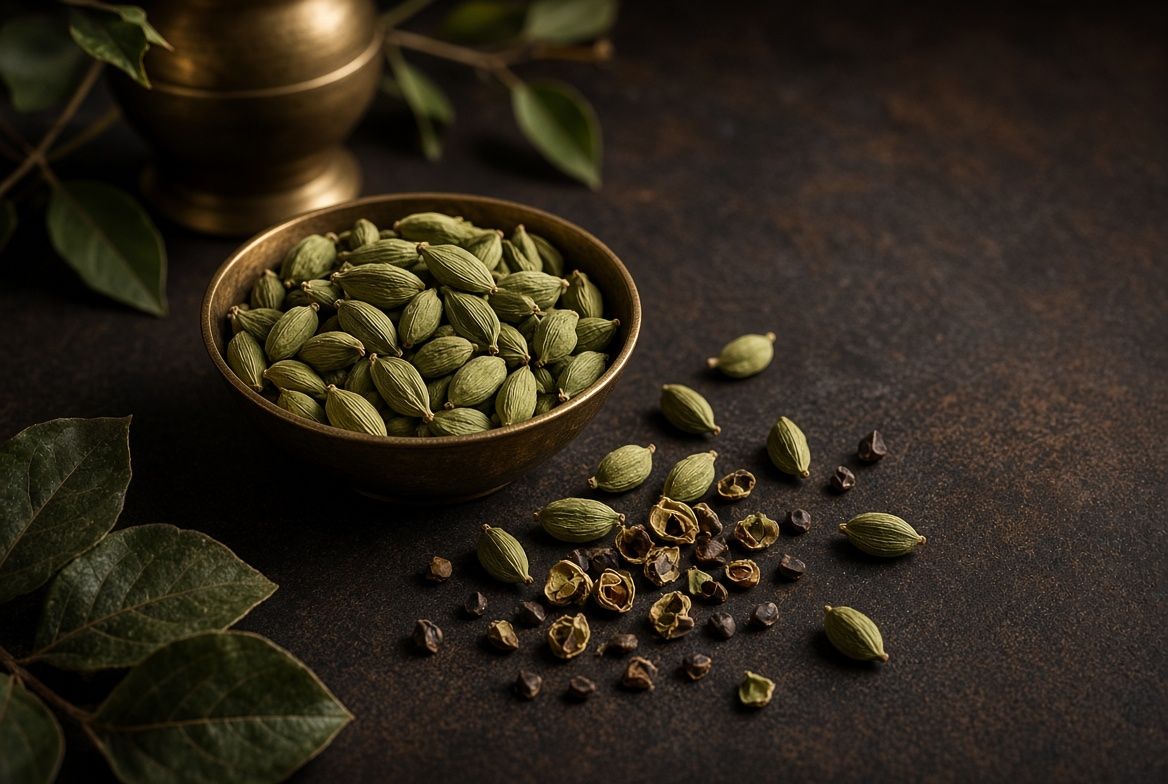
Botanical Identity & Classification
Inventory scope: Elettaria cardamomum · Zingiberaceae · capsules and enclosed seeds.
Nomenclatural check: Elettaria cardamomum (L.) Maton is accepted in this treatment (family Zingiberaceae). A synonym listed there is Amomum cardamomum L. in Sp. Pl.: 1 (1753). The stated native range is SW. India (Kew, Plants of the World Online: Elettaria cardamomum (L.) Maton).
Inventory decision: Specify green cardamom and distinguish whole capsule, decorticated seed and oil. Do not substitute black cardamom without identifying its species and processing.
Cardamom is Elettaria cardamomum (L.) Maton, in the Zingiberaceae family (Oxford University Plants 400: Elettaria cardamomum).
The study identifies green cardamom as Elettaria cardamomum (E. cardamomum), in the Zingiberaceae family, and states that its seeds are used as a spice ingredient in food (The effects of green cardamom supplementation on blood pressure and endothelium function in type 2 diabetic patients: A study protocol for a randomized controlled clinical trial).
Botanical & Scientific Profile
The green capsule and enclosed seeds need not make the same contribution to a drink. Note whether the analyzed material was whole pods, decorticated seeds or oil.
The profile states that the seed oil of Elettaria cardamomum has antibacterial properties; it provides no study details or specific human-study evidence (Oxford University Plants 400: Elettaria cardamomum).
Elettaria cardamomum is a herbaceous perennial forming clumps several metres tall, with sword-shaped leaves up to 60 cm long arranged alternately along erect pseudostems. Its flowers are produced year round on thin stems trailing along the ground. After pollination by insects and bees, three-angled pods containing aromatic seeds form (Oxford University Plants 400: Elettaria cardamomum).
The North Carolina Extension Gardener Plant Toolbox profile describes Elettaria cardamomum fruit as yellow-green, oblong capsules about ¾ inch long containing 15–20 aromatic seeds (Cardamom - Elettaria cardamomum | North Carolina Extension Gardener Plant Toolbox).
Cultural History & Traditional Herbalism
The review states that seeds of green cardamom (Elettaria cardamomum) are used to flavor sweet and savory foods and that the plant is commercially cultivated in southern India, Sri Lanka, Central America, and Southeast Asia (Cardamom: Potential Health Benefits).
The green pods of Elettaria cardamomum have been traded for over one thousand years. Arab traders introduced cardamom to the west, and Greeks and Romans used it for perfume, medicine and flavouring (Oxford University Plants 400: Elettaria cardamomum).
The plant profile states that Elettaria cardamomum has been traded for over 1,000 years, that India was the world’s largest producer until 1980, and that Guatemala is currently the largest producer (Cardamom - Elettaria cardamomum | North Carolina Extension Gardener Plant Toolbox).
The page states that cardamom fruits have been traded in India for at least 1,000 years and that historical Indian texts describe cardamom as a flavouring and medicine: the Charaka Samhita (written between the 2nd century BC and 2nd century AD) refers to it as an ingredient, while 4th-century-BC Sanskrit texts also mention it. These are textual records; the page says exports from the Malabar Coast were described by Portuguese traveller Barbosa in 1524, and that Garcia da Orta described international trade in cardamoms as well developed by 1563. It reports that Kerala continued to monopolise the trade until colonial times: the Raja’s officials bought cardamom, some was sold to Muslim merchants, and the best quality was exported; in the 19th century, British colonies established cardamom as a secondary crop in coffee plantations elsewhere in India. The page identifies the taxon as Elettaria cardamomum (L.) Maton and describes the historical commodity as cardamom, but does not specify the plant part in these trade accounts (Elettaria cardamomum (L.) Maton | Plants of the World Online | Kew Science).
Tradition, Folklore & Symbolism
Cardamom is known as the “queen of spices.” (Oxford University Plants 400: Elettaria cardamomum).
Herbal Energetics
Insufficient documented evidence for a traditional energetic classification. No temperature, direction or channel is inferred from the flavor of a cup.
InfiniTea sensory metaphor: Opening a small chamber. This is original editorial language, not a measured physiological action or a translation of a traditional diagnostic category.
Sensory Profile & Tea Applications
The profile describes cardamom as sought for its unique, unmistakable warm flavour and says its pods contain highly aromatic seeds (Oxford University Plants 400: Elettaria cardamomum).
The profile describes Elettaria cardamomum seeds as aromatic and its leaves as fragrant (Cardamom - Elettaria cardamomum | North Carolina Extension Gardener Plant Toolbox).
The study investigated hot-air convective drying of small cardamom (Elettaria cardamomum Maton) capsules at 40, 50, and 60°C, assessing aroma as essential oil yield. Essential oil yield, reported on a dry basis, increased with drying time; considering aroma and surface color together, the samples dried at 50°C were judged best. The accessible text does not report results for isolated seeds or identify individual volatile compounds (Hot air convective drying of small cardamom (Elettaria cardamomum Maton): Evaluation of drying, color, and aroma kinetics).
Sensory notebook: Smell the opened capsule and exposed seeds separately. Record citrus-like, resinous or sweet impressions only when present in the lot.
Proposed comparison, not a completed trial: Split a food-grade capsule and document the separate husk and seeds. Keep total mass and seed mass in different columns when comparing preparations.
For ordinary dried herbal or fruit infusions, the German Federal Institute for Risk Assessment advises using boiling water and not leaving the prepared infusion standing for hours. Cooling a hot infusion and steeping untreated dry material in cold water are different processes; this report does not validate the latter (Boiling water a must for herbal teas).
Safety & Responsible Use
This review discusses cardamom capsules as a culinary spice and considers the phytochemistry and biological activities of cardamom extracts and essential oil (Review Botany, traditional uses, phytochemistry and biological activities of cardamom Elettaria cardamomum (L.) Maton).
This protocol proposes testing whole green cardamom (Elettaria cardamomum) powder capsules in adult patients with type 2 diabetes; it excludes pregnancy and lactation and does not assess children or strained pod infusions. It is a study protocol, not evidence establishing safety for those populations or preparations (The effects of green cardamom supplementation on blood pressure and endothelium function in type 2 diabetic patients: A study protocol for a randomized controlled clinical trial).
The review reports that Elettaria cardamomum essential oil showed some movement toxicity in mice; it does not describe a specific human adverse event, contraindication, interaction, allergy, or pregnancy/lactation finding for this oil. The reported seizure effects and movement toxicity are animal evidence, not human observations (The Effects of Various Essential Oils on Epilepsy and Acute Seizure: A Systematic Review).
Preparation and exposure boundary: This review does not establish a safe medicinal dose in pregnancy, lactation or childhood, or rule out interactions or allergy. Do not substitute essential oil or a concentrated extract for the documented food or herb.
For U.S. food use, the relevant safety determination concerns the intended conditions of use. The existence of a traditional preparation or herbal medicine monograph does not establish that this ingredient, dose and beverage are cleared for sale (Understanding How the FDA Regulates Food Additives and GRAS Ingredients).
Historical Trade, Ecology & Sustainability
Elettaria cardamomum is described as being from Sri Lanka and the tropical rainforests of the Western Ghats along the Malabar Coast of southern India. The Cardamom Hills remain a centre of commercial cultivation, and the plant is also grown on a large scale in Guatemala and Tanzania (Oxford University Plants 400: Elettaria cardamomum).
Cardamom pods are harvested by hand before they are ripe so they do not split and lose their seeds. The profile describes cardamom as the third most valuable spice after saffron and vanilla (Oxford University Plants 400: Elettaria cardamomum).
The profile states that Elettaria cardamomum capsules are handpicked before ripening to prevent them from splitting and losing their seeds, and that fruit picking is labor-intensive (Cardamom - Elettaria cardamomum | North Carolina Extension Gardener Plant Toolbox).
Sourcing record: Request capsule versus seed, origin and postharvest drying; note what share of purchased weight is husk rather than aromatic seed.
InfiniTea Herb Lore & Ritualpreliminary draft
Energetics (original InfiniTea metaphor): Opening a small chamber. Use this as a private writing image, not a health statement.
Tradition & Folklore: Cardamom is known as the “queen of spices.” (Oxford University Plants 400: Elettaria cardamomum).
Ritual Cue (original contemporary InfiniTea interpretation): Draw a closed oval, then an open one. Put a question inside the first and one possible answer inside the second.
Private preliminary draft; not approved for publication.
Scholarly References & Research Verification
Research limitations
Ask whether oil composition was measured after a named drying treatment. Do not transfer a percentage in oil to the same percentage in tea.
References below identify the evidence used, not additional endorsements. A botanical authority establishes nomenclature, not the identity of a physical lot. Published study samples, traditional descriptions and InfiniTea proposals are distinguished in the text.
- Kew, Plants of the World Online: Elettaria cardamomum (L.) Maton | Taxonomic backbone
- Oxford University Plants 400: Elettaria cardamomum | botanical and historical plant profile
- The effects of green cardamom supplementation on blood pressure and endothelium function in type 2 diabetic patients: A study protocol for a randomized controlled clinical trial | study protocol for a randomized controlled clinical trial
- Cardamom - Elettaria cardamomum | North Carolina Extension Gardener Plant Toolbox | Horticultural plant profile
- Cardamom: Potential Health Benefits | narrative review
- Review Botany, traditional uses, phytochemistry and biological activities of cardamom Elettaria cardamomum (L.) Maton | review article
- Hot air convective drying of small cardamom (Elettaria cardamomum Maton): Evaluation of drying, color, and aroma kinetics | Laboratory study
- Elettaria cardamomum (L.) Maton | Plants of the World Online | Kew Science | Kew Plants of the World Online taxon page, including its Kew Species Profiles account of the plant’s history, trade, and cultivation.
- The Effects of Various Essential Oils on Epilepsy and Acute Seizure: A Systematic Review | A systematic review of primary research published in English from 1900 to 2017, including animal models, in vitro studies, and human case reports. The review states that no clinical trials of essential oils as antiepileptic drugs had been conducted; its Elettaria cardamomum evidence is an animal study of the essential oil in mice.
- Boiling water a must for herbal teas | BfR press release providing general food-safety guidance for preparing herbal and fruit infusions.
- Understanding How the FDA Regulates Food Additives and GRAS Ingredients | U.S. FDA consumer-information webpage describing food-additive and GRAS ingredient oversight.
Final Botanical Summary
Processing and the proportion of husk to seed change what a blender actually receives. A capsule of spice is not a capsule of extract.
Editorial disposition: Lot unverified. The report is a private reference, not a clinical recommendation, approval for sale or authenticated sensory trial.
Verification Status (November 2026)
Phase II source audit, claim by claim
- Claims checked
- 16
- Corrected
- 3
- Withheld
- 0
- Sources
- 11
Material: Lot unverified. No physical sample has been examined.
Citation check: All 4 Safety & Use citations were re-read against their sources in November 2026 and confirmed.
A private research reference, not a clinical recommendation or product claim. Checked to the Grimoire's research standards →