
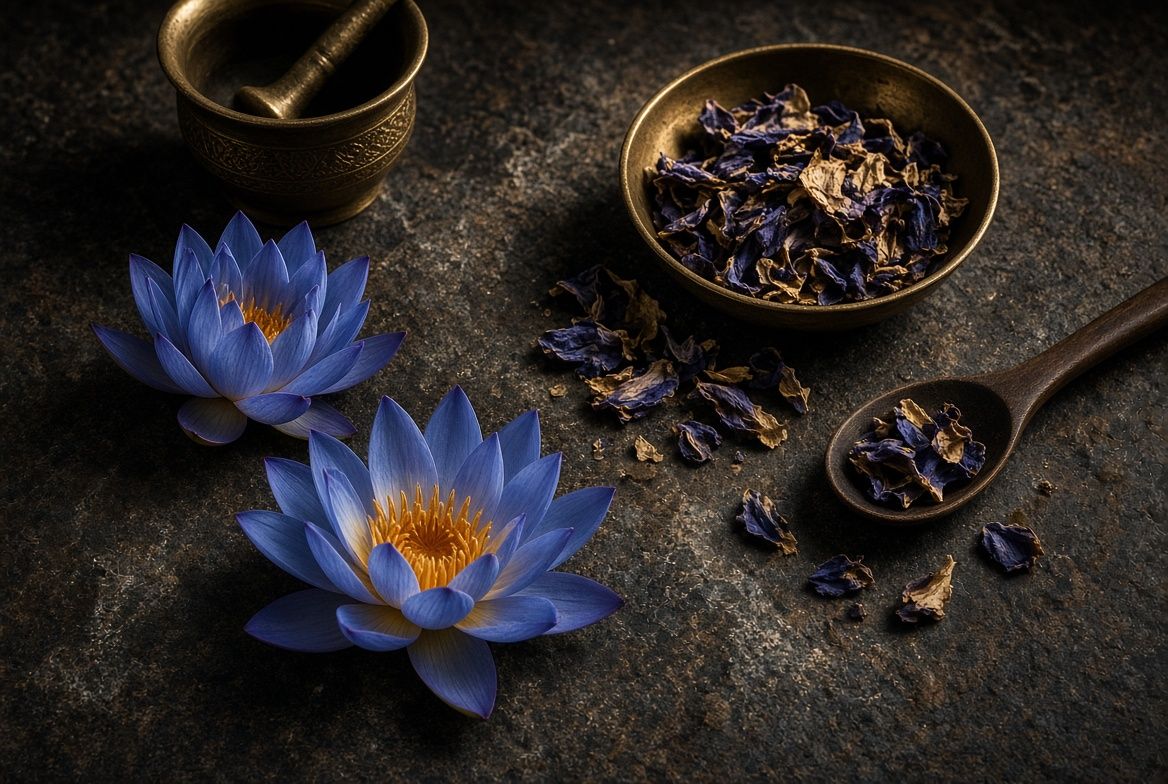
Botanical Identity & Classification
Inventory scope: Nymphaea caerulea (also treated below species rank within N. nouchali) · Nymphaeaceae · flower name provisional.
Nomenclatural check: Nymphaea caerulea Savigny is treated as a synonym of Nymphaea nouchali var. caerulea (Kew, Plants of the World Online: Nymphaea caerulea Savigny).
Inventory decision: Historical Egyptian water-lily imagery, a modern dried-flower listing and an extract sold for psychoactive use are different evidence. No tasting, inhalation, dosing or product-development recommendation.
Blue lotus (Nymphaea caerulea), also called blue water lily and blue Egyptian water lily, is an aquatic plant with petals usually pale bluish white to sky-blue or mauve (Blue lotus: Serenity in every petal, but is it safe?).
The Missouri Botanical Garden account for Nymphaea caerulea describes its flowers, petals, leaves, and rhizomes, and notes that Nelumbo nucifera, the Indian sacred lotus, is also sometimes called blue lotus (Nymphaea caerulea - Plant Finder - Missouri Botanical Garden).
Botanical & Scientific Profile
Keep an Egyptian water-lily motif, an authenticated botanical sample and a retail extract as three different objects. None independently establishes what a person consumed in antiquity or what is in a modern product.
Nymphaea caerulea has day-blooming, star-shaped flowers 4–6 inches across, with upright, pointed, light-blue petals spread flat on the water surface; each leaf connects to the plant rhizomes by a long petiole (Nymphaea caerulea - Plant Finder - Missouri Botanical Garden).
Six authentic extracts—concretes and absolutes produced using industrial extraction methods from cultivated blue lotus flowers collected in Hainan and Guangdong, China—were analyzed alongside 11 commercial products using GC-MS. The authentic concretes and absolutes contained no apomorphine and only negligible traces of nuciferine (10–72 ppb); the authors report that nuciferine and apomorphine were virtually absent from the authentic extracts. All 11 tested commercial products contained synthetic fragrance components, and none resembled the authentic extracts in aroma or composition (Chemical Composition, Market Survey, and Safety Assessment of Blue Lotus (Nymphaea caerulea Savigny) Extracts).
The negative result for one analyte in a defined set of floral extracts and reports of adverse effects from market products are not mutually exclusive. The material, extraction method and authentication differ.
Cultural History & Traditional Herbalism
The account says blue lotus (Nymphaea caerulea) has historically been used in Egypt as a stimulant, aphrodisiac, sexual enhancer, and remedy against general illness, and that perfumes and oils were created from it (Nymphaea caerulea - Plant Finder - Missouri Botanical Garden).
The article says ancient Egyptians used blue lotus (Nymphaea caerulea) in perfumes and religious and ceremonial rituals, as an aphrodisiac, and soaked in wine to induce intoxication (Blue lotus: Serenity in every petal, but is it safe?).
The Metropolitan Museum of Art identifies the depicted blue Egyptian water lily as Nymphaea coerulea and describes it as rising from the Nile at Aboukir Bay. The record documents an 1804 aquatint and stipple engraving printed in color and hand-colored, engraved by Joseph Constantine Stadler after Peter Charles Henderson; it documents the artwork’s depiction, not ancient Egyptian practice (The Blue Egyptian Water Lily, from "The Temple of Flora, or Garden of Nature").
Tradition, Folklore & Symbolism
The Metropolitan Museum of Art identifies the Middle Kingdom object as a model lotus flower and describes the blue or white water lily (Nymphaea coerulea and Nymphaea alba) flower as closing at night and reopening in the morning with a central yellow circle. The museum says ancient Egyptians saw this phenomenon as reflecting the sun’s rise at the dawn of creation (Model Lotus Flower).
According to the account, ancient Egyptians believed the world was originally covered by water and darkness, then a large blue lotus appeared and opened, bringing light; the solar deities Atum and Ra were said to come from its center (Nymphaea caerulea - Plant Finder - Missouri Botanical Garden).
Herbal Energetics
Insufficient documented evidence for a traditional energetic classification. No temperature, direction or channel is inferred from the flavor of a cup.
InfiniTea sensory metaphor: Daybreak on water. This is original editorial language, not a measured physiological action or a translation of a traditional diagnostic category.
Sensory Profile & Tea Applications
The article describes blue lotus (Nymphaea caerulea) petals as usually pale bluish white to sky-blue or mauve and says the plant was used in ancient Egypt in perfumes; it does not specify an aroma or taste (Blue lotus: Serenity in every petal, but is it safe?).
Sensory notebook: Keep this a visual study. Compare the form of a documented water lily with an identified sacred lotus; a modern package illustration cannot establish contents.
Proposed comparison, not a completed trial: Look at the arrangement of petals on a documented object and read its museum label. Describe what is visible before proposing an interpretation, and mark the latter as contemporary.
Safety & Responsible Use
This case series describes five active-duty patients who presented to the emergency department with altered mental status after using products described as blue lotus (Nymphaea caerulea): four after vaping and one after making an infused beverage (Toxicity From Blue Lotus (Nymphaea caerulea) After Ingestion or Inhalation: A Case Series).
Poison Control says high doses of blue lotus (Nymphaea caerulea) can cause drowsiness, confusion, and other symptoms; products may contain other plant species or contaminants, and combining it with alcohol or other sedating substances can cause excess sedation. It advises against giving blue lotus to children or using it during pregnancy or breastfeeding (Blue lotus: Serenity in every petal, but is it safe?).
Poison Control says products marketed as blue lotus (Nymphaea caerulea) may contain other plant species or contaminants, and describes use as tea, smoking, or vaping; it does not recommend avoiding all home preparation, tasting, or psychoactive use (Blue lotus: Serenity in every petal, but is it safe?).
In the article’s human vignette, a 29-year-old man who vaped blue lotus became agitated, possibly hallucinated, and had decreased responsiveness and marked drowsiness; his symptoms resolved during four hours of observation. The article says high doses can cause dizziness, drowsiness, confusion, agitation, nausea, fast heartbeat, euphoria, hallucinations, impaired concentration, or balance problems; excess sedation may occur with alcohol, painkillers, or anxiety medicines. It says interactions with drugs affecting dopamine or serotonin, or metabolized by the same liver enzymes, are possible; people with liver disease should probably avoid it, and it should not be given to children or used during pregnancy or breastfeeding because safety in these groups has not been studied; allergies are not discussed (Blue lotus: Serenity in every petal, but is it safe?).
Preparation and exposure boundary: This review does not establish a safe medicinal dose in pregnancy, lactation or childhood, or rule out interactions or allergy. Do not substitute essential oil or a concentrated extract for the documented food or herb.
For U.S. food use, the relevant safety determination concerns the intended conditions of use. The existence of a traditional preparation or herbal medicine monograph does not establish that this ingredient, dose and beverage are cleared for sale (Understanding How the FDA Regulates Food Additives and GRAS Ingredients).
Historical Trade, Ecology & Sustainability
Nymphaea caerulea is native to northern and central Africa (Nymphaea caerulea - Plant Finder - Missouri Botanical Garden).
Blue lotus (Nymphaea caerulea) is an aquatic plant found in lakes, pools, and rivers in the Nile River area and eastern Africa (Blue lotus: Serenity in every petal, but is it safe?).
The article describes blue lotus (Nymphaea caerulea) as an aquatic plant that mostly grows in Egypt and certain parts of Asia (Blue Lotus: Prohibited for Use).
Sourcing record: Do not prioritize sourcing for ingestion. If acquiring a study specimen, request botanical documentation and a chain of custody separate from any vaping or extract product.
InfiniTea Herb Lore & Ritualpreliminary draft
Energetics (original InfiniTea metaphor): Daybreak on water. Use this as a private writing image, not a health statement.
Tradition & Folklore: The Metropolitan Museum of Art identifies the Middle Kingdom object as a model lotus flower and describes the blue or white water lily (Nymphaea coerulea and Nymphaea alba) flower as closing at night and reopening in the morning with a central yellow circle. The museum says ancient Egyptians saw this phenomenon as reflecting the sun’s rise at the dawn of creation (Model Lotus Flower).
Ritual Cue (original contemporary InfiniTea interpretation): Sketch a flower opening toward light. Attribute the sketch to your notebook, not to an Egyptian rite.
Private preliminary draft; not approved for publication.
Scholarly References & Research Verification
Research limitations
No tasting or inhalation. Modern products, alkaloid findings and intoxication cases require composition-specific interpretation; museum imagery cannot authenticate them.
The record provides no evidence about ancient Egyptian uses of the plant or archaeological remains (The Blue Egyptian Water Lily, from "The Temple of Flora, or Garden of Nature"). The safety assessment was based on available literature, which the authors described as limited; they found no published safety data for the plant or its extracts as a whole. The article notes that nonvolatile or unidentified compounds in concrete and absolute may not have been detected or evaluated, so their safety could not be guaranteed; its conclusion of no major safety concerns applies to topical use of authentic concrete or absolute when diluted as a fragrance ingredient (Chemical Composition, Market Survey, and Safety Assessment of Blue Lotus (Nymphaea caerulea Savigny) Extracts).
References below identify the evidence used, not additional endorsements. A botanical authority establishes nomenclature, not the identity of a physical lot. Published study samples, traditional descriptions and InfiniTea proposals are distinguished in the text.
- Kew, Plants of the World Online: Nymphaea caerulea Savigny | Taxonomic backbone
- Blue lotus: Serenity in every petal, but is it safe? | Poison Control toxicology and safety article
- Nymphaea caerulea - Plant Finder - Missouri Botanical Garden | botanical garden plant profile
- Model Lotus Flower | museum collection object page
- Toxicity From Blue Lotus (Nymphaea caerulea) After Ingestion or Inhalation: A Case Series | case series (case report)
- Blue Lotus: Prohibited for Use | OPSS informational article
- The Blue Egyptian Water Lily, from "The Temple of Flora, or Garden of Nature" | Museum collection record for a print dated September 11, 1804
- Chemical Composition, Market Survey, and Safety Assessment of Blue Lotus (Nymphaea caerulea Savigny) Extracts | Peer-reviewed analytical and safety-assessment study of industrially produced authentic Nymphaea caerulea floral extracts and commercially available blue lotus products.
- Understanding How the FDA Regulates Food Additives and GRAS Ingredients | U.S. FDA consumer-information webpage describing food-additive and GRAS ingredient oversight.
Final Botanical Summary
Art history supports a cultural account, not the identity, composition or safety of a present-day product labeled blue lotus.
Editorial disposition: Identity hold. The report is a private reference, not a clinical recommendation, approval for sale or authenticated sensory trial.
Verification Status (November 2026)
Phase II source audit, claim by claim
- Claims checked
- 18
- Corrected
- 2
- Withheld
- 4
- Sources
- 9
Identity hold: the species, plant part or market name still needs confirming before any product decision. See Identity and the research limitations.
Citation check: All 5 Safety & Use citations were re-read against their sources in November 2026 and confirmed.
A private research reference, not a clinical recommendation or product claim. Checked to the Grimoire's research standards →