
Botanical Identity & Classification
Inventory scope: Centaurea cyanus · Asteraceae · colored marginal florets.
Nomenclatural check: Centaurea cyanus L. is accepted in this treatment (family Asteraceae). A synonym listed there is Centaurea segetalis Salisb. The stated native range is Central & E. Medit (Kew, Plants of the World Online: Centaurea cyanus L.).
Inventory decision: Verify food-grade edible-flower production; ornamental cut flowers are not a food source. Treat the colored florets as a visual ingredient unless there is evidence for a particular beverage effect.
The account identifies the species as Centaurea cyanus L., commonly called Cornflower, and discusses its achenes as those of a member of the Asteraceae (Centaurea cyanus L., Cornflower - Fermanagh Species Accounts).
The plant profile identifies cornflower as Centaurea cyanus in the Asteraceae family and lists Bachelor's Button, Bachelors Buttons, and Bluebottle as other common names (Cornflower - Centaurea cyanus).
Botanical & Scientific Profile
The colored marginal florets should not stand for the whole flowering shoot or every “blue” tea decoration. Historical pigment use and modern edible-flower composition are separate subjects.
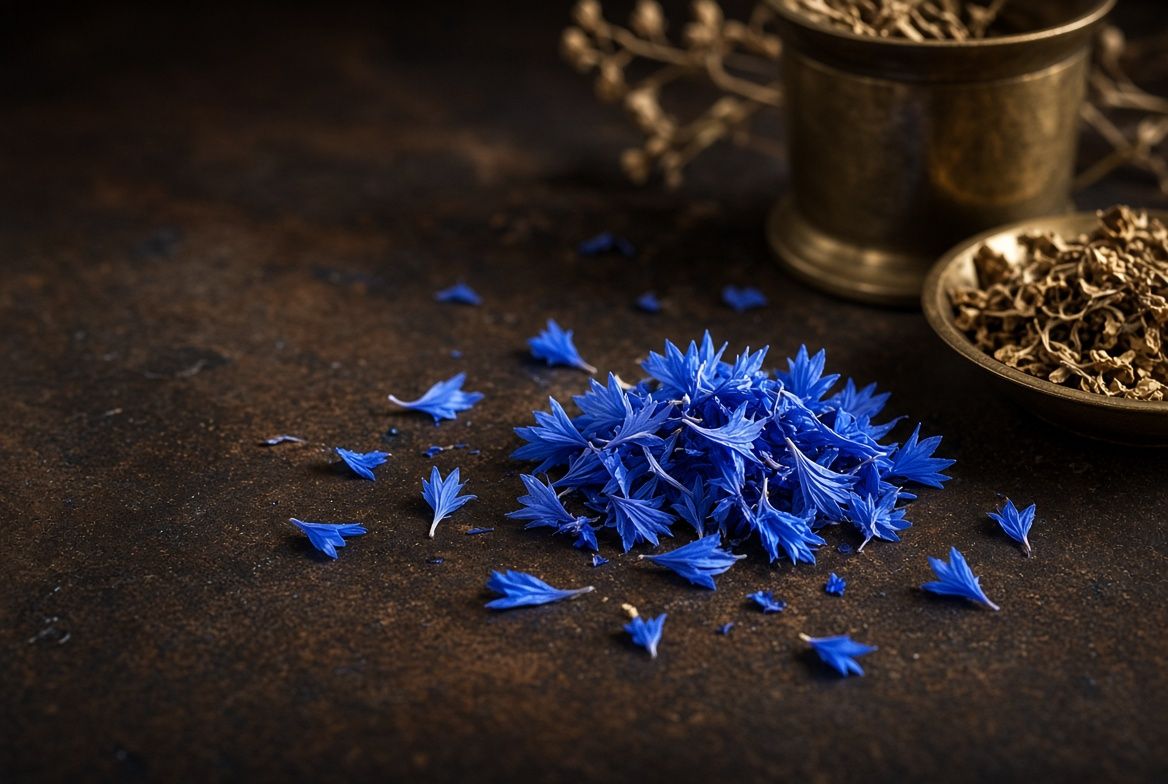
The account describes Centaurea cyanus flower-heads as having deep-violet or reddish-purple central florets and bright-blue marginal florets; it provides no chemical analysis of the petals or human-study findings (Centaurea cyanus L., Cornflower - Fermanagh Species Accounts).
For Centaurea cyanus, the profile describes flower heads approximately 1.5 inches in diameter, with a few large, spreading ray florets around a central cluster of disc florets; listed flower colors are blue, pink, and white (Cornflower - Centaurea cyanus).
For cornflower (Centaurea cyanus), the review reports research finding succinic acid to be the most abundant organic acid (2.55 g/100 g) and total tocopherols to be 1.30 mg/100 g on a dry basis, stated as 6.73% of the recommended daily intake. A separate study of cornflower phenolic compounds identified 12 flavonoids and 4 anthocyanins (Lesser-Explored Edible Flowers as a Choice of Phytochemical Sources for Food Applications).
Cultural History & Traditional Herbalism
The account says Centaurea cyanus flowers were used in herbal medicine as a tonic or stimulant and an emmenagogue, and that water distilled from the petals was formerly used as an eyewash for weak eyes (Centaurea cyanus L., Cornflower - Fermanagh Species Accounts).
The account says expressed juice from Centaurea cyanus petals apparently made blue ink and that, mixed with alum-water, it was used to make delicate blue paint for water-colour artists. It also reports, citing Grieve (1931), that dried petals were used by perfumers to add colour to pot-pourri (Centaurea cyanus L., Cornflower - Fermanagh Species Accounts).
The profile tags Centaurea cyanus as a dye plant but does not describe dye-making or its use. It also reports that Corning Glass Works featured a blue cornflower in its initial oven-to-table ware line, which became a trademark of Corning consumer products for three decades; the profile describes this as product branding, not dye use (Cornflower - Centaurea cyanus).
Tradition, Folklore & Symbolism
The article identifies the cornflower (Centeaurea cyanus) as France’s flower of remembrance and reports that Suzanne Lenhardt and Charlotte Malleterre organised Le Bleuet de France workshops where injured servicemen made tissue-paper cornflowers to sell for income. It dates the sale of bleuet remembrance badges to 1916, but does not explicitly date the workshops to that year. The article says bleuets are worn by service men and women at remembrance events and are synonymous with wartime loss and veterans’ solidarity (Bleuets for remembrance in France).
The account traces the genus name Centaurea to forms used by Pliny and to the Greek kentauros, and associates the name with the mythical centaur Chiron, who was believed to know herbal medicine (Centaurea cyanus L., Cornflower - Fermanagh Species Accounts).
Herbal Energetics
Insufficient documented evidence for a traditional energetic classification. No temperature, direction or channel is inferred from the flavor of a cup.
InfiniTea sensory metaphor: A visible detail. This is original editorial language, not a measured physiological action or a translation of a traditional diagnostic category.
Sensory Profile & Tea Applications
The Centaurea cyanus profile identifies the flowers as edible but provides no taste, aroma, or food or drink preparation details (Cornflower - Centaurea cyanus).
The account states that Centaurea cyanus flowers have no perfume (Centaurea cyanus L., Cornflower - Fermanagh Species Accounts).
Sensory notebook: Compare the dry blue florets with the color of the strained liquid. A beautiful dry blend is not necessarily a blue drink.
Proposed comparison, not a completed trial: Place a few verified food-grade florets against a white background and document any color released into water. Do not assume a blue petal must produce a blue drink.
For ordinary dried herbal or fruit infusions, the German Federal Institute for Risk Assessment advises using boiling water and not leaving the prepared infusion standing for hours. Cooling a hot infusion and steeping untreated dry material in cold water are different processes; this report does not validate the latter (Boiling water a must for herbal teas).
Safety & Responsible Use
For edible flowers, Colorado State University Extension advises positive plant identification and recommends introducing new flowers into the diet slowly to help identify allergic reactions, stomach upset, or other sensitivities (Edible Flowers).
The page says to use correctly identified flowers grown without pesticides, avoid flowers from florists, garden centers, or nurseries, and introduce flowers gradually because allergic reactions or stomach upset may occur; it does not report specific human cases. It cautions that people with ragweed allergies may be allergic to English chamomile (Anthemis nobilis) and advises limiting chamomile tea; it also says mustard flowers warrant attention to allergies. The page says daylily (Hemerocallis fulva) may act as a diuretic or laxative and should be eaten in moderation, and warns that many other lilies contain alkaloids and are not edible (Edible Flowers).
Preparation and exposure boundary: This review does not establish a safe medicinal dose in pregnancy, lactation or childhood, or rule out interactions or allergy. Do not substitute essential oil or a concentrated extract for the documented food or herb.
For U.S. food use, the relevant safety determination concerns the intended conditions of use. The existence of a traditional preparation or herbal medicine monograph does not establish that this ingredient, dose and beverage are cleared for sale (Understanding How the FDA Regulates Food Additives and GRAS Ingredients).
Historical Trade, Ecology & Sustainability
The account describes Centaurea cyanus as formerly a widespread arable weed, particularly associated with cereal fields on light-textured, sandy, moderately acidic soils. It says Cornflower was more prevalent in northern Ireland, where it was associated with flax cultivation, and that flax cultivation began to decline during the second decade of the 20th century as cheaper flax imports arrived (Centaurea cyanus L., Cornflower - Fermanagh Species Accounts).
The profile states that birds and butterflies use Centaurea cyanus flowers and fruit as a food source (Cornflower - Centaurea cyanus).
The account regards Centaurea cyanus as an ancient introduction and describes it as a rare casual and locally extinct in Fermanagh. It says the species is frequently included in wildflower seed mixtures; it does not state that its flowers themselves are included in the mixtures (Centaurea cyanus L., Cornflower - Fermanagh Species Accounts).
Sourcing record: Request cultivated food-grade florets, not material cut from cereal fields or florists, and keep agricultural and remembrance histories distinct.
InfiniTea Herb Lore & Ritualpreliminary draft
Energetics (original InfiniTea metaphor): A visible detail. Use this as a private writing image, not a health statement.
Tradition & Folklore: The article identifies the cornflower (Centeaurea cyanus) as France’s flower of remembrance and reports that Suzanne Lenhardt and Charlotte Malleterre organised Le Bleuet de France workshops where injured servicemen made tissue-paper cornflowers to sell for income. It dates the sale of bleuet remembrance badges to 1916, but does not explicitly date the workshops to that year. The article says bleuets are worn by service men and women at remembrance events and are synonymous with wartime loss and veterans’ solidarity (Bleuets for remembrance in France).
Ritual Cue (original contemporary InfiniTea interpretation): Draw one blue mark in a field of pencil lines. Write what your eye found first and what it missed.
Private preliminary draft; not approved for publication.
Scholarly References & Research Verification
Research limitations
Check food-use cultivation and exact part. No generic floristry, textile-dye or ornamental source establishes food safety.
References below identify the evidence used, not additional endorsements. A botanical authority establishes nomenclature, not the identity of a physical lot. Published study samples, traditional descriptions and InfiniTea proposals are distinguished in the text.
- Kew, Plants of the World Online: Centaurea cyanus L. | Taxonomic backbone
- Centaurea cyanus L., Cornflower - Fermanagh Species Accounts | botanical species account
- Cornflower - Centaurea cyanus | horticultural plant profile
- Lesser-Explored Edible Flowers as a Choice of Phytochemical Sources for Food Applications | review article
- Bleuets for remembrance in France | news article
- Edible Flowers | peer-reviewed university Extension publication
- Boiling water a must for herbal teas | BfR press release providing general food-safety guidance for preparing herbal and fruit infusions.
- Understanding How the FDA Regulates Food Additives and GRAS Ingredients | U.S. FDA consumer-information webpage describing food-additive and GRAS ingredient oversight.
Final Botanical Summary
Cornflower is a case where dry appearance, beverage color, historical symbolism and clinical evidence must not be allowed to stand in for each other.
Editorial disposition: Lot unverified. The report is a private reference, not a clinical recommendation, approval for sale or authenticated sensory trial.
Verification Status (November 2026)
Phase II source audit, claim by claim
- Claims checked
- 16
- Corrected
- 2
- Withheld
- 1
- Sources
- 8
Material: Lot unverified. No physical sample has been examined.
Citation check: All 3 Safety & Use citations were re-read against their sources in November 2026 and confirmed.
A private research reference, not a clinical recommendation or product claim. Checked to the Grimoire's research standards →