
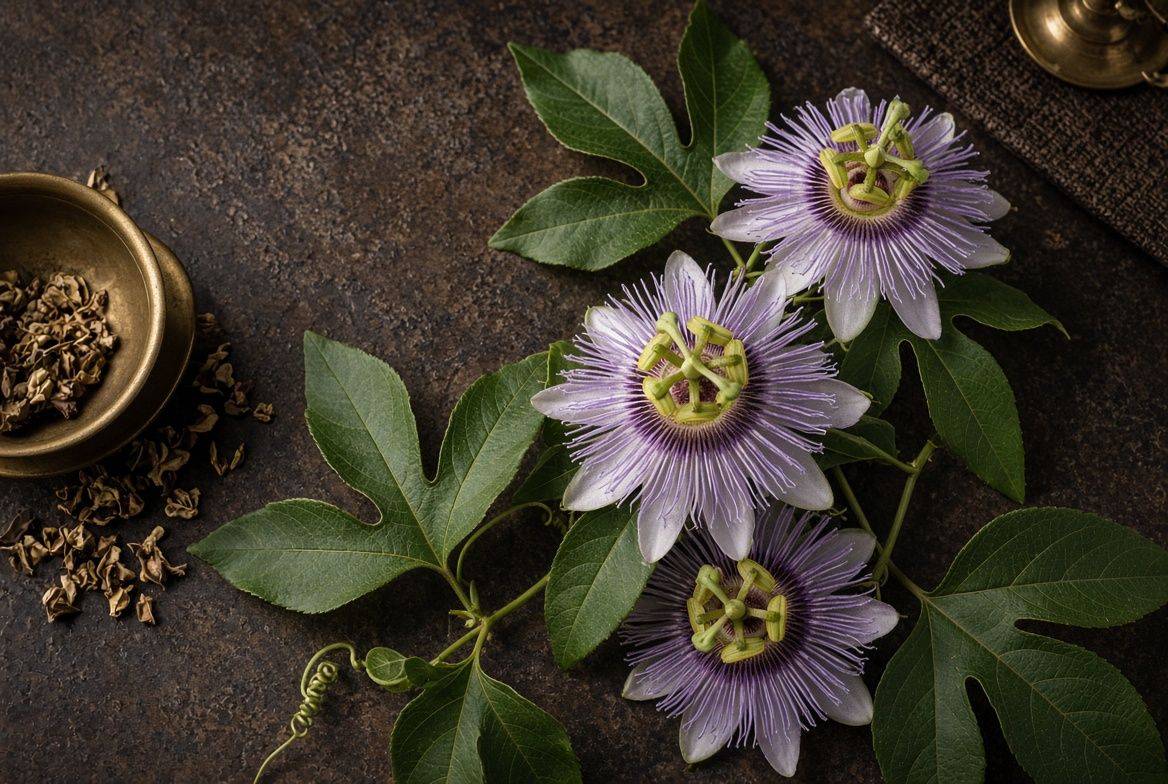
Botanical Identity & Classification
Inventory scope: Passiflora incarnata · Passifloraceae · aerial herb, provisional.
Nomenclatural check: Passiflora incarnata L. is accepted in this treatment (family Passifloraceae). A synonym listed there is Granadilla incarnata (L.) Medik. The stated native range is Central & E. U.S.A., Bermuda (Kew, Plants of the World Online: Passiflora incarnata L.).
Inventory decision: Do not equate passionfruit flavor, ornamental Passiflora flowers and medicinal P. incarnata aerial material. Confirm species and part before considering a blend or a clinical citation.
The page identifies Passiflora incarnata as Maypop and says it was cultivated by the Powhatan people in Virginia (Passionflower: Christian Curiosity, Exotic Vine, Tropical Fruit).
The NC State plant profile classifies Passiflora incarnata in the family Passifloraceae (Passiflora incarnata - Plant Toolbox - NC State University).
Botanical & Scientific Profile
The inventory concerns aerial herb of an identified passionflower. A documented use of maypop fruit does not establish a tradition of brewing its leaves, nor is a tropical passionfruit juice a proxy for the medicinal preparation.
A double-blind, placebo-controlled study in 41 healthy volunteers aged 18–35 compared tea made by steeping 2 g of dried Passiflora incarnata L. leaves, stems, seeds and flowers in 250 ml boiling water for 10 minutes with parsley tea. Only subjective sleep quality was significantly better with Passiflora tea, with a 5.2% mean increase relative to placebo; measured polysomnography parameters showed no significant changes. The report notes the study’s small sample and that participants with sleep disorders were excluded. It also identifies limitations in other clinical studies, including small samples, unclear preparations and absence of placebo groups (Assessment report on Passiflora incarnata L., herba).
The NC State plant profile describes Passiflora incarnata as having three-lobed leaves and white flowers with a central crown of pinkish-purple filaments; it reports that the flowers bloom from May to July (Passiflora incarnata - Plant Toolbox - NC State University).
Passiflora incarnata L. herba is specified to contain at least 1.5% total flavonoids, expressed as vitexin. Its flavonoids include mainly C-glycosides of apigenin and luteolin. The proposed trisubstituted benzoflavone derivative was not found in plant materials from India and France and was detected only in trace amounts in Italian material (Assessment report on Passiflora incarnata L., herba).
Cultural History & Traditional Herbalism
Archaeological research suggests human consumption of Passiflora incarnata in what is now the southeastern United States as early as the Late Archaic period, around 1000 BCE (Passionflower: Christian Curiosity, Exotic Vine, Tropical Fruit).
The NC State plant profile reports that Native Americans used Passiflora incarnata medicinally: they applied root poultices for boils, cuts, bruises, earaches, and inflammation, and cooked it in teas used to soothe nerves (Passiflora incarnata - Plant Toolbox - NC State University).
Use of Passiflora incarnata L. herba in the European Community to relieve mild symptoms of mental stress and aid sleep is documented in recognized handbooks dating, for example, from 1938, 1958, 1977 and 2003 (Assessment report on Passiflora incarnata L., herba).
The article identifies the plant as Passiflora incarnata and reports direct archaeological evidence of its seeds among artifacts at sites including the 17th-century Creek town of Fusihatchee in Alabama and several Apalachee sites in north Florida. It says archaeological evidence places human use in North America as early as the Late Archaic period (3,500–800 BCE), and reports seeds from sites spanning later periods in Alabama, Tennessee, Georgia, Louisiana, Mississippi, North and South Carolina, and Virginia. Separately, it says William Strachey documented Algonkian food use of wild passionflower fruits, called “maracock,” in coastal Virginia in his manuscript about Virginia, written by an English writer who served as the colony’s first secretary in 1610 (Passionflower).
Tradition, Folklore & Symbolism
The NC State plant profile says the name Passiflora relates to the crucifixion of Jesus Christ and that, in the 15th to 16th century, Roman Catholic priests in Latin America used parts of the flower to symbolize the Passion of Christ (Passiflora incarnata - Plant Toolbox - NC State University).
Herbal Energetics
Insufficient documented evidence for a traditional energetic classification. No temperature, direction or channel is inferred from the flavor of a cup.
InfiniTea sensory metaphor: Looking closely. This is original editorial language, not a measured physiological action or a translation of a traditional diagnostic category.
Sensory Profile & Tea Applications
The report describes comminuted Passiflora incarnata L. herba as a herbal tea for oral use. In a sleep-quality study, 2 g of dried leaves, stems, seeds and flowers were steeped in 250 ml boiling water for 10 minutes (Assessment report on Passiflora incarnata L., herba).
The page reports that Captain John Smith recorded Powhatan-grown Maracocks, in a passage about Passiflora incarnata, as a wild fruit “like a lemmon”; it also describes passionflower fruit as tart and bright, with a citrus-adjacent flavor (Passionflower: Christian Curiosity, Exotic Vine, Tropical Fruit).
Sensory notebook: Sketch the unusual floral structure from a labeled reference image; it need not resemble the dried aerial herb actually purchased.
Proposed comparison, not a completed trial: Arrange a labeled photograph of the fruit beside the herb specimen to keep the distinction visible. Do not brew an unidentified ornamental vine.
For ordinary dried herbal or fruit infusions, the German Federal Institute for Risk Assessment advises using boiling water and not leaving the prepared infusion standing for hours. Cooling a hot infusion and steeping untreated dry material in cold water are different processes; this report does not validate the latter (Boiling water a must for herbal teas).
Safety & Responsible Use
NCCIH says passionflower may cause drowsiness, dizziness, and confusion; it should not be used during pregnancy because it may induce uterine contractions and possibly cause other problems. Little is known about its safety during breastfeeding (Passionflower: Usefulness and Safety | NCCIH).
Passionflower taken with anesthesia or other medicines used before or after surgery might slow the nervous system too much. NCCIH advises talking with a health care provider if using it within 2 weeks of scheduled surgery (Passionflower: Usefulness and Safety | NCCIH).
The EMA/HMPC summary concerns preparations of the aerial parts of Passiflora incarnata L., including crushed or powdered dried parts and dry or liquid extracts. Based on traditional use, these preparations may be used to relieve mild symptoms of nervous tension and help with sleep; the stated traditional-use basis includes at least 30 years of safe use, including 15 years in the EU. No adverse effects had been reported at the time of the HMPC assessment (Pasiflora, partes aéreas de — Resumen para el público general).
NCCIH says passionflower should not be used during pregnancy because it may induce uterine contractions and possibly lead to other problems; little is known about safety during breastfeeding. Passionflower may interact with anesthesia or other medicines used before and after surgery, potentially slowing the nervous system too much; possible side effects include drowsiness, dizziness, and confusion. The page does not identify a specific plant part or provide human pregnancy or lactation study findings (Passionflower: Usefulness and Safety | NCCIH).
Preparation and exposure boundary: This review does not establish a safe medicinal dose in pregnancy, lactation or childhood, or rule out interactions or allergy. Do not substitute essential oil or a concentrated extract for the documented food or herb.
For U.S. food use, the relevant safety determination concerns the intended conditions of use. The existence of a traditional preparation or herbal medicine monograph does not establish that this ingredient, dose and beverage are cleared for sale (Understanding How the FDA Regulates Food Additives and GRAS Ingredients).
Historical Trade, Ecology & Sustainability
The NC State plant profile gives Passiflora incarnata’s origin as Central and Eastern U.S.A. and Bermuda, and lists its distribution as AL, AR, DC, DE, FL, GA, IL, IN, KS, KY, LA, MD, MO, MS, NC, OH, OK, PA, SC, TN, TX, VA, and WV (Passiflora incarnata - Plant Toolbox - NC State University).
The passionflower vine, Passiflora incarnata, is native to the southeastern United States and Central and South America (Passionflower: Usefulness and Safety | NCCIH).
Sourcing record: Obtain species, aerial-part composition and growing origin. Keep ornamental propagation material out of the food chain.
InfiniTea Herb Lore & Ritualpreliminary draft
Energetics (original InfiniTea metaphor): Looking closely. Use this as a private writing image, not a health statement.
Tradition & Folklore: The NC State plant profile says the name Passiflora relates to the crucifixion of Jesus Christ and that, in the 15th to 16th century, Roman Catholic priests in Latin America used parts of the flower to symbolize the Passion of Christ (Passiflora incarnata - Plant Toolbox - NC State University).
Ritual Cue (original contemporary InfiniTea interpretation): Draw something intricate in three lines. Name what disappeared in the simplification.
Private preliminary draft; not approved for publication.
Scholarly References & Research Verification
Research limitations
Confirm species and organ, and review sedating combinations and reproductive safety with a qualified clinician where applicable.
The article does not specify what the archaeologically recovered seeds were used for (Passionflower).
References below identify the evidence used, not additional endorsements. A botanical authority establishes nomenclature, not the identity of a physical lot. Published study samples, traditional descriptions and InfiniTea proposals are distinguished in the text.
- Kew, Plants of the World Online: Passiflora incarnata L. | Taxonomic backbone
- Passionflower: Christian Curiosity, Exotic Vine, Tropical Fruit | Cultural-history article
- Passiflora incarnata - Plant Toolbox - NC State University | university extension plant profile
- Assessment report on Passiflora incarnata L., herba | European Medicines Agency Committee for Herbal Medicinal Products (HMPC) assessment report
- Passionflower: Usefulness and Safety | NCCIH | NCCIH health-information fact sheet
- Pasiflora, partes aéreas de — Resumen para el público general | official regulatory summary
- Passionflower | Historical and ethnobotanical overview article in HerbalGram, Issue 112, pages 8–17.
- Boiling water a must for herbal teas | BfR press release providing general food-safety guidance for preparing herbal and fruit infusions.
- Understanding How the FDA Regulates Food Additives and GRAS Ingredients | U.S. FDA consumer-information webpage describing food-additive and GRAS ingredient oversight.
Final Botanical Summary
Christian Passion imagery is a historical interpretation of the flower, not a universal Indigenous meaning. The safety question concerns the actual aerial preparation.
Editorial disposition: Lot unverified. The report is a private reference, not a clinical recommendation, approval for sale or authenticated sensory trial.
Verification Status (November 2026)
Phase II source audit, claim by claim
- Claims checked
- 15
- Corrected
- 1
- Withheld
- 0
- Sources
- 9
Material: Lot unverified. No physical sample has been examined.
Citation check: All 5 Safety & Use citations were re-read against their sources in November 2026 and confirmed.
A private research reference, not a clinical recommendation or product claim. Checked to the Grimoire's research standards →