
Botanical Identity & Classification
Inventory scope: Rosa species, with R. canina as a documented example · Rosaceae · hips.
Nomenclatural check: Rosa canina L. is accepted in this treatment (family Rosaceae). A synonym listed there is Crepinia canina (L.) Gand. in Tab. Rhodo. Eur.: n.° 1297 (1881). The stated native range is Madeira, NW. Africa, Europe to Central Asia and Pakistan (Kew, Plants of the World Online: Rosa canina L.).
Inventory decision: Specify species, whole versus cut-and-sifted hips, and whether seeds and internal hairs remain. Do not transfer petal symbolism or clinical evidence from a particular powder to every hip infusion.
The page identifies dogrose as Rosa canina L. (family Rosaceae) and describes its ovaries maturing into fruits within rosehips (Rosa canina - Oxford University Plants 400).
The monograph lists Rosa canina L. as dog rose, gives rose hip and rose hip seed as common names, and places rose in the Rosaceae family (Rose Hip Uses, Benefits & Dosage).
Botanical & Scientific Profile
Use hip as the commodity description, with the species and removal of internal material stated separately. Claims about a defined seed-and-shell powder do not become claims about a filtered fruit drink.
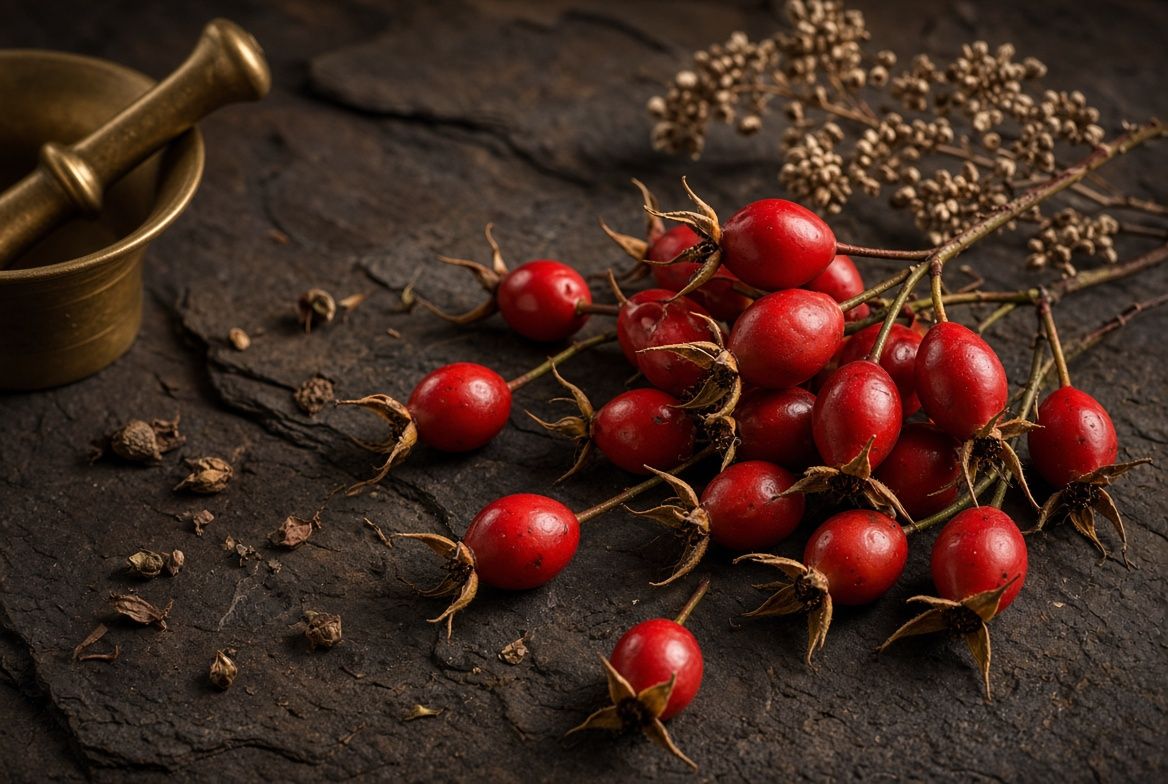
In Rosa canina, the ovaries mature into bony fruits surrounded by short, stiff hairs within brightly coloured rosehips (Rosa canina - Oxford University Plants 400).
The monograph reports that fresh rose hip contains 0.5%–1.7% vitamin C, usually as l-dehydroascorbic acid and l-ascorbic acid. It also lists pectin, tannins, carotenoids, vitamins A, B1, B2, B3 and K, and folate among rose hip constituents. Vitamin C content varies considerably in dried commercial rose hip products; its loss depends on growth conditions and processing methods (Rose Hip Uses, Benefits & Dosage).
The botanical description reports that mature Rosa canina hips are usually 1.5–2 cm long, bright red, and glabrous, and that they overwinter on the plant (Rosa canina - CLIMBERS).
The study measured ascorbic acid (AA) in rosehip fruits and tested home-style extraction methods using a mixture of three commercial samples; boiling in water for 15 minutes yielded the most AA, while the other four methods did not differ significantly from each other. For Rosa canina fruits, the reported AA content was 2.50% of dry weight for the 2023 collection and 3.70% for the 2015 collection. In separate drying experiments, AA content was highest at 80 °C among the tested temperatures, and the authors report that drying at 80 °C for 5–10 hours gave the highest content before longer drying caused a decline (Species- and Processing-Dependent Variability of Ascorbic Acid in Fruits of 14 Rosa Species and its Redox Behavior toward Iron and Copper Ions).
Cultural History & Traditional Herbalism
The post quotes British newspaper reports from September 1941 and January 1942 describing a wartime public campaign to collect rose-hip fruits from wild or cultivated bushes and have firms make them into syrup, amid the cessation of fruit imports such as oranges. The reports describe a specific food program; they discuss syrup, not modern rose-hip tea (The Rose Hip Collection Campaign (WW II).).
The page says rosehips have been used as syrup as food supplements; it gives no date or specific cultural origin for this use (Rosa canina - Oxford University Plants 400).
The page's ethnobotanical account reports that Rosa canina petals and hips have been used for digestive ailments, and that the hips have been used for colds and flu; it specifies no culture, location, or date for these medicinal uses (Rosa canina - CLIMBERS).
The article identifies dog rose (Rosa canina) and reports that during the war children gathered its hips by the sackful to make rosehip syrup, described as a key wartime vitamin C source when citrus imports were cut. It cites an Imperial War Museum entry on rosehip syrup in WWII and Ministry of Food 1940s hedgerow-harvest campaign leaflets; the article does not give specific locations or dates for the gathering (The wild roses of Britain).
Tradition, Folklore & Symbolism
The page says crushed Rosa canina rosehips make effective itching powder for childhood pranks (Rosa canina - Oxford University Plants 400).
Herbal Energetics
Comparative material only: The following entry is for a named different species, not an assignment to the inventory rose.
Traditional Chinese medicine record for Rosa laevigata Michx., the dried mature fruit (金櫻子): 性味 酸、甘、澀,平 (sour, sweet, astringent; neutral) (中藥材圖像數據庫 - 金櫻子).
Insufficient documented evidence for a traditional energetic classification. This limitation applies to the precise inventory part or species, not to the comparative or historically ambiguous material described here.
These are categories within the named tradition. They are not measurements of body temperature, pharmacological action or clinical efficacy.
InfiniTea sensory metaphor: What remains after flowering. This is original editorial language, not a measured physiological action or a translation of a traditional diagnostic category.
Sensory Profile & Tea Applications
The KnowSips editorial account describes dried, broken rose hips—usually the fruit of dog rose (Rosa canina)—as brewing into a tart, fruity infusion with a faint floral edge. The page recommends trying pure rosehip to learn its taste; it does not report testing a single-ingredient lot (What Is Rosehip Tea? Brewed From the Fruit of the Rose).
Sensory notebook: Inspect cut material for internal hairs and seed fragments; assess filtered liquor separately from edible pulp. Record tartness rather than assuming vitamin content from flavor.
Proposed comparison, not a completed trial: Record cut size, straining and retained particles; compare clarity against a white background. Keep a powder suspension and a filtered infusion in separate columns.
For ordinary dried herbal or fruit infusions, the German Federal Institute for Risk Assessment advises using boiling water and not leaving the prepared infusion standing for hours. Cooling a hot infusion and steeping untreated dry material in cold water are different processes; this report does not validate the latter (Boiling water a must for herbal teas).
Safety & Responsible Use
The monograph states that information on the safety and efficacy of rose hip in pregnancy and lactation is lacking. It reports allergy, including contact dermatitis and keratitis, associated with rose species and related plants; a clinical study of drinks containing rose hip powder reported loose stools and flatulence. The German Commission E Monographs list no known risks for rose hip (Rose Hip Uses, Benefits & Dosage).
Rosehip seeds are coated in stiff, pointed irritant hairs. For food use, remove the seeds and hairs or strain preparations through muslin or a fine-mesh sieve (Foraging Guide: Rosehips - How to Find, Identify & Use Them).
In the human trials, mild gastrointestinal complaints were reported with rosehip: loose stools and flatulence were more common with the rosehip drink in one trial, and mild, self-limiting gastrointestinal complaints were the most common adverse effects in another. A tablet trial reported no adverse effects and no significant abnormalities in physical, biochemical, hematological, or urinalysis measures; a short-term herbal-formulation trial reported no adverse impacts on renal or hepatic function. The article does not report specific contraindications, interactions, allergic reactions, or pregnancy or lactation findings (Effects of Daily Intake of Rosehip Extract on Low-Density Lipoprotein Cholesterol and Blood Glucose Levels: A Systematic Review).
Preparation and exposure boundary: This review does not establish a safe medicinal dose in pregnancy, lactation or childhood, or rule out interactions or allergy. Do not substitute essential oil or a concentrated extract for the documented food or herb.
For U.S. food use, the relevant safety determination concerns the intended conditions of use. The existence of a traditional preparation or herbal medicine monograph does not establish that this ingredient, dose and beverage are cleared for sale (Understanding How the FDA Regulates Food Additives and GRAS Ingredients).
Historical Trade, Ecology & Sustainability
The evocatively scented flowers of Rosa canina are described as a transient summer feature of hedges and waste places in Europe, North Africa, and western Asia (Rosa canina - Oxford University Plants 400).
The monograph states that Rosa canina is native to Europe, North Africa, and temperate areas of Asia (Rose Hip Uses, Benefits & Dosage).
The ecological account reports that birds and mammals are attracted to the fleshy Rosa canina hips and disperse the seeds (Rosa canina - CLIMBERS).
Sourcing record: Ask how much fruit remains for wildlife at wild-collection sites and how hairs and seeds are removed from the retail cut.
InfiniTea Herb Lore & Ritualpreliminary draft
Energetics (original InfiniTea metaphor): What remains after flowering. Use this as a private writing image, not a health statement.
For the separately attributed traditional material, see Herbal Energetics; the original sensory image is not a translation of that classification.
Tradition & Folklore: The page says crushed Rosa canina rosehips make effective itching powder for childhood pranks (Rosa canina - Oxford University Plants 400).
Ritual Cue (original contemporary InfiniTea interpretation): Draw a flower and then the outline of its fruit. Write down one useful thing that remained after a project ended.
Private preliminary draft; not approved for publication.
Scholarly References & Research Verification
Research limitations
Request species and the fractions retained after processing. Do not estimate vitamin C from color, sourness or a generic fresh-fruit analysis.
The extraction comparison used a mixture of commercial rosehip samples, and the species composition was not specified; therefore, its 15-minute boiling result is not specifically established for Rosa canina (Species- and Processing-Dependent Variability of Ascorbic Acid in Fruits of 14 Rosa Species and its Redox Behavior toward Iron and Copper Ions).
References below identify the evidence used, not additional endorsements. A botanical authority establishes nomenclature, not the identity of a physical lot. Published study samples, traditional descriptions and InfiniTea proposals are distinguished in the text.
- Kew, Plants of the World Online: Rosa canina L. | Taxonomic backbone
- Rosa canina - Oxford University Plants 400 | botanical species profile
- Rose Hip Uses, Benefits & Dosage | herbal natural-product monograph
- Rosa canina - CLIMBERS | botanical species profile
- The Rose Hip Collection Campaign (WW II). | food-history blog post quoting 1941 and 1942 newspaper reports and a 1943 Ministry of Food leaflet
- What Is Rosehip Tea? Brewed From the Fruit of the Rose | editorial article with sensory descriptions
- Foraging Guide: Rosehips - How to Find, Identify & Use Them | Foraging guide/article
- Species- and Processing-Dependent Variability of Ascorbic Acid in Fruits of 14 Rosa Species and its Redox Behavior toward Iron and Copper Ions | Laboratory study
- The wild roses of Britain | Grow Wild blog article by Charles Shi, published 27 October 2025
- Effects of Daily Intake of Rosehip Extract on Low-Density Lipoprotein Cholesterol and Blood Glucose Levels: A Systematic Review | A systematic review of four randomized clinical trials in adults assessing oral rosehip (Rosa canina) interventions, including a drink containing ground rosehip powder and rosehip fruit extract tablets or capsules. The review reports tolerability observations from these human trials; one trial used rosehip as part of a herbal combination.
- 中藥材圖像數據庫 - 金櫻子 | Hong Kong Baptist University Library, Chinese Medicinal Materials Image Database
- Boiling water a must for herbal teas | BfR press release providing general food-safety guidance for preparing herbal and fruit infusions.
- Understanding How the FDA Regulates Food Additives and GRAS Ingredients | U.S. FDA consumer-information webpage describing food-additive and GRAS ingredient oversight.
Final Botanical Summary
The hip is not the rose petal, and an infusion is not a quantified source of the nutrients present in fresh whole fruit.
Editorial disposition: Identity hold. The report is a private reference, not a clinical recommendation, approval for sale or authenticated sensory trial.
Verification Status (November 2026)
Phase II source audit, claim by claim
- Claims checked
- 15
- Corrected
- 3
- Withheld
- 0
- Sources
- 13
Identity hold: the species, plant part or market name still needs confirming before any product decision. See Identity and the research limitations.
Citation check: All 4 Safety & Use citations were re-read against their sources in November 2026 and confirmed.
A private research reference, not a clinical recommendation or product claim. Checked to the Grimoire's research standards →