
Botanical Identity & Classification
Inventory scope: Myristica fragrans · Myristicaceae · dried aril surrounding the seed.
Nomenclatural check: Myristica fragrans Houtt. is accepted in this treatment (family Myristicaceae). A synonym listed there is Palala fragrans (Houtt.) Kuntze. The stated native range is Maluku (Banda Islands) (Kew, Plants of the World Online: Myristica fragrans Houtt.).
Inventory decision: Mace is the aril; nutmeg is the seed of the same fruit. Do not use nutmeg poisoning data to claim a precise threshold for mace or offer concentrated preparations.
The nutmeg tree is Myristica fragrans Houtt. (family Myristicaceae), an evergreen tree (Oxford University Plants 400: Myristica fragans).
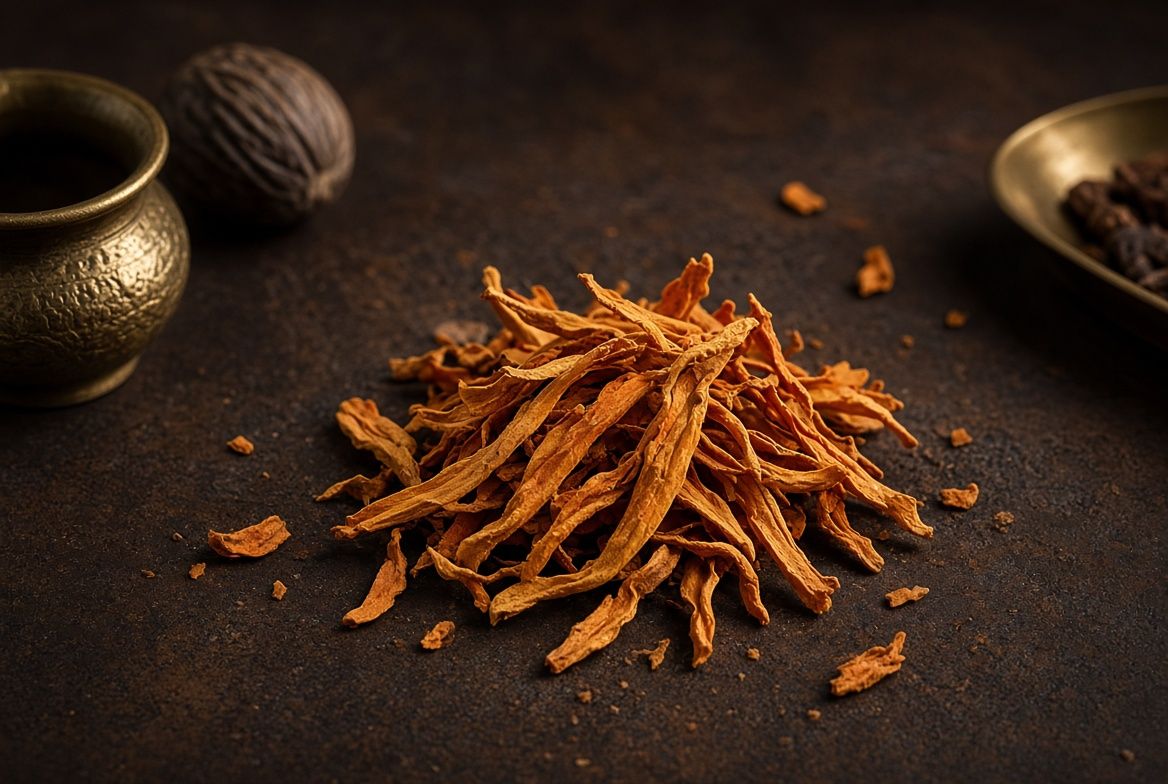
Mace is the dried aril of Myristica fragrans Houtt. (MYRISTICACEAE), and nutmeg is the dried kernel of its seed (Myristica fragrans - PROSEA).
The page describes nutmeg as the dried seed kernel and mace as the dried and cured aril; ripe fruit splits on the tree, and the seed surrounded by its red aril falls to the ground. In Grenada, farmers separate mace from the seed, grade it, dry it in the sun, and deliver it to GCNA receiving stations; mace is always delivered dried. At the station, mace is inspected and classified as No. 1 or No. 2, then cured in wooden bins for three months, with carbon disulphide suspended in each bin to deter insect pests, before it is bagged and fumigated for export (Production, handling and processing of nutmeg and mace and their culinary uses - Section III-Post harvest handling).
Botanical & Scientific Profile
Mace is the aril around the seed; nutmeg is the seed product. A paper or poisoning report that says only nutmeg should not silently become quantitative evidence about mace.
Mace essential oil is produced in very small quantities and is colourless to pale yellow, much like nutmeg oil. Mace oleoresin contains essential oil, fixed oil, and other substances soluble in the chosen solvent (Myristica fragrans - PROSEA).
Myristica fragrans produces a yellow fruit about the size of a ping-pong ball, with a thick, fleshy wall around a hard, shiny brown seed covered by a thin, red, fleshy aril (Oxford University Plants 400: Myristica fragans).
Per 100 g edible portion, mace contains approximately 16 g water, 22 g fat, 10 g essential oil, 48 g carbohydrates, 0.1 g phosphorus, and 13 mg iron. Its red pigment is lycopene, identical to the red colourant in tomato (Myristica fragrans - PROSEA).
Cultural History & Traditional Herbalism
The page states that the Maluku Islands (Moluccas) in eastern Indonesia were the only place where nutmeg and mace grew until the nineteenth century (Oxford University Plants 400: Myristica fragans).
Nutmeg and mace spread from their probable origin in Indonesia’s southern Moluccan Islands, especially Ambon and Banda. The first record of nutmeg in Europe, in Constantinople, dates from 540 AD; by the end of the 12th century, nutmeg and mace were generally known in Europe (Myristica fragrans - PROSEA).
The Dutch East India Company established a brutal spice monopoly in the mid-seventeenth century; British and French nutmeg plantations in Malaysia and Mauritius broke the monopoly at the end of the eighteenth century (Oxford University Plants 400: Myristica fragans).
The article identifies Myristica fragrans as the nutmeg tree, native to the Banda Islands in the Dutch East Indies (now Indonesia), and says the Dutch invaded the islands in 1621, established plantations, and controlled its trade. It reports that the Dutch treated nutmeg seeds with lime juice to prevent viable seeds from spreading and destroyed crops when harvests threatened to lower prices. Marianne North’s paintings depict the nutmeg tree’s foliage, flowers and fruit; her diary account from Jamaica describes the nut and the crimson mace surrounding it, identifying nutmeg and mace as two spices produced by the tree (A spice sensation in oils at the Marianne North Gallery).
Tradition, Folklore & Symbolism
No separate inherited symbolic or ceremonial use of this identified part was established here. A documented food, trade or medicinal practice should remain under its own description rather than being relabeled as ritual.
Herbal Energetics
Insufficient documented evidence for a traditional energetic classification. No temperature, direction or channel is inferred from the flavor of a cup.
InfiniTea sensory metaphor: A lattice, not a wall. This is original editorial language, not a measured physiological action or a translation of a traditional diagnostic category.
Sensory Profile & Tea Applications
The monograph describes volatile oil obtained by steam distillation from the seed of Myristica fragrans as having a nutmeg odour and taste; it says this oil is scarcely distinguishable from volatile oil of mace (Myristica fragrans Houtt. (PIM 355)).
Mace essential oil is colourless to pale yellow and much resembles nutmeg oil. Nutmeg and mace oleoresins are considered to have a truer odour and flavour than the corresponding essential oils and are preferred in food industries (Myristica fragrans - PROSEA).
Sensory notebook: Describe the branching blade before grinding. Compare the fragrance of culinary mace with labeled nutmeg without claiming they have identical chemistry.
Proposed comparison, not a completed trial: Examine an intact dried blade of mace beside a labeled photograph of the fruit. Draw its open network before grinding obscures the structure.
For ordinary dried herbal or fruit infusions, the German Federal Institute for Risk Assessment advises using boiling water and not leaving the prepared infusion standing for hours. Cooling a hot infusion and steeping untreated dry material in cold water are different processes; this report does not validate the latter (Boiling water a must for herbal teas).
Safety & Responsible Use
A case report describes a previously healthy six-year-old girl who developed altered consciousness and respiratory acidosis after accidentally ingesting six pieces of mace, the aril of Myristica fragrans; she recovered with supportive care. This single case report does not establish a safe or toxic dose threshold (Mace Poisoning: Accidental Toxic Ingestion in a Child Leading to a Reversible Coma).
In Myristica fragrans, the nutmeg is the seed and mace is the aril surrounding it; the monograph says intoxication from mace has been reported but is rare. It reports 1–3 nutmegs (5–15 g) as a toxic dose, but does not provide a separate dose estimate for mace (Myristica fragrans Houtt. (PIM 355)).
A published case describes a six-year-old child with impaired consciousness and abnormal muscle tone after eating fresh mace aril. The child recovered with supportive care. This is a direct warning about the aril, not a study of a dilute beverage and not a way to infer a safe threshold (Mace Poisoning: Accidental Toxic Ingestion in a Child Leading to a Reversible Coma).
Preparation and exposure boundary: This review does not establish a safe medicinal dose in pregnancy, lactation or childhood, or rule out interactions or allergy. Do not substitute essential oil or a concentrated extract for the documented food or herb.
For U.S. food use, the relevant safety determination concerns the intended conditions of use. The existence of a traditional preparation or herbal medicine monograph does not establish that this ingredient, dose and beverage are cleared for sale (Understanding How the FDA Regulates Food Additives and GRAS Ingredients).
Historical Trade, Ecology & Sustainability
Annual world production is about 3,000 tonnes of mace. Indonesia produces approximately 60% and Grenada 30% of the nutmeg and mace entering the world market. In Grenada, seeds with attached aril are collected after falling from split fruit. The page describes harvesting in Indonesia as labour-intensive and as diminishing losses, especially of mace (Myristica fragrans - PROSEA).
The nutmeg tree’s natural range is highly restricted, and nutmeg is now widely grown across the tropics (Oxford University Plants 400: Myristica fragans).
Banda and surrounding islands are the main centre of nutmeg cultivation. Smaller-scale cultivation occurs elsewhere in Indonesia, including North Sulawesi (Manado), western Sumatra, West Java, and Irian Jaya; Sri Lanka, Kerala in India, and Pinang off Peninsular Malaysia also have sizable acreages. Nutmeg is also cultivated in other per-humid or humid tropical regions (Myristica fragrans - PROSEA).
Sourcing record: Ask for origin, intact versus ground aril and authentication; acknowledge Banda’s history rather than presenting global spice trade as a neutral diffusion of flavors.
InfiniTea Herb Lore & Ritualpreliminary draft
Energetics (original InfiniTea metaphor): A lattice, not a wall. Use this as a private writing image, not a health statement.
Tradition & Folklore: The article identifies Myristica fragrans as the nutmeg tree, native to the Banda Islands in the Dutch East Indies (now Indonesia), and says the Dutch invaded the islands in 1621, established plantations, and controlled its trade. It reports that the Dutch treated nutmeg seeds with lime juice to prevent viable seeds from spreading and destroyed crops when harvests threatened to lower prices. Marianne North’s paintings depict the nutmeg tree’s foliage, flowers and fruit; her diary account from Jamaica describes the nut and the crimson mace surrounding it, identifying nutmeg and mace as two spices produced by the tree (A spice sensation in oils at the Marianne North Gallery). This is a record of use, not a claim of inherited ritual.
Ritual Cue (original contemporary InfiniTea interpretation): Sketch a loose net around one word you want to protect. Leave openings where a new idea might enter.
Private preliminary draft; not approved for publication.
Scholarly References & Research Verification
Research limitations
Confirm the aril as opposed to kernel or a mixed ground product. No concentrated nutmeg or mace challenge is appropriate.
References below identify the evidence used, not additional endorsements. A botanical authority establishes nomenclature, not the identity of a physical lot. Published study samples, traditional descriptions and InfiniTea proposals are distinguished in the text.
- Kew, Plants of the World Online: Myristica fragrans Houtt. | Taxonomic backbone
- Oxford University Plants 400: Myristica fragans | botanical profile
- Myristica fragrans - PROSEA | PROSEA botanical and crop-use handbook database record
- Myristica fragrans Houtt. (PIM 355) | International Programme on Chemical Safety Poisons Information Monograph (plant)
- Mace Poisoning: Accidental Toxic Ingestion in a Child Leading to a Reversible Coma | case report
- A spice sensation in oils at the Marianne North Gallery | Kew interpretive article about Marianne North’s paintings and items displayed from Kew’s Economic Botany Collection.
- Production, handling and processing of nutmeg and mace and their culinary uses - Section III-Post harvest handling | Description of nutmeg and mace harvesting, postharvest handling, and processing in Grenada, including GCNA receiving and processing stations.
- Mace Poisoning: Accidental Toxic Ingestion in a Child Leading to a Reversible Coma | A case report of a previously healthy six-year-old girl who reportedly ate six pieces of fresh mace, the aril surrounding nutmeg seeds. The article also discusses prior poison-center reports of nutmeg exposures; it does not report a poison-center study of mace.
- Boiling water a must for herbal teas | BfR press release providing general food-safety guidance for preparing herbal and fruit infusions.
- Understanding How the FDA Regulates Food Additives and GRAS Ingredients | U.S. FDA consumer-information webpage describing food-additive and GRAS ingredient oversight.
Final Botanical Summary
The shared tree explains the linked trade history, not identical composition. Mace should be identifiable as a separate spice and plant part.
Editorial disposition: Lot unverified. The report is a private reference, not a clinical recommendation, approval for sale or authenticated sensory trial.
Verification Status (November 2026)
Phase II source audit, claim by claim
- Claims checked
- 15
- Corrected
- 3
- Withheld
- 0
- Sources
- 10
Material: Lot unverified. No physical sample has been examined.
Citation check: All 4 Safety & Use citations were re-read against their sources in November 2026 and confirmed.
A private research reference, not a clinical recommendation or product claim. Checked to the Grimoire's research standards →