Botanical Identity & Classification
Inventory scope: Avena sativa · Poaceae · mature stems and leaves, harvest stage to verify.
Nomenclatural check: Avena sativa L. is accepted in this treatment (family Poaceae). A synonym listed there is Avena fatua var. sativa (L.) Hausskn. The stated native range is Cultigen from W. Asia; native to Iran and Iraq (Kew, Plants of the World Online: Avena sativa L.).
Inventory decision: Distinguish mature straw from green flowering herb, milky oat tops and grain. Do not transfer grain beta-glucan research or an unripe-herb monograph to commercial mature straw.
The account states that immature or milky seed of Avena spp. is distinct from oat straw or stem (Avena Sp. - Oats).
The common oat (Avena sativa) is a grass in the Poaceae family. Kew mentions oat straw as bedding for horses and cows but does not specify which plant parts the term includes (Common oat | Kew).
The EMA defines oat herb as the aerial parts of Avena sativa L. harvested before flowering. The HMPC summary covers preparations made by comminuting the aerial parts, expressing juice from fresh aerial parts, or extracting fresh or dried plant material with a solvent; based on traditional use, these preparations can be used to relieve mild symptoms of mental stress and aid sleep. The page notes that clinical-trial evidence is insufficient and separately reports laboratory studies in rats in which oat herb medicines reduced stress when given in food over seven weeks (Avenae herba - herbal medicinal product).
Botanical & Scientific Profile
Mature straw and green oat herb harvested before flowering are different materials even though the binomial is identical. Translating an herbal drug name as “oatstraw” can erase that difference.
The HMPC considers traditional use of preparations of the aerial parts of Avena sativa L. (oat herb) to relieve mild symptoms of mental stress and aid sleep plausible, despite insufficient clinical-trial evidence. The traditional-use basis includes at least 30 years of safe use, including at least 15 years in the EU (Avenae herba - herbal medicinal product).
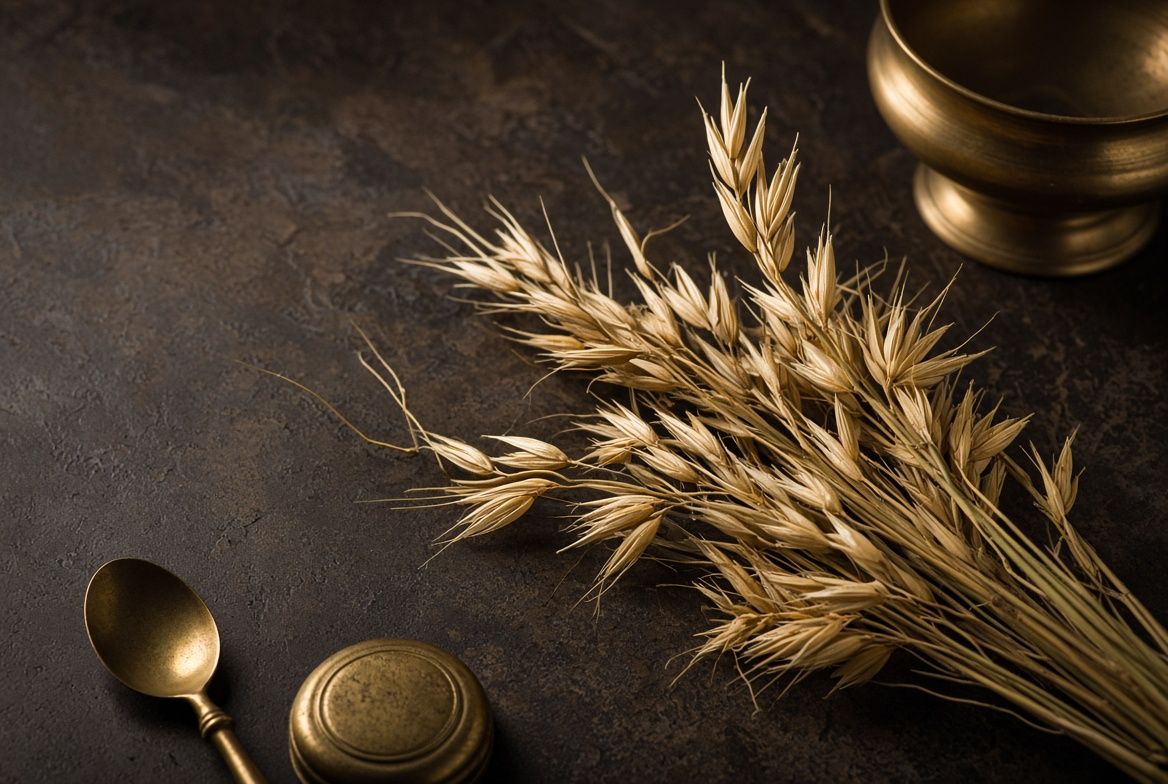
Common oat (Avena sativa) has upright stems that can reach 1.8 m in height; its wedge-shaped spikelets are 22–27 mm long (Common oat | Kew).
The chapter describes oat straw (the species is not specified for this statement) as good, palatable roughage and excellent bedding (Chapter I - BACKGROUND TO FODDER OATS WORLDWIDE).
Cultural History & Traditional Herbalism
Kew says the widely farmed common oat (Avena sativa) is descended from the wild oat Avena sterilis, once considered a weed of wheat and barley in the Fertile Crescent, and that the wild grass is thought to have reached Europe in the Bronze Age (Common oat | Kew).
The profile says oat was not widely regarded as a medicinal ingredient in Europe until the Middle Ages; in traditional Western practice, fresh and dried oats were used for various complaints. The German Commission E lists oat straw (stems and leaves) for external application to inflammatory and seborrheic skin disease, especially itching; other oat-herb uses it recorded were not approved uses. The European Medicines Agency’s HMPC distinguishes Avenae herbae (oat herb/straw), a traditional herbal product for mild mental-stress symptoms and to aid sleep, from Avenae fructus (oat grain), traditionally used for minor skin inflammation, such as sunburn, and to aid healing of minor wounds (Oat).
Tradition, Folklore & Symbolism
No separate inherited symbolic or ceremonial use of this identified part was established here. A documented food, trade or medicinal practice should remain under its own description rather than being relabeled as ritual.
Herbal Energetics
Insufficient documented evidence for a traditional energetic classification. No temperature, direction or channel is inferred from the flavor of a cup.
InfiniTea sensory metaphor: A field after harvest. This is original editorial language, not a measured physiological action or a translation of a traditional diagnostic category.
Sensory Profile & Tea Applications
Serene Tree Apothecary describes its oat straw (Avena sativa, green stalk and leaf cut while still green) as mild, faintly sweet, and grassy. This is the supplier’s commercial sensory description of the green-cut plant material (Oat Straw Herb for Oat Straw Tea | Dried, Cut & Sifted).
Sensory notebook: Inspect the cut for stems, leaf and grain fragments. Test hay-like aroma and color only on an identified lot; appearance is not a gluten test.
Proposed comparison, not a completed trial: Record stem, leaf and grain fragments separately on a white tray. Do not infer harvest stage from green color alone.
For ordinary dried herbal or fruit infusions, the German Federal Institute for Risk Assessment advises using boiling water and not leaving the prepared infusion standing for hours. Cooling a hot infusion and steeping untreated dry material in cold water are different processes; this report does not validate the latter (Boiling water a must for herbal teas).
Safety & Responsible Use
People with celiac disease who include oats in their diet should discuss whether and how much to eat with their doctor or a registered dietitian, and ensure the oats are gluten-free; cross-contact between oats and gluten-containing grains is common and can make oats unsafe (Eating, Diet, & Nutrition for Celiac Disease - NIDDK).
The HMPC conclusions cover preparations of the aerial parts of Avena sativa L. (oat herb) harvested before flowering; combinations with other herbal substances are not covered by this summary (Avenae herba - herbal medicinal product).
The page reports no oat-specific human observations or data on adverse effects, contraindications, interactions, allergies, or pregnancy or lactation. It states generally that gluten consumption by people with celiac disease can destroy the lining of the small intestine and carries a risk of other serious health conditions; it does not present this as a finding from a study described on the page (Questions and Answers on the Gluten-Free Food Labeling Final Rule).
Preparation and exposure boundary: This review does not establish a safe medicinal dose in pregnancy, lactation or childhood, or rule out interactions or allergy. Do not substitute essential oil or a concentrated extract for the documented food or herb.
For U.S. food use, the relevant safety determination concerns the intended conditions of use. The existence of a traditional preparation or herbal medicine monograph does not establish that this ingredient, dose and beverage are cleared for sale (Understanding How the FDA Regulates Food Additives and GRAS Ingredients).
Historical Trade, Ecology & Sustainability
Kew scientists and the Global Crop Diversity Trust have collected seeds from wild relatives of oats, including Avena sterilis, and conserved them in Kew’s Millennium Seed Bank (Common oat | Kew).
Common oat (Avena sativa) grows in temperate regions and is described by Kew as particularly hardy (Common oat | Kew).
Sourcing record: Require harvest stage and a food-grade supply chain, with gluten cross-contact controls if relevant; livestock bedding and beverage material are not equivalent grades.
InfiniTea Herb Lore & Ritualpreliminary draft
Energetics (original InfiniTea metaphor): A field after harvest. Use this as a private writing image, not a health statement.
Tradition & Folklore: The profile says oat was not widely regarded as a medicinal ingredient in Europe until the Middle Ages; in traditional Western practice, fresh and dried oats were used for various complaints. The German Commission E lists oat straw (stems and leaves) for external application to inflammatory and seborrheic skin disease, especially itching; other oat-herb uses it recorded were not approved uses. The European Medicines Agency’s HMPC distinguishes Avenae herbae (oat herb/straw), a traditional herbal product for mild mental-stress symptoms and to aid sleep, from Avenae fructus (oat grain), traditionally used for minor skin inflammation, such as sunburn, and to aid healing of minor wounds (Oat). This is a record of use, not a claim of inherited ritual.
Ritual Cue (original contemporary InfiniTea interpretation): List three useful things that remain when the obvious harvest is over.
Private preliminary draft; not approved for publication.
Scholarly References & Research Verification
Research limitations
Ask specifically for growth stage and for cereal cross-contact controls where relevant. Evidence for grain beta-glucan cannot fill an evidence gap for straw tea.
References below identify the evidence used, not additional endorsements. A botanical authority establishes nomenclature, not the identity of a physical lot. Published study samples, traditional descriptions and InfiniTea proposals are distinguished in the text.
- Kew, Plants of the World Online: Avena sativa L. | Taxonomic backbone
- Avena Sp. - Oats | botanical and herbal-use reference account
- Common oat | Kew | botanical plant profile
- Avenae herba - herbal medicinal product | European Medicines Agency summary of the Committee on Herbal Medicinal Products (HMPC) conclusions for the public
- Chapter I - BACKGROUND TO FODDER OATS WORLDWIDE | FAO book chapter
- Oat Straw Herb for Oat Straw Tea | Dried, Cut & Sifted | Commercial product page and supplier description
- Eating, Diet, & Nutrition for Celiac Disease - NIDDK | government health information page
- Oat | HerbalGram herb profile on Avena sativa, Issue 135, pages 8–14
- Questions and Answers on the Gluten-Free Food Labeling Final Rule | FDA regulatory FAQ on voluntary gluten-free claims for FDA-regulated packaged foods under 21 CFR 101.91; it is not a study of Avena sativa or oat tea. The page states that oats do not have to be certified as gluten-free, but oats labeled “gluten-free” must contain less than 20 ppm gluten; unavoidable gluten from cross-contact must also be below 20 ppm.
- Boiling water a must for herbal teas | BfR press release providing general food-safety guidance for preparing herbal and fruit infusions.
- Understanding How the FDA Regulates Food Additives and GRAS Ingredients | U.S. FDA consumer-information webpage describing food-additive and GRAS ingredient oversight.
Final Botanical Summary
An excellent example of the importance of harvest stage: evidence about the plant can still be evidence about the wrong product.
Editorial disposition: Identity hold. The report is a private reference, not a clinical recommendation, approval for sale or authenticated sensory trial.
Verification Status (November 2026)
Phase II source audit, claim by claim
- Claims checked
- 11
- Corrected
- 4
- Withheld
- 0
- Sources
- 11
Identity hold: the species, plant part or market name still needs confirming before any product decision. See Identity and the research limitations.
Citation check: All 4 Safety & Use citations were re-read against their sources in November 2026 and confirmed.
A private research reference, not a clinical recommendation or product claim. Checked to the Grimoire's research standards →