
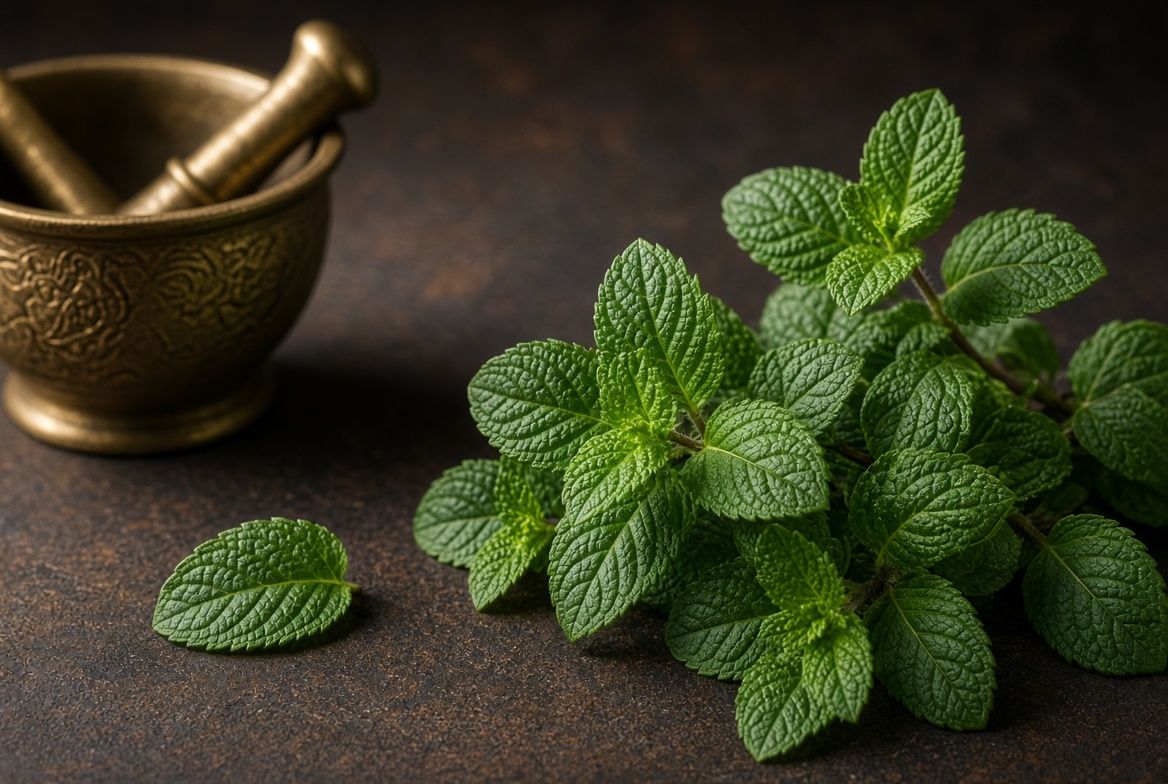
Botanical Identity & Classification
Inventory scope: Mentha × piperita · Lamiaceae · leaf.
Nomenclatural check: Mentha × piperita L. is accepted in this treatment (family Lamiaceae). A synonym listed there is Mentha aquatica var. piperita (L.) Alef. The stated native range is Europe to Central Asia (Kew, Plants of the World Online: Mentha × piperita L.).
Inventory decision: Keep leaf infusions separate from enteric-coated peppermint oil capsules and undiluted oil. Identify hybrid peppermint, not spearmint sold simply as mint.
The article identifies peppermint (Mentha piperita) as a cross between wintermint and spearmint (Plant science at the dinner table: peppermint).
The expanded Commission E monograph identifies peppermint as Mentha x piperita, family Lamiaceae, a natural hybrid of water mint (Mentha aquatica L.) and spearmint (M. spicata L.). Its pharmacopoeial name is Menthae piperitae folium; the leaf consists of fresh or dried leaves of the plant (Peppermint leaf).
Botanical & Scientific Profile
The material is leaf, not an enteric-coated peppermint-oil capsule. A capsule trial may be relevant to pharmacology but cannot establish the dose, site of release or symptom response of leaf tea.
The HMPC recognizes traditional use of peppermint leaf (Mentha x piperita L.) preparations to relieve digestion-related problems such as indigestion and flatulence; it notes that clinical-trial evidence is insufficient (Menthae piperitae folium - herbal medicinal product).
The article states that specialized cells in peppermint leaves produce peppermint oil, which is released when the leaves are crushed or chopped (Plant science at the dinner table: peppermint).
The monograph reports that peppermint (Mentha x piperita) leaf contains luteolin, hesperidin, and rutin; caffeic, chlorogenic, and rosmarinic acids and related tannins; and volatile oil composed mostly of monoterpenes, including menthol, menthone, cineole, pulegone, menthyl acetate, menthofuran, and limonene (Peppermint leaf).
Cultural History & Traditional Herbalism
The article states that an ancient Egyptian medical text dating as early as 1550 BC includes peppermint (Plant science at the dinner table: peppermint).
The monograph’s historical account says records from Greek, Roman, and ancient Egyptian eras document medicinal use of mint leaves for several thousand years. It says the origin of peppermint (Mentha x piperita) cultivation is disputed, although there is some evidence it was cultivated in ancient Egypt (Peppermint leaf).
The monograph’s historical account says Roman naturalist Pliny the Elder wrote about peppermint’s uses by Greeks and Romans; botanist John Ray recognized peppermint as a distinct species in the second edition of Synopsis Stirpium Britannicorum (1696) and in Historia Plantarum (1704); and peppermint became official in the London Pharmacopoeia in 1721 (Peppermint leaf).
The review reports that large-scale peppermint (Mentha × piperita) production for menthol began in England around 1750; by 1796, about 40.5 ha (100 acres) were cultivated near Mitcham, and early distillation yielded 900–1,360 kg of oil. Citing Parry (1925), it states that production expanded to 10 townships around Mitcham over the following 20 years and ceased in the original Mitcham area by 1940. The review also reports that Albert M. Todd imported ‘Black Mitcham’ roots from England in 1853 and began production in St. Joseph County, Michigan; he found it superior there to ‘White Mitcham,’ and by 1915 his company was growing Scotch spearmint because it outproduced native spearmint (Crop Wild Relatives as Germplasm Resource for Cultivar Improvement in Mint (Mentha L.)).
Tradition, Folklore & Symbolism
The monograph says the genus name Mentha derives from Mintha, the name of a mythical nymph who metamorphosed into the peppermint plant (Mentha x piperita) (Peppermint leaf).
Herbal Energetics
Insufficient documented evidence for a traditional energetic classification. No temperature, direction or channel is inferred from the flavor of a cup.
InfiniTea sensory metaphor: A clear pause. This is original editorial language, not a measured physiological action or a translation of a traditional diagnostic category.
Sensory Profile & Tea Applications
The article names peppermint lattes, peppermint bark, mint-flavored M&Ms, and candy canes as examples of peppermint-flavored foods and drinks (Plant science at the dinner table: peppermint).
The monograph describes peppermint (Mentha x piperita) as a perennial aromatic herb and says its species name, piperita, alludes to its aromatic and pungent taste (Peppermint leaf).
Sensory notebook: Record mint aroma and the cooling mouth sensation separately from brew temperature; do not assume more cooling means a more effective product.
Proposed comparison, not a completed trial: Compare the aroma of whole leaf and freshly broken leaf from one lot. Note perceived cooling separately from the measured temperature of the cup.
For ordinary dried herbal or fruit infusions, the German Federal Institute for Risk Assessment advises using boiling water and not leaving the prepared infusion standing for hours. Cooling a hot infusion and steeping untreated dry material in cold water are different processes; this report does not validate the latter (Boiling water a must for herbal teas).
Safety & Responsible Use
Peppermint leaf (Mentha x piperita L.) preparations may worsen gastroesophageal reflux and cause heartburn; people with gallstones or other bile-related problems should use caution (Menthae piperitae folium - herbal medicinal product).
The HMPC summary covers peppermint leaf (Mentha x piperita L.) preparations made by drying and comminuting the leaves or by producing a dry extract with ethanol, for traditional relief of digestion-related problems; it directs patients to the medicine’s package leaflet for instructions on use (Menthae piperitae folium - herbal medicinal product).
The proposal covers whole or cut dried leaf of Mentha x piperita L. and specifies an infusion of 1.5–3 g in 150 ml water, three times daily, for symptomatic relief of minor digestive disorders. It says patients with gastroesophageal reflux (heartburn) should not take peppermint leaf preparations because heartburn may increase (Final HMPWP Proposal for a Core-data for Peppermint Leaf).
For peppermint leaf tea, the report says adverse effects are rare with normal, prolonged use, but that peppermint may worsen gastro-oesophageal reflux by relaxing the lower oesophageal sphincter; this is a reported precaution, not a described human trial finding. It advises caution and medical supervision for cholangitis, gallstones, or other biliary disorders because peppermint may stimulate bile, and says people hypersensitive to peppermint preparations should not use them; drug interactions were not reported, serious events and deaths were not known, and pregnancy/lactation data were unavailable, although a reference says peppermint may dry up milk secretions and the report gives a general precaution against use unless medical advice considers the benefit greater than the potential risk (ASSESSMENT REPORT ON MENTHA X PIPERITA L., FOLIUM).
Preparation and exposure boundary: This review does not establish a safe medicinal dose in pregnancy, lactation or childhood, or rule out interactions or allergy. Do not substitute essential oil or a concentrated extract for the documented food or herb.
For U.S. food use, the relevant safety determination concerns the intended conditions of use. The existence of a traditional preparation or herbal medicine monograph does not establish that this ingredient, dose and beverage are cleared for sale (Understanding How the FDA Regulates Food Additives and GRAS Ingredients).
Historical Trade, Ecology & Sustainability
The monograph’s account of peppermint (Mentha x piperita) trade says commercial material is obtained entirely from cultivation in Bulgaria, Greece, Spain, northern Europe, and the United States. It identifies the United States as the leading producer of peppermint oil, especially in Washington, Oregon, Idaho, Wisconsin, and Indiana (Peppermint leaf).
The article states that peppermint has naturalized and grows wild in North America and Europe; peppermint plants spread by runners above and just below the ground’s surface and often become invasive in home gardens (Plant science at the dinner table: peppermint).
The monograph describes peppermint (Mentha x piperita) growing wild throughout Europe and North America along stream banks and in moist wastelands where it has escaped cultivation (Peppermint leaf).
Sourcing record: Verify the mint hybrid, leaf-to-stem ratio and separation from essential-oil stock; record the grower’s cultivar if available.
InfiniTea Herb Lore & Ritualpreliminary draft
Energetics (original InfiniTea metaphor): A clear pause. Use this as a private writing image, not a health statement.
Tradition & Folklore: The monograph says the genus name Mentha derives from Mintha, the name of a mythical nymph who metamorphosed into the peppermint plant (Mentha x piperita) (Peppermint leaf).
Ritual Cue (original contemporary InfiniTea interpretation): Mark a small space between two lines in your notebook. Use that space to write what you want to ask before answering.
Private preliminary draft; not approved for publication.
Scholarly References & Research Verification
Research limitations
Check the hybrid name and whether the evidence addresses reflux or biliary concerns for the leaf itself. Keep concentrated oil out of the beverage protocol.
References below identify the evidence used, not additional endorsements. A botanical authority establishes nomenclature, not the identity of a physical lot. Published study samples, traditional descriptions and InfiniTea proposals are distinguished in the text.
- Kew, Plants of the World Online: Mentha × piperita L. | Taxonomic backbone
- Plant science at the dinner table: peppermint | Michigan State University Extension educational article
- Peppermint leaf | Expanded Commission E monograph
- Menthae piperitae folium - herbal medicinal product | EMA herbal medicinal product summary for the public
- Final HMPWP Proposal for a Core-data for Peppermint Leaf | official monograph
- Crop Wild Relatives as Germplasm Resource for Cultivar Improvement in Mint (Mentha L.) | Review article on mint domestication, historical production, and germplasm resources.
- ASSESSMENT REPORT ON MENTHA X PIPERITA L., FOLIUM | EMA assessment of the traditional herbal substance—whole or cut dried leaves of Mentha × piperita L.—and preparations including infusion (comminuted leaf for tea) and tincture. The report reviews traditional-use and safety literature, including cited animal toxicity studies; it does not describe a controlled human safety study of peppermint leaf alone.
- Boiling water a must for herbal teas | BfR press release providing general food-safety guidance for preparing herbal and fruit infusions.
- Understanding How the FDA Regulates Food Additives and GRAS Ingredients | U.S. FDA consumer-information webpage describing food-additive and GRAS ingredient oversight.
Final Botanical Summary
Peppermint leaf makes a distinctive sensory contribution, but a leaf beverage cannot inherit the evidence for a formulated oil capsule.
Editorial disposition: Lot unverified. The report is a private reference, not a clinical recommendation, approval for sale or authenticated sensory trial.
Verification Status (November 2026)
Phase II source audit, claim by claim
- Claims checked
- 16
- Corrected
- 1
- Withheld
- 0
- Sources
- 9
Material: Lot unverified. No physical sample has been examined.
Citation check: All 5 Safety & Use citations were re-read against their sources in November 2026 and confirmed.
A private research reference, not a clinical recommendation or product claim. Checked to the Grimoire's research standards →