
Botanical Identity & Classification
Inventory scope: Citrus × aurantiifolia and C. × latifolia · Rutaceae · fruit or peel.
Nomenclatural check: Citrus × aurantiifolia (Christm.) Swingle is accepted in this treatment (family Rutaceae). A synonym listed there is Citrus medica f. aurantiifolium (Christm.) M.Hiroe. The stated native range is A cultigen from E. Himalaya (Kew, Plants of the World Online: Citrus × aurantiifolia (Christm.) Swingle).
Comparison taxon; not a substitute: Citrus × latifolia (Yu.Tanaka) Yu.Tanaka is accepted in this treatment (family Rutaceae). A synonym listed there is Citrus × aurantiifolia subsp. latifolia (Yu.Tanaka) S.Ríos, D.Rivera & Obón (Kew, Plants of the World Online: Citrus × latifolia (Yu.Tanaka) Yu.Tanaka).
Inventory decision: Distinguish Key or Mexican lime from Persian lime and identify juice versus zest. Keep skin exposure followed by sunlight separate from the risks of drinking diluted juice.
The profile names the plant Citrus x aurantiifolia, lists its species as aurantifolia and family as Rutaceae, and gives Key Lime and Mexican Lime as common names (Citrus x aurantiifolia (Key Lime, Mexican Lime) - Plant Toolbox).
The book identifies Mexican or Key lime as Citrus aurantifolia (Christ.) Swingle in the Rutaceae family. It describes lime fruit peel and leaves as used for culinary and non-culinary purposes, and lime twigs and leaves as used in perfumery and to extract petitgrain cedrat oil (The Lime: Botany, Production and Uses).
Botanical & Scientific Profile
Keep fruit identity and route of exposure together in citations. A skin reaction after lime juice and sunlight does not establish that drinking a dilute beverage causes the same reaction.
The plant profile presents no human studies or experimental results (Citrus x aurantiifolia (Key Lime, Mexican Lime) - Plant Toolbox).
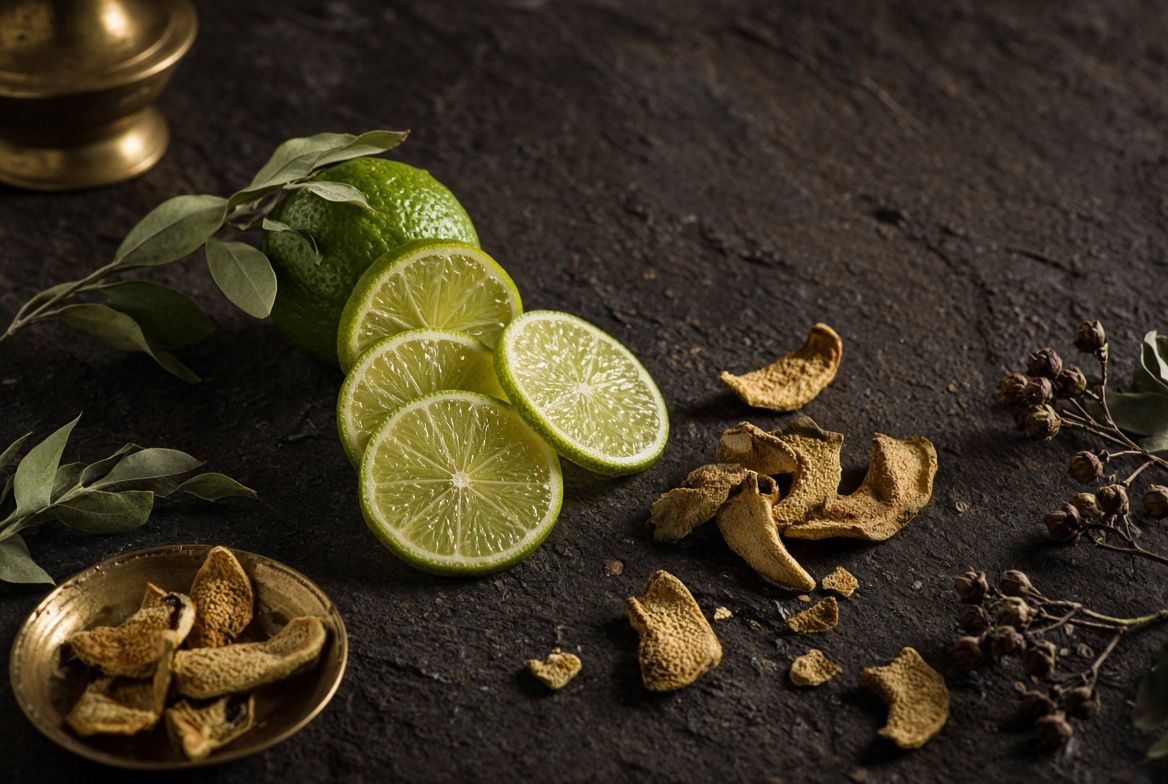
The fruit is described as spherical and seedy, green before ripening and yellow when ripe, with a thinner rind than Persian lime. The evergreen leaves are glossy and elliptical to oblong, and aromatic when crushed (Citrus x aurantiifolia (Key Lime, Mexican Lime) - Plant Toolbox).
The book describes Mexican lime as a vigorous, thorny tree typically 2–4 m tall, with aromatic leaves and fruit usually 2–5 cm in diameter. Its fruit has a thin rind, pale-green, juicy, very acidic pulp with intense flavour, many small seeds, and a high level of polyembryony (The Lime: Botany, Production and Uses).
Cultural History & Traditional Herbalism
The profile says that in Persian culture the fruit is dried for cooking, leaves are used for headaches and colds, and lime oil is used in soaps, gum, and sweets (Citrus x aurantiifolia (Key Lime, Mexican Lime) - Plant Toolbox).
The book says lime’s origin is controversial, while reporting that many researchers and historians believe it originated in Southeast Asia around 4000 BC. It describes Arab travellers carrying lime to North Africa and the Near East, its subsequent spread to Palestine and Mediterranean Europe, and Portuguese and Spanish voyagers taking it to the Americas in the early sixteenth century (The Lime: Botany, Production and Uses).
The datasheet reports that lime (Citrus aurantiifolia) is believed to have originated in northern India and adjoining parts of Myanmar, or in northern Malaysia. It says sour limes were probably among the first citrus fruits carried west from the east by crusaders; Arabs took sour lime to North Africa and surrounding regions, and it was then transported from Palestine to Mediterranean Europe (Citrus aurantiifolia (lime)).
The article reports that in 1747, aboard HMS Salisbury, Scottish physician James Lind divided 12 sailors with scurvy into six pairs; those given oranges and lemons did significantly better than sailors given alternatives including cider, vinegar, and seawater. In 1795, lemon juice became compulsory across the Royal Navy, and by 1800 the system was fully implemented; the article says storage and preservation reduced the juice’s vitamin C, and lemon juice was later replaced by lime juice, which was less effective because limes grown in British colonies contained less vitamin C than lemons. The 1867 Merchant Shipping Act required ships on certain long voyages to provide each crew member an ounce per day of lime or lemon juice; the article also describes the juice being mixed into grog to ensure sailors consumed it (The many forms of sea sickness).
Tradition, Folklore & Symbolism
The datasheet reports a belief associated with lime (Citrus aurantiifolia) that limes drive away evil spirits (Citrus aurantiifolia (lime)).
Herbal Energetics
Insufficient documented evidence for a traditional energetic classification. No temperature, direction or channel is inferred from the flavor of a cup.
InfiniTea sensory metaphor: A bright margin. This is original editorial language, not a measured physiological action or a translation of a traditional diagnostic category.
Sensory Profile & Tea Applications
The leaves are described as distinctively aromatic when crushed; flowers may be fragrant or unscented (Citrus x aurantiifolia (Key Lime, Mexican Lime) - Plant Toolbox).
The book describes lime juice as acidic and fragrant, and says Citrus aurantifolia has an exceptional aroma compared with other lime types. It also describes Mexican lime leaves as aromatic and notes that lime peel contains oil glands with essential oil (The Lime: Botany, Production and Uses).
Sensory notebook: Compare two labeled cultivars or parts rather than treating all lime as one flavor. Record fragrant oil from the rind separately from juice acidity.
Proposed comparison, not a completed trial: Use a labeled culinary fruit and record peel aroma separately from the sourness of juice. Avoid hand-to-skin transfer when handling the peel.
For ordinary dried herbal or fruit infusions, the German Federal Institute for Risk Assessment advises using boiling water and not leaving the prepared infusion standing for hours. Cooling a hot infusion and steeping untreated dry material in cold water are different processes; this report does not validate the latter (Boiling water a must for herbal teas).
Safety & Responsible Use
This case report and literature review describes lime peel or juice contacting skin followed by sunlight, particularly ultraviolet A radiation (320–400 nm), as a cause of phototoxic phytophotodermatitis. Erythema and sometimes blisters may develop within minutes to hours, though onset can be delayed; hyperpigmentation commonly follows as lesions resolve and can occasionally appear without preceding inflammation. The source addresses skin contact and subsequent light exposure; it does not assess whether drinking diluted lime causes sunburn (Margarita Dermatitis Revisited: A Case Report and Literature Review of Lime-Associated Phytophotodermatitis).
The profile describes fruit juice as edible, but notes that skins and plant material can cause problems and lists fruits and sap/juice as poison parts. It gives no advice about testing lime oil on skin (Citrus x aurantiifolia (Key Lime, Mexican Lime) - Plant Toolbox).
A 25-year-old woman developed a linear, irregular erythematous plaque with small vesicles on her left forearm after spilling a lime-containing mojito on it and spending several hours outdoors without sun protection; the acute symptoms healed over several days, leaving persistent hyperpigmentation. The diagnosis of lime-induced phytophotodermatitis was made clinically from the lesion pattern and exposure history, and she was advised to use hydrocortisone 1% cream and sun protection (Mojito-Induced Phytophotodermatitis: A Case of Lime-Triggered Skin Reaction).
Human case reports describe lime fruit peel or juice contacting skin followed by sun exposure, with effects including painful or sometimes itchy erythema and blisters, followed by postinflammatory hyperpigmentation; the reported 28-year-old man developed asymptomatic hand pigmentation three days after handling limes and sunlight exposure, which faded without medication. The review also cites a pregnant woman who developed an uncomfortable blistering eruption on both hands after making guacamole; pregnancy outcomes are not reported. These are clinical observations, not evidence about ingestion or systemic effects (Margarita Dermatitis Revisited: A Case Report and Literature Review of Lime-Associated Phytophotodermatitis).
Preparation and exposure boundary: This review does not establish a safe medicinal dose in pregnancy, lactation or childhood, or rule out interactions or allergy. Do not substitute essential oil or a concentrated extract for the documented food or herb.
For U.S. food use, the relevant safety determination concerns the intended conditions of use. The existence of a traditional preparation or herbal medicine monograph does not establish that this ingredient, dose and beverage are cleared for sale (Understanding How the FDA Regulates Food Additives and GRAS Ingredients).
Historical Trade, Ecology & Sustainability
The datasheet reports that 2013 world production statistics combined lemons and limes, giving a total of 15,420,482 tonnes. It says exports are insignificant relative to domestic consumption in most countries, while Mexico and Brazil are major producers and processors for the international trade in lime juice and oil. It also states that lime genetic resources are eroding and face serious threats and losses (Citrus aurantiifolia (lime)).
The profile gives the plant's origin as southeastern Asia, including Malaysia and Indonesia, and lists its distribution as China, India, Egypt, Europe, and the Americas, including Mexico and Florida (Citrus x aurantiifolia (Key Lime, Mexican Lime) - Plant Toolbox).
The book says Mexican or Key lime is grown in warm tropical to subtropical regions, including India, Mexico, the USA, Egypt, and the West Indies. It describes Mexican lime as very sensitive to frost but able to withstand drought better than most citrus cultivars (The Lime: Botany, Production and Uses).
Sourcing record: Specify Key/Mexican or Persian lime, fruit part and handling method; require food-grade rind if zest rather than juice is purchased.
InfiniTea Herb Lore & Ritualpreliminary draft
Energetics (original InfiniTea metaphor): A bright margin. Use this as a private writing image, not a health statement.
Tradition & Folklore: The datasheet reports a belief associated with lime (Citrus aurantiifolia) that limes drive away evil spirits (Citrus aurantiifolia (lime)).
Ritual Cue (original contemporary InfiniTea interpretation): Draw a thin green border around a page. Write one boundary that helps you enjoy what is inside it.
Private preliminary draft; not approved for publication.
Scholarly References & Research Verification
Research limitations
Document Persian versus Key/Mexican lime when known and avoid extrapolating peel-oil or skin-contact evidence to ingested fruit.
References below identify the evidence used, not additional endorsements. A botanical authority establishes nomenclature, not the identity of a physical lot. Published study samples, traditional descriptions and InfiniTea proposals are distinguished in the text.
- Kew, Plants of the World Online: Citrus × aurantiifolia (Christm.) Swingle | Taxonomic backbone
- Kew, Plants of the World Online: Citrus × latifolia (Yu.Tanaka) Yu.Tanaka | Taxonomic backbone
- Citrus x aurantiifolia (Key Lime, Mexican Lime) - Plant Toolbox | North Carolina Extension Gardener plant profile
- The Lime: Botany, Production and Uses | academic edited book excerpt
- Citrus aurantiifolia (lime) | CABI species datasheet
- Margarita Dermatitis Revisited: A Case Report and Literature Review of Lime-Associated Phytophotodermatitis | case report and literature review
- Mojito-Induced Phytophotodermatitis: A Case of Lime-Triggered Skin Reaction | primary human study (single-patient case report)
- The many forms of sea sickness | Historical blog article from the Royal College of Surgeons of England Library about scurvy prevention and medical care at sea.
- Boiling water a must for herbal teas | BfR press release providing general food-safety guidance for preparing herbal and fruit infusions.
- Understanding How the FDA Regulates Food Additives and GRAS Ingredients | U.S. FDA consumer-information webpage describing food-additive and GRAS ingredient oversight.
Final Botanical Summary
A lime-related skin reaction is route- and light-dependent. Reporting that mechanism accurately is more informative than labeling the whole fruit toxic.
Editorial disposition: Identity hold. The report is a private reference, not a clinical recommendation, approval for sale or authenticated sensory trial.
Verification Status (November 2026)
Phase II source audit, claim by claim
- Claims checked
- 16
- Corrected
- 3
- Withheld
- 0
- Sources
- 10
Identity hold: the species, plant part or market name still needs confirming before any product decision. See Identity and the research limitations.
Citation check: All 5 Safety & Use citations were re-read against their sources in November 2026 and confirmed.
A private research reference, not a clinical recommendation or product claim. Checked to the Grimoire's research standards →