
Botanical Identity & Classification
Inventory scope: Clitoria ternatea · Fabaceae · flowers.
Nomenclatural check: Clitoria ternatea L. is accepted in this treatment (family Fabaceae). A synonym listed there is Clitoria spectabilis Salisb. in Prodr. Stirp. Chap. Allerton: 336 (1796), nom. superfl. The stated native range is Cape Verde, Tropical & S. Africa, Arabian Peninsula (Kew, Plants of the World Online: Clitoria ternatea L.).
Inventory decision: Use the blue flower as the research subject, not root powder, seeds or an isolated pigment. A regulatory assessment of a coloring extract is not permission to market dried flowers for unrestricted drinking.
Butterfly pea is Clitoria ternatea in the Fabaceae family; its flowers are used to extract an edible blue dye and to color foods and beverages (Butterfly Pea - Clitoria ternatea | North Carolina Extension Gardener Plant Toolbox).
The review identifies butterfly pea as Clitoria ternatea L. (Fabaceae), an ornamental perennial climber (Review: A relation between ethnobotany and bioprospecting of edible flower Butterfly Pea (Clitoria ternatea) in Indonesia).
Botanical & Scientific Profile
Color is the strongest starting point for a flower monograph. Record the liquid before acidification and after it; a visible change is evidence about the sample under those conditions, not about antioxidant effects in the drinker.
A cited randomized crossover trial studied the acute effects of a Clitoria ternatea flower beverage on glycemic response and antioxidant capacity in healthy subjects; the page does not give the beverage preparation or trial results (Review: A relation between ethnobotany and bioprospecting of edible flower Butterfly Pea (Clitoria ternatea) in Indonesia).
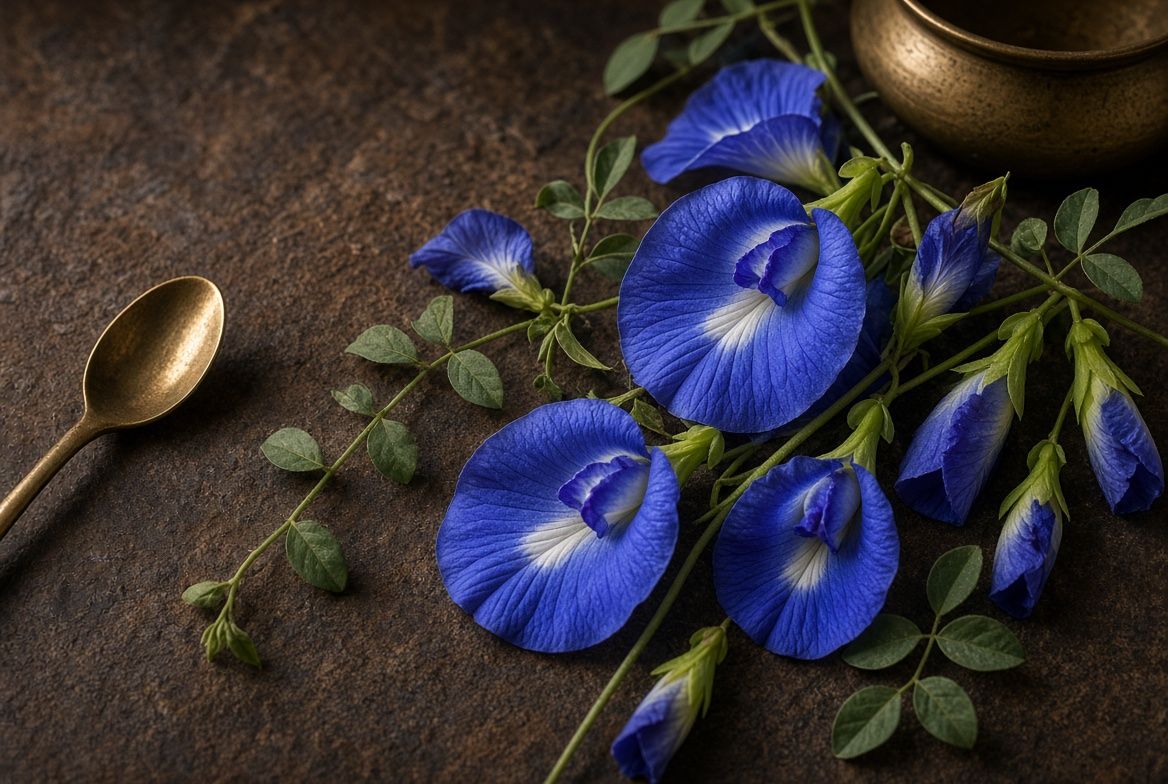
Flowers are blue to violet and about two inches across, with yellow centers described in the plant overview; some cultivars have white or double flowers (Butterfly Pea - Clitoria ternatea | North Carolina Extension Gardener Plant Toolbox).
The references include studies of Clitoria ternatea flower pigments and anthocyanins, phenolic content and antioxidant activity, and delphinidin glycosides in blue petals; the page does not provide detailed findings from those studies (Review: A relation between ethnobotany and bioprospecting of edible flower Butterfly Pea (Clitoria ternatea) in Indonesia).
Cultural History & Traditional Herbalism
In Malaysia, the flowers are used to color confectionery and are added to Peranakan dishes including nasi kerabu, pulut inti, kuih tekan, pulut tai tai, and savory nyonya z hang (rice dumplings). In Thailand, nam dok anchan is colored with the flowers and served with pandan-flavored syrup and lime juice; with lime, the blue changes to pinkish purple (Clitoria ternatea (butterfly-pea) | CABI Compendium).
The epithet ternatea means “of Ternate,” but the page says this may be a misnomer because the species is probably not native to Ternate (Butterfly Pea - Clitoria ternatea | North Carolina Extension Gardener Plant Toolbox).
The literature review reports that Indonesian communities use Clitoria ternatea flowers as eye medicine, for boils, as an ornamental plant, and as a symbol in traditional ceremonies; it assigns no date to these uses (Review: A relation between ethnobotany and bioprospecting of edible flower Butterfly Pea (Clitoria ternatea) in Indonesia).
The page states that Nasi Kerabu’s blue rice gets its color from the petals of butterfly pea (Clitoria ternatea), steeped to make an extract used in cooking the rice. It reports that some scholars suggest the dish developed among Kelantan’s Peranakan community around the 15th century, and that Malay communities along the Kelantan River used local herbs, edible plants, and butterfly pea flowers in its creation. The page presents this historical account as a suggestion; it does not describe direct evidence for it (NASI KERABU).
Tradition, Folklore & Symbolism
The review reports that Clitoria ternatea flowers serve as a symbol in traditional ceremonies in Indonesia, but does not specify the ceremonies or the symbol’s meaning (Review: A relation between ethnobotany and bioprospecting of edible flower Butterfly Pea (Clitoria ternatea) in Indonesia).
Herbal Energetics
Insufficient documented evidence for a traditional energetic classification. No temperature, direction or channel is inferred from the flavor of a cup.
InfiniTea sensory metaphor: Change made visible. This is original editorial language, not a measured physiological action or a translation of a traditional diagnostic category.
Sensory Profile & Tea Applications
Flower-derived dye colors foods and beverages blue and turns pink in acidic solutions (Butterfly Pea - Clitoria ternatea | North Carolina Extension Gardener Plant Toolbox).
The page discusses Clitoria ternatea as a food and beverage ingredient and natural food dye. Its references include studies of flower extract in bread, cooked rice, and a flower beverage (Review: A relation between ethnobotany and bioprospecting of edible flower Butterfly Pea (Clitoria ternatea) in Indonesia).
The study prepared hot-water infusions from dried Clitoria ternatea L. flowers (10 g/L, approximately 95°C for 15 minutes) and evaluated 10 beverage formulations, measuring pH, color, and total monomeric anthocyanin (TMA); undigested TMA ranged from 1.39 to 4.45 mg/kg, and beverage pH ranged from 5.07 to 6.02. All samples had negative b values; the control had pH 6.02 and hue angle 240.15°, while the authors discuss pH-sensitive anthocyanin color changes but did not directly test the mechanisms behind the observed color differences (Multi-response optimization of spice-enriched butterfly pea beverages by ANN and chemometric approaches: linking color attributes, functional properties, and in vitro bioaccessibility).
Sensory notebook: For a non-ingestive comparison, photograph the same blue infusion before and after acidification against white paper. Record color rather than assuming it predicts flavor or potency.
Proposed comparison, not a completed trial: Use matching clear glasses against a white background. Compare an unmodified portion with one to which lemon has been added; keep a separate lemon-only control.
For ordinary dried herbal or fruit infusions, the German Federal Institute for Risk Assessment advises using boiling water and not leaving the prepared infusion standing for hours. Cooling a hot infusion and steeping untreated dry material in cold water are different processes; this report does not validate the latter (Boiling water a must for herbal teas).
Safety & Responsible Use
EFSA noted that traditional use of dried Clitoria ternatea L. flowers for food colouring in Asian countries had occurred without apparent adverse health effects, but traditional use for preparing and consuming herbal infusions had not been established. Given potential cyclotide exposure from the intended infusion use and the unknown toxicological profile of cyclotides in the flowers, EFSA raised safety objections to placing the flowers on the EU market (Notification of dried flowers of Clitoria ternatea L. as a traditional food from a third country pursuant to Article 14 of Regulation (EU) 2015/2283).
The regulation specifies a food-color additive made by aqueous extraction of dried Clitoria ternatea flowers, followed by ultrafiltration, concentration, and pasteurization. It defines specifications and permitted food-color uses but does not address the safety of daily infusions made at arbitrary strengths (Butterfly pea flower extract).
In its 2022 supporting publication on dried C. ternatea flowers notified as a traditional food from a third country, EFSA recorded safety objections because the evidence did not exclude risk, including concerns about cyclotides with reported haemolytic, cytotoxic, immune, or uterine effects; these are concerns cited in the assessment, not demonstrated adverse effects in tea drinkers. A 14-day mouse study reported no mortality at 500–1,000 mg/kg but liver and kidney histopathological changes at 2,000 mg/kg. Human studies were small and did not provide adequate adverse-event or interaction assessment; clinically relevant interactions have not been demonstrated, while P-glycoprotein findings are limited to docking and a cell-line signal, and reproductive safety data are lacking (Clitoria ternatea as a phytopharmacological resource: plant metabolites, mechanistic evidence, translational prospects, and safety considerations).
Preparation and exposure boundary: This review does not establish a safe medicinal dose in pregnancy, lactation or childhood, or rule out interactions or allergy. Do not substitute essential oil or a concentrated extract for the documented food or herb.
For U.S. food use, the relevant safety determination concerns the intended conditions of use. The existence of a traditional preparation or herbal medicine monograph does not establish that this ingredient, dose and beverage are cleared for sale (Understanding How the FDA Regulates Food Additives and GRAS Ingredients).
Historical Trade, Ecology & Sustainability
The review describes exploring Clitoria ternatea ethnobiology in Indonesia as an initial step in assessing bioprospecting potential; it proposes further research toward commercial products, economic impact, and community participation in conservation (Review: A relation between ethnobotany and bioprospecting of edible flower Butterfly Pea (Clitoria ternatea) in Indonesia).
The plant is believed to be native to a broad area of tropical Africa and Asia; because it is widely naturalized throughout the tropics, its exact native home is difficult to determine (Butterfly Pea - Clitoria ternatea | North Carolina Extension Gardener Plant Toolbox).
The review describes Clitoria ternatea as distributed across Africa, Asia, Australia, North and South America, and the Northwestern, South-Central, and Southwestern Pacific (Review: A relation between ethnobotany and bioprospecting of edible flower Butterfly Pea (Clitoria ternatea) in Indonesia).
Sourcing record: Ask whether whole flowers include calyces, how they were dried, and whether the supplier monitors the crop’s spread outside its intended planting.
InfiniTea Herb Lore & Ritualpreliminary draft
Energetics (original InfiniTea metaphor): Change made visible. Use this as a private writing image, not a health statement.
Tradition & Folklore: The review reports that Clitoria ternatea flowers serve as a symbol in traditional ceremonies in Indonesia, but does not specify the ceremonies or the symbol’s meaning (Review: A relation between ethnobotany and bioprospecting of edible flower Butterfly Pea (Clitoria ternatea) in Indonesia).
Ritual Cue (original contemporary InfiniTea interpretation): Draw two squares, one blue and one violet. Give the same event a different title under each square.
Private preliminary draft; not approved for publication.
Scholarly References & Research Verification
Research limitations
Confirm whether a reference concerns whole flowers, an extract, or a color additive made to a particular specification. Do not treat one authorization as covering the other two.
The study did not conduct sensory evaluation or consumer acceptability testing (Multi-response optimization of spice-enriched butterfly pea beverages by ANN and chemometric approaches: linking color attributes, functional properties, and in vitro bioaccessibility).
References below identify the evidence used, not additional endorsements. A botanical authority establishes nomenclature, not the identity of a physical lot. Published study samples, traditional descriptions and InfiniTea proposals are distinguished in the text.
- Kew, Plants of the World Online: Clitoria ternatea L. | Taxonomic backbone
- Butterfly Pea - Clitoria ternatea | North Carolina Extension Gardener Plant Toolbox | Extension gardening plant profile
- Review: A relation between ethnobotany and bioprospecting of edible flower Butterfly Pea (Clitoria ternatea) in Indonesia | Review article
- Clitoria ternatea (butterfly-pea) | CABI Compendium | CABI Compendium datasheet
- Notification of dried flowers of Clitoria ternatea L. as a traditional food from a third country pursuant to Article 14 of Regulation (EU) 2015/2283 | EFSA supporting publication assessing a traditional food notification
- Butterfly pea flower extract | U.S. Code of Federal Regulations provision (21 CFR § 73.69)
- Multi-response optimization of spice-enriched butterfly pea beverages by ANN and chemometric approaches: linking color attributes, functional properties, and in vitro bioaccessibility | laboratory study
- NASI KERABU | Cultural heritage webpage entry on a traditional dish, including its history, ingredients, and preparation.
- Clitoria ternatea as a phytopharmacological resource: plant metabolites, mechanistic evidence, translational prospects, and safety considerations | A structured critical narrative review of Clitoria ternatea evidence, including safety of dried flowers and flower preparations, EFSA’s assessment of a traditional-food notification, animal toxicity findings, small human studies, and potential botanical–drug interactions.
- Boiling water a must for herbal teas | BfR press release providing general food-safety guidance for preparing herbal and fruit infusions.
- Understanding How the FDA Regulates Food Additives and GRAS Ingredients | U.S. FDA consumer-information webpage describing food-additive and GRAS ingredient oversight.
Final Botanical Summary
The change of color is a much stronger basis for an InfiniTea cue than a claim about cognition. Culinary history and regulatory exposure assessments answer different questions.
Editorial disposition: Lot unverified. The report is a private reference, not a clinical recommendation, approval for sale or authenticated sensory trial.
Verification Status (November 2026)
Phase II source audit, claim by claim
- Claims checked
- 16
- Corrected
- 1
- Withheld
- 0
- Sources
- 11
Material: Lot unverified. No physical sample has been examined.
Citation check: 3 of 4 Safety & Use citations confirmed against their sources in November 2026; 1 on a site that blocks automated reading, awaiting a check by hand.
A private research reference, not a clinical recommendation or product claim. Checked to the Grimoire's research standards →