
Botanical Identity & Classification
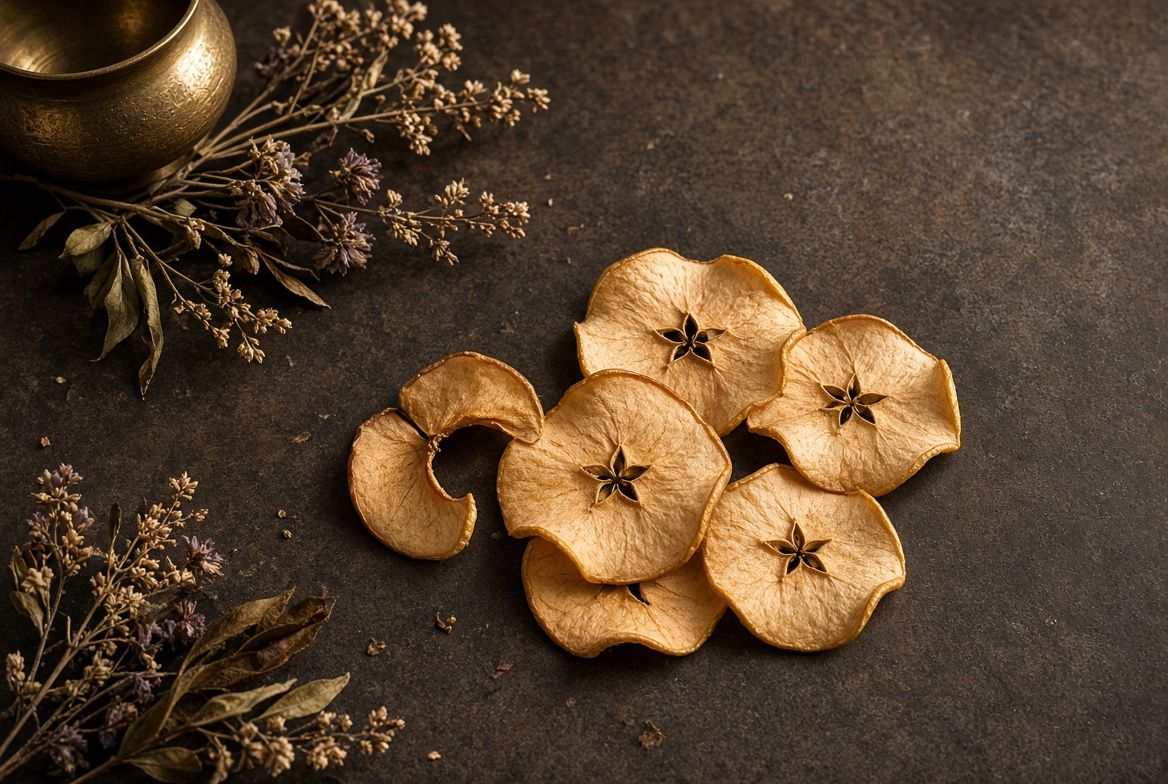
Inventory scope: Malus domestica · Rosaceae · dried fruit flesh, sometimes with peel.
Nomenclatural check: Malus domestica (Suckow) Borkh. is accepted in this treatment (family Rosaceae). A synonym listed there is Malus pumila var. domestica (Suckow) C.K.Schneid. in Ill. Handb. Laubholzk. 1: 715 (1906). The stated native range is Afghanistan to Central Asia and Xinjiang (Kew, Plants of the World Online: Malus domestica (Suckow) Borkh.).
Inventory decision: Specify peeled or unpeeled, cored, sweetened or unsweetened, and sulfited or unsulfited. A fruit piece, flavoring and apple seed are not interchangeable ingredients.
The article identifies commercial apple (Malus domestica Borkh.) as a deciduous member of the Rosaceae family and lists dried apples among the food products made from apples (A multifaceted overview of apple tree domestication).
The edible apple is identified as Malus domestica; dried apple slices were also called schnitz (Apple).
Botanical & Scientific Profile
Specify dried flesh, peel status, cultivar if known, and any sulfiting or other treatment. Fresh-fruit composition tables cannot be transferred directly to a sweetened or sulfited dried ingredient.
The FDA assessment lists dried apple slices as an example of a processed “other fruit and vegetable product.” It identifies mixing or blending other fruit and vegetable products, including dried, sliced apples, as a low-risk activity/food combination (Qualitative Risk Assessment: Risk of Activity/Food Combinations for Activities (Outside the Farm Definition) Conducted in a Facility Co-Located on a Farm).
Cultural History & Traditional Herbalism
A Pennsylvania Dutch food-history article reports that early Pennsylvania settlers quartered apples and hung them on strings by the kitchen fireplace to dry as schnitz; dried apples were used for winter storage and taken to market or used for barter (Apples, Apple Butter and Schnitz).
In Letters from an American Farmer (1782), Michel Crèvecoeur described drying apple slices on wooden platforms raised on poles. He said the slices spread on wooden boards were soon covered with neighborhood bees, wasps, and other sucking insects, which he believed accelerated drying (Apple).
Colonial-era dried apples, called schnitz, were stored in bags hung in attic rafters to keep them dry and away from mice. Pennsylvania Dutch settlers in eastern Pennsylvania developed a brisk business selling schnitz (Apple).
The chapter’s abstract states that apple drying had been practiced in the United States for well over a century as a commercial preservation method. It reports that in 1907, H. P. Gould described apple “evaporation” as apparently having begun in western New York State, where the industry had already been established for many years; the abstract does not name a particular community or specify a drying technique. The binomial Malus domestica is not stated (Dried Apple Products).
Tradition, Folklore & Symbolism
No separate inherited symbolic or ceremonial use of this identified part was established here. A documented food, trade or medicinal practice should remain under its own description rather than being relabeled as ritual.
Herbal Energetics
Insufficient documented evidence for a traditional energetic classification. No temperature, direction or channel is inferred from the flavor of a cup.
InfiniTea sensory metaphor: A season kept. This is original editorial language, not a measured physiological action or a translation of a traditional diagnostic category.
Sensory Profile & Tea Applications
Dried apples were used in pies and dumplings. Pennsylvania Dutch schnitz pie was made by cooking dried apples in water, adding sugar and spices, and baking the mixture in a lidded pie crust (Apple).
Sensory notebook: Compare the aroma of the dry piece with the strained brew. Record sugar on the ingredient label and do not assume all fruit sweetness passes into water.
Proposed comparison, not a completed trial: Compare slices of similar thickness and record browning, added sugar and any treatment indicated on the label. Record sweetness before and after dilution separately.
For ordinary dried herbal or fruit infusions, the German Federal Institute for Risk Assessment advises using boiling water and not leaving the prepared infusion standing for hours. Cooling a hot infusion and steeping untreated dry material in cold water are different processes; this report does not validate the latter (Boiling water a must for herbal teas).
Safety & Responsible Use
Illinois Extension’s food-preservation guidance says apple slices prepared for drying may be treated with ascorbic acid or an antidarkening/antimicrobial solution. Sodium bisulfite or sulfite dips are most effective against browning for long-term storage of dried apples, but people with asthma should not use them (Apples | Food Preservation - Illinois Extension).
The assessment states that many foodborne pathogens, including Salmonella spp., can survive for extended periods under dry conditions, even when they cannot grow. It does not provide commercial dried-fruit storage guidance or say that visibly dry pieces are pathogen-free (Qualitative Risk Assessment: Risk of Activity/Food Combinations for Activities (Outside the Farm Definition) Conducted in a Facility Co-Located on a Farm).
The FDA identifies dried apple slices as an example of a processed fruit and vegetable product and lists sulfites among chemical hazards associated with dried fruit and vegetable products. It states that sulfiting fruits and vegetables is not a low-risk activity because sulfites that are not properly declared on the label can cause serious adverse health consequences or death; declaring sulfites on the package label is identified as an intervention to control this hazard (Qualitative Risk Assessment: Risk of Activity/Food Combinations for Activities (Outside the Farm Definition) Conducted in a Facility Co-Located on a Farm).
The alert says undeclared sulfites are a labeling concern for sulfite-sensitive individuals who must avoid the ingredient because of potential health consequences, but it reports no observed adverse effects or clinical data. It identifies dried fruits among foods in which undeclared added sulfites are frequently found; it also states that sulfites are not major food allergens under the FD&C Act and should not appear in a “Contains” statement (Import Alert 99-21 — Detention Without Physical Examination of Food Products Containing Undeclared Added Sulfiting Agents).
Preparation and exposure boundary: This review does not establish a safe medicinal dose in pregnancy, lactation or childhood, or rule out interactions or allergy. Do not substitute essential oil or a concentrated extract for the documented food or herb.
For U.S. food use, the relevant safety determination concerns the intended conditions of use. The existence of a traditional preparation or herbal medicine monograph does not establish that this ingredient, dose and beverage are cleared for sale (Understanding How the FDA Regulates Food Additives and GRAS Ingredients).
Historical Trade, Ecology & Sustainability
The BCH organism record describes Malus domestica as a deciduous tree adapted primarily to temperate climates, predominantly associated with managed habitats such as commercial and domestic orchards, gardens, and other cultivated areas. It states that trees may also persist in disturbed sites, roadsides, field margins, abandoned orchards, and woodland edges (Malus domestica (Apple) | BCH-ORGA-SCBD-12099 | Organism).
The BCH organism record states that Malus domestica originated in Central Asia and is now widely cultivated in temperate regions across Europe, Asia, North America, South America, Australia, New Zealand, and parts of Africa. It gives the species’ native range as extending broadly from Afghanistan through Central Asia to Xinjiang, China (Malus domestica (Apple) | BCH-ORGA-SCBD-12099 | Organism).
Sourcing record: Request cultivar if known, cored fruit, peel status, additives, drying and storage specifications; a brown or pale slice does not prove how it was preserved.
InfiniTea Herb Lore & Ritualpreliminary draft
Energetics (original InfiniTea metaphor): A season kept. Use this as a private writing image, not a health statement.
Tradition & Folklore: The chapter’s abstract states that apple drying had been practiced in the United States for well over a century as a commercial preservation method. It reports that in 1907, H. P. Gould described apple “evaporation” as apparently having begun in western New York State, where the industry had already been established for many years; the abstract does not name a particular community or specify a drying technique. The binomial Malus domestica is not stated (Dried Apple Products). This is a record of use, not a claim of inherited ritual.
Ritual Cue (original contemporary InfiniTea interpretation): Write the date beside a memory of harvest or shared food. Add one detail that would be lost if you recorded only the season.
Private preliminary draft; not approved for publication.
Scholarly References & Research Verification
Research limitations
Check the ingredient statement and processing declaration, especially where sulfite sensitivity is relevant. Exclude seeds and core rather than studying them as tea material.
The assessment provides a broad qualitative analysis and does not report apple-slice-specific sulfite measurements, exposure estimates, or illness data (Qualitative Risk Assessment: Risk of Activity/Food Combinations for Activities (Outside the Farm Definition) Conducted in a Facility Co-Located on a Farm).
References below identify the evidence used, not additional endorsements. A botanical authority establishes nomenclature, not the identity of a physical lot. Published study samples, traditional descriptions and InfiniTea proposals are distinguished in the text.
- Kew, Plants of the World Online: Malus domestica (Suckow) Borkh. | Taxonomic backbone
- A multifaceted overview of apple tree domestication | review article
- Apple | encyclopedia reference article
- Qualitative Risk Assessment: Risk of Activity/Food Combinations for Activities (Outside the Farm Definition) Conducted in a Facility Co-Located on a Farm | FDA qualitative risk assessment
- Apples, Apple Butter and Schnitz | historical foodways article
- Apples | Food Preservation - Illinois Extension | Illinois Extension food-preservation guidance webpage
- Malus domestica (Apple) | BCH-ORGA-SCBD-12099 | Organism | Biosafety Clearing-House organism database record
- Dried Apple Products | Book chapter on processed apple products
- Import Alert 99-21 — Detention Without Physical Examination of Food Products Containing Undeclared Added Sulfiting Agents | FDA regulatory guidance for detaining specified imported foods from firms on the alert’s Red List when added sulfites are undeclared and analysis finds levels greater than 10 ppm. The page describes an initial Liquid Chromatography Mass Spectrometry analysis and, for results above 10 mg/kg, an AOAC Optimized Monier-Williams check analysis; it is not a clinical study.
- Boiling water a must for herbal teas | BfR press release providing general food-safety guidance for preparing herbal and fruit infusions.
- Understanding How the FDA Regulates Food Additives and GRAS Ingredients | U.S. FDA consumer-information webpage describing food-additive and GRAS ingredient oversight.
Final Botanical Summary
Drying is part of the ingredient identity. Cultivar history informs the fruit entry, while additives and storage determine questions about the purchased piece.
Editorial disposition: Lot unverified. The report is a private reference, not a clinical recommendation, approval for sale or authenticated sensory trial.
Verification Status (November 2026)
Phase II source audit, claim by claim
- Claims checked
- 11
- Corrected
- 2
- Withheld
- 0
- Sources
- 11
Material: Lot unverified. No physical sample has been examined.
Citation check: All 5 Safety & Use citations were re-read against their sources in November 2026 and confirmed.
A private research reference, not a clinical recommendation or product claim. Checked to the Grimoire's research standards →