
Botanical Identity & Classification
Inventory scope: Camellia sinensis · Theaceae · young leaves and buds.
Nomenclatural check: Camellia sinensis (L.) Kuntze is accepted in this treatment (family Theaceae). A synonym listed there is Camellia thea Link in Enum. Hort. Berol. Alt. 2: 73 (1822), nom. superfl. The stated native range is E. Himalaya to S. China and N. Indo-China, Hainan (Kew, Plants of the World Online: Camellia sinensis (L.) Kuntze).
Inventory decision: A tea name can identify a location, a leaf grade, an oxidation method, a scenting step or a combination. Keep each of these fields distinct on the purchase record.
The species is Camellia sinensis (L.) Kuntze, in the Theaceae family; the page describes tea as an Asian, caffeine-containing evergreen shrub (Oxford University Plants 400: Camellia sinensis).
Camellia sinensis is the plant whose leaves are used to make tea (Camellia sinensis: Labor and the Tea Plant).
Botanical & Scientific Profile
Variety, place, harvest and manufacture are independent descriptors. A rolled leaf is not a species, a tea named for a region is not necessarily one grade, and an aromatic flower used in scenting is not the source of the tea leaf.
A laboratory analysis of 20 commercial tea products found 14–61 mg of caffeine per 6- or 8-ounce serving of white, green, and black teas, with no observable trend in caffeine concentration by tea variety; steep time affected the concentration (Technical Note: Caffeine Content of Brewed Teas).
The page states that tea contains caffeine and complex mixtures of chemicals called polyphenols (Oxford University Plants 400: Camellia sinensis).
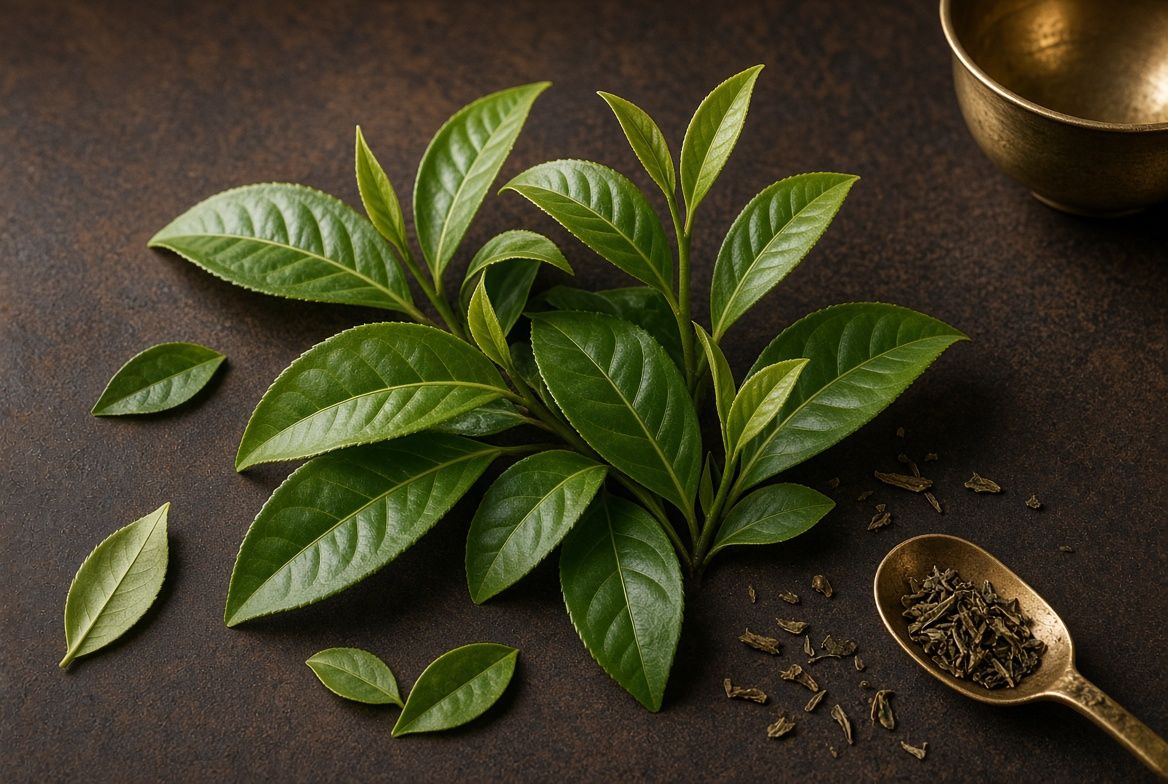
Camellia sinensis has glossy evergreen leaves and bright white flowers with yellow centers (Camellia sinensis: Labor and the Tea Plant).
Cultural History & Traditional Herbalism
The Ministry of Agriculture, Forestry and Fisheries’ Uji tea profile recounts that tea introduced by the priest Eisai was planted at Kozan-ji Temple and that part of it was later planted in Uji; it also describes Uji tea’s appreciation by the Ashikaga shogun family and the establishment of tea gardens with feudal-government encouragement. The profile credits Soen Nagatani in 1738 with devising the temomi hand-rolling production method, and identifies the Uji temomi method as a traditional sencha rolling method (Uji Tea | Traditional Foods in Japan).
The page states that in late seventeenth-century Europe, tea imported from China was an expensive, often adulterated luxury beverage, and that during the eighteenth century European East India companies entered complex trade relationships with China as tea began transforming international commerce (Oxford University Plants 400: Camellia sinensis).
The article reports that UNESCO added “Traditional tea processing techniques and associated social practices in China” to its intangible cultural heritage list on November 29, 2022; it is a report of an inscription, not a human study. The heritage element covers knowledge and practices related to managing tea plantations, picking tea leaves, manual processing, drinking, and sharing tea; the article names green, yellow, dark, white, oolong, and black teas and says China has over 2,000 tea products, including reprocessed teas such as flower-scented teas (China's traditional tea-making enters UNESCO cultural heritage list).
The review describes tea processing in China as involving regional artisanal methods: hand-plucking selected tender buds and young leaves, pan-firing, sun-withering, rolling, and charcoal roasting. It cites UNESCO’s 2026 item, “Traditional Tea Processing Techniques and Associated Social Practices in China”; separately, it says that from the Tang Dynasty onward, Lu Yu’s The Classic of Tea documented tea cultivation, processing, and consumption (From classical practices to precision agriculture: a multidisciplinary review of tea (Camellia sinensis)).
The evidence indicates that tea was grown about 2,100 years ago to meet the drinking habits of the Western Han Dynasty (207 BCE–9 CE), and was carried toward Central Asia by about 200 CE, several hundred years earlier than previously recorded. The earliest physical evidence from Chang'an and Ngari suggests that a branch of the Silk Road across the Tibetan Plateau was established in the second to third century CE (Earliest tea as evidence for one branch of the Silk Road across the Tibetan Plateau).
Tradition, Folklore & Symbolism
According to a legend set around 2737 BCE, Camellia sinensis leaves blew into water boiling in Emperor Shen Nong’s garden. After tasting the drink, he exclaimed “t’sa,” meaning “godlike,” and the name “cha” was adopted for the drink (Camellia sinensis: Labor and the Tea Plant).
The page states that tea became an eighteenth-century social fad among Britain’s middle and upper classes, associated with a refined, often pretentious tea-drinking culture; during the Industrial Revolution, the burgeoning urban population began relying on tea, and the stereotype of Britain as a nation of tea drinkers was born (Oxford University Plants 400: Camellia sinensis).
Herbal Energetics
Insufficient documented evidence for a traditional energetic classification. No temperature, direction or channel is inferred from the flavor of a cup.
InfiniTea sensory metaphor: Attention across change. This is original editorial language, not a measured physiological action or a translation of a traditional diagnostic category.
Sensory Profile & Tea Applications
The page states that tea flavour depends on where tea plants grow, the quality of harvested leaves, and how processing modifies polyphenols (Oxford University Plants 400: Camellia sinensis).
The authors suggested that farmers may have selected hybrid landraces of Chinese Assam type tea for their unique taste, associating these hybrids with low caffeine and high theobromine content (Domestication Origin and Breeding History of the Tea Plant (Camellia sinensis) in China and India Based on Nuclear Microsatellites and cpDNA Sequence Data).
Black Tea, including Assam and CTC
The article identifies Assam as a major tea-growing region and says it produces both orthodox whole-leaf tea and CTC tea. It defines CTC as Crush, Tear, Curl: a machine processes withered leaves by crushing, tearing, and curling them into small, uniform pellets. In its historical account, the article says that in 1823 Robert Bruce encountered the Singpho community in Upper Assam, who had prepared beverages from a wild tea-like plant for generations. Leaf samples were later sent to the Botanical Gardens in Calcutta and identified as Camellia sinensis var. assamica; the first British tea garden was established at Chabua in 1837 (Detailed Profile of the Tea Industry in India).
The Tea Board of India describes Assam teas as deep amber, strong, full-bodied and malty. Both orthodox and CTC teas are manufactured there; “Assam Orthodox” is a registered geographical indication. Malt is a sensory comparison here, not evidence of added barley (Assam).
One commercially published Indian-style masala chai recipe simmers CTC tea with milk and judges the finished cup partly by its toffee color. This documents one recipe, not a single traditional method for Assam or for India (Assam Milk Tea Recipe: Steeped, Boiled and Iced).
Preparation comparison: Compare CTC and orthodox leaf from a documented Assam origin. Start checking the granular brew earlier; record body, astringency and whether milk changes the balance, rather than assuming every Assam is CTC.
Green Tea
The article’s historical account says that steaming tea leaves stopped them from darkening; it does not specify an enzymatic mechanism. Chinese tea makers later moved largely to roasting and pan-firing, and most fine Chinese green teas are still pan-fired. Japan retained steaming, and the 1738 method of steaming and rolling loose leaf developed by tea producer Soen Nagatani led to sencha. The article describes Japanese tea as first influenced by China and later developing apart from it, with local innovations (The History of Green Tea: From Ancient China to Japan’s Way of Tea).
Uji tea is defined as green tea made by Kyoto Prefecture processors from leaves grown in Kyoto, Nara, Shiga, or Mie Prefectures, using a production method originating in the Uji region. In 1738, Soen Nagatani devised the temomi method: steaming tea buds and drying them over a tea drier while rolling them by hand; the page identifies this as the origin of subsequent Japanese tea production methods. Sencha is made from open-air-grown leaves that are steamed, rolled, and dried. For brewing, the page says to put leaves in a teapot and pour in hot water, adjusting the water temperature to the characteristics of the leaves; it gives no specific temperature (Uji Tea | Traditional Foods in Japan).
Japan’s agricultural ministry contrasts the refreshing bitterness of open-air-grown sencha with the richer umami of shaded leaves. Its Uji guidance adjusts water temperature to the tea rather than prescribing a universal figure (Uji Tea | Traditional Foods in Japan).
Preparation comparison: Compare one labeled steamed tea and one pan-fired tea. Use the maker’s brewing guidance first and then vary water temperature alone; note vegetal aroma, roast notes and bitterness.
Gunpowder Green Tea
Firsd Tea’s product profile describes Gunpowder 3505 as green tea made from leaves from Zhejiang Province, China, tightly rolled into pearl-shaped pellets, and identifies it as the main ingredient of Moroccan mint green tea (Gunpowder - Green Tea).
The article, dated June 9, 2026, says traditional Moroccan mint tea, often called atay, is made with Chinese gunpowder green tea, fresh mint, and sugar. The tea leaves are rinsed with hot water, then mint and sugar are added and the tea is steeped in a small metal teapot. The article describes mint tea as a common way to welcome guests and share conversation in Morocco, including in homes and shops. It says the tea is usually very sweet and is poured from above the glass, forming a light foam (Mint Tea 101).
In a published Moroccan family account, rinsed gunpowder tea, fresh mint and sugar are served in small glasses as hospitality. The author describes pouring from a height. This is one family’s account, not a fixed recipe for an entire country (Moroccan Mint Tea Ritual).
Preparation comparison: Allow room for the pellets to open. Taste the base separately from a mint-and-sugar preparation, recording which notes come from the leaf and which from the additions. Do not present a single house recipe as the Moroccan standard.
Longjing / Dragon Well
The article describes Longjing leaves as hand-pressed into flat, spear-like shapes during pan-firing. It traces the tea’s history to the Song dynasty (960–1279), says it peaked during the Qing dynasty (1644–1911), and reports that Longjing was presented to world leaders at Hangzhou’s 2016 G20 summit (The quintessential tea missing from 'Chinamaxxing').
A Hangzhou account follows Fan Shenghua, a practitioner of West Lake Longjing pan-frying who has taught the craft in schools. This evidence places skill transmission with a named practitioner; a flat leaf in a packet does not authenticate West Lake origin (A closer look at Chinese tea's application for world heritage status).
In a Longjing brewing experiment, sensory evaluation at 70–80 °C found more umami and less bitterness and astringency; 70 °C performed best in that comparison. This is a result for the studied tea and conditions, not a universal definition of the traditional method (Deng and colleagues, brewing temperature and Longjing sensory quality).
Preparation comparison: Use a clear vessel for a comparative infusion and watch the flat leaves move. Record origin as declared: a flattened green leaf alone cannot prove West Lake provenance.
Jasmine Green Tea / Dragon Pearls
The Fujian Provincial People’s Government page describes Fuzhou’s jasmine tea scenting technique as using refined green tea leaves and high-quality jasmine flowers from Fuzhou: mature flowers release fragrance that the tea absorbs. It says the technique transitioned to large-scale commercial production during the Qing Dynasty (1644–1911) and the tea served as a tribute to the royal court (National ICH: Fuzhou jasmine tea scenting technique).
Fuzhou’s agricultural heritage nomination describes ready-to-open jasmine buds and baked green tea being mixed, aired to release heat, re-piled and separated from spent blossoms. This is evidence of a regional scenting craft, not a requirement that all jasmine teas contain visible flowers or be rolled into pearls (Jasmine and Tea Culture System of Fuzhou City. GIAHS Proposal for the Globally Important Agricultural Heritage Systems (GIAHS) Initiative).
The Fuzhou nomination describes a persistent floral aroma and sweet taste, and a serving sequence that includes viewing the leaf, steeping, decanting to a pitcher and serving. It distinguishes floral scenting from the commercial presentation called “dragon pearl.” (Jasmine and Tea Culture System of Fuzhou City. GIAHS Proposal for the Globally Important Agricultural Heritage Systems (GIAHS) Initiative).
Preparation comparison: Give rolled leaf space to unfurl and compare aroma across two infusions. Do not count decorative blossoms as proof of scenting quality or presume every jasmine green tea is pearl-shaped.
White Tea
The article says Fuding white tea production involves no frying or rolling and allows moderate natural oxidation; it lists withering and drying among the production techniques. It also states that the technique is recognized as a national intangible cultural heritage item under the traditional craft category (National ICH: Fuding white tea production technique).
The page describes Fuding white tea production as using natural withering without roasting, a distinctive method it says is the only white tea practice listed as intangible cultural heritage in China. It states that traditional white tea production, particularly the withering and drying stages, is adapted to local conditions and raw materials and reflects generations of accumulated knowledge (Fuding White Tea Culture System).
Fujian’s heritage account describes Fuding white tea as fresh and sweet, with a delicate aroma and apricot-yellow liquor. Its serving sequence gives time to observe the tea and smell it before tasting; it does not prescribe a universal steeping time (National ICH: Fuding white tea production technique).
Preparation comparison: Observe the mixed colors of wet leaf and record liquor color and aroma. Do not infer caffeine exposure from pallor or assume that a delicate profile requires one universal brewing temperature.
Lapsang Souchong
The article’s introduction identifies Tongmu Village, Xingcun Town, in the Wuyi (Bohea) Mountains of Fujian, China, as the core producing area of Lapsang Souchong black tea (Camellia sinensis). It states that smoking the tea with a flame of rolling pine needles or branches gives it a smoky pine aroma (Molecular insights into the contribution of specialty smoking process to the aroma of Lapsang Souchong black tea (Camellia sinensis)).
The page states that Lapsang Souchong black tea is processed by smoking with a flame of rolling pine needles or branches and is known for its smoky pine aroma. It identifies Tongmu Village, Xingcun Town, Wuyi (Bohea) Mountain, Fujian, China, as the tea’s core producing area, and says the distinctive smoking procedure contributes to the final tea’s sensory characteristics. The introduction reports that α-terpineol, 4-methylguaiacol, geraniol, and juniperol were the most plentiful compositions in SLS black tea, together accounting for up to 44.2% of total volatile compounds, citing Yao et al. (2005) (Molecular insights into the contribution of specialty smoking process to the aroma of Lapsang Souchong black tea (Camellia sinensis)).
A contemporary tea guide contrasts a smoked Tongmu tea with an unsmoked product carrying honey and longan comparisons, and describes successive small-vessel infusions. This is a guide’s sensory vocabulary, not a historical recipe or a blinded tasting (Lapsang Souchong: Pine Smoke, Longan, and Jin Jun Mei).
Preparation comparison: Compare a labeled pine-smoked example with an unsmoked black tea. Keep the cup and strainer separate during a comparison so residual smoke aroma does not mask the next sample.
Bai Mudan / White Peony Tea
Hey China’s retail page for Fuding White Peony describes it as Fujian white tea made from one bud and two leaves, and provides cup and gongfu-style brewing instructions, including repeat infusions. This is a product description, not evidence of a universal grade specification (Fuding White Peony Tea (Bai Mudan) - Hey China).
In a controlled Fujian comparison, spring shoots from three named cultivars were processed alike as Bai Mudan and evaluated by seven trained tasters. Zhenghe Dabaicha showed pronounced floral notes, Fuan Dabaicha a mild floral and green-apple nuance, and Fuding Dahaocha more downy aroma and sweetness. Those are the panel’s findings for these samples, not tasting results for InfiniTea (Chemical Profiling and Sensory Analysis Reveal Quality Differentiation in Baimudan White Tea Processed from Three Major Fujian Tea Cultivars).
One Fuding White Peony seller gives repeated small-vessel infusions as an option and describes its own tea as mellow, floral and grassy. That product description is kept separate from the controlled cultivar comparison (Fuding White Peony Tea (Bai Mudan) - Hey China).
Preparation comparison: Examine the bud-to-leaf mix and compare one longer infusion with successive shorter ones. “White Peony” is a tea name here, not a declaration of peony petals as an ingredient.
Proposed comparison, not a completed trial: Keep a separate tasting sheet for each of the eight styles. Record the first and subsequent infusions, then compare only samples for which the leaf mass, water and vessel are known.
For these eight styles, the proposed comparisons are sensory observations, not validated processing schedules for bottled cold tea.
Safety & Responsible Use
NCCIH’s safety summary for green tea (Camellia sinensis) reports no safety concerns for adults consuming it as a beverage, while green tea extract supplements can cause side effects. Uncommon liver injuries have been reported, primarily with extracts in tablet or capsule form. Green tea at high doses can reduce blood levels and effectiveness of nadolol, and green tea products may interact with other medicines (Green Tea: Usefulness and Safety).
In this study of commercial brewed teas, caffeine concentration differed across samples, showed no observable trend by tea variety, and was affected by steep time (Technical Note: Caffeine Content of Brewed Teas).
NCCIH’s safety guidance says green tea (Camellia sinensis) contains caffeine. During pregnancy, caffeine intake should not exceed moderate levels; people who are or might be pregnant are advised to consult a health care provider. High caffeine intake while breastfeeding can cause fussiness and poor sleep in an infant, while breastfeeding infants usually do not have adverse effects when mothers consume low-to-moderate caffeine. The source does not discuss white tea or recommend accounting for total daily caffeine intake (Green Tea: Usefulness and Safety).
For green tea infusions, EFSA experts found generally no indication of liver damage, even after high consumption; the few reported human cases were considered likely to reflect rare, unpredictable reactions. They considered hot-water-brewed infusions and instant or ready-to-drink beverages with similar catechin content generally safe. In supervised human studies of supplements, EGCG doses of 800 mg/day may have been associated with initial signs of liver damage; this finding concerns supplements, not brewed infusions (EFSA assesses safety of green tea catechins).
Preparation and exposure boundary: This review does not establish a safe medicinal dose in pregnancy, lactation or childhood, or rule out interactions or allergy. Do not substitute essential oil or a concentrated extract for the documented food or herb.
For U.S. food use, the relevant safety determination concerns the intended conditions of use. The existence of a traditional preparation or herbal medicine monograph does not establish that this ingredient, dose and beverage are cleared for sale (Understanding How the FDA Regulates Food Additives and GRAS Ingredients).
Historical Trade, Ecology & Sustainability
The page describes the Assam Valley tea industry as an early commercial enterprise established by private British capital. From 1872 to 1900, the area under tea cultivation expanded from 27,000 to 204,000 acres (Power Structure, Discipline, and Labour in Assam Tea Plantations under Colonial Rule).
British colonizers established tea plantations in Assam, initially importing Chinese tea plants and Chinese laborers. After many Chinese laborers refused work beyond the scope of their jobs, including clearing forest for tea cultivation, the colonizers turned to the Naga people of Upper Assam. The colonizers later planted native Assam tea varieties and relied on indentured Central Indian laborers. A 2019 Oxfam report estimates that up to 750,000 women, men, and children were brought to Assam between 1870 and 1900; it says children made up one-third of the workforce in 1877 and half by 1930 (Camellia sinensis: Labor and the Tea Plant).
The page states that Fortune’s tea plants were established in northern India alongside native Indian tea plants and eventually spread across the British Empire as a cheap, guaranteed tea supply (Oxford University Plants 400: Camellia sinensis).
Sourcing record: Record region, estate or collective, leaf grade, harvest season and process; ask about worker protections rather than treating an origin name as a labor credential.
InfiniTea Herb Lore & Ritualpreliminary draft
Energetics (original InfiniTea metaphor): Attention across change. Use this as a private writing image, not a health statement.
Tradition & Folklore: According to a legend set around 2737 BCE, Camellia sinensis leaves blew into water boiling in Emperor Shen Nong’s garden. After tasting the drink, he exclaimed “t’sa,” meaning “godlike,” and the name “cha” was adopted for the drink (Camellia sinensis: Labor and the Tea Plant).
Ritual Cue (original contemporary InfiniTea interpretation): Observe the same leaf dry, wet and opened. Write one true sentence about each state without ranking them.
Private preliminary draft; not approved for publication.
Scholarly References & Research Verification
Research limitations
Look for grower, region, harvest, cultivar, processing sequence and scenting or smoking declaration. Do not infer caffeine content from liquor color or leaf shape.
The article describes the Silk Road branch as suggested by the evidence; the date of its establishment is given as the second to third century CE (Earliest tea as evidence for one branch of the Silk Road across the Tibetan Plateau).
References below identify the evidence used, not additional endorsements. A botanical authority establishes nomenclature, not the identity of a physical lot. Published study samples, traditional descriptions and InfiniTea proposals are distinguished in the text.
- Kew, Plants of the World Online: Camellia sinensis (L.) Kuntze | Taxonomic backbone
- Oxford University Plants 400: Camellia sinensis | botanical species profile and historical narrative
- Camellia sinensis: Labor and the Tea Plant | JSTOR Daily article from the Dumbarton Oaks Plant Humanities Initiative
- Technical Note: Caffeine Content of Brewed Teas | journal article; laboratory analytical study
- Uji Tea | Traditional Foods in Japan | official government traditional-food profile
- Domestication Origin and Breeding History of the Tea Plant (Camellia sinensis) in China and India Based on Nuclear Microsatellites and cpDNA Sequence Data | research study
- Detailed Profile of the Tea Industry in India | Informational web article
- The History of Green Tea: From Ancient China to Japan’s Way of Tea | historical article
- Gunpowder - Green Tea | commercial tea product profile
- The quintessential tea missing from 'Chinamaxxing' | feature article
- National ICH: Fuzhou jasmine tea scenting technique | government cultural heritage information page
- National ICH: Fuding white tea production technique | government informational article
- Molecular insights into the contribution of specialty smoking process to the aroma of Lapsang Souchong black tea (Camellia sinensis) | research article
- Fuding White Peony Tea (Bai Mudan) - Hey China | commercial retail product page
- Green Tea: Usefulness and Safety | government health fact sheet
- Power Structure, Discipline, and Labour in Assam Tea Plantations under Colonial Rule | Research Article
- China's traditional tea-making enters UNESCO cultural heritage list | official news report
- From classical practices to precision agriculture: a multidisciplinary review of tea (Camellia sinensis) | Multidisciplinary review article
- Earliest tea as evidence for one branch of the Silk Road across the Tibetan Plateau | Phytoliths and biomolecular components extracted from ancient plant remains from Chang'an (Xi'an) and Ngari (Ali), western Tibet, China.
- EFSA assesses safety of green tea catechins | EFSA assessed possible links between epigallocatechin gallate (EGCG), the most abundant catechin in green tea, and liver damage. For infusions, the assessment considered reported human cases and consumption data; for supplements, it also considered human studies conducted with volunteers under medical supervision. The page does not specify the studies’ names, sample sizes, or durations.
- Assam | Official Tea Board India webpage describing Assam tea.
- Assam Milk Tea Recipe: Steeped, Boiled and Iced | Teabox vendor blog recipe and tea-tasting guide, by the Teabox Tea Tasting Team.
- Mint Tea 101 | USAC blog article about Moroccan mint tea and hospitality
- Moroccan Mint Tea Ritual | Personal ethnographic account published on the USC Folklore Archives website.
- A closer look at Chinese tea's application for world heritage status | News feature about the application of Chinese tea-making techniques and associated social practices for UNESCO intangible cultural heritage status.
- Deng and colleagues, brewing temperature and Longjing sensory quality | Primary sensory and chemical study; PubMed abstract
- Jasmine and Tea Culture System of Fuzhou City. GIAHS Proposal for the Globally Important Agricultural Heritage Systems (GIAHS) Initiative | Fuzhou Municipal Government GIAHS proposal, dated February 20, 2014
- Jasmine and Tea Culture System of Fuzhou City. GIAHS Proposal for the Globally Important Agricultural Heritage Systems (GIAHS) Initiative | A 2014 GIAHS proposal PDF from the Fuzhou Municipal Government.
- Fuding White Tea Culture System | Informational webpage about Fuding’s white tea agricultural heritage and production
- National ICH: Fuding white tea production technique | Fujian Provincial People's Government culture-and-arts webpage; credited to govt.chinadaily.com.cn.
- Lapsang Souchong: Pine Smoke, Longan, and Jin Jun Mei | Informational tea guide article from ChineseTeaGuide.com
- Chemical Profiling and Sensory Analysis Reveal Quality Differentiation in Baimudan White Tea Processed from Three Major Fujian Tea Cultivars | Experimental sensory evaluation and chemical profiling of Baimudan white tea
- Understanding How the FDA Regulates Food Additives and GRAS Ingredients | U.S. FDA consumer-information webpage describing food-additive and GRAS ingredient oversight.
Final Botanical Summary
Eight entries share a botanical origin but not a single method or cultural history. Caffeine and extract safety cannot be inferred from the color word in a tea name.
Editorial disposition: Lot unverified. The report is a private reference, not a clinical recommendation, approval for sale or authenticated sensory trial.
Verification Status (November 2026)
Phase II source audit, claim by claim
- Claims checked
- 26
- Corrected
- 8
- Withheld
- 1
- Sources
- 33
Material: Lot unverified. No physical sample has been examined.
Citation check: All 5 Safety & Use citations were re-read against their sources in November 2026 and confirmed.
A private research reference, not a clinical recommendation or product claim. Checked to the Grimoire's research standards →