
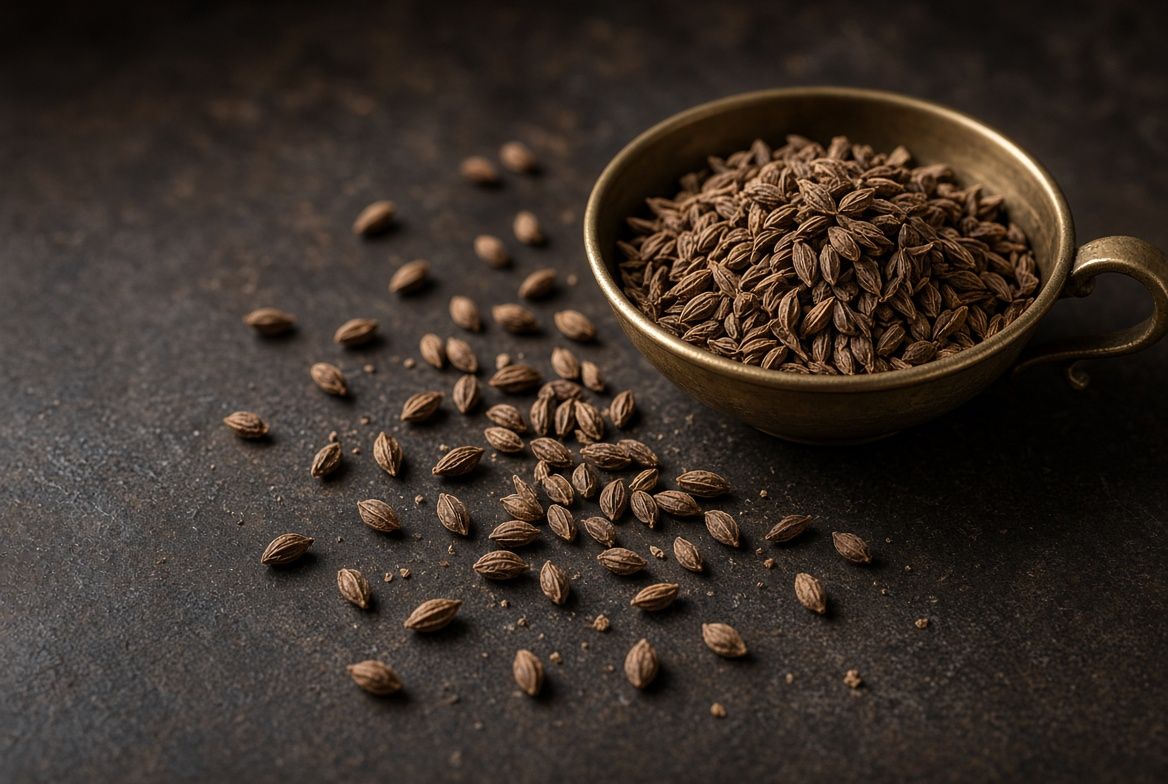
Botanical Identity & Classification
Inventory scope: Pimpinella anisum · Apiaceae · dry fruit.
Nomenclatural check: Pimpinella anisum L. is accepted in this treatment (family Apiaceae). A synonym listed there is Anisum vulgare Gaertn. The stated native range is SE. Türkiye to Central Israel, Cyprus (Kew, Plants of the World Online: Pimpinella anisum L.).
Inventory decision: The kitchen “seed” is a fruit. Distinguish this annual herb from star anise, which comes from a tree; do not recommend essential oil or home preparations for infants.
The Herb Society of America fact sheet identifies anise, or aniseed, as the annual plant Pimpinella anisum and says its aromatic fruits are commonly called seeds (Anise, Pimpinella anisum).
The PROSEA record identifies anise as Pimpinella anisum L. (family Umbelliferae) and lists Apium anisum (L.) Crantz, Anisum vulgare Gaertner, and Anisum officinarum Moench as synonyms (Pimpinella anisum L. - PROSEA).
Botanical & Scientific Profile
“Seed” is the culinary name for the dry fruit; it does not make aniseed a close relative of star anise. Similar aroma cannot make the toxicological records interchangeable.
The HMPC’s traditional-use conclusions for dried fruit (aniseed) of Pimpinella anisum L. cover symptoms of mild indigestion, including bloating and flatulence, and use as an expectorant for coughs associated with colds. The page states that clinical-trial evidence is insufficient; the conclusions are based on traditional use, including evidence of safe use for at least 30 years, at least 15 of them in the EU (Anisi fructus - herbal medicinal product).
A randomized, crossover, placebo-controlled, single-blind clinical trial in 20 people with chronic constipation tested a tea combining Pimpinella anisum L. fruit (aniseed), Foeniculum vulgare, Sambucus nigra L., and Cassia angustifolia. Mean radiologically measured colonic transit time was 15.7 hours during the active-treatment period and 42.3 hours during placebo treatment (p < 0.001); because the trial tested a multi-herb combination, it does not establish an effect of aniseed alone (Assessment report on Pimpinella anisum L., fructus and Pimpinella anisum L., aetheroleum).
The Herb Society of America fact sheet says the essential oil of anise (Pimpinella anisum) is reportedly antibacterial, antiviral, insecticidal, expectorant, antispasmodic, and estrogenic; it gives no preparation, route, study type, results, or limitations (Anise, Pimpinella anisum).
Cultural History & Traditional Herbalism
The Herb Society of America fact sheet reports that Egyptians were the first to cultivate anise as a spice, and that ancient culinary uses also occurred in Greece and Rome (Anise, Pimpinella anisum).
The PROSEA record says anise probably originated in the eastern Mediterranean region and was used by ancient Egyptians about 1500 BC; it also records use by the Greeks and Romans (Pimpinella anisum L. - PROSEA).
The report states that traditional Indian medicine used Pimpinella anisum L. fruit (aniseed) as an antiseptic, stomachic, carminative, and stimulant, and to prevent flatulence and colic (Assessment report on Pimpinella anisum L., fructus and Pimpinella anisum L., aetheroleum).
The page identifies Pimpinella anisum as anise and reports that it was native to the Mediterranean region, perhaps Egypt. It equates the ancient Egyptian term inst with anise and says the Papyrus Ebers (c. 1550 BCE) mentions it as a medicine for abdominal and dental diseases. It also reports that Pliny, writing in the first century CE, described esteemed anise varieties from Crete and Egypt and recorded Egyptian uses of anise mixed with wine for treating poisonous snake bites (Anise – Nutritional Geography).
Tradition, Folklore & Symbolism
The Herb Society of America fact sheet says Romans ate anise-seed cakes at the end of feasts and that use following celebrations led to special cakes after a wedding (Anise, Pimpinella anisum).
The PROSEA record states that in the Netherlands, sugar-coated anise seeds are given to guests visiting a newborn baby (Pimpinella anisum L. - PROSEA).
Herbal Energetics
Insufficient documented evidence for a traditional energetic classification. No temperature, direction or channel is inferred from the flavor of a cup.
InfiniTea sensory metaphor: A familiar note in another voice. This is original editorial language, not a measured physiological action or a translation of a traditional diagnostic category.
Sensory Profile & Tea Applications
The Herb Society of America fact sheet says anise (Pimpinella anisum) gives candies a pronounced licorice flavor and has a flavor similar to star anise (Illicium verum) and Florence fennel (Foeniculum vulgare) (Anise, Pimpinella anisum).
The PROSEA record describes anise as aromatic and its fruit-derived essential oil as having the fruit’s characteristic odour and sweet taste (Pimpinella anisum L. - PROSEA).
Sensory notebook: Compare intact and lightly broken culinary fruit by aroma. Write “licorice-like” as a flavor analogy only, not as a declaration of licorice content.
Proposed comparison, not a completed trial: Place a labeled anise fruit beside a photograph of an authenticated culinary star anise. Sketch the contrast before describing the common aromatic impression.
For ordinary dried herbal or fruit infusions, the German Federal Institute for Risk Assessment advises using boiling water and not leaving the prepared infusion standing for hours. Cooling a hot infusion and steeping untreated dry material in cold water are different processes; this report does not validate the latter (Boiling water a must for herbal teas).
Safety & Responsible Use
The EMA summary says medicines containing dried fruit (aniseed) of Pimpinella anisum L. must not be used by people allergic to aniseed, anethole, or plants of the Apiaceae family (Umbelliferae), specifically caraway, celery, coriander, dill, or fennel. Allergic reactions affecting the skin or airways may occur (Anisi fructus - herbal medicinal product).
The report contraindicates anise oil for children and adolescents, and does not recommend aniseed or aniseed preparations for children under 12 because adequate safety data are lacking. It describes a case report of a 12-day-old infant who received multiple doses of undiluted anise oil for colic and developed generalized tonic-clonic seizures; no further seizures were noted after hospital admission, and the infant recovered without reported sequelae (Assessment report on Pimpinella anisum L., fructus and Pimpinella anisum L., aetheroleum).
The summary concerns the fruit of Pimpinella anisum L., including dried aniseed and preparations made by drying and comminuting or crushing it. It states that aniseed medicines must not be used by people allergic to aniseed, Apiaceae plants (caraway, celery, coriander, dill or fennel), or anethole, and that allergic skin or airway reactions may occur (Aniseed herbal summary - European Medicines Agency).
The monograph lists known sensitivity to Apiaceae (including fennel, caraway, coriander and dill) or anethol as a contraindication, warns that people with known Asteraceae sensitivity should avoid aniseed because of cross-reactivity risk, and says allergic reactions affecting the skin, respiratory system or gastrointestinal system may occur; it does not report specific human cases or study details. It states that there are no data on aniseed use in pregnant patients, that animal studies showed reproductive toxicity of trans-anethol, and that whether aniseed constituents enter human breast milk is unknown; use during pregnancy and lactation is not recommended. Interactions are listed as not known (Draft Community Herbal Monograph on Pimpinella anisum L., fructus).
Preparation and exposure boundary: This review does not establish a safe medicinal dose in pregnancy, lactation or childhood, or rule out interactions or allergy. Do not substitute essential oil or a concentrated extract for the documented food or herb.
For U.S. food use, the relevant safety determination concerns the intended conditions of use. The existence of a traditional preparation or herbal medicine monograph does not establish that this ingredient, dose and beverage are cleared for sale (Understanding How the FDA Regulates Food Additives and GRAS Ingredients).
Historical Trade, Ecology & Sustainability
The PROSEA record states that anise-specific production and trade statistics are unavailable because anise is grouped with other spices in the “spice seeds” category. It estimates world trade of all spice seeds at 44,000–53,000 tonnes annually in 1976–1980, and annual anise-oil production at 40–50 tonnes in the 1980s; the former Soviet Union, Spain, and Poland were the main exporting countries, and France was the main importer (Pimpinella anisum L. - PROSEA).
The PROSEA record states that anise can be grown in temperate and subtropical climates but does not grow well in tropical lowlands. It lists cultivation in southern Europe, especially Spain and Italy, the former Soviet Union, Bulgaria, Romania, Turkey, Iran, northern Africa, India, China, Japan, Chili, Argentina, and Mexico, and says anise is only very occasionally grown in South-East Asia (Pimpinella anisum L. - PROSEA).
Sourcing record: Request whole or authenticated cut fruit, country of cultivation and controls against mixing similarly scented spices during packing.
InfiniTea Herb Lore & Ritualpreliminary draft
Energetics (original InfiniTea metaphor): A familiar note in another voice. Use this as a private writing image, not a health statement.
Tradition & Folklore: The Herb Society of America fact sheet says Romans ate anise-seed cakes at the end of feasts and that use following celebrations led to special cakes after a wedding (Anise, Pimpinella anisum).
Ritual Cue (original contemporary InfiniTea interpretation): Write two words that sound alike but mean different things. Use each in a sentence that makes the difference clear.
Private preliminary draft; not approved for publication.
Scholarly References & Research Verification
Research limitations
Retain fruit identity and Apiaceae allergy evidence; exclude star-shaped fruits, foraged look-alikes and essential oil from the aniseed test.
References below identify the evidence used, not additional endorsements. A botanical authority establishes nomenclature, not the identity of a physical lot. Published study samples, traditional descriptions and InfiniTea proposals are distinguished in the text.
- Kew, Plants of the World Online: Pimpinella anisum L. | Taxonomic backbone
- Anise, Pimpinella anisum | educational fact sheet
- Pimpinella anisum L. - PROSEA | botanical and agronomic handbook database record
- Anisi fructus - herbal medicinal product | EMA summary of the HMPC’s scientific conclusions on a herbal medicinal product
- Assessment report on Pimpinella anisum L., fructus and Pimpinella anisum L., aetheroleum | European Medicines Agency Committee on Herbal Medicinal Products (HMPC) final assessment report
- Aniseed herbal summary - European Medicines Agency | official herbal-medicine summary
- Anise – Nutritional Geography | Historical and ethnobotanical summary webpage
- Draft Community Herbal Monograph on Pimpinella anisum L., fructus | A 2006 draft EMA/HMPC monograph on aniseed, identified as dried Pimpinella anisum L. fruit, including comminuted aniseed and oral herbal preparations such as tea. It is a traditional-use monograph, not a report of a clinical safety study; it cites animal reproductive-toxicity findings for trans-anethol and provides no data from use in pregnant patients.
- Boiling water a must for herbal teas | BfR press release providing general food-safety guidance for preparing herbal and fruit infusions.
- Understanding How the FDA Regulates Food Additives and GRAS Ingredients | U.S. FDA consumer-information webpage describing food-additive and GRAS ingredient oversight.
Final Botanical Summary
Sweet anise notes recur in unrelated plants. Species, organ and route of use carry more information than flavor resemblance.
Editorial disposition: Lot unverified. The report is a private reference, not a clinical recommendation, approval for sale or authenticated sensory trial.
Verification Status (November 2026)
Phase II source audit, claim by claim
- Claims checked
- 16
- Corrected
- 2
- Withheld
- 0
- Sources
- 10
Material: Lot unverified. No physical sample has been examined.
Citation check: All 5 Safety & Use citations were re-read against their sources in November 2026 and confirmed.
A private research reference, not a clinical recommendation or product claim. Checked to the Grimoire's research standards →