
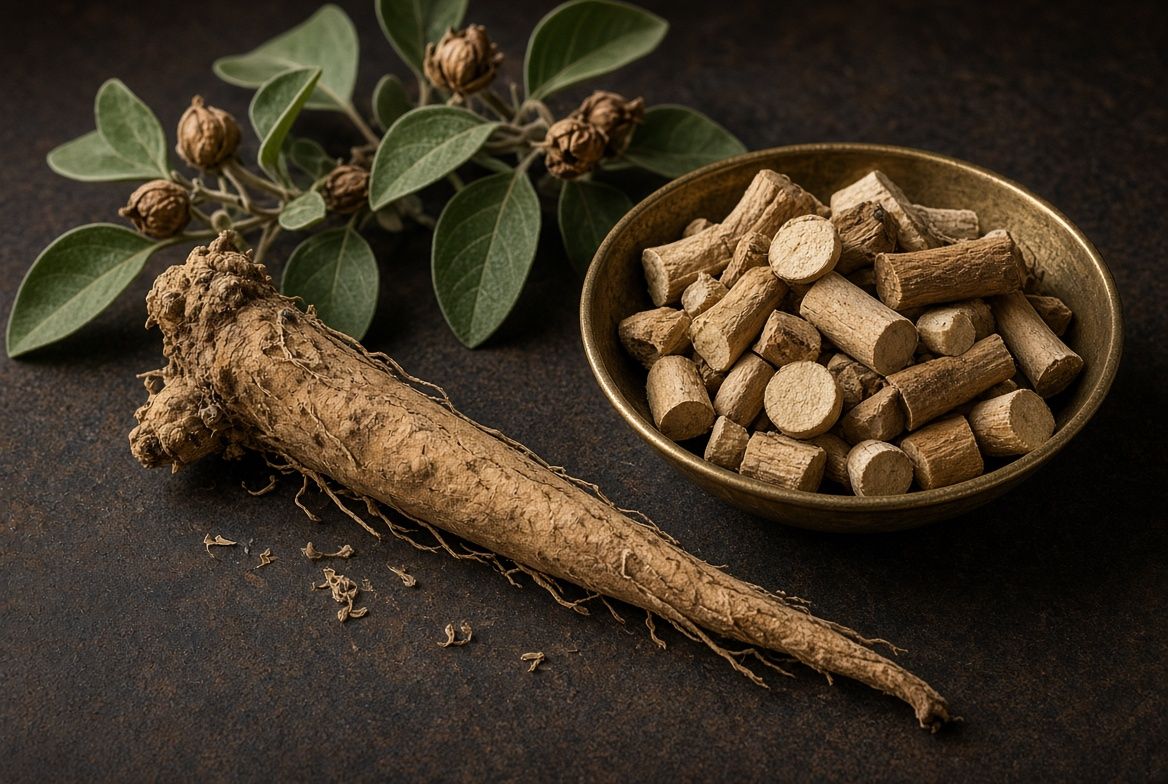
Botanical Identity & Classification
Inventory scope: Withania somnifera · Solanaceae · root.
Nomenclatural check: Withania somnifera (L.) Dunal is accepted in this treatment (family Solanaceae). A synonym listed there is Withania chevalieri A.E.Gonç. The stated native range is S. Europe to Central China, Africa to Myanmar (Kew, Plants of the World Online: Withania somnifera (L.) Dunal).
Inventory decision: Separate cut root, powdered root consumed whole, standardized root extract and combined root-and-leaf extract. Do not convert a capsule trial into a recommendation for a nightly cup.
The species is Withania somnifera (L.) Dunal, an evergreen shrub that is not part of the ginseng family (Ashwagandha: Is it helpful for stress, anxiety, or sleep? - Health Professional Fact Sheet).
Kew identifies ashwagandha as Withania somnifera and places it in the nightshade family, Solanaceae (Ashwagandha - Withania somnifera - Kew Gardens).
Botanical & Scientific Profile
Root-only material, extracts made from root and leaf, and preparations standardized by withanolide content belong on separate lines in an evidence table. A clinical outcome for a particular extract is not a dose conversion for brewing dried root.
Ashwagandha root and leaf differ chemically. The plant contains steroidal lactones called withanolides and alkaloids; preclinical research suggests other, non-withanolide constituents may also contribute to proposed effects (Ashwagandha: Is it helpful for stress, anxiety, or sleep? - Health Professional Fact Sheet).
A 2021 systematic review covered seven studies in India, with 491 adults randomized to ashwagandha or placebo for 6–8 weeks. The studies used root extracts, root-and-leaf extracts, an extract with unspecified plant parts, or root granules; overall, ashwagandha groups had lower validated self-reported stress and anxiety, sleeplessness and fatigue, and serum cortisol than placebo groups. In a separate Indian randomized trial, 80 adults took root extract or placebo for 8 weeks: participants with insomnia taking ashwagandha showed improvements in sleep measures, alertness on rising, and perceived anxiety, while those without insomnia reported improved sleep but not improved perceived anxiety or mental alertness on awakening (Ashwagandha: Is it helpful for stress, anxiety, or sleep? - Health Professional Fact Sheet).
A randomized, placebo-controlled study gave 80 healthy adults (40 men and 40 women) 300 mg of standardized aqueous Withania somnifera root extract twice daily for eight weeks. Heart rate, blood pressure, weight, hematology, liver-function markers, and thyroid measures (TSH, T3, and T4) showed no significant adverse changes reported in the review (A Systematic and Ethnobotanical Review of Ashwagandha's (Withania Somnifera) Teratogenic and Abortifacient Potentials).
Cultural History & Traditional Herbalism
Withania somnifera has been used in Ayurveda for centuries as a Rasayana, or rejuvenating tonic; traditional preparations have principally used aqueous extracts of mature roots (A Systematic and Ethnobotanical Review of Ashwagandha's (Withania Somnifera) Teratogenic and Abortifacient Potentials).
The document states that dried roots of Withania somnifera have been used for centuries in traditional Indian medicine systems, including Ayurveda, Siddha, Unani, and Sowa Rigpa. It says that pharmacopeias and related literature specifically highlight the roots, and lists the Ayurvedic Pharmacopoeia of India among the sources used to interpret the document. It provides no specific historical episode, named community, or dated ethnobotanical record beyond these statements (Ashwagandha Root Laboratory Guidance Document).
Tradition, Folklore & Symbolism
The Sanskrit name ashwagandha is associated with the roots’ reputed wet-horse smell: “ashwa” means horse and “gandha” means smell (Ashwagandha: Is it helpful for stress, anxiety, or sleep? - Health Professional Fact Sheet).
Kew explains that the name combines Sanskrit ashva (“horse”) and gandha (“smell”), referring to the root’s strong horse-like odor (Ashwagandha - Withania somnifera - Kew Gardens).
Herbal Energetics
In Ayurveda, Withania somnifera is described as a Rasayana, or rejuvenating tonic, and is associated with adaptogenic properties (A Systematic and Ethnobotanical Review of Ashwagandha's (Withania Somnifera) Teratogenic and Abortifacient Potentials).
The page identifies ashwagandha as Withania somnifera and says the root is primarily used. Its Ayurvedic properties are listed as rasa: madhura (sweet) and tikta (bitter); virya: ushna (hot); and vipaka: madhura (sweet). These are presented as traditional Ayurvedic properties, not as findings from a human or laboratory study (Ashwagandha - Charak Samhita).
These are categories within the named tradition. They are not measurements of body temperature, pharmacological action or clinical efficacy.
InfiniTea sensory metaphor: Weight and rest. This is original editorial language, not a measured physiological action or a translation of a traditional diagnostic category.
Sensory Profile & Tea Applications
Kew describes the ashwagandha root as having a strong horse-like odor (Ashwagandha - Withania somnifera - Kew Gardens).
Sensory notebook: Record the odor of the dry cut root separately from that of the infusion; the traditional name is not a tasting result for this lot.
Proposed comparison, not a completed trial: Compare the appearance of a cross-section with that of powder. If powder has already lost the structure used for recognition, record that loss rather than trying to identify it by smell.
For ordinary dried herbal or fruit infusions, the German Federal Institute for Risk Assessment advises using boiling water and not leaving the prepared infusion standing for hours. Cooling a hot infusion and steeping untreated dry material in cold water are different processes; this report does not validate the latter (Boiling water a must for herbal teas).
Safety & Responsible Use
Ashwagandha (Withania somnifera) should be avoided during pregnancy and not used while breastfeeding. It is not recommended for people about to have surgery or those with autoimmune or thyroid disorders. It may cause drowsiness and may interact with medicines for diabetes or high blood pressure, immunosuppressants, sedatives, anticonvulsants, and thyroid hormone medicines. It may be safe for short-term use (up to 3 months), but there is not enough information to reach conclusions about long-term safety (Ashwagandha: Usefulness and Safety).
Reports link ashwagandha supplements to liver injury, although product contents were not independently verified in all cases. Thyroid effects reported in the page include small T4 increases in three adult men taking 500 mg/day of standardized root-and-leaf extract for 8 weeks, and lower TSH with higher T3 and T4 versus placebo in a trial of root extract at 300 mg twice daily for 8 weeks (Ashwagandha: Is it helpful for stress, anxiety, or sleep? - Health Professional Fact Sheet).
Ashwagandha preparations may cause drowsiness, stomach upset, diarrhea, and vomiting in some individuals; although rare, a number of cases link liver injury to ashwagandha supplements. The page says ashwagandha should be avoided during pregnancy, should not be used while breastfeeding, and is not recommended for people with thyroid disorders; it also notes possible interactions with thyroid hormone medications and other medicines, including those for diabetes and high blood pressure, immunosuppressants, sedatives, and anticonvulsants (Ashwagandha: Usefulness and Safety).
Preparation and exposure boundary: This review does not establish a safe medicinal dose in pregnancy, lactation or childhood, or rule out interactions or allergy. Do not substitute essential oil or a concentrated extract for the documented food or herb.
For U.S. food use, the relevant safety determination concerns the intended conditions of use. The existence of a traditional preparation or herbal medicine monograph does not establish that this ingredient, dose and beverage are cleared for sale (Understanding How the FDA Regulates Food Additives and GRAS Ingredients).
Historical Trade, Ecology & Sustainability
In the Ramganjmandi area, local women harvest most of the roots by digging around each plant with a slender pick and pulling the root by hand; harvesting, initial cleaning, and preparation are done by hand. The page says Ixoreal provides funding for schools, community medicine, and job creation in the community around Kota (Ashwagandha - Sustainable Herbs Initiative).
Withania somnifera is cultivated in tropical and subtropical areas of Asia, Africa, and Europe (Ashwagandha: Is it helpful for stress, anxiety, or sleep? - Health Professional Fact Sheet).
Kew lists Withania somnifera as native to Afghanistan, Algeria, Angola, Assam, Bangladesh, Botswana, Burundi, Cameroon, Canary Is., Cape Provinces, Cape Verde, Chad, China North-Central, China South-Central, Cyprus, Djibouti, East Aegean Is., Egypt, Eritrea, Ethiopia, Free State, Greece, Gulf States, India, Iran, Kenya, Kriti, KwaZulu-Natal, Lebanon-Syria, Lesotho, Libya, Malawi, Mali, Mauritania, Morocco, Mozambique, Myanmar, Namibia, Niger, Nigeria, Northern Provinces, Oman, Pakistan, Palestine, Rwanda, Sardegna, Saudi Arabia, Sicilia, Sinai, Somalia, Spain, Sri Lanka, Sudan, Swaziland, Tanzania, Tunisia, Turkey, Uganda, West Himalaya, Yemen, and Zambia (Ashwagandha - Withania somnifera - Kew Gardens).
Sourcing record: Prioritize documented cultivated roots; ask how roots are separated from aerial material and who performs the digging, sorting and drying.
InfiniTea Herb Lore & Ritualpreliminary draft
Energetics (original InfiniTea metaphor): Weight and rest. Use this as a private writing image, not a health statement.
For the separately attributed traditional material, see Herbal Energetics; the original sensory image is not a translation of that classification.
Tradition & Folklore: The Sanskrit name ashwagandha is associated with the roots’ reputed wet-horse smell: “ashwa” means horse and “gandha” means smell (Ashwagandha: Is it helpful for stress, anxiety, or sleep? - Health Professional Fact Sheet).
Ritual Cue (original contemporary InfiniTea interpretation): Draw the outline of a root. Inside it, write the name of something that supports you but rarely gets noticed.
Private preliminary draft; not approved for publication.
Scholarly References & Research Verification
Research limitations
Request species, organ, extraction method and withanolide standardization for each study comparator. For cut root, keep the clinical benefit of the cup unresolved.
The page does not identify a specific Ayurvedic pharmacopoeia or cite a source specifically for the rasa, virya, and vipaka listing (Ashwagandha - Charak Samhita).
References below identify the evidence used, not additional endorsements. A botanical authority establishes nomenclature, not the identity of a physical lot. Published study samples, traditional descriptions and InfiniTea proposals are distinguished in the text.
- Kew, Plants of the World Online: Withania somnifera (L.) Dunal | Taxonomic backbone
- Ashwagandha: Is it helpful for stress, anxiety, or sleep? - Health Professional Fact Sheet | NIH Office of Dietary Supplements health professional fact sheet
- Ashwagandha - Withania somnifera - Kew Gardens | Kew Gardens plant information page
- A Systematic and Ethnobotanical Review of Ashwagandha's (Withania Somnifera) Teratogenic and Abortifacient Potentials | Systematic and ethnobotanical review
- Ashwagandha: Usefulness and Safety | NCCIH health information page
- Ashwagandha - Sustainable Herbs Initiative | webpage article
- Ashwagandha - Charak Samhita | Secondary herb-database account
- Ashwagandha Root Laboratory Guidance Document | Laboratory Guidance Document reviewing analytical methods for Withania somnifera dried root material and root extracts; it also refers to pharmacopeias and monographs, including the Ayurvedic Pharmacopoeia of India.
- Boiling water a must for herbal teas | BfR press release providing general food-safety guidance for preparing herbal and fruit infusions.
- Understanding How the FDA Regulates Food Additives and GRAS Ingredients | U.S. FDA consumer-information webpage describing food-additive and GRAS ingredient oversight.
Final Botanical Summary
The most useful evidence question is not whether “ashwagandha works,” but whether an identified root preparation was tested for the particular outcome being discussed.
Editorial disposition: Lot unverified. The report is a private reference, not a clinical recommendation, approval for sale or authenticated sensory trial.
Verification Status (November 2026)
Phase II source audit, claim by claim
- Claims checked
- 17
- Corrected
- 2
- Withheld
- 2
- Sources
- 10
Material: Lot unverified. No physical sample has been examined.
Citation check: All 4 Safety & Use citations were re-read against their sources in November 2026 and confirmed.
A private research reference, not a clinical recommendation or product claim. Checked to the Grimoire's research standards →