
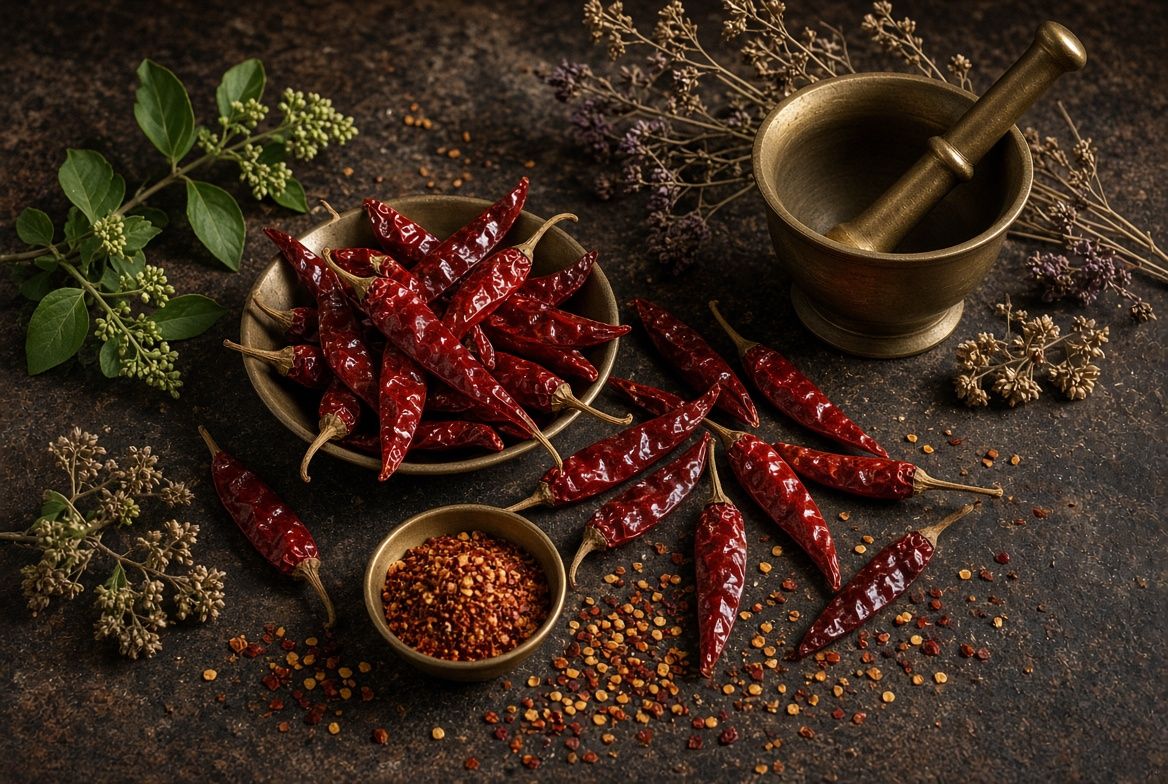
Botanical Identity & Classification
Inventory scope: Capsicum species · Solanaceae · fruit.
Nomenclatural check: Capsicum annuum L. is accepted in this treatment (family Solanaceae). A synonym listed there is Capsicum indicum var. vulgatum Dierb. The stated native range is S. U.S.A. to Brazil, Caribbean (Kew, Plants of the World Online: Capsicum annuum L.).
Inventory decision: The common name spans species and cultivars. Ask for the cultivar and preparation; do not treat a pepper concentrate or challenge product as an ordinary food ingredient.
Chili peppers belong to the genus Capsicum in the Solanaceae family. The study focuses on domesticated Capsicum annuum var. annuum and discusses its wild progenitor, C. annuum var. glabriusculum, as well as C. frutescens (Interdisciplinary insights into the cultural and chronological context of chili pepper (Capsicum annuum var. annuum L.) domestication in Mexico).
The page calls Capsicum chili peppers, discusses their fruits, and names Capsicum annuum, C. chinense, C. frutescens, C. baccatum, C. chacoense, and C. pubescens (Capsicum Breeding: History and Development).
Botanical & Scientific Profile
An ingredient named chili does not identify a species or heat level. Separate the source of pungency from color and sweetness; results for one fruit tissue and cultivar cannot stand for all peppers.
The researchers analyzed modern Capsicum seeds and 130 archaeological seeds using microscope photography and measurements, and used scanning electron microscopy to image seed coats. They identified 14 significantly variable morphological attributes, mainly related to seed size and area. Quadratic discriminant analysis correctly predicted the species of 82% of the modern specimens (Interdisciplinary insights into the cultural and chronological context of chili pepper (Capsicum annuum var. annuum L.) domestication in Mexico).
In the genus Capsicum, the fruit is a berry and varies in shape and size; the plants have simple, alternately arranged leaves with smooth margins and typically small flowers with five white petals (Pepper | Culinary Uses, Types, Domestication, History, & Spicy Varieties).
Capsaicin and dihydrocapsaicin are the two principal capsaicinoids in commonly consumed Capsicum species and together constitute about 80–90% of total capsaicinoids. Glandular cells in the fruit’s placental epidermis produce these compounds (High capsaicin levels can harbour health risks).
The study measured capsaicin and dihydrocapsaicin in the pericarp and placenta of 18 ornamental pepper (Capsicum annuum L.) cultivars sampled at green and red ripening stages; capsaicinoids were analyzed by HPLC. The placenta contained significantly higher levels of both compounds than the pericarp, and the reported capsaicin and dihydrocapsaicin ranges across samples were 0–6.7915 mg·g⁻¹ and 0–5.329 mg·g⁻¹, respectively (An Analysis of Capsaicin, Dihydrocapsaicin, Vitamin C and Flavones in Different Tissues during the Development of Ornamental Pepper).
Cultural History & Traditional Herbalism
The earliest archaeological seeds in the study, dating to the end of the Late Archaic and onset of the Preclassic, were predominantly identified as the wild progenitor Capsicum annuum var. glabriusculum. The authors interpret this pattern as suggesting widespread use of wild chili pepper populations by early peoples (Interdisciplinary insights into the cultural and chronological context of chili pepper (Capsicum annuum var. annuum L.) domestication in Mexico).
The abstract says Capsicum or chili peppers were predominantly first domesticated in America and were introduced from there to the rest of the world by Columbus (Capsicum Breeding: History and Development).
Peppers of the genus Capsicum are native to tropical America; traces of pepper fruits have been found in prehistoric remains in Peru and Mexico (Pepper | Culinary Uses, Types, Domestication, History, & Spicy Varieties).
The article reports the oldest unambiguous archaeological macroremains of Capsicum pepper from preceramic strata at Coxcatlán Cave in the Tehuacán Valley, Puebla, and caves near Ocampo, Tamaulipas; their association with other remains suggests an approximate age of 9,000–7,000 years before present, but the pepper remains themselves were not directly dated and cannot be identified as cultivated or domesticated. For genetic evidence, the researchers analyzed 139 wild and 49 domesticated C. annuum types using 17 microsatellite markers; wild peppers in northeastern Mexico, including Tamaulipas, Nuevo León, San Luis Potosí, and Veracruz, showed high genetic similarity to domesticated types. The authors’ combined evidence supports central-east Mexico, including the Tehuacán Valley, and northeastern Mexico as possible areas of origin; the genetic evidence favors the northeastern area (Multiple lines of evidence for the origin of domesticated chili pepper, Capsicum annuum, in Mexico).
Tradition, Folklore & Symbolism
No separate inherited symbolic or ceremonial use of this identified part was established here. A documented food, trade or medicinal practice should remain under its own description rather than being relabeled as ritual.
Herbal Energetics
Insufficient documented evidence for a traditional energetic classification. No temperature, direction or channel is inferred from the flavor of a cup.
InfiniTea sensory metaphor: A boundary clearly marked. This is original editorial language, not a measured physiological action or a translation of a traditional diagnostic category.
Sensory Profile & Tea Applications
The study describes a spectrum of Capsicum forms and flavors, from wild through intermediate, semiwild, and semidomesticated forms to domesticated peppers. It does not provide a specific aroma or taste profile or a food-preparation method (Interdisciplinary insights into the cultural and chronological context of chili pepper (Capsicum annuum var. annuum L.) domestication in Mexico).
In hot peppers, capsaicin causes pungency and is characterized by acrid vapors and a burning taste (Pepper | Culinary Uses, Types, Domestication, History, & Spicy Varieties).
Sensory notebook: Record aroma, fruit character, onset of heat and duration separately on an already characterized culinary sample. Do not taste an unknown concentrate to establish its strength.
Proposed comparison, not a completed trial: Compare intact food-grade fruits visually and use declared pungency information. Do not handle or taste unknown powders to establish a heat ranking.
For ordinary dried herbal or fruit infusions, the German Federal Institute for Risk Assessment advises using boiling water and not leaving the prepared infusion standing for hours. Cooling a hot infusion and steeping untreated dry material in cold water are different processes; this report does not validate the latter (Boiling water a must for herbal teas).
Safety & Responsible Use
BfR reports that high capsaicinoid intake can cause gastrointestinal effects, including burning, nausea, vomiting, and abdominal or chest pain. It notes that a single bolus, such as a spicy corn chip eaten quickly, may cause a more pronounced reaction than the same amount consumed in a complex dish over time (High capsaicin levels can harbour health risks).
Individual pungency perception and the capsaicinoid profile, food matrix, and processing of Capsicum products can affect the likelihood and severity of effects. BfR says the data are insufficient to establish a specific dose threshold for symptoms; it does not discuss setting a household medicinal tea dose by pepper count (High capsaicin levels can harbour health risks).
The page reports that capsaicin-containing foods can cause mouth and throat irritation or pain and intestinal discomfort, and may also cause shortness of breath, allergic reactions, chest pain, palpitations, heart attacks, strokes, or repeated vomiting with potentially life-threatening esophageal damage. Human case reports described reversible cerebral vasoconstriction after ingestion of a Carolina Reaper pepper and a heart attack believed related to repeated ingestion of cayenne pepper pills; a 14-year-old died hours after the One Chip Challenge, but the page does not establish the cause of death. The challenge was described as unsuitable for children or teenagers, people with food allergies or sensitivity to spicy foods, people with heart or lung disease, and people who were pregnant (Is the One Chip Challenge® dangerous?).
Preparation and exposure boundary: This review does not establish a safe medicinal dose in pregnancy, lactation or childhood, or rule out interactions or allergy. Do not substitute essential oil or a concentrated extract for the documented food or herb.
For U.S. food use, the relevant safety determination concerns the intended conditions of use. The existence of a traditional preparation or herbal medicine monograph does not establish that this ingredient, dose and beverage are cleared for sale (Understanding How the FDA Regulates Food Additives and GRAS Ingredients).
Historical Trade, Ecology & Sustainability
The source reports that the natural range of the wild progenitor Capsicum annuum var. glabriusculum extends from the southern United States to northern Bolivia and Brazil. Its ecological niche models indicate that climatic suitability for all three studied taxa—C. annuum var. annuum, C. annuum var. glabriusculum, and C. frutescens—was restricted to the southern half of Mexico at 6,000 BP (Interdisciplinary insights into the cultural and chronological context of chili pepper (Capsicum annuum var. annuum L.) domestication in Mexico).
Capsicum plants are perennials, but in most areas outside their native habitat they are grown as tender summer annuals (Pepper | Culinary Uses, Types, Domestication, History, & Spicy Varieties).
Birds’ TRPV1 receptors cannot be activated by capsaicinoids, so birds can eat highly pungent Capsicum fruits and contribute to seed dispersal (High capsaicin levels can harbour health risks).
Sourcing record: Ask for cultivar and pungency range, measurement method where available, and whether a powder contains added extract.
InfiniTea Herb Lore & Ritualpreliminary draft
Energetics (original InfiniTea metaphor): A boundary clearly marked. Use this as a private writing image, not a health statement.
Tradition & Folklore: No separate inherited symbolic or ceremonial use of this identified part was established here. A documented food, trade or medicinal practice should remain under its own description rather than being relabeled as ritual.
Ritual Cue (original contemporary InfiniTea interpretation): Draw a line you do not intend to cross today. Give it a name; there is no tasting challenge attached.
Private preliminary draft; not approved for publication.
Scholarly References & Research Verification
Research limitations
Obtain cultivar, organ and product specification. Avoid kitchen experiments with irritant concentrated extracts or airborne pepper dust.
The archaeological evidence comes from only two sites, and the chili remains do not establish whether the peppers were cultivated or domesticated (Multiple lines of evidence for the origin of domesticated chili pepper, Capsicum annuum, in Mexico).
References below identify the evidence used, not additional endorsements. A botanical authority establishes nomenclature, not the identity of a physical lot. Published study samples, traditional descriptions and InfiniTea proposals are distinguished in the text.
- Kew, Plants of the World Online: Capsicum annuum L. | Taxonomic backbone
- Interdisciplinary insights into the cultural and chronological context of chili pepper (Capsicum annuum var. annuum L.) domestication in Mexico | peer-reviewed original research study
- Capsicum Breeding: History and Development | book chapter
- Pepper | Culinary Uses, Types, Domestication, History, & Spicy Varieties | encyclopedia article
- High capsaicin levels can harbour health risks | scientific risk-assessment opinion
- An Analysis of Capsaicin, Dihydrocapsaicin, Vitamin C and Flavones in Different Tissues during the Development of Ornamental Pepper | laboratory study
- Multiple lines of evidence for the origin of domesticated chili pepper, Capsicum annuum, in Mexico | Research article published in the Proceedings of the National Academy of Sciences of the United States of America.
- Is the One Chip Challenge® dangerous? | Poison Control educational article about capsaicin and the Paqui One Chip Challenge®. It describes three human cases: a 15-year-old who developed reversible cerebral vasoconstriction after eating a Carolina Reaper pepper, a 25-year-old diagnosed with a heart attack after repeated use of oral cayenne pepper pills, and a 14-year-old who died hours after participating in the challenge. The cited evidence includes case reports; the page does not describe a controlled study of the chip.
- Boiling water a must for herbal teas | BfR press release providing general food-safety guidance for preparing herbal and fruit infusions.
- Understanding How the FDA Regulates Food Additives and GRAS Ingredients | U.S. FDA consumer-information webpage describing food-additive and GRAS ingredient oversight.
Final Botanical Summary
The food history belongs first to the Americas. Heat varies enough that an unqualified chili-pepper entry is inadequate for a formulation.
Editorial disposition: Identity hold. The report is a private reference, not a clinical recommendation, approval for sale or authenticated sensory trial.
Verification Status (November 2026)
Phase II source audit, claim by claim
- Claims checked
- 15
- Corrected
- 2
- Withheld
- 0
- Sources
- 10
Identity hold: the species, plant part or market name still needs confirming before any product decision. See Identity and the research limitations.
Citation check: All 4 Safety & Use citations were re-read against their sources in November 2026 and confirmed.
A private research reference, not a clinical recommendation or product claim. Checked to the Grimoire's research standards →