
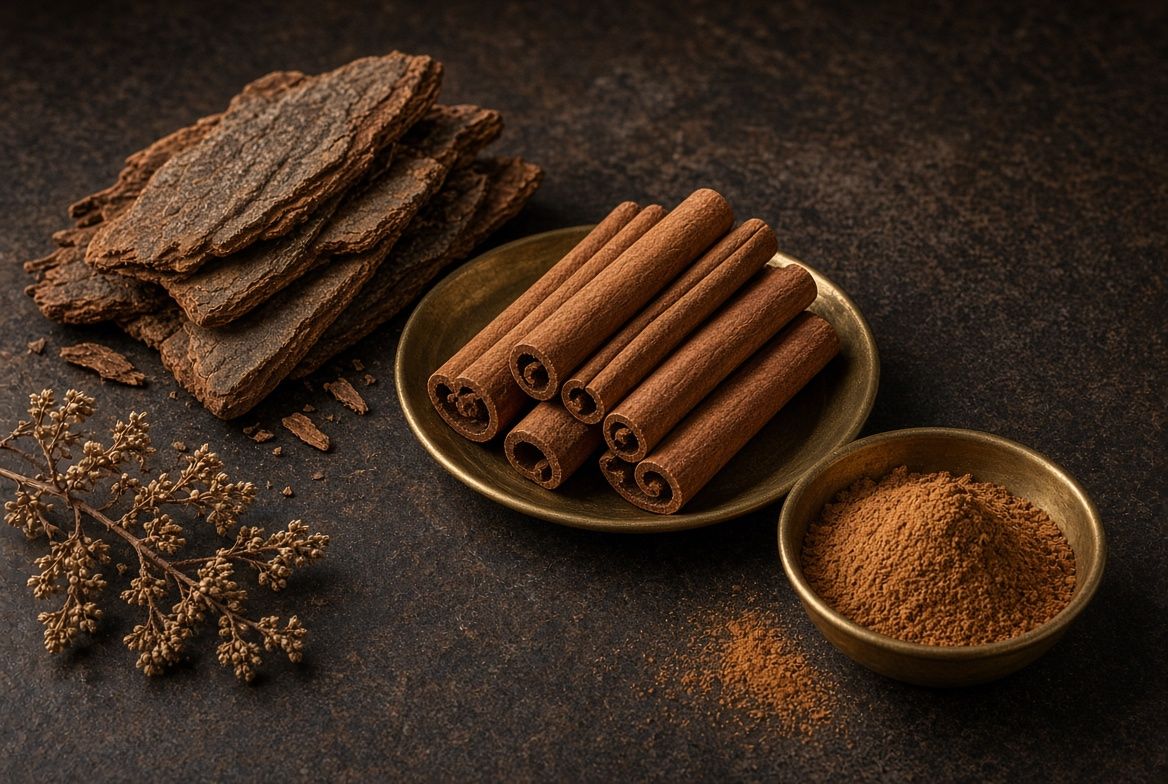
Botanical Identity & Classification
Inventory scope: Cinnamomum verum and cassia-type Cinnamomum species · Lauraceae · bark.
Nomenclatural check: Cinnamomum verum J.Presl is accepted in this treatment (family Lauraceae). A synonym listed there is Cinnamomum zeylanicum var. pleei Lukman. The stated native range is Sri Lanka (Kew, Plants of the World Online: Cinnamomum verum J.Presl).
Inventory decision: Identify Ceylon versus cassia-type bark before discussing repeated exposure. Color, price and a generic “cinnamon” label cannot substitute for a specification or coumarin analysis.
Ceylon cinnamon, or true cinnamon, is Cinnamomum verum J.S. Presl of the Lauraceae family; the spice is its dried inner bark (Cinnamomum verum J.S. Presl).
The page identifies Ceylon cinnamon as Cinnamomum verum, also known as Cinnamomum zeylanicum and Laurus cinnamomum, and cassia cinnamon as Cinnamomum aromaticum, also known as Cinnamomum cassia (Cinnamon: Usefulness and Safety).
Kew accepts Cinnamomum aromaticum Nees. Names applied to commercial cassia and names used in older materia medica must be read with their author and plant part; the inventory does not assign a species to an unidentified cassia powder (Cinnamomum aromaticum Nees | Plants of the World Online).
Botanical & Scientific Profile
“Cinnamon” is not a reliable statement of coumarin exposure. Keep Ceylon and named cassia-type barks separate even if the finished powder looks similar.
The PROSEA description of Cinnamomum verum records an evergreen tree up to 18 m tall with strongly aromatic bark about 10 mm thick; commercial cinnamon bark is no more than 0.5 cm thick (Cinnamomum verum J.S. Presl).
The article reports that cinnamon (Cinnamomum verum) contains 0.5 to 1 percent essential oil, whose principal component is cinnamic aldehyde (Cinnamon | Plant, Spice, History, & Uses).
Preliminary research indicates that a nasal spray containing Ceylon cinnamon extract might improve allergic rhinitis (hay fever) symptoms, but more reliable evidence is needed to confirm the result (Cinnamon: Usefulness and Safety).
Cultural History & Traditional Herbalism
The source states that the Portuguese occupied Sri Lanka in 1536 and the Dutch took over in 1656, establishing virtual monopolies on the cinnamon trade (Cinnamomum verum J.S. Presl).
The article reports that cinnamon (the article’s subject, Cinnamomum verum) was sought in Egypt for embalming and religious practices and used in medieval Europe for religious rites and as a flavoring (Cinnamon | Plant, Spice, History, & Uses).
The bark, leaves, flowers, fruits, and roots of cinnamon have a long history of use in traditional medicine and cuisine in China, India, and Persia (Iran); the page gives no date for this history (Cinnamon: Usefulness and Safety).
The paper identifies the cinnamon-peeling community as migrants from South India originally known as the Chalia and later as the Salagama; it says that, sometime during the Kandyan period, a Kandyan king assigned them the hereditary duty of peeling Cinnamomum zeylanicum. Peeling was done by one section of the community, described as about one-third of its four-tier hierarchy; the work included extracting the inner bark from branches and preparing it into layered quills. The paper says Salagama peelers’ descendants have practiced the craft for at least 400 years and that peeling methods remain largely unchanged, drawing on historical references and present-day observations about the industry (Cinnamomum Zeylanicum: Continuing Voyages of Discovery).
Tradition, Folklore & Symbolism
No separate inherited symbolic or ceremonial use of this identified part was established here. A documented food, trade or medicinal practice should remain under its own description rather than being relabeled as ritual.
Herbal Energetics
The Chinese Medicine Specimen Database record identifies the giant cinnamon bark specimen as Cinnamomum cassia Presl and classifies it as an interior-warming drug; its odour is described as heavily aromatic (Giant Cinnamon Bark (特大肉桂; Te Da Rou Gui)).
In the Chinese materia medica entry for rougui, dried cassia bark is described as acrid, sweet and very hot. The classification belongs to that named bark drug; it is not a classification of every Ceylon cinnamon product (肉桂 Rougui / Cinnamomi Cortex (Cassia Bark)).
These are categories within the named tradition. They are not measurements of body temperature, pharmacological action or clinical efficacy.
InfiniTea sensory metaphor: A curl of warmth. This is original editorial language, not a measured physiological action or a translation of a traditional diagnostic category.
Sensory Profile & Tea Applications
The Cinnamomum verum record describes the bark as strongly aromatic and attributes its organoleptic properties to steam-volatile oil and trace amounts of coumarin; it describes cinnamon bark oil as pale yellow (Cinnamomum verum J.S. Presl).
The article describes the dried inner bark of cinnamon (Cinnamomum verum) as reddish brown to brown, with a delicately fragrant aroma and a warm, sweet taste (Cinnamon | Plant, Spice, History, & Uses).
Sensory notebook: Compare authenticated barks by quill form and aroma. Record origin and species before recording a preference; do not use sweetness as a coumarin test.
Proposed comparison, not a completed trial: Photograph the cross-section of a documented quill before milling. Do not use the number of layers as a substitute for authentication of powder.
For ordinary dried herbal or fruit infusions, the German Federal Institute for Risk Assessment advises using boiling water and not leaving the prepared infusion standing for hours. Cooling a hot infusion and steeping untreated dry material in cold water are different processes; this report does not validate the latter (Boiling water a must for herbal teas).
Safety & Responsible Use
The BfR states that Cassia cinnamon contains higher coumarin levels than Ceylon cinnamon, which contains low levels. Evidence that coumarin can damage the liver comes from animal experiments and its use as a medicine; in a small group of especially sensitive people, medicinal use for a few weeks can cause liver damage, usually reversible. The FAQ reports no cases of liver damage following cinnamon consumption in the scientific literature to date. The BfR advises people who frequently use large amounts of cinnamon in home cooking to use Ceylon cinnamon (FAQ on coumarin in cinnamon and other foods).
Reports indicate that some types of topical cinnamon oil or powder may cause skin irritation or contact dermatitis. Studies of Ceylon and cassia cinnamon during pregnancy suggest safety in amounts commonly found in foods, while larger amounts of Ceylon cinnamon during pregnancy are considered unsafe. Cassia cinnamon contains coumarin, and some cassia products have high levels; prolonged use could be an issue for sensitive people, such as those with liver disease. The page does not quantify coumarin exposure per cup (Cinnamon: Usefulness and Safety).
The BfR states that Cassia cinnamon contains more coumarin than Ceylon cinnamon: food-monitoring data showed an average of approximately 3,000 mg/kg in Cassia and a highest measured level of 10,000 mg/kg, while Ceylon cinnamon contains low levels. The BfR set a tolerable daily intake of 0.1 mg/kg bodyweight per day; it says a 60 kg adult reaches this intake at about 2 g of Cassia cinnamon daily, and advises people who frequently use large amounts of cinnamon in cooking to choose Ceylon cinnamon (FAQ on coumarin in cinnamon and other foods).
Preparation and exposure boundary: This review does not establish a safe medicinal dose in pregnancy, lactation or childhood, or rule out interactions or allergy. Do not substitute essential oil or a concentrated extract for the documented food or herb.
For U.S. food use, the relevant safety determination concerns the intended conditions of use. The existence of a traditional preparation or herbal medicine monograph does not establish that this ingredient, dose and beverage are cleared for sale (Understanding How the FDA Regulates Food Additives and GRAS Ingredients).
Historical Trade, Ecology & Sustainability
The source reports Cinnamomum verum growing wild in south-west India, western Sri Lanka, and the Tenasserim Hills of Burma (Myanmar). It also reports cultivation in southern India, the Seychelles, and Madagascar, and says Sri Lanka continues to dominate the market (Cinnamomum verum J.S. Presl).
FAO estimates cited for 1998 report 24,000 ha harvested in Sri Lanka, producing 12,000 t, and 3,400 ha in the Seychelles, producing 600 t; the source reports annual Ceylon cinnamon exports of about 6,000 t (Cinnamomum verum J.S. Presl).
The article states that cinnamon (Cinnamomum verum) grows in moist, well-drained soils and that growers harvest the main crop during the wet season by cutting shoots close to the ground (Cinnamon | Plant, Spice, History, & Uses).
Sourcing record: Request a botanical declaration and, where repeated consumption is intended, a lot-specific coumarin result rather than relying on the country name alone.
InfiniTea Herb Lore & Ritualpreliminary draft
Energetics (original InfiniTea metaphor): A curl of warmth. Use this as a private writing image, not a health statement.
For the separately attributed traditional material, see Herbal Energetics; the original sensory image is not a translation of that classification.
Tradition & Folklore: The paper identifies the cinnamon-peeling community as migrants from South India originally known as the Chalia and later as the Salagama; it says that, sometime during the Kandyan period, a Kandyan king assigned them the hereditary duty of peeling Cinnamomum zeylanicum. Peeling was done by one section of the community, described as about one-third of its four-tier hierarchy; the work included extracting the inner bark from branches and preparing it into layered quills. The paper says Salagama peelers’ descendants have practiced the craft for at least 400 years and that peeling methods remain largely unchanged, drawing on historical references and present-day observations about the industry (Cinnamomum Zeylanicum: Continuing Voyages of Discovery). This is a record of use, not a claim of inherited ritual.
Ritual Cue (original contemporary InfiniTea interpretation): Draw a spiral and write one ordinary comfort along its curve. Stop when the line turns inward.
Private preliminary draft; not approved for publication.
Scholarly References & Research Verification
Research limitations
Require botanical name and lot testing for a quantitative coumarin conclusion. No household preparation is validated here to remove that uncertainty.
References below identify the evidence used, not additional endorsements. A botanical authority establishes nomenclature, not the identity of a physical lot. Published study samples, traditional descriptions and InfiniTea proposals are distinguished in the text.
- Kew, Plants of the World Online: Cinnamomum verum J.Presl | Taxonomic backbone
- Cinnamomum verum J.S. Presl | PROSEA botanical and crop-production species record
- Cinnamon: Usefulness and Safety | government health fact sheet
- Cinnamon | Plant, Spice, History, & Uses | encyclopedia article
- Giant Cinnamon Bark (特大肉桂; Te Da Rou Gui) | Chinese medicine specimen database record
- FAQ on coumarin in cinnamon and other foods | FAQ
- Cinnamomum Zeylanicum: Continuing Voyages of Discovery | Historical and ethnobotanical paper by Jennifer Moragoda; marked “Draft Version: Not for Distribution or Citation.”
- Cinnamomum aromaticum Nees | Plants of the World Online | Kew Plants of the World Online taxonomic record
- 肉桂 Rougui / Cinnamomi Cortex (Cassia Bark) | 藥用植物圖像數據庫的中藥記錄;未指明特定古典醫學傳統。
- Boiling water a must for herbal teas | BfR press release providing general food-safety guidance for preparing herbal and fruit infusions.
- Understanding How the FDA Regulates Food Additives and GRAS Ingredients | U.S. FDA consumer-information webpage describing food-additive and GRAS ingredient oversight.
Final Botanical Summary
A common kitchen substitution can matter in a regularly consumed beverage. Distinguish what is known about the species from what would require a lot assay.
Editorial disposition: Identity hold. The report is a private reference, not a clinical recommendation, approval for sale or authenticated sensory trial.
Verification Status (November 2026)
Phase II source audit, claim by claim
- Claims checked
- 16
- Corrected
- 4
- Withheld
- 0
- Sources
- 11
Identity hold: the species, plant part or market name still needs confirming before any product decision. See Identity and the research limitations.
Citation check: All 4 Safety & Use citations were re-read against their sources in November 2026 and confirmed.
A private research reference, not a clinical recommendation or product claim. Checked to the Grimoire's research standards →