
Botanical Identity & Classification
Inventory scope: Syzygium aromaticum · Myrtaceae · dried unopened flower buds.
Nomenclatural check: Syzygium aromaticum (L.) Merr. & L.M.Perry is accepted in this treatment (family Myrtaceae). A synonym listed there is Caryophyllus aromaticus L. The stated native range is Maluku (Kew, Plants of the World Online: Syzygium aromaticum (L.) Merr. & L.M.Perry).
Inventory decision: These are buds, not seeds. Do not translate culinary use to clove oil ingestion, especially in children, or advise applying oil for dental pain.
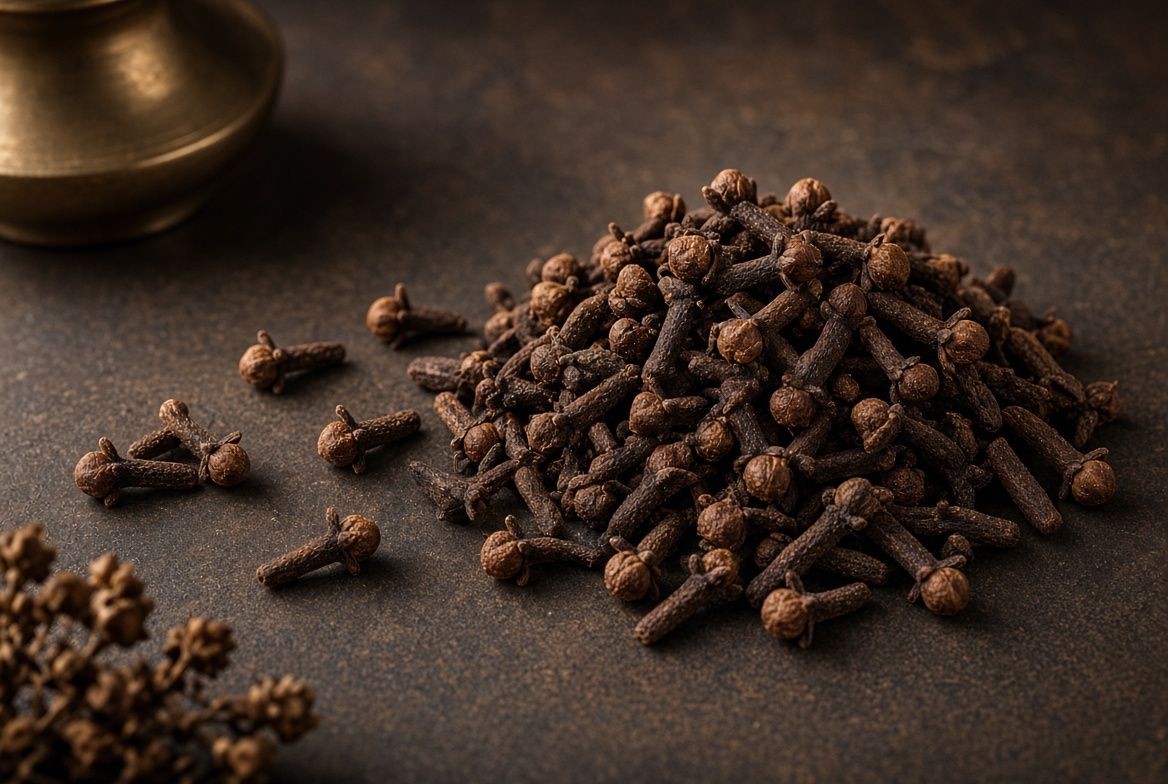
Syzygium aromaticum (L.) Merrill & Perry, in the Myrtaceae family, is commonly called clove. It is a small evergreen tree, and cloves are its dried, unopened, immature flower buds (Oxford University Plants 400: Syzygium aromaticum).
The PROSEA record identifies clove as Syzygium aromaticum (L.) Merrill & Perry, family Myrtaceae, and lists Caryophyllus aromaticus L., Eugenia aromatica (L.) Baill., and Eugenia caryophyllus (Sprengel) Bullock & Harrison as synonyms (Syzygium aromaticum (L.) Merrill & Perry).
Botanical & Scientific Profile
The spice is an unopened flower bud, not a seed. A toxicology report on concentrated clove oil should remain visible as a warning without being presented as the expected outcome of ordinary spice use.
Clove oil from Syzygium aromaticum was traditionally believed to have mild anesthetic properties and was used for toothache relief; the source reports no specific human studies, preparation details, results, or limitations (Oxford University Plants 400: Syzygium aromaticum).
In Syzygium aromaticum, oil glands occur in many parts of the plant, especially the flower buds; the source says clove oil comprises up to 90% eugenol and is used in anatomical investigations under a microscope (Oxford University Plants 400: Syzygium aromaticum).
The PROSEA botanical description identifies Syzygium aromaticum as an evergreen tree up to 20 m tall, with opposite, simple leaves measuring 6–13 cm by 3–6 cm and flower buds 1–2 cm long (Syzygium aromaticum (L.) Merrill & Perry).
Cultural History & Traditional Herbalism
Historical accounts in the source date Chinese trade in Syzygium aromaticum cloves with Southeast Asia to at least the third century BCE and Mediterranean trade to at least the fourth century CE. By the eighth century CE, cloves were known throughout Europe; traders knew they could be imported from places including Java, Malacca, and Sri Lanka, and their rarity brought vast prices (Oxford University Plants 400: Syzygium aromaticum).
The PROSEA record says clove has been highly valued as a spice by the Chinese since ancient times and describes the crop and its trade as having a history dating to the Han Dynasty in the 3rd century BC (Syzygium aromaticum (L.) Merrill & Perry).
The review states that cloves (Syzygium aromaticum) and nutmeg (Myristica fragrans) from the Maluku Islands, known as the “Spice Islands,” were once central to maritime routes that influenced cultural exchange and economic development across Asia and Europe (Bridging tradition and science: the health-promoting potentials of Indonesian local spices in ethnic foods).
The essay identifies clove (Syzygium aromaticum Kuntze) as indigenous only to the northern Moluccas and says its export from that region can be traced to Roman times through Pliny the Elder’s first-century A.D. writings. Direct archaeological evidence cited is a single clove among charred plant remains on the floor of a burned pantry room at Terqa, in present-day Syria, dated to 1700 B.C.; the authors say this find suggests the clove trade to the West may have begun much earlier. The essay states that clove production remained indigenous to the northern Moluccas until the sixteenth century, that Portuguese traders reached the region in 1512, and that a late-seventeenth-century agreement between the defeated Ternatese sultan and the Dutch East India Company ended clove growing in the northern Moluccas and concentrated the trade around Ambon (Introduction).
Tradition, Folklore & Symbolism
The PROSEA record states that more than 90% of cloves are used with tobacco to make kretek cigarettes, smoked mainly in Indonesia; it says the custom’s origin is unknown and that Rumphius reported it in the Moluccas in the 18th century (Syzygium aromaticum (L.) Merrill & Perry).
Herbal Energetics
丁香 (Dingxiang; Clove; Caryophylli Flos) is identified as the dried flower buds of Eugenia caryophyllata Thunb. The record classifies it as 甘 (sweet) and 温 (warm). It does not state rasa/virya/vipaka terminology or provide clinical evidence. The listed traditional uses are warming the stomach and kidney, and treating stomach-cold pain and distension, hiccups, vomiting and diarrhea, painful obstruction, hernia pain, bad breath, and toothache (identified herb record).
These are categories within the named tradition. They are not measurements of body temperature, pharmacological action or clinical efficacy.
InfiniTea sensory metaphor: A small thing with a large presence. This is original editorial language, not a measured physiological action or a translation of a traditional diagnostic category.
Sensory Profile & Tea Applications
The flower buds of Syzygium aromaticum are aromatic, and cloves are used as flavourings for hams, apple dishes, pickles, and wines (Oxford University Plants 400: Syzygium aromaticum).
The PROSEA description of Syzygium aromaticum clove bud oil gives it a strong, characteristic sweet and spicy clove odor and a warm, almost burning, spicy flavor (Syzygium aromaticum (L.) Merrill & Perry).
Sensory notebook: Sketch the head and stalk of one intact clove. Record the first recognizable aroma separately from mouth-numbing impressions reported for other preparations.
Proposed comparison, not a completed trial: Compare intact buds with one bud broken just before observation. Record which notes are present in the dry material before attributing them to a blend.
For ordinary dried herbal or fruit infusions, the German Federal Institute for Risk Assessment advises using boiling water and not leaving the prepared infusion standing for hours. Cooling a hot infusion and steeping untreated dry material in cold water are different processes; this report does not validate the latter (Boiling water a must for herbal teas).
Safety & Responsible Use
The article states that swallowing a large amount of eugenol oil (clove oil) can cause an overdose. As little as 10 milliliters in adults, or smaller amounts in children, can have serious effects; symptoms include nervous system problems and liver failure, particularly in children (Eugenol oil overdose: MedlinePlus Medical Encyclopedia).
For a suspected eugenol oil overdose, seek immediate emergency help and contact the local poison control center or Poison Help at 1-800-222-1222 in the United States. Do not make the person vomit unless poison control or a health care provider instructs you to (Eugenol oil overdose: MedlinePlus Medical Encyclopedia).
LiverTox reports severe acute liver injury after accidental ingestion of large amounts of eugenol-containing clove oil, with described cases largely involving children. After reported ingestions of 10–30 mL, agitation, reduced consciousness or coma may occur within hours; liver injury typically appears 12–24 hours later, with markedly elevated aminotransferases and coagulation abnormalities, and may progress to hepatic failure. The monograph describes the injury as generally worsening for several days before improving and resolving within 1–3 weeks; renal dysfunction may also occur (Eugenol (Clove Oil) — LiverTox: Clinical and Research Information on Drug-Induced Liver Injury).
Preparation and exposure boundary: This review does not establish a safe medicinal dose in pregnancy, lactation or childhood, or rule out interactions or allergy. Do not substitute essential oil or a concentrated extract for the documented food or herb.
For U.S. food use, the relevant safety determination concerns the intended conditions of use. The existence of a traditional preparation or herbal medicine monograph does not establish that this ingredient, dose and beverage are cleared for sale (Understanding How the FDA Regulates Food Additives and GRAS Ingredients).
Historical Trade, Ecology & Sustainability
Syzygium aromaticum was once found only in the Moluccas; during the nineteenth century, cloves spread rapidly into French and British tropical colonies across the globe (Oxford University Plants 400: Syzygium aromaticum).
The PROSEA record says Syzygium aromaticum was first cultivated on islands of the Moluccas, where it also occurs wild, and occurs wild in New Guinea; it is abundant as a second-storey forest tree on lower mountain slopes (Syzygium aromaticum (L.) Merrill & Perry).
The review reports that Indonesia is one of the world’s largest producers of cloves (flower buds), nutmeg, cinnamon, and pepper, and that smallholder farmers in spice-producing regions depend on spice cultivation and processing for their livelihoods (Bridging tradition and science: the health-promoting potentials of Indonesian local spices in ethnic foods).
Sourcing record: Verify unopened bud material and geographical origin, and distinguish local cultivation histories from later colonial control of the spice trade.
InfiniTea Herb Lore & Ritualpreliminary draft
Energetics (original InfiniTea metaphor): A small thing with a large presence. Use this as a private writing image, not a health statement.
For the separately attributed traditional material, see Herbal Energetics; the original sensory image is not a translation of that classification.
Tradition & Folklore: The PROSEA record states that more than 90% of cloves are used with tobacco to make kretek cigarettes, smoked mainly in Indonesia; it says the custom’s origin is unknown and that Rumphius reported it in the Moluccas in the 18th century (Syzygium aromaticum (L.) Merrill & Perry).
Ritual Cue (original contemporary InfiniTea interpretation): Name a small gesture that changed the tone of a whole conversation. Let the entry be as short as the gesture.
Private preliminary draft; not approved for publication.
Scholarly References & Research Verification
Research limitations
Keep oil ingestion, topical preparations and culinary buds distinct. Do not add neat oil to a beverage or use this report for pediatric dosing.
References below identify the evidence used, not additional endorsements. A botanical authority establishes nomenclature, not the identity of a physical lot. Published study samples, traditional descriptions and InfiniTea proposals are distinguished in the text.
- Kew, Plants of the World Online: Syzygium aromaticum (L.) Merr. & L.M.Perry | Taxonomic backbone
- Oxford University Plants 400: Syzygium aromaticum | Botanical and historical plant-profile webpage
- Syzygium aromaticum (L.) Merrill & Perry | PROSEA botanical and crop-use database record
- Bridging tradition and science: the health-promoting potentials of Indonesian local spices in ethnic foods | review article
- Eugenol oil overdose: MedlinePlus Medical Encyclopedia | Medical encyclopedia article on overdose and poisoning guidance
- Eugenol (Clove Oil) — LiverTox: Clinical and Research Information on Drug-Induced Liver Injury | Official clinical reference monograph (secondary review of human case reports and other literature)
- Introduction | Introductory essay by Paul Michael Taylor to the English translation and digital edition of F.S.A. de Clercq’s 1890 book, Ternate: The Residency and its Sultanate.
- identified herb record | Hong Kong Baptist University Chinese Medicinal Materials Image Database; no specific classical tradition is named.
- Boiling water a must for herbal teas | BfR press release providing general food-safety guidance for preparing herbal and fruit infusions.
- Understanding How the FDA Regulates Food Additives and GRAS Ingredients | U.S. FDA consumer-information webpage describing food-additive and GRAS ingredient oversight.
Final Botanical Summary
Botanical identity ties a small bud to a particular island trade history. Concentrated eugenol products require a different safety discussion.
Editorial disposition: Lot unverified. The report is a private reference, not a clinical recommendation, approval for sale or authenticated sensory trial.
Verification Status (November 2026)
Phase II source audit, claim by claim
- Claims checked
- 16
- Corrected
- 3
- Withheld
- 0
- Sources
- 10
Material: Lot unverified. No physical sample has been examined.
Citation check: All 4 Safety & Use citations were re-read against their sources in November 2026 and confirmed.
A private research reference, not a clinical recommendation or product claim. Checked to the Grimoire's research standards →