
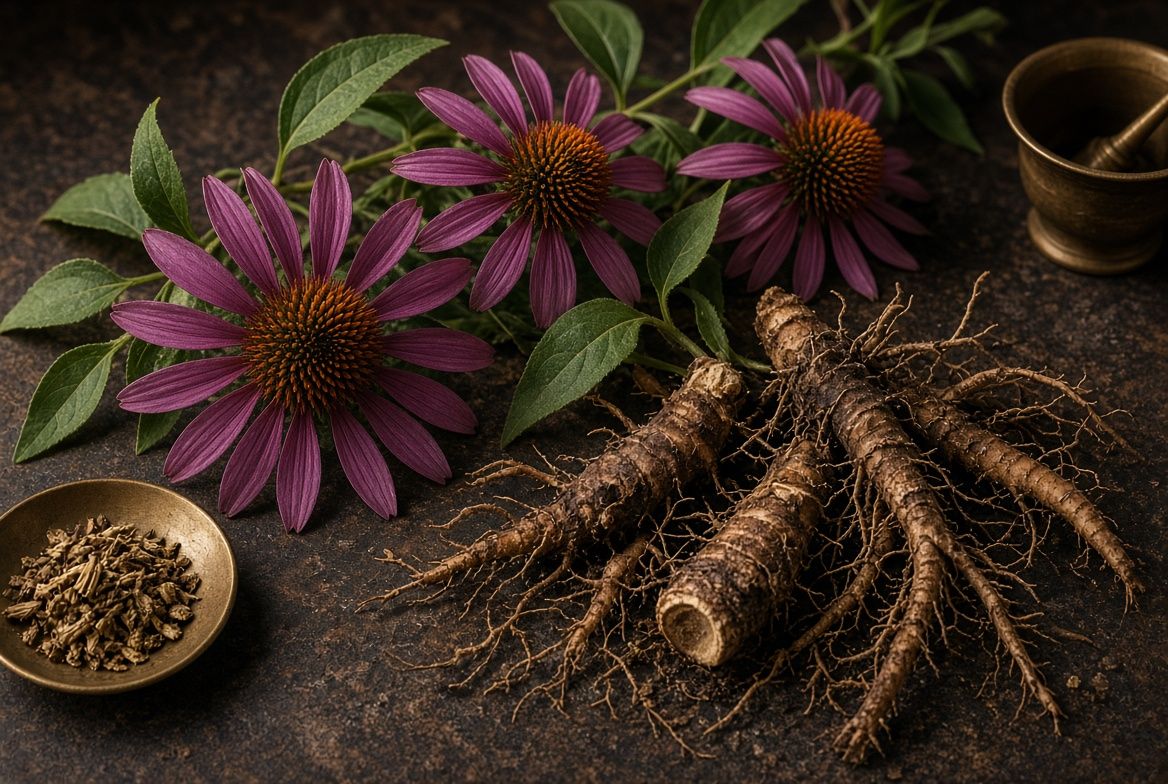
Botanical Identity & Classification
Inventory scope: Echinacea purpurea, E. angustifolia and related medicinal species · Asteraceae · part unresolved.
Nomenclatural check: Echinacea purpurea (L.) Moench is accepted in this treatment (family Asteraceae). A synonym listed there is Rudbeckia purpurea L. The stated native range is Central & E. U.S.A (Kew, Plants of the World Online: Echinacea purpurea (L.) Moench).
Comparison taxon; not a substitute: Echinacea angustifolia DC. is accepted in this treatment (family Asteraceae). A synonym listed there is Echinacea pallida variety angustifolia. The stated native range is W. Canada to N. & Central U.S.A (Kew, Plants of the World Online: Echinacea angustifolia DC.).
Inventory decision: Record species and root versus aerial material, pressed juice versus dried herb, and cultivated versus wild origin. Do not credit every Native nation with a practice documented for just one.
The authors identify Echinacea angustifolia DC. as a member of the Asteraceae family and describe its root as the commercially harvested plant part in Kansas, while noting that the part of Echinacea used in trade has varied historically (One Hundred Years of Echinacea angustifolia Harvest in the Smoky Hills of Kansas, USA).
The plant portrait identifies Echinacea purpurea (L.) Moench as a member of Compositae. It explains that “echinacea” products may be extracts of E. purpurea, E. angustifolia, or E. pallida, used individually or in mixtures, and may also involve adulterants; products are made from leaf extracts or, more often, root extracts (1165. Echinacea purpurea (L.) Moench).
Botanical & Scientific Profile
Three labels are needed for interpreting an echinacea trial: species, organ and preparation. “Echinacea extract” without those fields is not a comparable intervention.
The page reports that human research on echinacea (the species and plant part are not specified for these findings) suggests it may slightly reduce the chance of catching a cold, but whether it shortens a cold is unclear. One recent study in children suggested echinacea might reduce respiratory tract infections and associated complications, but the overall evidence does not establish a clear connection (Echinacea: Usefulness and Safety).
NCCIH-sponsored research suggests that soil conditions affecting the plant’s bacterial community influence the activity of echinacea extracts. The page’s cited plant-microbiome study examined Echinacea purpurea (Echinacea: Usefulness and Safety).
The report is limited to fresh Echinacea purpurea herb (herba recens) and its preparations; medicinal products containing the plant’s roots, or combinations of roots and herb, are outside its scope, though some related data are included for information. It describes herb as the fresh above-ground flowering parts and discusses expressed juice from fresh herb; some clinical studies specifically used juice from above-ground parts, while other studies used root-containing combinations (Assessment report on Echinacea purpurea (L.) Moench., herba recens).
Cultural History & Traditional Herbalism
The article states that Echinacea was one of the most important medicinal plants used by Indigenous people in the Prairie Bioregion, but that details of the traditional harvesting method are not well known (One Hundred Years of Echinacea angustifolia Harvest in the Smoky Hills of Kansas, USA).
Sweet (1823) recorded Rudbeckia purpurea as introduced into cultivation in 1699, but the article says Sweet’s plant was not the Echinacea purpurea cultivated under that name today. It identifies Sweet’s plant as Rudbeckia serotina, now Echinacea laevigata, and says that plant was apparently in cultivation since 1816 (1165. Echinacea purpurea (L.) Moench).
The page states that Echinacea purpurea was originally discovered by Native Americans in North America, who used the plant medicinally for respiratory tract infections, tooth pain, and snakebite; it gives no date for this use (Echinacea: Usefulness and Safety).
The page reports that purple coneflower (Echinacea angustifolia) and other Echinacea species were important medicinal plants used by Indigenous people of the Great Plains, and that harvesting and traditional use continue in many tribal communities. It says Lewis and Clark learned about the plant during their expedition and, in 1805, sent roots and seeds to President Jefferson; it does not specify which Indigenous community provided this knowledge or identify the plant parts used medicinally by particular communities (Echinacea Research | Kelly Kindscher).
Tradition, Folklore & Symbolism
The authors report that Echinacea, or “snakeroot,” digging in the Great Plains was a family enterprise, with father-son teams and multigenerational family outings to collect roots; the account includes evidence from north-central Kansas history (One Hundred Years of Echinacea angustifolia Harvest in the Smoky Hills of Kansas, USA).
Herbal Energetics
Insufficient documented evidence for a traditional energetic classification. No temperature, direction or channel is inferred from the flavor of a cup.
InfiniTea sensory metaphor: Standing one's ground. This is original editorial language, not a measured physiological action or a translation of a traditional diagnostic category.
Sensory Profile & Tea Applications
The article describes Echinacea purpurea as having a good honey scent. Its ray limbs are usually described as pink to purple, while some cultivars have off-white or white rays, including ‘White Swan’ (1165. Echinacea purpurea (L.) Moench).
Sensory notebook: Treat any sensory claim as part-specific: label the sample before describing root texture, leaf aroma or tingling. Do not taste an unidentified lot to establish species.
Proposed comparison, not a completed trial: Use a paper comparison of sample labels until the part is confirmed. Record which comparisons would change both species and organ and therefore cannot isolate either factor.
For ordinary dried herbal or fruit infusions, the German Federal Institute for Risk Assessment advises using boiling water and not leaving the prepared infusion standing for hours. Cooling a hot infusion and steeping untreated dry material in cold water are different processes; this report does not validate the latter (Boiling water a must for herbal teas).
Safety & Responsible Use
The page says short-term use is likely safe for most adults for products containing Echinacea purpurea extracts and some mixtures of E. purpurea and E. angustifolia. It identifies digestive tract symptoms, including abdominal pain and nausea, as the most common side effects, and says allergic reactions in some people may be severe. For children, it says short-term use of E. purpurea extract is possibly safe, but children in a clinical trial developed rashes that may have resulted from an allergic reaction (Echinacea: Usefulness and Safety).
For echinacea, the page reports conflicting evidence about interactions with some drugs metabolized by the liver and theoretical reasons to suspect interactions with immunosuppressants or caffeine. It advises people taking any type of medicine to talk with a health care provider before using echinacea or other herbal products (Echinacea: Usefulness and Safety).
For most adults, extracts of Echinacea purpurea and some mixtures of E. purpurea and E. angustifolia are likely safe for short periods, but allergic reactions can occur and may be severe; digestive symptoms, including abdominal pain and nausea, are the most common reported side effects. Short-term E. purpurea extract is possibly safe for children, but some children in a clinical trial developed rashes that may have been allergic reactions, and severe reactions are a concern; the page advises consulting a child’s health care provider. Evidence about interactions with drugs metabolized by the liver is conflicting, while interactions with immunosuppressants or caffeine are theoretical; studies suggest solid or liquid extracts of E. purpurea and E. angustifolia may be safe for up to 7 days during the first trimester, but breastfeeding safety is little known (Echinacea: Usefulness and Safety).
Preparation and exposure boundary: This review does not establish a safe medicinal dose in pregnancy, lactation or childhood, or rule out interactions or allergy. Do not substitute essential oil or a concentrated extract for the documented food or herb.
For U.S. food use, the relevant safety determination concerns the intended conditions of use. The existence of a traditional preparation or herbal medicine monograph does not establish that this ingredient, dose and beverage are cleared for sale (Understanding How the FDA Regulates Food Additives and GRAS Ingredients).
Historical Trade, Ecology & Sustainability
The authors report that Echinacea angustifolia remained locally common in central Kansas but faced threats from mixed-grass prairie loss and alteration, herbicide use, and spring grazing that damaged flowering stalks and reduced seed production. Their interviews and observations describe selective harvesting, landowners restricting digging, and some harvested plants resprouting within two years as relevant to conservation (One Hundred Years of Echinacea angustifolia Harvest in the Smoky Hills of Kansas, USA).
Echinacea purpurea is extensively grown in gardens, wildflower roadside plantings, and prairie restoration sites, and is also grown commercially. The article says naturalized, persisting populations resulting from these activities may extend its apparent natural range; habitat destruction has locally reduced population sizes, although the species may still be regarded as Least Concern (LC) (1165. Echinacea purpurea (L.) Moench).
The article describes Echinacea as a genus of herbaceous perennials endemic to North American tallgrass and midgrass prairies, glades, and open woodlands. It reports that Echinacea angustifolia grows in mixed-grass prairie habitat, including the Smoky Hills of north-central Kansas (One Hundred Years of Echinacea angustifolia Harvest in the Smoky Hills of Kansas, USA).
Sourcing record: For roots, request cultivated origin or a documented wild-harvest plan; record the specific community and species when discussing Indigenous knowledge.
InfiniTea Herb Lore & Ritualpreliminary draft
Energetics (original InfiniTea metaphor): Standing one's ground. Use this as a private writing image, not a health statement.
Tradition & Folklore: The authors report that Echinacea, or “snakeroot,” digging in the Great Plains was a family enterprise, with father-son teams and multigenerational family outings to collect roots; the account includes evidence from north-central Kansas history (One Hundred Years of Echinacea angustifolia Harvest in the Smoky Hills of Kansas, USA).
Ritual Cue (original contemporary InfiniTea interpretation): Sketch the outline of a coneflower without picking one. Write one way to support the place it grows.
Private preliminary draft; not approved for publication.
Scholarly References & Research Verification
Research limitations
Do not transfer results for expressed fresh aerial juice to dried root, another species, or the unspecified inventory lot. Confirm the part before any tasting.
Many of the discussed studies used roots, other Echinacea species, or combined preparations, so their findings do not establish effects attributable to fresh aerial herb alone (Assessment report on Echinacea purpurea (L.) Moench., herba recens). The page gives no named Indigenous nation or community and provides limited community-specific ethnobotanical detail (Echinacea Research | Kelly Kindscher).
References below identify the evidence used, not additional endorsements. A botanical authority establishes nomenclature, not the identity of a physical lot. Published study samples, traditional descriptions and InfiniTea proposals are distinguished in the text.
- Kew, Plants of the World Online: Echinacea purpurea (L.) Moench | Taxonomic backbone
- Kew, Plants of the World Online: Echinacea angustifolia DC. | Taxonomic backbone
- One Hundred Years of Echinacea angustifolia Harvest in the Smoky Hills of Kansas, USA | Field study combining interviews and harvest observations with historical market research
- 1165. Echinacea purpurea (L.) Moench | Open-access botanical plant portrait and taxonomic, horticultural, and medicinal-use review
- Echinacea: Usefulness and Safety | institutional health information fact sheet
- Assessment report on Echinacea purpurea (L.) Moench., herba recens | Official monograph / assessment report
- Echinacea Research | Kelly Kindscher | University webpage presenting research on Echinacea, published papers, and a book synopsis.
- Boiling water a must for herbal teas | BfR press release providing general food-safety guidance for preparing herbal and fruit infusions.
- Understanding How the FDA Regulates Food Additives and GRAS Ingredients | U.S. FDA consumer-information webpage describing food-additive and GRAS ingredient oversight.
Final Botanical Summary
The preparation is central to both clinical interpretation and stewardship. Harvesting a root raises a different question from harvesting an aerial part.
Editorial disposition: Identity hold. The report is a private reference, not a clinical recommendation, approval for sale or authenticated sensory trial.
Verification Status (November 2026)
Phase II source audit, claim by claim
- Claims checked
- 14
- Corrected
- 3
- Withheld
- 0
- Sources
- 9
Identity hold: the species, plant part or market name still needs confirming before any product decision. See Identity and the research limitations.
Citation check: All 4 Safety & Use citations were re-read against their sources in November 2026 and confirmed.
A private research reference, not a clinical recommendation or product claim. Checked to the Grimoire's research standards →