
Botanical Identity & Classification
Inventory scope: Sambucus nigra · Viburnaceae (also treated as Adoxaceae) · flowers.
Nomenclatural check: Sambucus nigra L. is accepted in this treatment (family Viburnaceae). A synonym listed there is Sambucus florida Salisb. The stated native range is Azores, Europe to W. Iran (Kew, Plants of the World Online: Sambucus nigra L.).
Inventory decision: Identify the flowers and exclude leaves and coarse stems. Do not carry berry syrup trials or berry-specific processing instructions across to flowers; cordial may contain other ingredients.
The profile identifies Sambucus nigra L. as a member of Adoxaceae and gives elder as its common name (Oxford University Plants 400: Sambucus nigra).
The article identifies black elder as Sambucus nigra L. in Adoxaceae, reports fläder as its common Swedish name and hylle as its traditional name in southern Sweden, and uses elderflower to refer to the plant’s flowers (From Supernatural to Ornamental: Black Elder (Sambucus nigra L., Family Adoxaceae) in Sweden).
Adoxaceae occurs in older citations; the family used consistently here is Viburnaceae, following the linked taxonomic backbone.
Botanical & Scientific Profile
Flower and fruit records need their own safety and history. An account of elderflower cordial does not validate unprocessed berries or the inclusion of leaves or stems.
The EU HMPC’s traditional-use conclusions for preparations of Sambucus nigra L. flowers (Sambuci flos) concern relief of early common-cold symptoms. The source says clinical-trial evidence is insufficient and notes a lack of clinical studies with elder flower (Sambuci flos - herbal medicinal product).
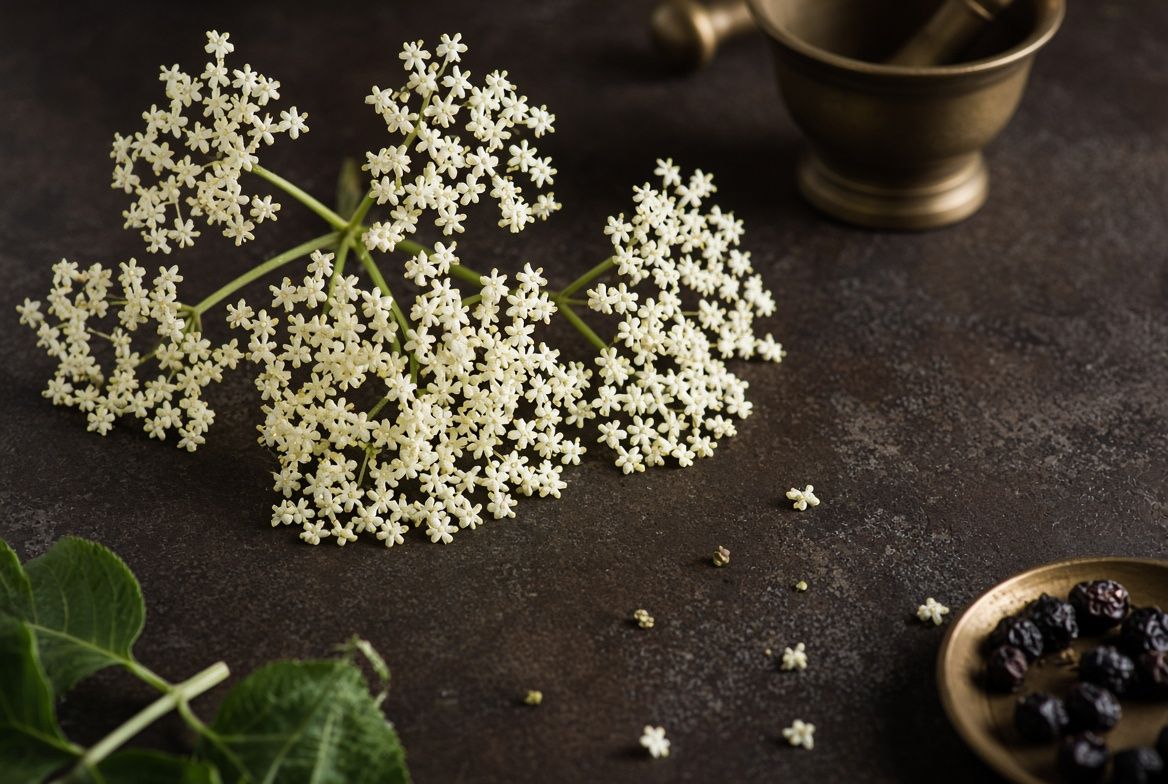
Elder has pinnate foliage, hollow young stems, and grey, furrowed bark. Its small white flowers form prominent flat-topped clusters and later become spherical black berries (Oxford University Plants 400: Sambucus nigra).
The article describes Sambucus nigra as a deciduous shrub, more rarely a small tree reaching 4–5 m, and says that it mostly remains a shrub in Sweden; its flowers are white with bright yellow anthers in broad, flat inflorescences, and ripe berries are black and shiny (From Supernatural to Ornamental: Black Elder (Sambucus nigra L., Family Adoxaceae) in Sweden).
The source concerns flowers of Sambucus nigra L. and preparations made by drying and comminuting the flowers or extracting them in a solvent. The HMPC concluded that these preparations may be used to relieve early symptoms of the common cold on the basis of traditional use, including at least 30 years of safe use (at least 15 years in the EU) (Elder flower summary).
Cultural History & Traditional Herbalism
The profile notes uses of elder leaves as insect repellent and dye, flowers as facewash, and the plant in numerous medicines. Martin Blochwitz’s Anatomia Sambuci was published after his death in 1631 and was still being printed at the century’s end (Oxford University Plants 400: Sambucus nigra).
The article reports that black elder was probably cultivated in Denmark during Viking times, circa 800–1050 CE, and in southernmost Sweden from medieval times; written medicinal references include Christian Petersen’s account from Lund in 1533 and Henrick Smid’s account from Malmö in 1546 (From Supernatural to Ornamental: Black Elder (Sambucus nigra L., Family Adoxaceae) in Sweden).
The article says elderflowers are enjoyed throughout Europe and that elderflower syrup in Germany is called Holenderblütensirup (Elderberry in the Garden and the Kitchen).
Earlier Swedish accounts describe flowers of Sambucus nigra as herbal tea and as hot wraps against colds. The first known published Swedish elderflower-cordial recipe appeared in Britta Olsson’s 1972 cookbook; newspaper analysis reports that similar recipes were reproduced nationally each early summer from 1974, as city dwellers gathered flowers in parks to make non-alcoholic cordial. A questionnaire distributed in 2019 received 81 responses, whose participants reported using elderflowers mainly for cordial, as well as tinctures, schnapps, tea, ice cream, and wine (From Supernatural to Ornamental: Black Elder (Sambucus nigra L., Family Adoxaceae) in Sweden).
Tradition, Folklore & Symbolism
Swedish folklore accounts in the article describe hyllefrun, the ‘elderberry lady,’ as a protective spirit believed to inhabit elder bushes; offerings were made to her on occasions such as Christmas (From Supernatural to Ornamental: Black Elder (Sambucus nigra L., Family Adoxaceae) in Sweden).
Folklore associated elder both with the cross of Christ’s crucifixion and with the tree on which Judas was said to have hanged himself (Oxford University Plants 400: Sambucus nigra).
Herbal Energetics
Insufficient documented evidence for a traditional energetic classification. No temperature, direction or channel is inferred from the flavor of a cup.
InfiniTea sensory metaphor: A season passing. This is original editorial language, not a measured physiological action or a translation of a traditional diagnostic category.
Sensory Profile & Tea Applications
Elder berries are used in jam and wine; its flowers provide flavouring for proprietary cordials (Oxford University Plants 400: Sambucus nigra).
The article describes Sambucus nigra flowers as sweet and spicy in scent and describes the shrub as fragrant during its flowering period (From Supernatural to Ornamental: Black Elder (Sambucus nigra L., Family Adoxaceae) in Sweden).
Sensory notebook: Compare food-grade flowers with a labeled cordial. Record the contribution of added sugar or acid separately from the fragrance of the blossoms.
Proposed comparison, not a completed trial: Record the loose flowers, any visible stalk fragments and the presence of added citrus separately. Compare the declared ingredients in a cordial before treating it as an aroma standard.
For ordinary dried herbal or fruit infusions, the German Federal Institute for Risk Assessment advises using boiling water and not leaving the prepared infusion standing for hours. Cooling a hot infusion and steeping untreated dry material in cold water are different processes; this report does not validate the latter (Boiling water a must for herbal teas).
Safety & Responsible Use
The EU HMPC’s traditional-use conclusions for Sambucus nigra L. flower preparations (Sambuci flos) cover relief of early common-cold symptoms in adults and adolescents over 12. If symptoms worsen or last longer than one week while taking the medicine, a doctor or qualified healthcare practitioner should be consulted (Sambuci flos - herbal medicinal product).
For elderflower syrup, the article recommends harvesting pristine, fully opened white or cream-colored flowerheads and avoiding browned, overripe ones; it advises cleaning preparation surfaces and equipment and says the syrup from its recipe cannot safely be consumed after room-temperature storage or canning (Elderberry in the Garden and the Kitchen).
For Sambucus nigra L. flos, the monograph lists hypersensitivity to the active substance as a contraindication. It reports no interactions and states that undesirable effects are not known; these are monograph statements, not reports of specific human study observations. Safety during pregnancy and lactation has not been established, and use is not recommended because data are insufficient (Community Herbal Monograph on Sambucus Nigra L., flos).
Preparation and exposure boundary: This review does not establish a safe medicinal dose in pregnancy, lactation or childhood, or rule out interactions or allergy. Do not substitute essential oil or a concentrated extract for the documented food or herb.
For U.S. food use, the relevant safety determination concerns the intended conditions of use. The existence of a traditional preparation or herbal medicine monograph does not establish that this ingredient, dose and beverage are cleared for sale (Understanding How the FDA Regulates Food Additives and GRAS Ingredients).
Historical Trade, Ecology & Sustainability
The profile describes elder as fast-growing and readily self-seeding, and as widespread and abundant. It also says the plant colonises supermarket shelves as readily as hedgerows (Oxford University Plants 400: Sambucus nigra).
The article reports that people gathered Sambucus nigra flowers in Swedish city parks from the late 1970s onward and documents small-scale commercial flower cultivation, with yearly harvests of 300 kg at Flädergården in Vinslöv and 250 kg at Lasätter fläder near Nyköping (From Supernatural to Ornamental: Black Elder (Sambucus nigra L., Family Adoxaceae) in Sweden).
Elder grows in hedgerows, woodland, and waste ground, tolerates varied soil conditions, and persists in urban settings as well as exposed coastal locations (Oxford University Plants 400: Sambucus nigra).
Sourcing record: Record the fraction of flowers collected from a stand, the fruit harvest forgone, and how coarse stems are removed.
InfiniTea Herb Lore & Ritualpreliminary draft
Energetics (original InfiniTea metaphor): A season passing. Use this as a private writing image, not a health statement.
Tradition & Folklore: Swedish folklore accounts in the article describe hyllefrun, the ‘elderberry lady,’ as a protective spirit believed to inhabit elder bushes; offerings were made to her on occasions such as Christmas (From Supernatural to Ornamental: Black Elder (Sambucus nigra L., Family Adoxaceae) in Sweden).
Ritual Cue (original contemporary InfiniTea interpretation): Name one fleeting sign that a season has changed. Record it without gathering anything.
Private preliminary draft; not approved for publication.
Scholarly References & Research Verification
Research limitations
Require documented flower material with extraneous green tissue controlled. Do not transfer evidence from a berry extract or a sweetened cordial directly to flower tea.
References below identify the evidence used, not additional endorsements. A botanical authority establishes nomenclature, not the identity of a physical lot. Published study samples, traditional descriptions and InfiniTea proposals are distinguished in the text.
- Kew, Plants of the World Online: Sambucus nigra L. | Taxonomic backbone
- Oxford University Plants 400: Sambucus nigra | University botanical profile webpage
- From Supernatural to Ornamental: Black Elder (Sambucus nigra L., Family Adoxaceae) in Sweden | Diachronic qualitative ethnobiological and historical study using historical sources, newspaper materials, literature, questionnaires, and participant observation
- Sambuci flos - herbal medicinal product | EMA/HMPC herbal medicinal product summary
- Elderberry in the Garden and the Kitchen | Penn State Extension article
- Elder flower summary | official summary of an herbal medicine assessment
- Community Herbal Monograph on Sambucus Nigra L., flos | Superseded final EMA/HMPC community herbal monograph, adopted 3 July 2008. It addresses traditional use of dried elder flower as herbal tea and specified ethanol-containing liquid extract and tincture preparations; it does not describe a clinical safety study design.
- Boiling water a must for herbal teas | BfR press release providing general food-safety guidance for preparing herbal and fruit infusions.
- Understanding How the FDA Regulates Food Additives and GRAS Ingredients | U.S. FDA consumer-information webpage describing food-additive and GRAS ingredient oversight.
Final Botanical Summary
Flower collection removes potential fruit. The sourcing decision and the medicinal evidence are both different from those for elderberries.
Editorial disposition: Lot unverified. The report is a private reference, not a clinical recommendation, approval for sale or authenticated sensory trial.
Verification Status (November 2026)
Phase II source audit, claim by claim
- Claims checked
- 17
- Corrected
- 3
- Withheld
- 0
- Sources
- 9
Material: Lot unverified. No physical sample has been examined.
Citation check: All 4 Safety & Use citations were re-read against their sources in November 2026 and confirmed.
A private research reference, not a clinical recommendation or product claim. Checked to the Grimoire's research standards →