
Botanical Identity & Classification
Inventory scope: Zingiber officinale · Zingiberaceae · rhizome.
Nomenclatural check: Zingiber officinale Roscoe is accepted in this treatment (family Zingiberaceae). A synonym listed there is Amomum angustifolium Salisb. The stated native range is E. Himalaya to S. Central China (Kew, Plants of the World Online: Zingiber officinale Roscoe).
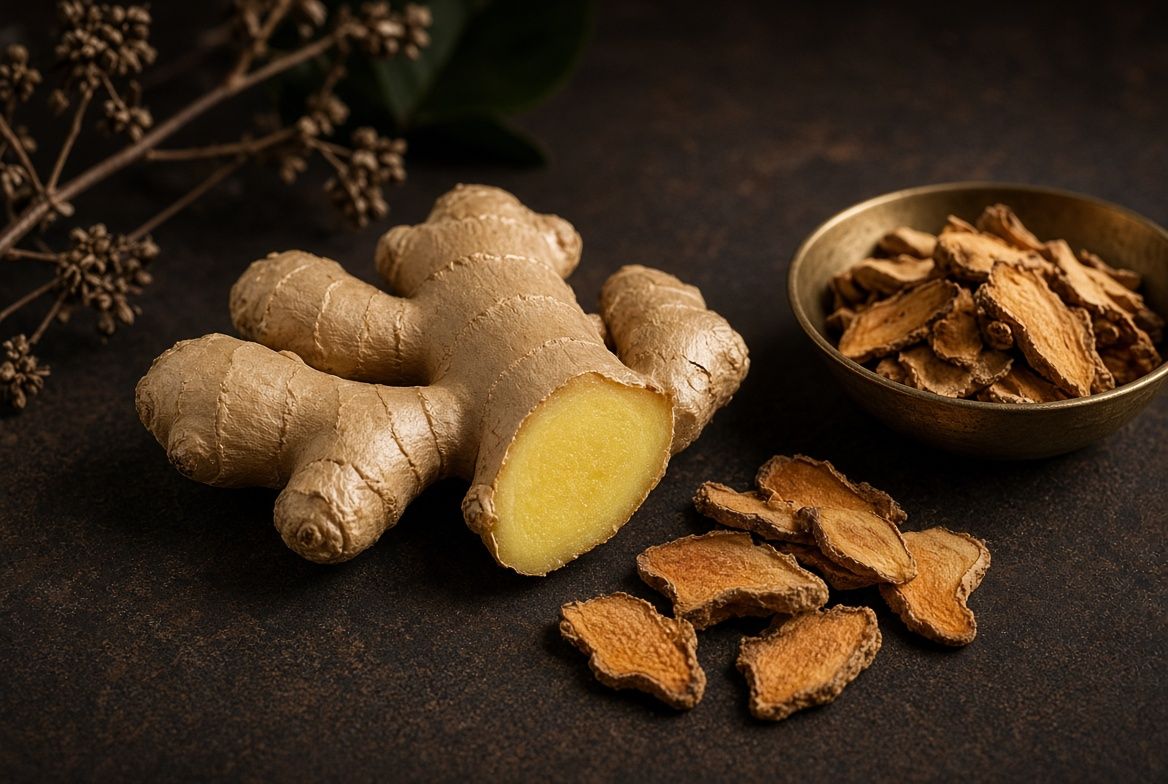
Inventory decision: Refer to the underground stem as a rhizome. Distinguish fresh slices, dried chips, powdered spice and supplement products when discussing evidence or adverse effects.
The article identifies ginger as the rhizomes (underground stems) of Zingiber officinale (Why ginger is at the root of holiday traditions).
The article identifies ginger (Zingiber officinale) as a flowering plant in the Zingiberaceae family, the same family as turmeric and cardamom (Plant science at the dinner table: Ginger).
Botanical & Scientific Profile
Keep the organ name rhizome even when a trade label says root. Water lost during drying makes equal fresh and dried weights a poor way to isolate the effect of processing alone.
The article explains that ginger’s edible part is its rhizome, an underground stem that grows just beneath the soil surface and stores nutrients, including carbohydrates and proteins, until the plant needs them to survive winter or send up shoots that form new plants (Plant science at the dinner table: Ginger).
The article’s botanical description of Zingiber officinale states that its rhizome has a fleshy yellow interior with secretory cells and ethereal oils; nodes other than the first few bear axillary buds that enable rhizome enlargement through sympodial growth (Ginger ( Zingiber officinale Rosc.): Aromatic Spice and Medicinal Herb.).
For people, studies of ginger (Zingiber officinale)—whose rhizome is used for food and health purposes—for nausea and vomiting have mostly tested dietary supplements rather than foods. Research suggests ginger may help with pregnancy-associated nausea and vomiting (Ginger: Usefulness and Safety).
Cultural History & Traditional Herbalism
The article reports that Zingiber officinale ginger was cultivated in Southeast Asia since ancient times, traded beyond the region by the 1st century, and increasingly used for culinary purposes (Why ginger is at the root of holiday traditions).
The article’s historical account says Zingiber officinale has been valued as a spice and medicinal herb in India and China since ancient times, and describes its medicinal use as extending back to ancient Greek and Roman times (Ginger ( Zingiber officinale Rosc.): Aromatic Spice and Medicinal Herb.).
The abstract identifies ginger (Zingiber officinale) as one of the most important spices in Medieval and Renaissance Europe. It says the paper examines how ginger’s flavor was shaped by preservation techniques, historical periods, and contexts, and how contemporary sensory assumptions may have influenced accounts of its history (A Flavor Mystery. Ginger Varieties, Preservation Techniques, and Cultural Implications (14th–20th Centuries)).
Tradition, Folklore & Symbolism
The article’s historical account states that ginger was believed to ward off plague in England at the time of Henry VIII (Ginger ( Zingiber officinale Rosc.): Aromatic Spice and Medicinal Herb.).
The article reports that some historians credit Queen Elizabeth I with popularizing gingerbread men by having them decorated in the likeness of members of her court and guests (Why ginger is at the root of holiday traditions).
Herbal Energetics
In traditional Chinese medicine, fresh ginger—the fresh rhizome of Zingiber officinale—is described as pungent and slightly warm, while dried ginger, the dried rhizome, is described as pungent and hot. These are medicinal-property descriptions in the article’s review of traditional Chinese medicine theory (Pharmacological activity and clinical application analysis of traditional Chinese medicine ginger from the perspective of one source and multiple substances).
The article says that in Chinese and Japanese systems of medicine, fresh Zingiber officinale rhizome is used for its warming properties and as a remedy for coughs and nausea, while dried ginger is indicated for digestive ailments (Ginger ( Zingiber officinale Rosc.): Aromatic Spice and Medicinal Herb.).
In the Hong Kong Baptist University Chinese materia medica record, ganjiang is dried Zingiber officinale rhizome, classified as acrid and hot. Compare the fresh-rhizome record below: drying is not erased by the common English name “ginger.” (中藥材圖像數據庫 - 乾薑).
The record identifies 生薑 as fresh rhizome of the ginger-family plant 薑, Zingiber officinale (Willd.) Rosc. It gives the traditional properties as 辛、微溫 (pungent; slightly warm) and lists traditional functions: promoting sweating and relieving the exterior, warming the middle and stopping vomiting, warming the lung and relieving cough, and resolving fish-and-crab or medicinal toxicity. No rasa, virya, or vipaka classification is stated. The page provides no actual clinical evidence (identified herb record).
These are categories within the named tradition. They are not measurements of body temperature, pharmacological action or clinical efficacy.
InfiniTea sensory metaphor: A spark that lingers. This is original editorial language, not a measured physiological action or a translation of a traditional diagnostic category.
Sensory Profile & Tea Applications
The article says ginger lent dishes exotic, aromatic flavors and that making gingerbread cookies was among the spice’s popular holiday uses (Why ginger is at the root of holiday traditions).
Author Dixie Sandborn recalls the aroma of warm gingerbread filling the house; the article also says ginger can be candied as a spicy and sweet treat (Plant science at the dinner table: Ginger).
Sensory notebook: Compare the aroma of fresh-cut ginger and dried chips; log how long the pungent aftertaste lasts rather than calling one sample stronger in every respect.
Proposed comparison, not a completed trial: Compare a fresh slice and a dried chip by appearance and aroma. Record mass and hydration state; treat a difference in pungency as an observation, not a measure of clinical potency.
For ordinary dried herbal or fruit infusions, the German Federal Institute for Risk Assessment advises using boiling water and not leaving the prepared infusion standing for hours. Cooling a hot infusion and steeping untreated dry material in cold water are different processes; this report does not validate the latter (Boiling water a must for herbal teas).
Safety & Responsible Use
In studies of ginger (Zingiber officinale) for nausea and vomiting in people, most tested dietary supplements rather than foods. Ginger taken orally can cause abdominal discomfort, heartburn, diarrhea, and mouth and throat irritation (Ginger: Usefulness and Safety).
For pregnant people considering dietary supplements of ginger (Zingiber officinale), the source says use may be safe and advises consulting a health care provider. It does not give separate guidance about extracts or concentrated drinks (Ginger: Usefulness and Safety).
The page says ginger dietary supplements taken orally have been used safely in many research studies, but can cause abdominal discomfort, heartburn, diarrhea, and mouth or throat irritation. It says supplement use during pregnancy may be safe and recommends consulting a health care provider; little is known about safety while breastfeeding. It warns that herbs and medicines can interact harmfully and advises discussing ginger with a health care provider if taking medicine; it does not report a specific ginger allergy or contraindication (Ginger: Usefulness and Safety).
Preparation and exposure boundary: This review does not establish a safe medicinal dose in pregnancy, lactation or childhood, or rule out interactions or allergy. Do not substitute essential oil or a concentrated extract for the documented food or herb.
For U.S. food use, the relevant safety determination concerns the intended conditions of use. The existence of a traditional preparation or herbal medicine monograph does not establish that this ingredient, dose and beverage are cleared for sale (Understanding How the FDA Regulates Food Additives and GRAS Ingredients).
Historical Trade, Ecology & Sustainability
The article reports that most of the world’s ginger supply is grown in India, growers in Hawaii largely supply the United States, and ginger rhizomes can be harvested after the first year of growth (Why ginger is at the root of holiday traditions).
The article says ginger favors warmer, more humid climates for producing mass quantities of rhizomes; it also describes ginger as a hearty crop that can do well in cooler temperatures and can be grown indoors or in greenhouses (Why ginger is at the root of holiday traditions).
The article says ginger originated in tropical rainforests from India to Southern Asia and is a perennial plant (Plant science at the dinner table: Ginger).
Sourcing record: Request fresh versus dried processing records and verify that the underground stem, not a filler or flavor extract, is represented.
InfiniTea Herb Lore & Ritualpreliminary draft
Energetics (original InfiniTea metaphor): A spark that lingers. Use this as a private writing image, not a health statement.
For the separately attributed traditional material, see Herbal Energetics; the original sensory image is not a translation of that classification.
Tradition & Folklore: The article’s historical account states that ginger was believed to ward off plague in England at the time of Henry VIII (Ginger ( Zingiber officinale Rosc.): Aromatic Spice and Medicinal Herb.).
Ritual Cue (original contemporary InfiniTea interpretation): Draw a branching line like a rhizome. At one fork, write the first small action you can actually take.
Private preliminary draft; not approved for publication.
Scholarly References & Research Verification
Research limitations
Ask whether fresh, dried, powdered or extract material was used. A trial in a particular nausea setting does not answer a general question about a ginger beverage.
References below identify the evidence used, not additional endorsements. A botanical authority establishes nomenclature, not the identity of a physical lot. Published study samples, traditional descriptions and InfiniTea proposals are distinguished in the text.
- Kew, Plants of the World Online: Zingiber officinale Roscoe | Taxonomic backbone
- Why ginger is at the root of holiday traditions | Purdue Agriculture news story
- Plant science at the dinner table: Ginger | Michigan State University Extension educational article
- Ginger ( Zingiber officinale Rosc.): Aromatic Spice and Medicinal Herb. | University blog article
- Ginger: Usefulness and Safety | health fact sheet
- Pharmacological activity and clinical application analysis of traditional Chinese medicine ginger from the perspective of one source and multiple substances | review article
- A Flavor Mystery. Ginger Varieties, Preservation Techniques, and Cultural Implications (14th–20th Centuries) | Conference paper
- 中藥材圖像數據庫 - 乾薑 | Materia medica database entry
- identified herb record | Hong Kong Baptist University Chinese Medicinal Materials Image Database entry for 生薑 (Shengjiang); no specific named tradition is identified.
- Boiling water a must for herbal teas | BfR press release providing general food-safety guidance for preparing herbal and fruit infusions.
- Understanding How the FDA Regulates Food Additives and GRAS Ingredients | U.S. FDA consumer-information webpage describing food-additive and GRAS ingredient oversight.
Final Botanical Summary
Preparation changes the tasting question as well as the evidence question. A study of a supplement for nausea is not a dose guide for fresh ginger tea.
Editorial disposition: Lot unverified. The report is a private reference, not a clinical recommendation, approval for sale or authenticated sensory trial.
Verification Status (November 2026)
Phase II source audit, claim by claim
- Claims checked
- 19
- Corrected
- 3
- Withheld
- 1
- Sources
- 11
Material: Lot unverified. No physical sample has been examined.
Citation check: All 4 Safety & Use citations were re-read against their sources in November 2026 and confirmed.
A private research reference, not a clinical recommendation or product claim. Checked to the Grimoire's research standards →