
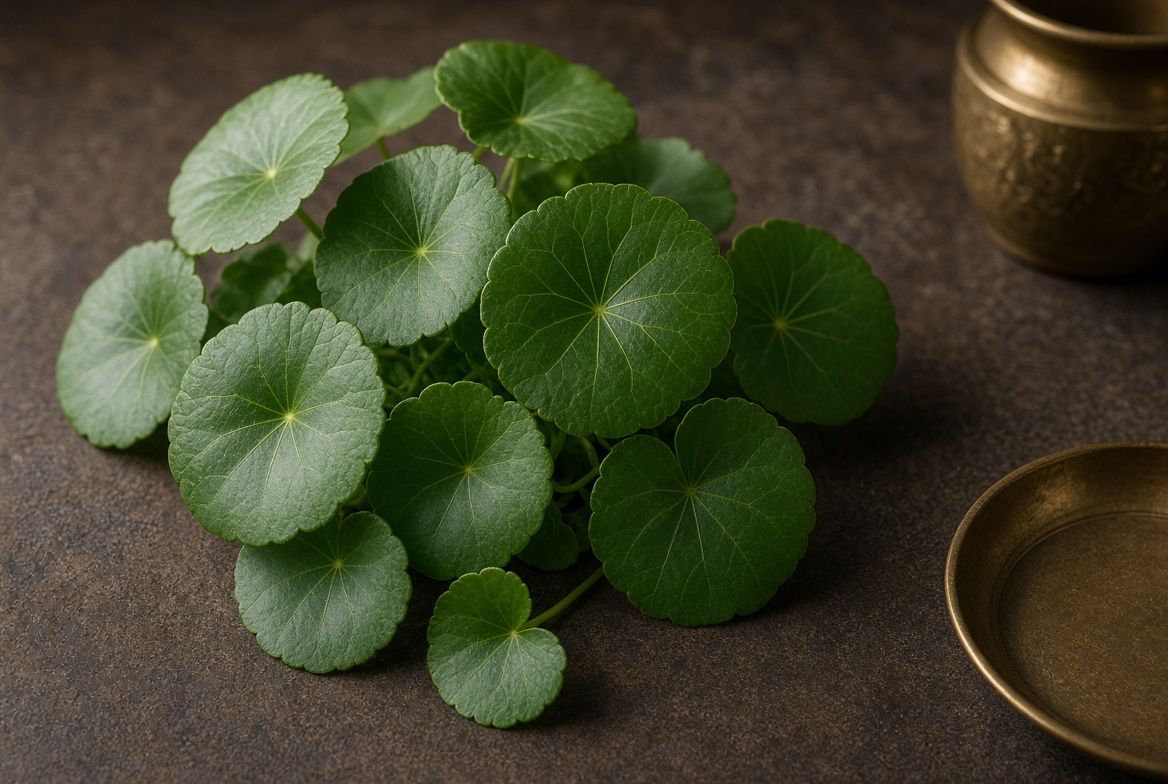
Botanical Identity & Classification
Inventory scope: Centella asiatica · Apiaceae · leaf or aerial material.
Nomenclatural check: Centella asiatica (L.) Urb. is accepted in this treatment (family Apiaceae). A synonym listed there is Hydrocotyle asiatica L. The stated native range is Caucasus, Tropical & Subtropical Old World to E. Australia and W. Pacific (Kew, Plants of the World Online: Centella asiatica (L.) Urb.).
Inventory decision: Do not confuse gotu kola with kola nut. Culinary fresh leaves, standardized triterpene extracts and topical preparations belong to different records of exposure.
The article identifies Centella asiatica (L.) Urb. as a stoloniferous plant in the genus Centella and family Apiaceae (Umbelliferae), and lists Hydrocotyle asiatica L. as a synonym (Morphological Description and Ethnobotanical Review of the Orphan Crop Myin-Hkwa (Centella asiatica L.) From Myanmar).
The review identifies Centella asiatica (L.) Urban, commonly called gotu kola, as a member of the Apiaceae family. It lists Centella coriacea, Hydrocotyle asiatica, Hydrocotyle lunata, and Trisanthus cochinchinensis as synonyms (Centella asiatica (L.) Urban: From Traditional Medicine to Modern Medicine with Neuroprotective Potential).
Botanical & Scientific Profile
Retain Mandukaparni and other vernacular names with their source traditions. “Brahmi” without a botanical name is insufficient for transferring evidence between Centella and Bacopa.
A double-blind, placebo-controlled study in 40 healthy adults found that a single 12-gram oral dose of Centella asiatica (gotu kola; plant part not specified) in grape juice reduced acoustic startle response more than placebo (−68% versus −29%). Pulse, blood pressure, and mood ratings did not change; laboratory tests were not performed (Centella asiatica).
In this study, Myanmar-origin Centella asiatica plants grown in Japan were described as semi-erect and prostrate, with wide, peltate, orbicular leaves cordate at the base. Measured ranges were 5.00–7.70 cm for leaf length, 5.30–9.00 cm for leaf width, 27.69–79.22 cm² for leaf area, and 19.50–37.10 cm for petiole length (Morphological Description and Ethnobotanical Review of the Orphan Crop Myin-Hkwa (Centella asiatica L.) From Myanmar).
The review identifies triterpene saponosides as the major reported chemical group in Centella asiatica, including asiatic acid, madecassic acid, asiaticoside, and madecassoside. In vitro studies of plant extracts and compounds report enzyme effects and neurite development; animal studies report findings involving memory, oxidative stress, and other neurological outcomes (Centella asiatica (L.) Urban: From Traditional Medicine to Modern Medicine with Neuroprotective Potential).
Cultural History & Traditional Herbalism
The review reports that leaves of Centella asiatica (gotu kola) are commonly eaten in Sri Lanka as a green salad called sambol (A review of edible selected green leaves which use in Sri Lankan culinary).
According to the article’s account of Myanmar use, myin-hkwa is consumed as a leafy vegetable and used as a medicinal herb; its young leaves are eaten raw in salads, deep-fried, served as a separate soup, or cooked with Roselle leaves in a soup (Morphological Description and Ethnobotanical Review of the Orphan Crop Myin-Hkwa (Centella asiatica L.) From Myanmar).
The review states that Centella asiatica has been used for centuries in Ayurvedic and Chinese traditional medicine and that it was traditionally used as a brain tonic in Ayurvedic medicine (Centella asiatica (L.) Urban: From Traditional Medicine to Modern Medicine with Neuroprotective Potential).
In Galle district, Southern Province, the study documented Gotukola (Centella asiatica) porridge as a traditional food practice among Sinhalese participants. Gotukola leaves are used to make an extract that is boiled with coconut milk, crushed shallots, and garlic; jaggery is commonly served with the porridge to balance its bitter taste. This evidence came from in-depth interviews and observations with 30 Sinhalese people aged 60–75, collected from January to April 2024 (An exploration of the porridge tradition in Southern Sri Lankan culture).
Tradition, Folklore & Symbolism
The article recounts a historical belief that gotu kola was one of the “miracle elixirs of life” and that the Chinese herbalist Li Ching-Yun, who some believed lived to age 197, used it regularly (Morphological Description and Ethnobotanical Review of the Orphan Crop Myin-Hkwa (Centella asiatica L.) From Myanmar).
The article reports Chi-hsueh-ts’ao as a Chinese name for Centella asiatica, Bo-ti-ts’ien as meaning “ground coin,” and P’o’t’ung-cbien as meaning “broken copper coin.” It also says the plant was historically known in China as “snow plant,” referring to its cooling properties (The Ethnopharmacology of Centella asiatica (L.) Urban (Apiaceae)).
Herbal Energetics
In Ayurveda, Centella asiatica is described as a mental rejuvenator called medhya rasayana, a tonic used to reduce mental fatigue and improve mental clarity (Morphological Description and Ethnobotanical Review of the Orphan Crop Myin-Hkwa (Centella asiatica L.) From Myanmar).
The article identifies Mandookaparni as Centella asiatica L. Urban and, citing Narhari Pandit’s Raj Nighantu, Parpatadi varga (verses 63–66), describes its Ayurvedic qualities as tikta rasa (bitter), madhura vipaka (sweet), and sheeta virya (cold). The trial used Mandookaparni Avleha, made with Mandookaparni, honey, cow ghee, and sugar; the article reports no plant part for the qualities (Comparative efficacy of Medhya Rasayana, Bacopa monnieri, and Centella asiatica in enhancing memory and IQ of 8–10 year-old healthy boys: A prakriti-based double-blind, randomized controlled trial).
Herba Centellae is the dried whole part of Centella asiatica (L.) Urb. in the family Umbelliferae; its Chinese Pharmacopoeia (2020) name is “Centellae Herba.” The page states that it can clear heat and drain dampness, and detoxify and disperse swelling. It does not give the queried flavor, temperature, movement, channels, rasa, virya, or vipaka (Identification of Easily Confused Species of Chinese Materia Medica in Hong Kong by Macroscopic and Microscopic Characteristics Project: Herba Glechomae versus Herba Centellae).
These are categories within the named tradition. They are not measurements of body temperature, pharmacological action or clinical efficacy.
InfiniTea sensory metaphor: An ordinary leaf at the table. This is original editorial language, not a measured physiological action or a translation of a traditional diagnostic category.
Sensory Profile & Tea Applications
The article describes Centella asiatica as prized for its slightly pungent flavor and aroma, and its leaves as slightly bitter (Morphological Description and Ethnobotanical Review of the Orphan Crop Myin-Hkwa (Centella asiatica L.) From Myanmar).
Leyel described “vellarine” as having the odor and bitter, persistent taste of the fresh Centella asiatica plant. The source says the oil in the plant’s fruits has a fragrance characteristic of the leaf oils (The Ethnopharmacology of Centella asiatica (L.) Urban (Apiaceae)).
Sensory notebook: Document the flavor of the culinary leaf only from an identified food preparation or source. A skin-product study says nothing about the taste or efficacy of a tea.
Proposed comparison, not a completed trial: Compare label evidence and leaf outline on identified specimens. Do not use the shape of a dried fragment alone to distinguish products sold under an ambiguous name.
For ordinary dried herbal or fruit infusions, the German Federal Institute for Risk Assessment advises using boiling water and not leaving the prepared infusion standing for hours. Cooling a hot infusion and steeping untreated dry material in cold water are different processes; this report does not validate the latter (Boiling water a must for herbal teas).
Safety & Responsible Use
LiverTox reports rare published cases of acute symptomatic liver injury after oral Centella asiatica products, including reports involving tablets taken for weight loss and oral use for acne. Few prospective studies have reported laboratory results during treatment, and the case reports did not rule out contamination or other hepatotoxic ingredients. The plant part used in the reported oral products is not specified (Centella asiatica).
The review reports skin irritation and contact dermatitis in some cases involving Centella asiatica preparations. It does not report liver injury after ingestion; it states that the plant is known to be safe at recommended doses (Centella asiatica (L.) Urban: From Traditional Medicine to Modern Medicine with Neuroprotective Potential).
Rare human reports describe acute, hepatocellular liver injury with jaundice after oral Centella asiatica products, with onset reported at 3–8 weeks and complete recovery in 1–2 months after stopping; some cases had immune or autoimmune features, and one detailed case recurred on re-exposure. Small trials reported mild, transient, nonspecific effects (headache, dizziness, bloating, diarrhea, or nausea), and allergic reactions have been reported, particularly with topical use; the page says serum enzyme elevations have not been linked to therapy, but notes limited laboratory monitoring, and advises withdrawal if liver injury appears and avoiding rechallenge. The page provides no pregnancy, lactation, or interaction findings (Centella asiatica).
Preparation and exposure boundary: This review does not establish a safe medicinal dose in pregnancy, lactation or childhood, or rule out interactions or allergy. Do not substitute essential oil or a concentrated extract for the documented food or herb.
For U.S. food use, the relevant safety determination concerns the intended conditions of use. The existence of a traditional preparation or herbal medicine monograph does not establish that this ingredient, dose and beverage are cleared for sale (Understanding How the FDA Regulates Food Additives and GRAS Ingredients).
Historical Trade, Ecology & Sustainability
The article describes Centella asiatica as an orphaned species in Japan, where local people are little aware of it as a daily food; it also states that data on market-oriented production in Japan are unavailable (Morphological Description and Ethnobotanical Review of the Orphan Crop Myin-Hkwa (Centella asiatica L.) From Myanmar).
The article says Centella asiatica is marketed as a medicinal herb in China, Java, India, Madagascar, Sri Lanka, and, more recently, the United States (The Ethnopharmacology of Centella asiatica (L.) Urban (Apiaceae)).
The article reports that Centella asiatica is widespread in tropical and subtropical regions and favors relatively shady, damp habitats, including wetlands, riversides, ponds, wet meadows, and forests at elevations of 300–1,800 m. In Myanmar, it is reported from cooler regions near water and from paddy fields (Morphological Description and Ethnobotanical Review of the Orphan Crop Myin-Hkwa (Centella asiatica L.) From Myanmar).
Sourcing record: Ask for authenticated edible aerial material and growing-water and microbial controls; avoid applying topical cosmetic specifications to a beverage ingredient.
InfiniTea Herb Lore & Ritualpreliminary draft
Energetics (original InfiniTea metaphor): An ordinary leaf at the table. Use this as a private writing image, not a health statement.
For the separately attributed traditional material, see Herbal Energetics; the original sensory image is not a translation of that classification.
Tradition & Folklore: The article recounts a historical belief that gotu kola was one of the “miracle elixirs of life” and that the Chinese herbalist Li Ching-Yun, who some believed lived to age 197, used it regularly (Morphological Description and Ethnobotanical Review of the Orphan Crop Myin-Hkwa (Centella asiatica L.) From Myanmar).
Ritual Cue (original contemporary InfiniTea interpretation): Write down a plant you first knew as food. Note how your description changes when you begin there rather than with a supplement claim.
Private preliminary draft; not approved for publication.
Scholarly References & Research Verification
Research limitations
Record species and organ and distinguish a leaf food, a standardized oral extract and a topical preparation. Cosmetic evidence cannot establish an oral safety margin.
The study was limited to a selected sample in Galle district; it did not cover other Sri Lankan regions or communities (An exploration of the porridge tradition in Southern Sri Lankan culture). The article does not specify the part associated with the Ayurvedic qualities or state accepted taxonomic status or synonyms; its identification of Mandookaparni with Centella asiatica is the article’s own (Comparative efficacy of Medhya Rasayana, Bacopa monnieri, and Centella asiatica in enhancing memory and IQ of 8–10 year-old healthy boys: A prakriti-based double-blind, randomized controlled trial).
References below identify the evidence used, not additional endorsements. A botanical authority establishes nomenclature, not the identity of a physical lot. Published study samples, traditional descriptions and InfiniTea proposals are distinguished in the text.
- Kew, Plants of the World Online: Centella asiatica (L.) Urb. | Taxonomic backbone
- Morphological Description and Ethnobotanical Review of the Orphan Crop Myin-Hkwa (Centella asiatica L.) From Myanmar | original research article with morphological characterization and an ethnobotanical review
- Centella asiatica (L.) Urban: From Traditional Medicine to Modern Medicine with Neuroprotective Potential | review article
- Centella asiatica | LiverTox clinical reference monograph on drug-induced liver injury
- A review of edible selected green leaves which use in Sri Lankan culinary | review article
- The Ethnopharmacology of Centella asiatica (L.) Urban (Apiaceae) | ethnopharmacological review article
- An exploration of the porridge tradition in Southern Sri Lankan culture | Open-access original ethnographic article based on interviews and field observations
- Comparative efficacy of Medhya Rasayana, Bacopa monnieri, and Centella asiatica in enhancing memory and IQ of 8–10 year-old healthy boys: A prakriti-based double-blind, randomized controlled trial | Prakriti-based, double-blind, randomized, two-arm comparative clinical trial; not a review.
- Identification of Easily Confused Species of Chinese Materia Medica in Hong Kong by Macroscopic and Microscopic Characteristics Project: Herba Glechomae versus Herba Centellae | Government Chinese Medicines Testing Institute, Department of Health; an identification pamphlet comparing Chinese materia medica by macroscopic and microscopic characteristics.
- Boiling water a must for herbal teas | BfR press release providing general food-safety guidance for preparing herbal and fruit infusions.
- Understanding How the FDA Regulates Food Additives and GRAS Ingredients | U.S. FDA consumer-information webpage describing food-additive and GRAS ingredient oversight.
Final Botanical Summary
Starting with a named food tradition gives this leaf a fuller history than starting with a list of proposed medical benefits.
Editorial disposition: Lot unverified. The report is a private reference, not a clinical recommendation, approval for sale or authenticated sensory trial.
Verification Status (November 2026)
Phase II source audit, claim by claim
- Claims checked
- 19
- Corrected
- 3
- Withheld
- 1
- Sources
- 11
Material: Lot unverified. No physical sample has been examined.
Citation check: All 4 Safety & Use citations were re-read against their sources in November 2026 and confirmed.
A private research reference, not a clinical recommendation or product claim. Checked to the Grimoire's research standards →