
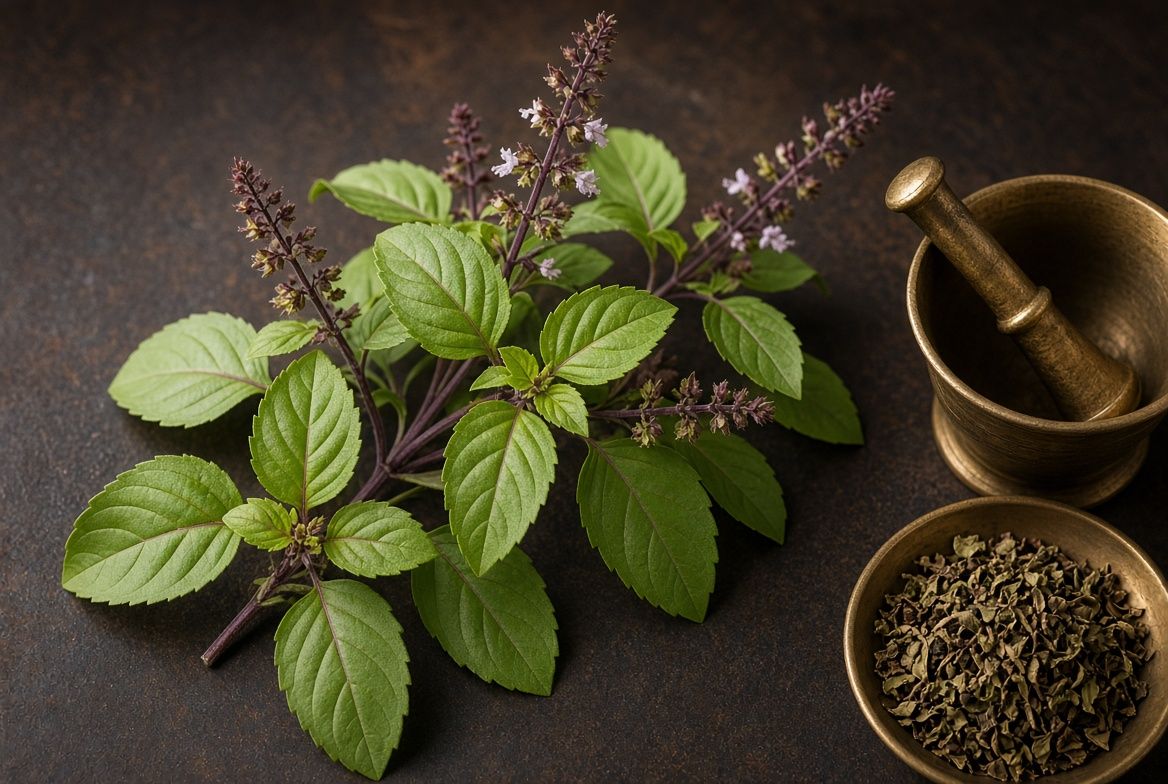
Botanical Identity & Classification
Inventory scope: Ocimum tenuiflorum (syn. O. sanctum) · Lamiaceae · leaf or aerial herb.
Nomenclatural check: Ocimum tenuiflorum L. is accepted in this treatment (family Lamiaceae). A synonym listed there is Ocimum sanctum L. The stated native range is Tropical & Subtropical Asia to W. Pacific (Kew, Plants of the World Online: Ocimum tenuiflorum L.).
Inventory decision: Tulsi is a cultural name as well as a market label. Obtain the species and plant part; do not silently equate all named tulsi types with one chemotype or with sweet basil.
The article identifies Tulsi, also called holy basil, as Ocimum tenuiflorum L. in the Lamiaceae family and states that Ocimum sanctum L. is a synonym of O. tenuiflorum (The Cultural and Commercial Value of Tulsi (Ocimum tenuiflorum L.): Multidisciplinary Approaches Focusing on Species Authentication).
The article identifies holy basil (Ocimum tenuiflorum) as a relative of sweet basil (Ocimum basilicum) and says they have different flavor profiles (Ocimum tenuiflorum : Holy Basil or Tulasi/Tulsi).
Botanical & Scientific Profile
This is the tulsi entry. An account of reverence for tulsi belongs here with a named tradition; even here a general account is not evidence that all Hindu households use the plant in the same way.
This systematic review of human ingestion studies of tulsi (Ocimum sanctum, O. tenuiflorum, or O. gratissimum, commonly prepared from leaves) included 24 independent clinical studies with 1,111 participants and reported favorable outcomes across metabolic, immune, and neurocognitive domains. In a randomized crossover study, 22 healthy adults taking 300 mg per day of ethanolic tulsi leaf extract for four weeks had increased cytokine levels, including interferon-γ and interleukin-4. In a placebo-controlled study, 40 healthy adults taking 300 mg per day of ethanolic tulsi leaf extract for four weeks showed improvements in cognitive measures; the review reports that cognitive effects were significant only after the first two weeks. The review noted methodological limitations across the evidence base (The Clinical Efficacy and Safety of Tulsi in Humans: A Systematic Review of the Literature).
DNA barcoding with ITS and trnH-psbA identified 22 of 26 community Tulsi samples (84%): 10 as O. tenuiflorum, eight as O. gratissimum, three as O. basilicum-type samples, and one as a Veronica species (The Cultural and Commercial Value of Tulsi (Ocimum tenuiflorum L.): Multidisciplinary Approaches Focusing on Species Authentication).
Holy basil (Ocimum tenuiflorum) is an aromatic perennial herbaceous subshrub that grows 30–60 cm tall, with fragrant green or purple leaves and tubular flowers that may be pale pink, lavender, or white (Ocimum tenuiflorum : Holy Basil or Tulasi/Tulsi).
Cultural History & Traditional Herbalism
The article states that Tulsi has been used for centuries in Asia, Africa, and the Middle East in cuisine, cosmetics, herbal remedies, and religious ceremonies; it is part of Ayurveda, Siddha, and Unani, and the Rig Veda first mentions it around 1500 BC (The Cultural and Commercial Value of Tulsi (Ocimum tenuiflorum L.): Multidisciplinary Approaches Focusing on Species Authentication).
In Ayurveda, holy basil (Ocimum tenuiflorum) has a long history of medicinal use for a broad spectrum of ailments; its leaves are also used to make tea (Ocimum tenuiflorum : Holy Basil or Tulasi/Tulsi).
Holy basil, also called tulsi, is often used in Ayurvedic medicine and is considered a sacred plant in Hinduism (What is holy basil, and can it provide health benefits?).
The page identifies holy basil as Ocimum tenuiflorum and describes Hindu practices involving the plant: tulsi leaves are used in worship of Vishnu and associated deities, and the plant is worshipped as an avatar of Lakshmi. It states that tulsi is traditionally planted in the central courtyard of Hindu houses or beside Hanuman temples, and that the plant is worshipped during evening lamp-lighting in Kartik. It also reports that Vaishnavas use prayer beads made from tulsi stems or roots as a symbol of initiation; a later passage names the plant as Ocimum sanctum Linn (Holy basil or tulsi).
Tradition, Folklore & Symbolism
The article describes Tulsi as one of the most sacred plants on the Indian subcontinent and says it represents the Hindu goddess Virinda Tulsi (The Cultural and Commercial Value of Tulsi (Ocimum tenuiflorum L.): Multidisciplinary Approaches Focusing on Species Authentication).
In Hindu tradition, holy basil (Ocimum tenuiflorum) is considered the most sacred plant species, a manifestation of god in the plant kingdom, and a threshold between heaven and earth. It is also regarded as Lakshmi, consort of Vishnu and goddess of wealth and prosperity (Ocimum tenuiflorum : Holy Basil or Tulasi/Tulsi).
Holy basil (Ocimum tenuiflorum), also called tulsi, is grown in many Hindu homes, often in the courtyard in a dedicated four-sided structure. Its presence is believed to increase piety, foster meditation, purify, and protect. Devotees commonly worship the plant in the morning and evening with mantras and offerings of flowers, incense, or water from the Ganges; Tuesdays and Fridays are considered especially sacred. Watering and caring for the plant, usually undertaken by women of the household, is considered worshipful and meritorious (Holy basil | Description, Uses, Tulsi, Hinduism, & Facts).
Herbal Energetics
The Ayurvedic monograph for Tulsi (Ocimum sanctum Linn.) lists katu (pungent) and tikta (bitter) rasa, laghu (light) and ruksa (dry) guna, and usna (heating) virya (Tulsi - Shri Dhanwantry Ayurvedic College & Hospital).
The plant list identifies Tulasi as Ocimum sanctum Linn. and lists its uses as bronchitis, skin diseases, allergy, anemia, fever, and liver disorders. The document describes rasa as taste, virya as drug strength or potency, and vipaka as the end product of a drug’s digestion and metabolism, but does not give Tulasi-specific rasa, virya, or vipaka values (Ayurveda: The Science of Life).
These are categories within the named tradition. They are not measurements of body temperature, pharmacological action or clinical efficacy.
InfiniTea sensory metaphor: Attentive tending. This is original editorial language, not a measured physiological action or a translation of a traditional diagnostic category.
Sensory Profile & Tea Applications
Holy basil (Ocimum tenuiflorum) has fragrant leaves and a peppery flavor with hints of clove and spice; sweet or Thai basil (Ocimum basilicum) is described as milder and sweeter (Ocimum tenuiflorum : Holy Basil or Tulasi/Tulsi).
Holy basil has an aromatic flavor described as strongly clove-like and peppery, with notes of mint and lemon (What is holy basil, and can it provide health benefits?).
Sensory notebook: Compare aroma descriptions such as clove-like, green or peppery only on labeled lots; do not use a scent note to assign a religious or varietal identity.
Proposed comparison, not a completed trial: Record the cultivar or local name verbatim alongside the scientific name. Compare the scent of two identified samples without ranking them as more or less authentic to a community.
For ordinary dried herbal or fruit infusions, the German Federal Institute for Risk Assessment advises using boiling water and not leaving the prepared infusion standing for hours. Cooling a hot infusion and steeping untreated dry material in cold water are different processes; this report does not validate the latter (Boiling water a must for herbal teas).
Safety & Responsible Use
Ohio State advises caution for people taking antidiabetic medications because holy basil may lower fasting blood glucose, and says people trying to get pregnant, pregnant people, and lactating people should not use it. Animal studies suggest holy basil seed oil may increase bleeding risk when used with anticoagulant or antiplatelet drugs; the article does not state that these findings concern leaf tea (What is holy basil, and can it provide health benefits?).
This systematic review of human ingestion studies of tulsi (Ocimum sanctum, O. tenuiflorum, or O. gratissimum) found that the longest included study lasted 13 weeks. Of 24 studies, 15 reported no adverse events, eight did not describe or refer to adverse events, and one reported occasional mild nausea. The authors noted that the short study durations and lack of reported adverse effects do not rule out long-term side effects, so the findings do not establish long-term safety (The Clinical Efficacy and Safety of Tulsi in Humans: A Systematic Review of the Literature).
The review reports that no adverse reactions had been reported in human clinical trials, without specifying the trials or the form of Ocimum used. It says two animal studies suggested large amounts of holy basil might negatively affect fertility, and that safety during pregnancy and lactation had not been investigated; it therefore states that holy basil should probably be avoided at those times until more is known (Ocimum sanctum Linn. A reservoir plant for therapeutic applications: An overview).
Preparation and exposure boundary: This review does not establish a safe medicinal dose in pregnancy, lactation or childhood, or rule out interactions or allergy. Do not substitute essential oil or a concentrated extract for the documented food or herb.
For U.S. food use, the relevant safety determination concerns the intended conditions of use. The existence of a traditional preparation or herbal medicine monograph does not establish that this ingredient, dose and beverage are cleared for sale (Understanding How the FDA Regulates Food Additives and GRAS Ingredients).
Historical Trade, Ecology & Sustainability
Interview participants reported that commercial Tulsi products were increasingly available in the UK, including products they had previously had to import from India (The Cultural and Commercial Value of Tulsi (Ocimum tenuiflorum L.): Multidisciplinary Approaches Focusing on Species Authentication).
The article describes Tulsi as native to tropical Asia, where it grows wild in warm regions. It describes O. gratissimum as native to Africa and abundant in the wild, but difficult to find in India and less able to grow there (The Cultural and Commercial Value of Tulsi (Ocimum tenuiflorum L.): Multidisciplinary Approaches Focusing on Species Authentication).
Holy basil (Ocimum tenuiflorum) is native to tropical and subtropical Asia (Ocimum tenuiflorum : Holy Basil or Tulasi/Tulsi).
Sourcing record: Request the grower’s local name alongside its scientific identification, and document whether a cultivated type or a mixed harvest was supplied.
InfiniTea Herb Lore & Ritualpreliminary draft
Energetics (original InfiniTea metaphor): Attentive tending. Use this as a private writing image, not a health statement.
For the separately attributed traditional material, see Herbal Energetics; the original sensory image is not a translation of that classification.
Tradition & Folklore: The article describes Tulsi as one of the most sacred plants on the Indian subcontinent and says it represents the Hindu goddess Virinda Tulsi (The Cultural and Commercial Value of Tulsi (Ocimum tenuiflorum L.): Multidisciplinary Approaches Focusing on Species Authentication).
Ritual Cue (original contemporary InfiniTea interpretation): Name one ordinary thing in your care. Write what tending it will look like tomorrow, without imitating a devotional observance.
Private preliminary draft; not approved for publication.
Scholarly References & Research Verification
Research limitations
Check vernacular and cultivar labels against lot documentation. Keep a sacred plant's cultural significance separate from ingestion guidance.
References below identify the evidence used, not additional endorsements. A botanical authority establishes nomenclature, not the identity of a physical lot. Published study samples, traditional descriptions and InfiniTea proposals are distinguished in the text.
- Kew, Plants of the World Online: Ocimum tenuiflorum L. | Taxonomic backbone
- The Cultural and Commercial Value of Tulsi (Ocimum tenuiflorum L.): Multidisciplinary Approaches Focusing on Species Authentication | mixed-methods study using interviews and DNA barcoding
- Ocimum tenuiflorum : Holy Basil or Tulasi/Tulsi | Plant of the Week article
- The Clinical Efficacy and Safety of Tulsi in Humans: A Systematic Review of the Literature | systematic review
- What is holy basil, and can it provide health benefits? | Ohio State Health & Discovery wellness article by a registered dietitian at Ohio State Wexner Medical Center
- Tulsi - Shri Dhanwantry Ayurvedic College & Hospital | Ayurvedic botanical monograph
- Holy basil or tulsi | Institutional informational PDF about tulsi’s religious and medicinal uses
- Holy basil | Description, Uses, Tulsi, Hinduism, & Facts | Britannica descriptive article on holy basil and Hindu religious practices
- Ayurveda: The Science of Life | A 2012 Department of AYUSH overview document; it gives general Ayurvedic drug principles and lists commonly used medicinal plants, rather than presenting a Tulasi pharmacopoeial monograph.
- Ocimum sanctum Linn. A reservoir plant for therapeutic applications: An overview | A review of traditional uses and reported pharmacological studies, including preclinical animal studies. Its safety section says two animal studies suggested large amounts of holy basil might negatively affect fertility and notes human clinical-trial safety only generally; it does not describe the trials’ design or preparations.
- Boiling water a must for herbal teas | BfR press release providing general food-safety guidance for preparing herbal and fruit infusions.
- Understanding How the FDA Regulates Food Additives and GRAS Ingredients | U.S. FDA consumer-information webpage describing food-additive and GRAS ingredient oversight.
Final Botanical Summary
A respectful account names Hindu devotional contexts on their own terms and does not turn a living practice into a proprietary ritual.
Editorial disposition: Lot unverified. The report is a private reference, not a clinical recommendation, approval for sale or authenticated sensory trial.
Verification Status (November 2026)
Phase II source audit, claim by claim
- Claims checked
- 18
- Corrected
- 2
- Withheld
- 0
- Sources
- 12
Material: Lot unverified. No physical sample has been examined.
Citation check: All 4 Safety & Use citations were re-read against their sources in November 2026 and confirmed.
A private research reference, not a clinical recommendation or product claim. Checked to the Grimoire's research standards →