
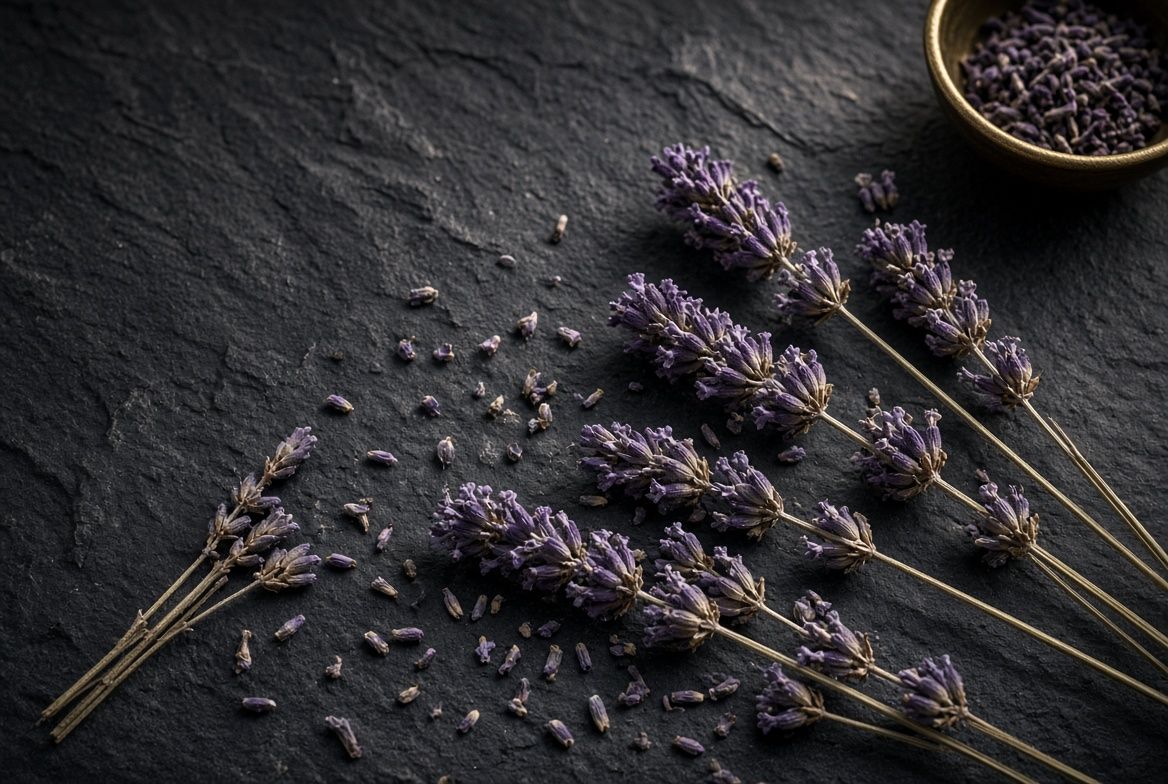
Botanical Identity & Classification
Inventory scope: Lavandula angustifolia · Lamiaceae · culinary flowers, provisional.
Nomenclatural check: Lavandula angustifolia Mill. is accepted in this treatment (family Lamiaceae) (Kew, Plants of the World Online: Lavandula angustifolia Mill., Lavandula angustifolia Mill. | Plants of the World Online).
Inventory decision: Distinguish English lavender from lavandin and other lavender species. A culinary bud, inhaled aroma, proprietary oral oil product and bottle of essential oil are different materials.
The review identifies English, or true, lavender as Lavandula angustifolia Mill. and lists ‘Hidcote’, ‘Munstead’, and ‘Maillette’ among its cultivars. It describes lavender flowers as the culinary part, in contrast with the leaves typically used from comparator herbs including rosemary, thyme, oregano, sage, and basil (Considering Culinary Use of Lavender: Sensory and Cultural Factors).
The article places lavender in the Lamiaceae (Labiatae) family and lists Lavandula angustifolia Mill., L. angustifolia subsp. angustifolia (L. spica L.), and L. angustifolia subsp. pyrenaica (DC) Guinea (L. vera DC). It also names L. stoechas L. as Greek, French, or Spanish Lavender (Herbs in History: Lavender).
Botanical & Scientific Profile
The cultivar and intended market matter more than a shared lavender label. Do not use evidence about a standardized lavender-oil product as a finding about culinary flowers.
The profile reports that recent research found lavender oil to be antimicrobial; it does not specify the Lavandula species, oil preparation, or test conditions (Lavandula species - Oxford University Plants 400).
The review’s compositional table reports that Lavandula angustifolia essential oil typically contains about 25–45% linalool and 25–45% linalyl acetate, with camphor typically below 1% and 1,8-cineole typically below 3%. These are approximate ranges that vary with chemotype, cultivar or clone, plant part, harvest stage, and extraction method (Considering Culinary Use of Lavender: Sensory and Cultural Factors).
The article suggests that lavender’s name may refer to the elongated stalks of lavender, bearing small flowers along them; it does not assign this description to a particular species (Herbs in History: Lavender).
Cultural History & Traditional Herbalism
Eighteenth-century sources indicate that English lavender was favored over lavender grown in mainland Europe and commanded a much higher price. English lavender production declined severely in the twentieth century and has recently resurged, with many new farms established (Lavandula species - Oxford University Plants 400).
The review reports that cultivation of Lavandula angustifolia around Isparta, Türkiye, in recent decades has contributed to local lavender gastronomy, including lavender-flavoured Turkish delight, ice cream, muhallebi, gözleme, and Turkish coffee (Considering Culinary Use of Lavender: Sensory and Cultural Factors).
In this historical account, Dioscorides’s first-century CE description of lavender as stoichas says its decoction was used for chest conditions and that it was mixed into antidotes. Pliny’s account says it was administered as a draught to provoke menstruation and was also mixed into antidotes (Herbs in History: Lavender).
Tradition, Folklore & Symbolism
The profile says the name lavender derives from the Latin “lavare,” meaning “to wash.” (Lavandula species - Oxford University Plants 400).
Herbal Energetics
Insufficient documented evidence for a traditional energetic classification. No temperature, direction or channel is inferred from the flavor of a cup.
InfiniTea sensory metaphor: A narrow ribbon of fragrance. This is original editorial language, not a measured physiological action or a translation of a traditional diagnostic category.
Sensory Profile & Tea Applications
The review’s table characterizes Lavandula angustifolia aroma as sweet, floral, and fruity-fresh, and identifies its flowers as preferred culinary lavender for desserts, baked goods, dairy products, chocolate, syrups, and teas, recommending sparing use (Considering Culinary Use of Lavender: Sensory and Cultural Factors).
The article describes lavender as having a delicate, inebriating scent and violet-periwinkle flowers, and says that taking a warm lavender infusion brings a relaxing feeling (Herbs in History: Lavender).
The review identifies low-camphor Lavandula angustifolia as the preferred culinary lavender; its essential oil typically contains less than 1% camphor and is described as sweet, floral, and fruity-fresh, with use recommended sparingly. It reports that lavender is commonly infused into warm rather than boiling liquids for short periods, strained out, or added near the end of cooking; it also describes traditional tea use of L. stoechas in Türkiye (Considering Culinary Use of Lavender: Sensory and Cultural Factors).
Sensory notebook: Crush one food-grade bud on paper and note floral, herbaceous or camphor-like impressions. For blending notes, ask when perfume begins to obscure the base tea.
Proposed comparison, not a completed trial: If two documented culinary cultivars are available, compare them blind at equal dry mass. Note whether the composition of the sample is mostly calyces, whole flower spikes or mixed stem.
For ordinary dried herbal or fruit infusions, the German Federal Institute for Risk Assessment advises using boiling water and not leaving the prepared infusion standing for hours. Cooling a hot infusion and steeping untreated dry material in cold water are different processes; this report does not validate the latter (Boiling water a must for herbal teas).
Safety & Responsible Use
For lavender (Lavandula angustifolia), NCCIH says consumption in amounts typically used in foods is likely safe. Oral lavender products may cause diarrhea, headache, nausea, or burping; aromatherapy with lavender oil may cause headache or coughing; and topical lavender products may cause allergic skin reactions. These safety statements distinguish food use, oral products, aromatherapy, and topical use (Lavender: Usefulness and Safety).
For lavender (Lavandula angustifolia), NCCIH notes theoretical reasons to suspect interactions with some sedative drugs or herbs, particularly before surgery, and says little is known about safety during pregnancy or breastfeeding. It advises people taking medicines to consult a health care provider before using lavender or other herbal products (Lavender: Usefulness and Safety).
NCCIH says oral lavender products might be safe in the short term and at the amounts tested in studies, but some people may experience diarrhea, headache, nausea, or burping. There are theoretical reasons to suspect interactions with some sedative drugs or herbs, particularly around surgery; the page advises discussing lavender use with a health care provider when taking medicines. Little is known about lavender safety during pregnancy or breastfeeding (Lavender: Usefulness and Safety).
Preparation and exposure boundary: This review does not establish a safe medicinal dose in pregnancy, lactation or childhood, or rule out interactions or allergy. Do not substitute essential oil or a concentrated extract for the documented food or herb.
For U.S. food use, the relevant safety determination concerns the intended conditions of use. The existence of a traditional preparation or herbal medicine monograph does not establish that this ingredient, dose and beverage are cleared for sale (Understanding How the FDA Regulates Food Additives and GRAS Ingredients).
Historical Trade, Ecology & Sustainability
Lavender is grown commercially in England despite the cooler climate, and the recent resurgence in English production has seen many new farms become established (Lavandula species - Oxford University Plants 400).
The profile describes lavenders as native to the Mediterranean, the Middle East, and Africa, and as thriving in hot, dry climates and thin, well-drained soils (Lavandula species - Oxford University Plants 400).
The review reports that cultivation of Lavandula angustifolia around Isparta, Türkiye, in recent decades has been associated with local lavender-based foods and drinks, including Turkish delight, ice cream, muhallebi, gözleme, and Turkish coffee (Considering Culinary Use of Lavender: Sensory and Cultural Factors).
Sourcing record: Ask for species or hybrid, cultivar where available, and whether the flowers were harvested and stored for food rather than for fragrance markets.
InfiniTea Herb Lore & Ritualpreliminary draft
Energetics (original InfiniTea metaphor): A narrow ribbon of fragrance. Use this as a private writing image, not a health statement.
Tradition & Folklore: The profile says the name lavender derives from the Latin “lavare,” meaning “to wash.” (Lavandula species - Oxford University Plants 400).
Ritual Cue (original contemporary InfiniTea interpretation): Draw one thin stripe across a page. Along it write the single detail you want to remember from today.
Private preliminary draft; not approved for publication.
Scholarly References & Research Verification
Research limitations
Require a food-use flower specification and distinguish true lavender from lavandin. No oral essential-oil protocol is inferred here.
The review notes that systematic sensory studies comparing lavender flavour before and after typical baking and cooking regimes are lacking (Considering Culinary Use of Lavender: Sensory and Cultural Factors).
References below identify the evidence used, not additional endorsements. A botanical authority establishes nomenclature, not the identity of a physical lot. Published study samples, traditional descriptions and InfiniTea proposals are distinguished in the text.
- Kew, Plants of the World Online: Lavandula angustifolia Mill. | Taxonomic backbone
- Lavandula angustifolia Mill. | Plants of the World Online | Taxonomic backbone
- Considering Culinary Use of Lavender: Sensory and Cultural Factors | narrative historical review
- Herbs in History: Lavender | historical and botanical review article
- Lavandula species - Oxford University Plants 400 | institutional botanical profile
- Lavender: Usefulness and Safety | NCCIH health information page
- Boiling water a must for herbal teas | BfR press release providing general food-safety guidance for preparing herbal and fruit infusions.
- Understanding How the FDA Regulates Food Additives and GRAS Ingredients | U.S. FDA consumer-information webpage describing food-additive and GRAS ingredient oversight.
Final Botanical Summary
The word lavender can describe a flavor, an inhaled fragrance or a studied product. Only the first is the default scope here.
Editorial disposition: Lot unverified. The report is a private reference, not a clinical recommendation, approval for sale or authenticated sensory trial.
Verification Status (November 2026)
Phase II source audit, claim by claim
- Claims checked
- 16
- Corrected
- 1
- Withheld
- 0
- Sources
- 8
Material: Lot unverified. No physical sample has been examined.
Citation check: All 4 Safety & Use citations were re-read against their sources in November 2026 and confirmed.
A private research reference, not a clinical recommendation or product claim. Checked to the Grimoire's research standards →