
Botanical Identity & Classification
Inventory scope: Aloysia citrodora · Verbenaceae · leaf.
Nomenclatural check: Aloysia citrodora Paláu is accepted in this treatment (family Verbenaceae). A synonym listed there is Lippia citrodora (Paláu) Kunth. The stated native range is S. Bolivia to NW. Argentina (Kew, Plants of the World Online: Aloysia citrodora Paláu).
Inventory decision: Do not substitute common vervain, lemon balm or lemongrass. Identify the leaf and distinguish an infusion from concentrated aromatic oil or solvent extract.
Lemon verbena is Aloysia citrodora Palau, in Verbenaceae. The European Pharmacopoeia monograph lists Aloysia triphylla, Verbena triphylla, and Lippia citriodora as synonyms (Herb Profile: Lemon Verbena (Aloysia citrodora)).
The datasheet identifies Aloysia citrodora Paláu, commonly called lemon verbena, as a shrub in the Verbenaceae family. Its leaves are used to flavor foods, beverages, and liquors, and the plant is also used medicinally (Aloysia citrodora (lemon verbena)).
Botanical & Scientific Profile
Retain the vernacular name cedrón with its language and setting where a source supplies them. Similar lemon scents across unrelated plants are not evidence of shared medicinal practice.
Reported lemon verbena essential-oil compounds include geranial, neral, limonene, geraniol, linalool, and 1,8-cineole. Composition varies with plant part, maturity, genotype, environmental conditions, and harvesting conditions (Herb Profile: Lemon Verbena (Aloysia citrodora)).
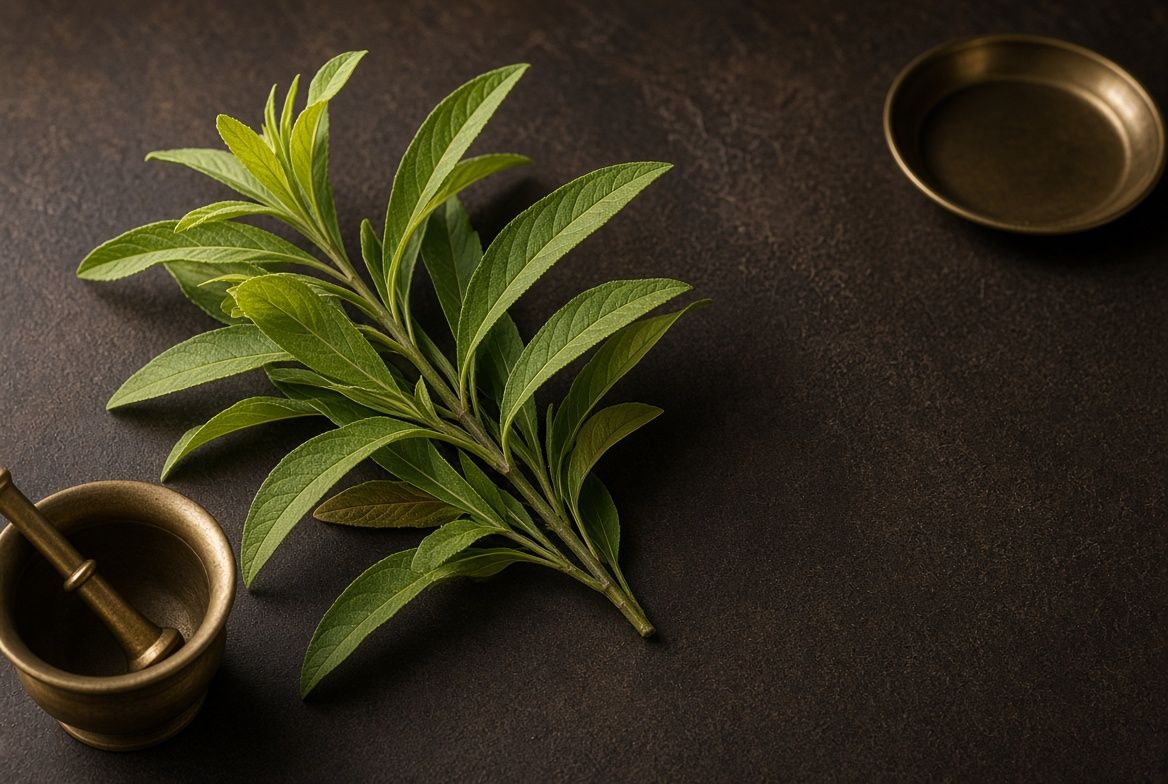
The aromatic shrub grows 1–3 m tall. Its leaves are ternate (arranged in groups of three); the elliptic blades are 2–8 × 1–2.5 cm, with entire or slightly serrate margins (Aloysia citrodora (lemon verbena)).
The English Wikipedia species page describes lemon verbena (Aloysia citrodora) as a perennial shrub or subshrub growing 2–3 m high, with glossy, pointed leaves about 8 cm long and small purple or white flowers. It reports citral (30–35%), nerol, and geraniol as major isolates in lemon verbena oil, and verbascoside in extracts (Aloysia citrodora Paláu).
Cultural History & Traditional Herbalism
In 1784, Spanish botanist and physician Antonio Palau y Verdera described Aloysia citrodora from cultivated specimens in Madrid (Herb Profile: Lemon Verbena (Aloysia citrodora)).
The datasheet reports that Spanish explorers introduced lemon verbena to Spain in the 17th century; Antonio Palau described it in 1784 using material from the Real Jardín Botánico in Madrid, and it later spread from Spain to other Mediterranean regions (Aloysia citrodora (lemon verbena)).
The page reports that French botanist Philibert Commerson collected lemon verbena (Aloysia citrodora) in Buenos Aires around 1767 during his botanical circumnavigation with Bougainville. It says Casimiro Gómez Ortega named the plant Aloysia citriodora in Madrid in 1797, but did not effectively publish the name then. The page also reports that a 1779 anonymous booklet described the new species; Juan Armada and Alfredo Barra later argued that Aloysia citrodora was the correct name. The name was effectively published in the first volume of Palau’s Parte Práctica de Botánica in 1784 (Aloysia citrodora Paláu).
The page reports that the European Medicines Agency’s EU herbal monograph concerns lemon verbena leaf (Aloysia citrodora Paláu, folium). It gives two authorized traditional-use indications for product labeling: relief of mild symptoms of mental stress and aid to sleep; and symptomatic treatment of mild gastrointestinal complaints, including bloating and flatulence (Herb Profile: Lemon Verbena (Aloysia citrodora)).
The article reports that in Argentina, Aloysia citriodora Palau (cedrón) leaves are used as an aromatic infusion or decoction for abdominal pain, nausea, and dizziness, citing four prior sources (1978, 2001, and 2004). It also notes reported uses elsewhere in South America, including for indigestion, tachycardia, and anxiety. The article’s own study used an aqueous decoction prepared from commercially purchased leaves from Paraguay; its experiments were conducted on mice, rats, and isolated rat tissues, not with an Argentine community (Sedative and Cardiovascular Effects of Aloysia citriodora Palau, on Mice and Rats).
Tradition, Folklore & Symbolism
Reported customs include putting lemon verbena in a pillow or hanging it beside a bed to ward off nightmares and evil spirits, and strewing it on floors to release its aroma and ostensibly purify rooms or buildings (Herb Profile: Lemon Verbena (Aloysia citrodora)).
Herbal Energetics
Insufficient documented evidence for a traditional energetic classification. No temperature, direction or channel is inferred from the flavor of a cup.
InfiniTea sensory metaphor: A clear return. This is original editorial language, not a measured physiological action or a translation of a traditional diagnostic category.
Sensory Profile & Tea Applications
Lemon verbena leaves are strongly lemon-scented; citral is their primary aromatic component, while other terpenes contribute a flowery note (Herb Profile: Lemon Verbena (Aloysia citrodora)).
The datasheet says Aloysia citrodora has strongly lemon-scented leaves and that its leaves are used to add lemon flavor to food, beverages, and liquors (Aloysia citrodora (lemon verbena)).
Sensory notebook: Compare the dry leaf, warmed leaf aroma and finished cup for persistence of lemon-like scent. Score sourness separately.
Proposed comparison, not a completed trial: Compare identified dried leaf with lemon peel in separate containers. Record texture and leaf shape before asking which aromas they share.
For ordinary dried herbal or fruit infusions, the German Federal Institute for Risk Assessment advises using boiling water and not leaving the prepared infusion standing for hours. Cooling a hot infusion and steeping untreated dry material in cold water are different processes; this report does not validate the latter (Boiling water a must for herbal teas).
Safety & Responsible Use
The page says that a limited number of toxicity studies found no safety concerns for aqueous lemon verbena leaf extracts used for appropriate indications and at recommended dosages. Lemon verbena products may affect mental-alertness tasks and may increase drowsiness when taken with alcohol or other products with sedative properties (Herb Profile: Lemon Verbena (Aloysia citrodora)).
Potential skin irritation from lemon verbena essential oil has been reported; topical use, such as in cosmetics, carries a moderate risk of skin sensitization. The page does not provide a comparison with swallowed leaf tea or advise on using fragrance-ingredient information to guide tea safety or dosing (Herb Profile: Lemon Verbena (Aloysia citrodora)).
In the mouse leaf-extract study, no significant maternal toxicity or changes in pregnancy outcomes were observed; the total number of foetal defects was higher in the treated group but not significantly so. This animal evidence does not establish human pregnancy or lactation safety: the report states safety is unestablished and use during pregnancy and lactation is not recommended. In the insomnia syrup trial, mild, transient restlessness, diarrhoea, tremor, sleepiness and localised itching were reported; the report lists renal problems as a contraindication due to possible irritation during excretion, reports no drug interactions, and notes no reported special warnings or precautions (Verbenae citriodorae folium - AR - European Medicines Agency).
Preparation and exposure boundary: This review does not establish a safe medicinal dose in pregnancy, lactation or childhood, or rule out interactions or allergy. Do not substitute essential oil or a concentrated extract for the documented food or herb.
For U.S. food use, the relevant safety determination concerns the intended conditions of use. The existence of a traditional preparation or herbal medicine monograph does not establish that this ingredient, dose and beverage are cleared for sale (Understanding How the FDA Regulates Food Additives and GRAS Ingredients).
Historical Trade, Ecology & Sustainability
Lemon verbena does not appear threatened in its native range by overharvesting, is not subject to CITES, has not been assessed under IUCN Red List criteria, and has no suppliers listed as providing FairWild-certified leaf. In Paraguay, soybean expansion reportedly displaced agricultural activities, including land formerly used for lemon verbena, and contributed to deforestation and displacement of rural communities (Herb Profile: Lemon Verbena (Aloysia citrodora)).
The datasheet lists Aloysia citrodora as invasive in Cuba and South Africa and reports it naturalized across a wide range of habitats and regions worldwide. It also cites a report that wild populations in Argentina are overexploited (Aloysia citrodora (lemon verbena)).
Aloysia citrodora is native from northern Argentina to southern Bolivia and adjacent Paraguay, where it occurs in arid bushland in dry inter-Andean valleys at 2,300–3,250 m. It is widely cultivated in and beyond its native range (Herb Profile: Lemon Verbena (Aloysia citrodora)).
Sourcing record: Request leaf identity, source region and harvest-to-drying interval; if provenance is historical rather than lot-specific, label it accordingly.
InfiniTea Herb Lore & Ritualpreliminary draft
Energetics (original InfiniTea metaphor): A clear return. Use this as a private writing image, not a health statement.
Tradition & Folklore: Reported customs include putting lemon verbena in a pillow or hanging it beside a bed to ward off nightmares and evil spirits, and strewing it on floors to release its aroma and ostensibly purify rooms or buildings (Herb Profile: Lemon Verbena (Aloysia citrodora)).
Ritual Cue (original contemporary InfiniTea interpretation): Choose a phrase you want to return to tomorrow. Write it once and leave the page otherwise blank.
Private preliminary draft; not approved for publication.
Scholarly References & Research Verification
Research limitations
Resolve botanical synonyms in trade records and confirm the organ. Distinguish the beverage from essential oil and concentrated extracts.
References below identify the evidence used, not additional endorsements. A botanical authority establishes nomenclature, not the identity of a physical lot. Published study samples, traditional descriptions and InfiniTea proposals are distinguished in the text.
- Kew, Plants of the World Online: Aloysia citrodora Paláu | Taxonomic backbone
- Herb Profile: Lemon Verbena (Aloysia citrodora) | herb profile article
- Aloysia citrodora (lemon verbena) | CABI Compendium species datasheet
- Aloysia citrodora Paláu | English Wikipedia species page (GBIF dataset record)
- Sedative and Cardiovascular Effects of Aloysia citriodora Palau, on Mice and Rats | Original pharmacology research article that includes background on traditional plant use.
- Verbenae citriodorae folium - AR - European Medicines Agency | EMA assessment report on Aloysia citrodora Paláu (syn. Aloysia triphylla), folium; the preparation assessed is comminuted leaf for oral use as herbal tea. Pregnancy evidence includes a mouse study of a single intraperitoneal dose of aqueous leaf extract during organogenesis and a separate mouse study of intraperitoneal verbascoside; the report also describes adverse effects in one insomnia trial of a syrup, a preparation not covered by the report.
- Boiling water a must for herbal teas | BfR press release providing general food-safety guidance for preparing herbal and fruit infusions.
- Understanding How the FDA Regulates Food Additives and GRAS Ingredients | U.S. FDA consumer-information webpage describing food-additive and GRAS ingredient oversight.
Final Botanical Summary
Its lemon-like fragrance links this leaf sensorially to unrelated plants, not taxonomically or therapeutically.
Editorial disposition: Lot unverified. The report is a private reference, not a clinical recommendation, approval for sale or authenticated sensory trial.
Verification Status (November 2026)
Phase II source audit, claim by claim
- Claims checked
- 16
- Corrected
- 3
- Withheld
- 0
- Sources
- 8
Material: Lot unverified. No physical sample has been examined.
Citation check: 2 of 4 Safety & Use citations confirmed against their sources in November 2026; 2 on sites that block automated reading, awaiting a check by hand.
A private research reference, not a clinical recommendation or product claim. Checked to the Grimoire's research standards →