
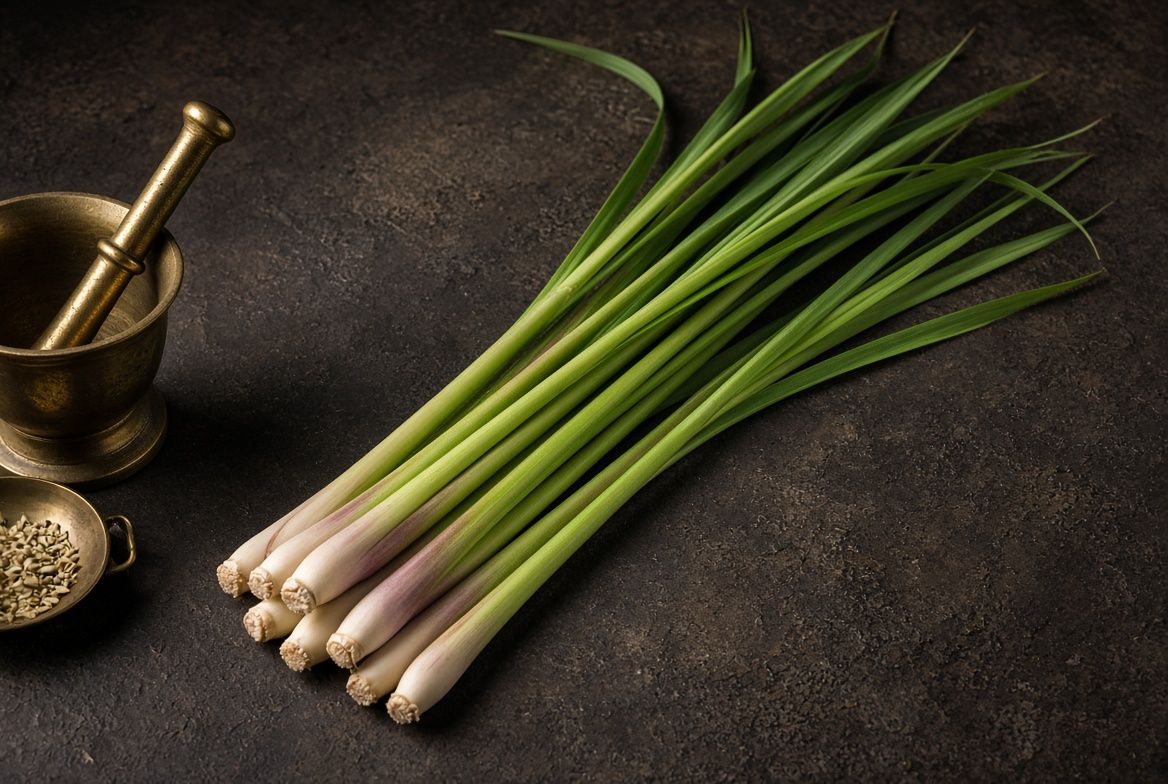
Botanical Identity & Classification
Inventory scope: Cymbopogon citratus · Poaceae · leaf or lower shoot, provisional.
Nomenclatural check: Cymbopogon citratus (DC.) Stapf is accepted in this treatment (family Poaceae). A synonym listed there is Andropogon citratus DC. The stated native range is S. India, Sri Lanka (Kew, Plants of the World Online: Cymbopogon citratus (DC.) Stapf).
Inventory decision: Verify whether the lot is C. citratus or another Cymbopogon species. Culinary stalk, leaf tea and distilled oil need distinct specifications; an oil’s composition is not a drink recipe.
PROSEA identifies Cymbopogon citratus (DC.) Stapf as a perennial aromatic grass in the family Gramineae and reports that its leaves are steam-distilled to produce West Indian lemongrass oil (Cymbopogon citratus (DC.) Stapf).
The study identifies Cymbopogon citratus (DC) Stapf. as lemongrass (Ethnobotanical study of Cymbopogon citratus (DC) Stapf. (Lemongrass) in Northern Morocco: Traditional uses and phytochemical composition).
Botanical & Scientific Profile
Specify blade, basal shoot or a mixture. An analysis of distilled oil cannot tell the reader how much of any constituent enters water from a bruised shoot.
PROSEA describes Cymbopogon citratus culms as reaching 2(–3) m and its linear leaf blades as 50–100 cm long. It reports that the oil’s main constituent is citral, with geranial at 40–62% and neral at 25–38%, and also lists myrcene, limonene, and geraniol (Cymbopogon citratus (DC.) Stapf).
In a face-to-face questionnaire study of 46 residents of the Tangier metropolitan area, about two-thirds knew of Cymbopogon citratus (lemongrass), about 56% used it in their diets, and one-third cultivated it; the abstract does not specify which plant part participants used (Ethnobotanical study of Cymbopogon citratus (DC) Stapf. (Lemongrass) in Northern Morocco: Traditional uses and phytochemical composition).
This review’s table of major components reports camphene, limonene, nonan-4-ol, citronellal, citronellol, neral, geraniol, and citral in Cymbopogon citratus essential oil. It describes Cymbopogon essential-oil composition as mainly monoterpenes, monoterpenoids, sesquiterpenes, and sesquiterpenoids, with a few fatty alcohols (Review of phytomedicine, phytochemistry, ethnopharmacology, toxicology, and pharmacological activities of Cymbopogon genus).
Cultural History & Traditional Herbalism
PROSEA states that the exact origin of Cymbopogon citratus is unknown, that a Malesian origin is most likely, and that the plant has been cultivated for several centuries in South and South-East Asia (Cymbopogon citratus (DC.) Stapf).
Survey participants in Northern Morocco reported mixing Cymbopogon citratus (lemongrass) with other ingredients for Moroccan tea, home-cooked meals, and traditional remedies for colds, flu, and digestive discomfort; the abstract does not specify which plant part was used (Ethnobotanical study of Cymbopogon citratus (DC) Stapf. (Lemongrass) in Northern Morocco: Traditional uses and phytochemical composition).
This review reports that lemongrass tea is traditionally used in Tanzania to reduce fever and that women use it to ease dysmenorrhea. It also records a belief that the tea cleans the fallopian tubes and facilitates blood flow; the page does not attribute a broader set of ailment uses specifically to Tanzania (Review of phytomedicine, phytochemistry, ethnopharmacology, toxicology, and pharmacological activities of Cymbopogon genus).
The review states that Cymbopogon leaves have traditionally been used as tea or decoction in Asia, South America, and Africa, but does not identify a specific community, date, or country-level practice for Brazil or Mexico. It lists Brazil and Mexico among the countries where Cymbopogon citratus occurs, but does not specifically document C. citratus lemongrass tea use in either country. This account is presented as a literature review, not as direct evidence from a named community (Review of phytomedicine, phytochemistry, ethnopharmacology, toxicology, and pharmacological activities of Cymbopogon genus).
Tradition, Folklore & Symbolism
No separate inherited symbolic or ceremonial use of this identified part was established here. A documented food, trade or medicinal practice should remain under its own description rather than being relabeled as ritual.
Herbal Energetics
Insufficient documented evidence for a traditional energetic classification. No temperature, direction or channel is inferred from the flavor of a cup.
InfiniTea sensory metaphor: A clean line. This is original editorial language, not a measured physiological action or a translation of a traditional diagnostic category.
Sensory Profile & Tea Applications
PROSEA describes steam-distilled Cymbopogon citratus leaf oil as yellow or amber-coloured and somewhat viscous, with a very strong fresh-grassy, lemon-like, herbaceous or tea-like odour and an earthy undertone reminiscent of Ceylon citronella oil (Cymbopogon citratus (DC.) Stapf).
This review describes geraniol as having a rose-like aroma and citral as having a lemon-like aroma. It reports that these compounds are used as raw materials in commercial flavors, cosmetics, and fragrances, including soaps and detergents (Review of phytomedicine, phytochemistry, ethnopharmacology, toxicology, and pharmacological activities of Cymbopogon genus).
The study used two single-factor experimental designs to compare solar-drying methods and loads for Cymbopogon citratus grown in Antioquia, Colombia; the accessible text does not specify the plant part. Geranial and neral were found in higher amounts, and isogeranial and β-myrcene were also identified. D2 and D1 had higher aromatic intensity and overall quality scores of 7.1 and 6.9, respectively, on a 0–10 scale; the study concerns drying, not an infusion evaluation (Effect of solar drying on physical, chemical, and sensory properties of Cymbopogon citratus grown in Antioquia - Colombia).
Sensory notebook: Compare leaf cut with a culinary stalk sample for citrus aroma, fibrous material and clarity after straining. Keep lemongrass distinct from lemon verbena and lemon balm.
Proposed comparison, not a completed trial: Compare food-grade blade and lower shoot separately. Record strip width and cut surfaces so a difference attributed to the organ is not simply a difference in preparation.
For ordinary dried herbal or fruit infusions, the German Federal Institute for Risk Assessment advises using boiling water and not leaving the prepared infusion standing for hours. Cooling a hot infusion and steeping untreated dry material in cold water are different processes; this report does not validate the latter (Boiling water a must for herbal teas).
Safety & Responsible Use
This review reports oral adverse effects including fatigue, dry mouth, excessive urination, and vertigo, as well as risks associated with citronella oil and topical products. It separately reports low toxicity and long-term suitability up to 100 mg/kg for Cymbopogon citratus essential oil; it does not provide a safe long-term dose or adverse-event rate for C. citratus leaf tea (Review of phytomedicine, phytochemistry, ethnopharmacology, toxicology, and pharmacological activities of Cymbopogon genus).
PROSEA reports that West Indian lemongrass oil from Cymbopogon citratus is approved by the United States FDA for food use under paragraph 182.20, is generally recognized as safe in the United States (GRAS No. 2624), and is used in alcoholic and nonalcoholic beverages (Cymbopogon citratus (DC.) Stapf).
In the human study, lower creatinine clearance rates and glomerular filtration rates were reported in subjects consuming the tea. The review also associates lemongrass with volume depletion, but does not report specific adverse-event details or establish effects on pregnancy, lactation, allergies, or interactions (Plant vs. Kidney: Evaluating Nephrotoxicity of Botanicals with the Latest Toxicological Tools).
Preparation and exposure boundary: This review does not establish a safe medicinal dose in pregnancy, lactation or childhood, or rule out interactions or allergy. Do not substitute essential oil or a concentrated extract for the documented food or herb.
For U.S. food use, the relevant safety determination concerns the intended conditions of use. The existence of a traditional preparation or herbal medicine monograph does not establish that this ingredient, dose and beverage are cleared for sale (Understanding How the FDA Regulates Food Additives and GRAS Ingredients).
Historical Trade, Ecology & Sustainability
PROSEA states that Cymbopogon citratus is cultivated and often naturalized throughout the tropics and warm subtropics, grows best in sunny, warm, humid conditions, and is normally killed by frost (Cymbopogon citratus (DC.) Stapf).
In the questionnaire study of Tangier metropolitan-area residents, one-third of participants reported cultivating Cymbopogon citratus (lemongrass); the abstract does not specify which plant part was cultivated (Ethnobotanical study of Cymbopogon citratus (DC) Stapf. (Lemongrass) in Northern Morocco: Traditional uses and phytochemical composition).
The review reports that the Cymbopogon genus is distributed in more than 40 countries and is native to Asia, Africa, Australia, and tropical islands. It lists Cymbopogon citratus in Bangladesh, Brazil, Tanzania, Ghana, Guadeloupe, the French West Indies, Kenya, Mauritius, Argentina, Thailand, Uganda, Nigeria, India, Mexico, Singapore, Togo, and Trinidad (Review of phytomedicine, phytochemistry, ethnopharmacology, toxicology, and pharmacological activities of Cymbopogon genus).
Sourcing record: Ask which grass, which cut and which country of cultivation supplied the leaf; do not substitute oil-production specifications for food-grade grass.
InfiniTea Herb Lore & Ritualpreliminary draft
Energetics (original InfiniTea metaphor): A clean line. Use this as a private writing image, not a health statement.
Tradition & Folklore: The review states that Cymbopogon leaves have traditionally been used as tea or decoction in Asia, South America, and Africa, but does not identify a specific community, date, or country-level practice for Brazil or Mexico. It lists Brazil and Mexico among the countries where Cymbopogon citratus occurs, but does not specifically document C. citratus lemongrass tea use in either country. This account is presented as a literature review, not as direct evidence from a named community (Review of phytomedicine, phytochemistry, ethnopharmacology, toxicology, and pharmacological activities of Cymbopogon genus). This is a record of use, not a claim of inherited ritual.
Ritual Cue (original contemporary InfiniTea interpretation): Draw one long blade of grass. Write a sentence along it, then shorten that sentence without changing what it means.
Private preliminary draft; not approved for publication.
Scholarly References & Research Verification
Research limitations
Resolve Cymbopogon species and organ before comparing sources. Keep uncertainties for medicinal exposure separate from use as a culinary aromatic.
References below identify the evidence used, not additional endorsements. A botanical authority establishes nomenclature, not the identity of a physical lot. Published study samples, traditional descriptions and InfiniTea proposals are distinguished in the text.
- Kew, Plants of the World Online: Cymbopogon citratus (DC.) Stapf | Taxonomic backbone
- Cymbopogon citratus (DC.) Stapf | PROSEA botanical handbook database record
- Ethnobotanical study of Cymbopogon citratus (DC) Stapf. (Lemongrass) in Northern Morocco: Traditional uses and phytochemical composition | study
- Review of phytomedicine, phytochemistry, ethnopharmacology, toxicology, and pharmacological activities of Cymbopogon genus | review
- Effect of solar drying on physical, chemical, and sensory properties of Cymbopogon citratus grown in Antioquia - Colombia | Laboratory study
- Review of phytomedicine, phytochemistry, ethnopharmacology, toxicology, and pharmacological activities of Cymbopogon genus | Review article
- Plant vs. Kidney: Evaluating Nephrotoxicity of Botanicals with the Latest Toxicological Tools | The review reports a human clinical trial involving 105 subjects who consumed lemongrass tea made from 2, 4, or 8 g of powdered leaves daily for 30 days. The page does not provide further details about the trial design.
- Boiling water a must for herbal teas | BfR press release providing general food-safety guidance for preparing herbal and fruit infusions.
- Understanding How the FDA Regulates Food Additives and GRAS Ingredients | U.S. FDA consumer-information webpage describing food-additive and GRAS ingredient oversight.
Final Botanical Summary
Identity starts with which grass and which part. The term lemon describes an aromatic resemblance, not citrus fruit content.
Editorial disposition: Lot unverified. The report is a private reference, not a clinical recommendation, approval for sale or authenticated sensory trial.
Verification Status (November 2026)
Phase II source audit, claim by claim
- Claims checked
- 15
- Corrected
- 2
- Withheld
- 0
- Sources
- 9
Material: Lot unverified. No physical sample has been examined.
Citation check: 3 of 4 Safety & Use citations confirmed against their sources in November 2026; 1 on a site that blocks automated reading, awaiting a check by hand.
A private research reference, not a clinical recommendation or product claim. Checked to the Grimoire's research standards →