
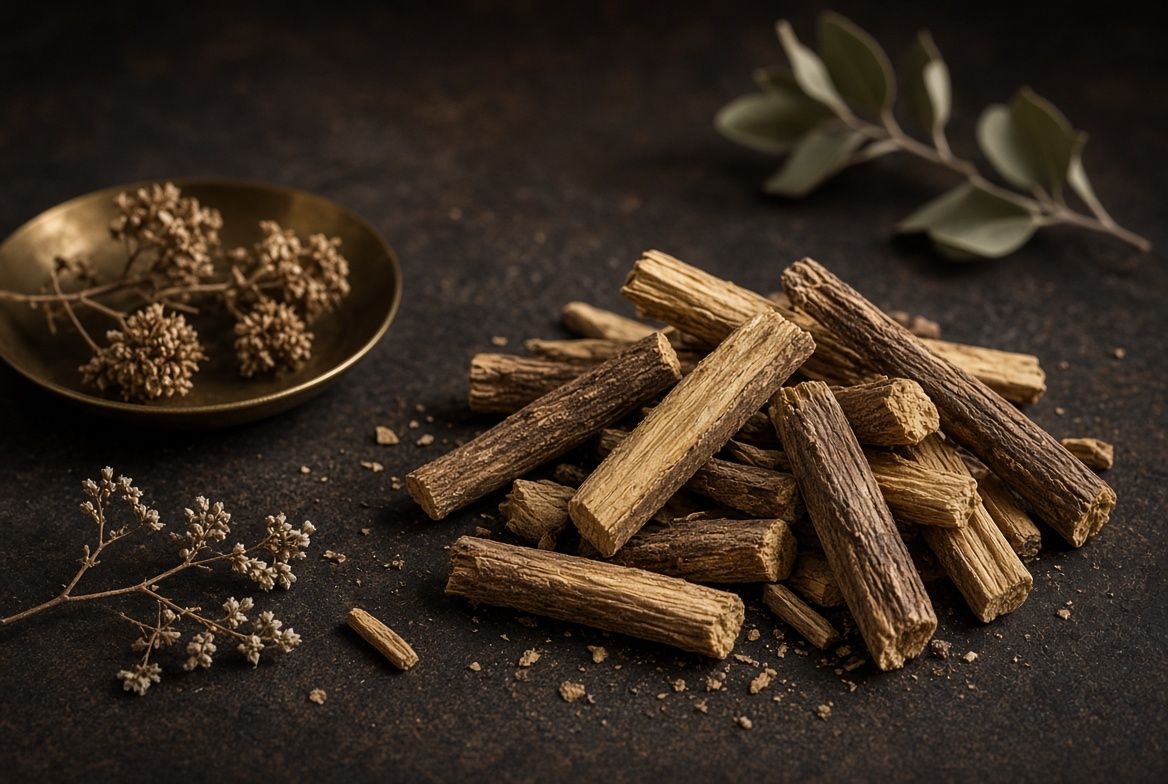
Botanical Identity & Classification
Inventory scope: Glycyrrhiza glabra and other medicinal Glycyrrhiza species · Fabaceae · root and sometimes stolon.
Nomenclatural check: Glycyrrhiza glabra L. is accepted in this treatment (family Fabaceae). A synonym listed there is Glycyrrhiza laevis Pall. The stated native range is Central Medit. to Mongolia and Pakistan (Kew, Plants of the World Online: Glycyrrhiza glabra L.).
Comparison taxon; not a substitute: Glycyrrhiza uralensis Fisch. ex DC. is accepted in this treatment (family Fabaceae). A synonym listed there is Glycyrrhiza korshinskyi Grig. The stated native range is E. European Russia to Siberia and Pakistan (Kew, Plants of the World Online: Glycyrrhiza uralensis Fisch. ex DC.).
Inventory decision: The label must identify species and whether glycyrrhizin was removed. Do not treat ordinary root as deglycyrrhizinated licorice, or an anise-flavored confection as proof of root content.
The article identifies licorice as Glycyrrhiza glabra L. and gives Leguminosae as its family; its account of medicinal uses describes the root as the part used (Herbs in History: Licorice).
The NCCIH page lists licorice root as a common name and gives the Latin names Glycyrrhiza glabra, Glycyrrhiza uralensis, and Glycyrrhiza inflata. Other listed common names are licorice, liquorice, sweet root, gan cao, gan zao, and Chinese licorice (Licorice Root: Usefulness and Safety).
Botanical & Scientific Profile
In a safety review, “licorice” is not a sufficient description of exposure. Distinguish intact root, a quantified extract, a deglycyrrhizinated product and an anise-flavored food with no licorice root.
The page states that licorice contains glycyrrhizin, also called glycyrrhizic acid (Licorice Root: Usefulness and Safety).
The review reports that glycyrrhizin is a major bioactive compound in Glycyrrhiza glabra roots, accounting for about 10% of root dry weight. It also identifies the root flavonoids liquiritin, isoliquiritin, glabridin, and hispaglabridins A and B (The Multifunctionality of Licorice and Its By-Products: A Review on Traditional and Innovative Applications for Circular Bioeconomy and Sustainable Innovation).
For people with recurrent canker sores, NCCIH says licorice mouth rinse or gargle might reduce ulcer size and pain, while topical licorice might reduce ulcer size. One study found that licorice extract combined with a canker-sore medicine was more effective than the medicine alone. A licorice gargle or lozenges before surgery might prevent or lessen sore throat after intubation. Preliminary evidence suggests topical licorice-root gels might help atopic dermatitis symptoms or burn healing, and one preliminary study found that licorice-extract mouthwash might improve halitosis and reduce the bacteria that cause it; more research is needed for the topical-gel findings. The page does not identify the licorice species used for these findings. NCCIH says there is not enough high-quality evidence to clearly support licorice for any health condition (Licorice Root: Usefulness and Safety).
Cultural History & Traditional Herbalism
The article reports that the mid-fifth-century BCE Hippocratic-attributed work Diseases of Women mentions licorice (Glycyrrhiza glabra L.) in a postpartum formula for expelling the placenta; the plant part is not specified in that passage (Herbs in History: Licorice).
The page says licorice root has a long history of use in ancient Assyrian, Egyptian, Greek, Arab, Chinese, Tibetan, and Indian cultures. Traditional medicine practices used it for coughing, asthma, wound healing, and diseases of the lungs, liver, and arteries; the page lists Glycyrrhiza glabra, G. uralensis, and G. inflata as licorice’s Latin names (Licorice Root: Usefulness and Safety).
The review notes historical use of licorice among Ancient Egyptians, Greeks, Romans, and East Chinese populations in the Former Han era. It also reports that licorice roots and rhizomes have been used in the food industry for more than 4,000 years (The Multifunctionality of Licorice and Its By-Products: A Review on Traditional and Innovative Applications for Circular Bioeconomy and Sustainable Innovation).
The review identifies liquorice, mainly Glycyrrhiza glabra L., and reports that Theophrastus (4th–3rd century BCE) called it the “Scythian” root; in Enquiry into Plants, he said Scythians held the root in their mouths to quench thirst and reportedly used it with mares’ milk cheese to go eleven or twelve days without drinking. The article says the Greeks probably learned liquorice’s pharmacological uses from the Scythians, while presenting this as a likelihood rather than direct evidence. In 1st-century CE Rome, Pliny the Elder described use of the root for asthma, throat ailments, mouth ulcerations and sterility in Naturalis Historia (A history of the therapeutic use of liquorice in Europe).
Tradition, Folklore & Symbolism
In its account of Theophrastus’s Historia plantarum, the article reports that the Scythians were said to spend eleven or twelve days without food or drink by relying on licorice (Glycyrrhiza glabra L.) and cheese made from mares’ milk (Herbs in History: Licorice).
The review reports that the non-alcoholic Egyptian licorice drink Erk Sous is especially consumed during Ramadan and is appreciated for its refreshing properties, particularly in hot climates (The Multifunctionality of Licorice and Its By-Products: A Review on Traditional and Innovative Applications for Circular Bioeconomy and Sustainable Innovation).
Herbal Energetics
The entry identifies Gancao (Liquorice Root) as the dried root and rhizome of Glycyrrhiza uralensis Fisch. (Fabaceae). It says the material is primarily produced in Inner Mongolia, Shanxi, Gansu, Xinjiang, and Ningxia, China. Its listed properties are sweet and neutral; the entry describes its taste as sweet and distinctive. Processed gan cao is described as slightly sticky, with a burnt smell and sweet taste, and as having sweet and neutral properties (Medicinal Plant Images Database).
These are categories within the named tradition. They are not measurements of body temperature, pharmacological action or clinical efficacy.
InfiniTea sensory metaphor: A long echo. This is original editorial language, not a measured physiological action or a translation of a traditional diagnostic category.
Sensory Profile & Tea Applications
The article gives the Calabria PDO sensory description for licorice (Glycyrrhiza glabra L.) roots: fresh root is straw yellow, with a sweet, aromatic, intense, lasting flavour; dried root is straw yellow to ochre yellow, with a sweet, fruity, slightly astringent flavour (Herbs in History: Licorice).
Licorice is used as a flavoring in candy, other foods, and tobacco products. The page says many U.S. products labeled “licorice” do not contain actual licorice and that anise oil is often used instead because it smells and tastes like licorice (Licorice Root: Usefulness and Safety).
Sensory notebook: Use a written flavor comparison or a supplier sensory sheet when tasting is inappropriate; distinguish initial sweetness from a lingering aftertaste.
Proposed comparison, not a completed trial: Use a written comparison of ingredient labels rather than tasting several concentrated licorice preparations. Record whether the ingredient is root, extract or simply flavoring.
For ordinary dried herbal or fruit infusions, the German Federal Institute for Risk Assessment advises using boiling water and not leaving the prepared infusion standing for hours. Cooling a hot infusion and steeping untreated dry material in cold water are different processes; this report does not validate the latter (Boiling water a must for herbal teas).
Safety & Responsible Use
Licorice root contains glycyrrhizin, or glycyrrhizic acid, which can cause serious adverse effects, including irregular heartbeat and cardiac arrest, especially when consumed in large amounts or over the long term. The page also links even small amounts of glycyrrhizin from licorice-root products to severe adverse effects in people who consume a lot of salt, have hypertension, or have heart or kidney conditions. Interactions between licorice and corticosteroids have been reported (Licorice Root: Usefulness and Safety).
The review reports that excessive licorice consumption can cause pseudo-hyperaldosteronism, characterized by arterial hypertension and hypokalemia. It gives 100 mg per day as the acceptable daily intake of glycyrrhizin and notes that individual tolerance varies with factors including sex, age, health conditions, and concomitant medication use (The Multifunctionality of Licorice and Its By-Products: A Review on Traditional and Innovative Applications for Circular Bioeconomy and Sustainable Innovation).
NCCIH says consuming large amounts of oral licorice extract during pregnancy—about 250 grams of licorice per week—is unsafe and can increase the risk of delivery before gestational age 38 weeks. Oral licorice products without glycyrrhizin, called deglycyrrhizinated licorice, are a distinct preparation that might be safe for up to 4 months. The page says little is known about licorice safety during breastfeeding (Licorice Root: Usefulness and Safety).
Licorice contains glycyrrhizin (glycyrrhizic acid), which can cause serious adverse effects, including irregular heartbeat and cardiac arrest, especially with large amounts or long-term consumption; even small amounts from licorice root products have been linked to severe effects in people who consume a lot of salt or have hypertension, heart conditions, or kidney conditions. The page also reports interactions between licorice and corticosteroids, and says consuming large amounts of oral licorice extract during pregnancy (about 250 grams of licorice per week) is unsafe and can increase the risk of delivery before 38 weeks’ gestation; little is known about safety while breastfeeding. Hypokalemia appears in the title of a cited systematic review and meta-analysis, but the page provides no specific findings from it (Licorice Root: Usefulness and Safety).
Preparation and exposure boundary: This review does not establish a safe medicinal dose in pregnancy, lactation or childhood, or rule out interactions or allergy. Do not substitute essential oil or a concentrated extract for the documented food or herb.
For U.S. food use, the relevant safety determination concerns the intended conditions of use. The existence of a traditional preparation or herbal medicine monograph does not establish that this ingredient, dose and beverage are cleared for sale (Understanding How the FDA Regulates Food Additives and GRAS Ingredients).
Historical Trade, Ecology & Sustainability
The review states that licorice is distributed across Asia and regions of southern Europe and describes Iraq as its putative center of origin. It lists Italy, Spain, Greece, France, Iran, Iraq, Turkey, China, the United States, and the United Kingdom among countries where commercial cultivation occurs (The Multifunctionality of Licorice and Its By-Products: A Review on Traditional and Innovative Applications for Circular Bioeconomy and Sustainable Innovation).
The article reports that the Liquirizia di Calabria PDO covers fresh or dried licorice and its extract from cultivated or wild Glycyrrhiza glabra plants of the typica variety, known in Calabria as Cordara (Herbs in History: Licorice).
The review reports that roots and underground stems of 3–4-year-old licorice plants are harvested in autumn. At the Amarelli factory in Calabria, southern Italy, harvesting takes place from November to April (The Multifunctionality of Licorice and Its By-Products: A Review on Traditional and Innovative Applications for Circular Bioeconomy and Sustainable Innovation).
Sourcing record: Obtain species-level traceability, root or stolon specification and, for regular use, analytical glycyrrhizin information specific to the material.
InfiniTea Herb Lore & Ritualpreliminary draft
Energetics (original InfiniTea metaphor): A long echo. Use this as a private writing image, not a health statement.
For the separately attributed traditional material, see Herbal Energetics; the original sensory image is not a translation of that classification.
Tradition & Folklore: In its account of Theophrastus’s Historia plantarum, the article reports that the Scythians were said to spend eleven or twelve days without food or drink by relying on licorice (Glycyrrhiza glabra L.) and cheese made from mares’ milk (Herbs in History: Licorice).
Ritual Cue (original contemporary InfiniTea interpretation): Read one kind sentence twice, leaving a pause after the second reading. No tasting is needed.
Private preliminary draft; not approved for publication.
Scholarly References & Research Verification
Research limitations
Seek glycyrrhizin information and duration of use before making any exposure comparison. Keep this file out of routine beverage trials where medication or cardiovascular risks are unresolved.
The page does not state meridian channels or provide herbarium-specimen details (Medicinal Plant Images Database).
References below identify the evidence used, not additional endorsements. A botanical authority establishes nomenclature, not the identity of a physical lot. Published study samples, traditional descriptions and InfiniTea proposals are distinguished in the text.
- Kew, Plants of the World Online: Glycyrrhiza glabra L. | Taxonomic backbone
- Kew, Plants of the World Online: Glycyrrhiza uralensis Fisch. ex DC. | Taxonomic backbone
- Herbs in History: Licorice | historical review article
- Licorice Root: Usefulness and Safety | NCCIH health-information overview of evidence, traditional use, and safety
- The Multifunctionality of Licorice and Its By-Products: A Review on Traditional and Innovative Applications for Circular Bioeconomy and Sustainable Innovation | review article
- A history of the therapeutic use of liquorice in Europe | Historical review of written records on liquorice’s medicinal use in Europe, with comparisons to traditions outside Europe and modern research.
- Medicinal Plant Images Database | Medicinal plant database entry
- Boiling water a must for herbal teas | BfR press release providing general food-safety guidance for preparing herbal and fruit infusions.
- Understanding How the FDA Regulates Food Additives and GRAS Ingredients | U.S. FDA consumer-information webpage describing food-additive and GRAS ingredient oversight.
Final Botanical Summary
Sweetness is not a measure of safe exposure. Frequent use in several blends matters even if no single serving looks like a supplement.
Editorial disposition: Lot unverified. The report is a private reference, not a clinical recommendation, approval for sale or authenticated sensory trial.
Verification Status (November 2026)
Phase II source audit, claim by claim
- Claims checked
- 19
- Corrected
- 1
- Withheld
- 1
- Sources
- 9
Material: Lot unverified. No physical sample has been examined.
Citation check: 4 of 5 Safety & Use citations confirmed against their sources in November 2026; 1 on a site that blocks automated reading, awaiting a check by hand.
A private research reference, not a clinical recommendation or product claim. Checked to the Grimoire's research standards →