
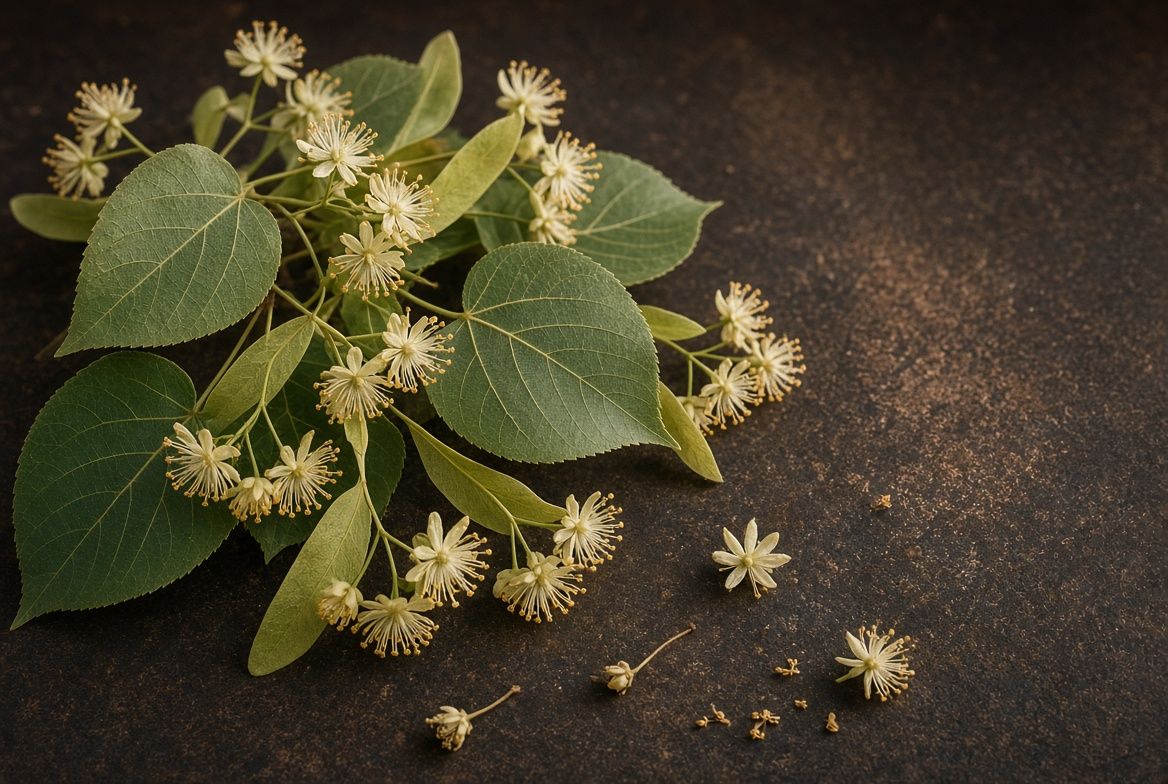
Botanical Identity & Classification
Inventory scope: Tilia species · Malvaceae · inflorescence with associated bract when specified.
Nomenclatural check: Tilia cordata Mill. is accepted in this treatment (family Malvaceae). The stated native range is Europe to Central Siberia and N. Iran (Kew, Plants of the World Online: Tilia cordata Mill.).
Comparison taxon; not a substitute: Tilia platyphyllos Scop. is accepted in this treatment (family Malvaceae). The stated native range is Europe to N. Iran (Kew, Plants of the World Online: Tilia platyphyllos Scop.).
Inventory decision: Keep the European medicinal species and Mexican market identities separate. Flor de tila alone is insufficient identification; do not approve an unlabeled sample by smell or a photograph.
The EMA page identifies Tiliae flos (lime flower) with Tilia cordata Miller, Tilia platyphyllos Scop., Tilia × vulgaris Heyne, or mixtures of these species; the listed monograph and assessment documents describe the material as flos (flowers) (Tiliae flos - herbal medicinal product).
A Mexican phytochemical thesis reviews calming infusions made from flowers of Ternstroemia sylvatica and from flowers or leaves of T. lineata subsp. lineata. Its experimental work screened extracts; it did not establish the safety of a commercial flor de tila beverage (Metabolitos secundarios de diferentes especies de Ternstroemiaceae mexicanas).
Botanical & Scientific Profile
The trade name flor de tila is a question, not its own answer. A European Tilia flower monograph cannot authenticate a Mexican market lot, and a Mexican use record cannot identify every item sold under the same name.
In a study of Tilia americana var. mexicana, inflorescences and leaves were successively macerated in hexane, ethyl acetate, and methanol; male CD-1 mice received methanolic extracts and were tested in the open field, elevated plus-maze, hole-board, and pentobarbital-induced sleep test. Both plant parts showed anxiolytic-like effects and potentiated pentobarbital-induced hypnosis. The paper reports that flumazenil and WAY100635 inhibited the flavonoid mixture’s anxiolytic-like effect in the plus-maze; its abstract and discussion also describe benzodiazepine and 5-HT1A receptor participation in the effects (Anxiolytic and sedative-like effects of flavonoids from Tilia americana var. mexicana: GABAergic and serotonergic participation).
HPLC analysis confirmed quercetin, rutin, and isoquercitrin in Tilia americana var. mexicana inflorescence and leaf extracts. The experiments used mice, with six animals per treatment group; plant material was collected in June 2010 from Morelia, Michoacán; Santa María Ahuacatitlán, Morelos; and Honey, Puebla (Anxiolytic and sedative-like effects of flavonoids from Tilia americana var. mexicana: GABAergic and serotonergic participation).
Cultural History & Traditional Herbalism
The article describes Tilia americana var. mexicana as native to Mexico and historically used as a sedative; it also reports that aerial tissues are used in traditional Mexican medicine for central nervous system-related conditions. It names no specific date or cultural group for this use (Ethnobotany in a Modern City: The Persistence in the Use of Medicinal Plants in Guadalajara, Mexico).
In central Veracruz, Mexico, Tilia mexicana flowers were widely used and commercialized for medicinal purposes; an infusion of the flowers, known as té de tila, was used as a calming drink for the nerves (DISTRIBUCIÓN ESPACIAL DE Tilia mexicana Schlecht. (Tiliaceae) EN EL PAISAJE DEL CENTRO DEL ESTADO DE VERACRUZ, MÉXICO).
The article documents Mexican traditional use of Tilia americana var. mexicana inflorescence infusions, especially for their tranquilizing effects, and also reports traditional use of the flowers for enterocolitis, gastroenteritis, and hepatic and nephritic colics (Anxiolytic and sedative-like effects of flavonoids from Tilia americana var. mexicana: GABAergic and serotonergic participation).
During five years of fieldwork in the central portion of Veracruz, the authors observed shepherds using young leaves of Tilia mexicana as fodder for sheep and goats, and bark to make ropes. Inflorescences were sold year-round in markets in towns in central Veracruz; the authors reported increased sales during the April–June flowering period, when people believed fresh flowers made a more effective medicinal infusion. They reported that harvesting could involve felling trees or breaking off many branches, and that excessive inflorescence collection reduces the chance of recruitment; the article called for rational management and conservation (An endangered and potentially economic tree of Mexico: Tilia mexicana (Tiliaceae).).
Tradition, Folklore & Symbolism
The article reports a popular belief that Tilia infusion has a greater medicinal effect during the April–June flowering months and states that inflorescence marketing increases during that period (Anxiolytic and sedative-like effects of flavonoids from Tilia americana var. mexicana: GABAergic and serotonergic participation).
Herbal Energetics
Insufficient documented evidence for a traditional energetic classification. No temperature, direction or channel is inferred from the flavor of a cup.
InfiniTea sensory metaphor: Shelter. This is original editorial language, not a measured physiological action or a translation of a traditional diagnostic category.
Sensory Profile & Tea Applications
The article reports popular use of lime-blossom infusions and recommends a flower decoction for calming the nerves, heart disease, blood pressure, and menstrual colic. It also reports that infusions of the flowers and fruits are used for colon spasms, menstrual irregularities, rheumatism, and hypertension. The article gives no taste or aroma description (Ethnobotany in a Modern City: The Persistence in the Use of Medicinal Plants in Guadalajara, Mexico).
The article describes inflorescences used as an infusion and gives no description of the infusion’s aroma, taste, or sensory chemistry (Anxiolytic and sedative-like effects of flavonoids from Tilia americana var. mexicana: GABAergic and serotonergic participation).
Sensory notebook: On an authenticated specimen, sketch the floral cluster and its bract; note whether the lot includes fragments that cannot be assigned to either.
Proposed comparison, not a completed trial: Compare labeled photographs of inflorescences and bracts. Do not brew, taste or assign a calming action to a sample whose species remains uncertain.
Safety & Responsible Use
The article states that fruits of Mexican Ternstroemia are sold in traditional markets to make a decoction, and that the plants are locally known as “tilas” or “trompillos.” It reports a cited finding that Ternstroemia sylvatica fruits are toxic rather than antidepressant (Anatomy and foliar architecture of two Mexican species ...).
This study tested Tilia americana var. mexicana inflorescence and leaf extracts in male CD-1 mice; it does not report a human sedative dose or human safety findings (Anxiolytic and sedative-like effects of flavonoids from Tilia americana var. mexicana: GABAergic and serotonergic participation).
For these flowers and preparations, the monograph states that fertility data are unavailable and safety during pregnancy and lactation has not been established; because data are insufficient, use during pregnancy and lactation is not recommended. It lists hypersensitivity to the active substance as a contraindication, interactions as “none reported,” and undesirable effects as “none known”; it does not report human observations establishing pregnancy safety or the absence of risk (Community herbal monograph on Tilia cordata Miller, Tilia platyphyllos Scop., Tilia x vulgaris Heyne or their mixtures, flos).
Preparation and exposure boundary: This review does not establish a safe medicinal dose in pregnancy, lactation or childhood, or rule out interactions or allergy. Do not substitute essential oil or a concentrated extract for the documented food or herb.
For U.S. food use, the relevant safety determination concerns the intended conditions of use. The existence of a traditional preparation or herbal medicine monograph does not establish that this ingredient, dose and beverage are cleared for sale (Understanding How the FDA Regulates Food Additives and GRAS Ingredients).
Historical Trade, Ecology & Sustainability
A survey of seven sites recorded 49 Tilia mexicana individuals, all more than 60 cm in diameter at breast height, with site densities from 13.0 to 47.8 individuals per hectare. Distribution was aggregated at steep-slope sites D and F, where flower cutting was not reported and goat grazing was occasional, and random at the other sites, where human activities were more intensive. The article says flower harvesting frequently involves felling trees, which can kill them and may support traditional use for seed production; it warns that T. mexicana could disappear from the central Veracruz landscape without a management and conservation plan, including nondamaging flower-cutting techniques and protection of individuals that could serve as seed sources (DISTRIBUCIÓN ESPACIAL DE Tilia mexicana Schlecht. (Tiliaceae) EN EL PAISAJE DEL CENTRO DEL ESTADO DE VERACRUZ, MÉXICO).
The article states that harvesting inflorescences reduces seed production and the establishment of new Tilia individuals, and suggests that greater use of leaves could help reduce pressure on the species’ reproduction. It also reports that a preliminary tetrazolium test found low seed viability; the data were not shown (Anxiolytic and sedative-like effects of flavonoids from Tilia americana var. mexicana: GABAergic and serotonergic participation).
The article describes Tilia americana var. mexicana as native to Mexico (Ethnobotany in a Modern City: The Persistence in the Use of Medicinal Plants in Guadalajara, Mexico).
Sourcing record: Insist on a botanical name and organ at the collection site; ask how flower clusters are collected without unnecessarily stripping branches.
InfiniTea Herb Lore & Ritualpreliminary draft
Energetics (original InfiniTea metaphor): Shelter. Use this as a private writing image, not a health statement.
Tradition & Folklore: The article reports a popular belief that Tilia infusion has a greater medicinal effect during the April–June flowering months and states that inflorescence marketing increases during that period (Anxiolytic and sedative-like effects of flavonoids from Tilia americana var. mexicana: GABAergic and serotonergic participation).
Ritual Cue (original contemporary InfiniTea interpretation): Draw the outline of a canopy. Under it, write the name of a place where you can pause without having to explain yourself.
Private preliminary draft; not approved for publication.
Scholarly References & Research Verification
Research limitations
Hold unresolved material. Request the local market name, collecting region, scientific identification, associated bracts and voucher or other independent identity evidence.
References below identify the evidence used, not additional endorsements. A botanical authority establishes nomenclature, not the identity of a physical lot. Published study samples, traditional descriptions and InfiniTea proposals are distinguished in the text.
- Kew, Plants of the World Online: Tilia cordata Mill. | Taxonomic backbone
- Kew, Plants of the World Online: Tilia platyphyllos Scop. | Taxonomic backbone
- Tiliae flos - herbal medicinal product | Regulatory herbal medicinal product webpage
- Anxiolytic and sedative-like effects of flavonoids from Tilia americana var. mexicana: GABAergic and serotonergic participation | animal pharmacology and phytochemical study
- Ethnobotany in a Modern City: The Persistence in the Use of Medicinal Plants in Guadalajara, Mexico | Ethnobotanical study with interviews, taxonomic identification, and a literature review
- DISTRIBUCIÓN ESPACIAL DE Tilia mexicana Schlecht. (Tiliaceae) EN EL PAISAJE DEL CENTRO DEL ESTADO DE VERACRUZ, MÉXICO | field study
- Anatomy and foliar architecture of two Mexican species ... | botanical study
- Metabolitos secundarios de diferentes especies de Ternstroemiaceae mexicanas | Laboratory phytochemical study with an ethnobotanical literature review
- An endangered and potentially economic tree of Mexico: Tilia mexicana (Tiliaceae). | Ethnobotanical and economic botany research article published in Economic Botany 54(1), pages 113–118 (2000).
- Community herbal monograph on Tilia cordata Miller, Tilia platyphyllos Scop., Tilia x vulgaris Heyne or their mixtures, flos | European Medicines Agency community herbal monograph for traditional use of the flowers (flos) of Tilia cordata Miller, Tilia platyphyllos Scop., Tilia x vulgaris Heyne, or their mixtures. It covers comminuted herbal substance used as herbal tea and specified liquid extracts and tinctures; the traditional-use indications are relief of common-cold symptoms and mild symptoms of mental stress. The monograph provides no pregnancy study design, study results, or human pregnancy observations.
- Understanding How the FDA Regulates Food Additives and GRAS Ingredients | U.S. FDA consumer-information webpage describing food-additive and GRAS ingredient oversight.
Final Botanical Summary
Regional language is evidence about a name, not proof of the species in a bag. Local ethnobotany must not be replaced by a European monograph.
Editorial disposition: Identity hold. The report is a private reference, not a clinical recommendation, approval for sale or authenticated sensory trial.
Verification Status (November 2026)
Phase II source audit, claim by claim
- Claims checked
- 15
- Corrected
- 4
- Withheld
- 1
- Sources
- 11
Identity hold: the species, plant part or market name still needs confirming before any product decision. See Identity and the research limitations.
Citation check: All 4 Safety & Use citations were re-read against their sources in November 2026 and confirmed.
A private research reference, not a clinical recommendation or product claim. Checked to the Grimoire's research standards →