
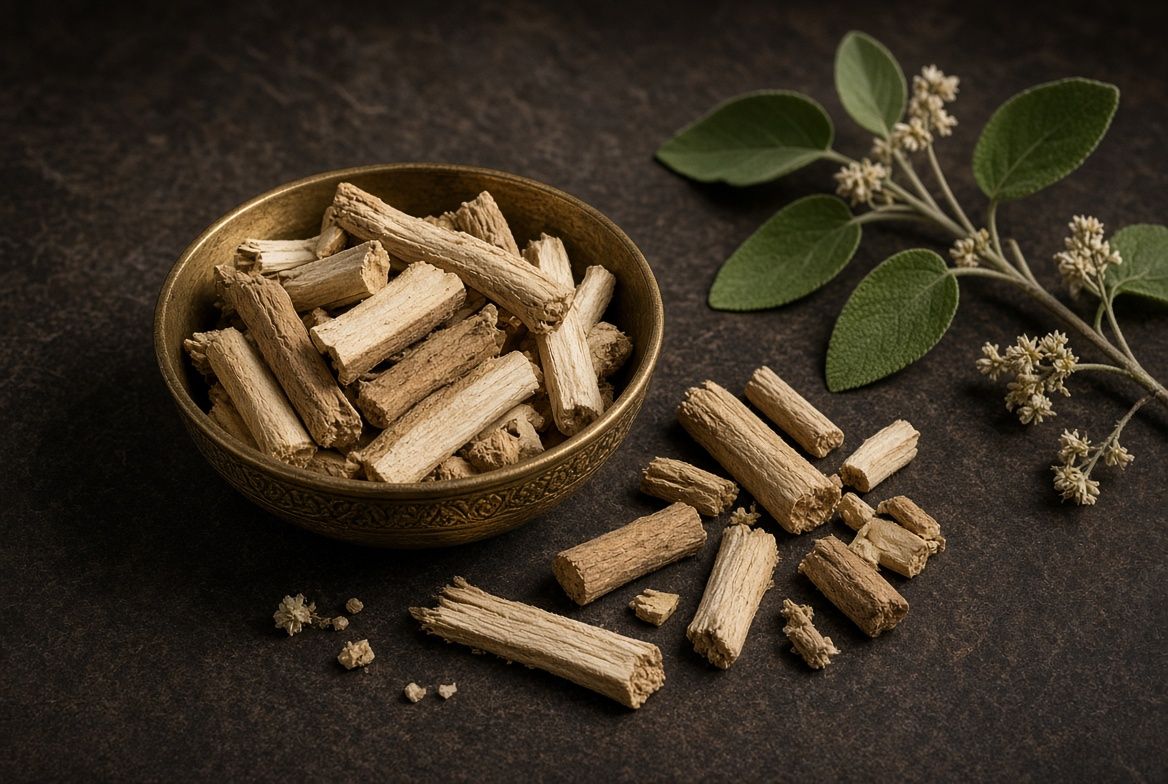
Botanical Identity & Classification
Inventory scope: Althaea officinalis · Malvaceae · root.
Nomenclatural check: Althaea officinalis L. is accepted in this treatment (family Malvaceae). A synonym listed there is Malva althaea E.H.L.Krause. The stated native range is Europe to Central Siberia and W. Pakistan, NW. Africa (Kew, Plants of the World Online: Althaea officinalis L.).
Inventory decision: Keep the root separate from leaf, confectionery and multi-ingredient syrups. When discussing mucilage, specify whether the preparation was a water macerate, syrup or extract.
The EMA assessment report, citing the European Pharmacopoeia, identifies marshmallow root (Althaeae radix) as the dried root of Althaea officinalis L., which may be peeled or unpeeled and whole or cut; the report does not specify the plant family (Assessment report on Althaea officinalis L., radix).
Botanical & Scientific Profile
Root maceration matters here because mouthfeel, not fragrance alone, is the research question. A medicinal monograph on a particular preparation is not validation of room-temperature storage.
The EMA assessment report describes human evidence for Althaea officinalis root preparations. In a post-marketing surveillance study of syrup containing aqueous root extract (DER 1:19.5–23.5), 313 children were studied; efficacy was rated very good to good in 84.3%, satisfactory in 7.7%, and sufficient to poor in 8%. Physicians and patients or parents judged the results, and no objective measures were made. A retrospective observational study of syrup in 599 children found efficacy rated very good or good in over 90% of cases, with no adverse effects reported. A double-blind, placebo-controlled four-week study of 63 patients with dry cough associated with ACE-inhibitor therapy used 40 mg of Althaea officinalis drops (20 drops three times daily); the preparation’s composition was not described. Three patients were excluded for non-compliance. In the Althaea group, mean cough score decreased from 2.66 ± 0.95 to 1.23 ± 1 (P<0.05) (Assessment report on Althaea officinalis L., radix).
This 1898 dispensatory entry on Althaea officinalis root reports no human studies, study-specific preparations, clinical results, or study limitations; it does describe traditional uses and preparations, including decoction and poultice (Althaea (U. S. P.)—Althaea.).
The EMA draft assessment report describes a post-marketing surveillance study of water-extract syrup from Althaea officinalis root (DER 1:19.5–23.5) in 313 children aged 3 months to 12.4 years: efficacy was rated very good to good in 84.3%. A retrospective observational study of the same syrup in 599 children aged 0–12 years reported efficacy rated very good or good in over 90% of cases in every age group. Assessments relied on physicians, patients, or parents, with no objective measures; neither study was randomized and controlled. Separately, a double-blind, placebo-controlled trial in 63 patients with ACE-inhibitor-associated dry cough reported a statistically significant cough-score reduction after four weeks of Althaea officinalis drops, but the preparation’s composition was not described, limiting interpretation (Assessment report on Althaea officinalis L., radix).
Cultural History & Traditional Herbalism
The EMA assessment report says marshmallow was used in traditional European medicine from ancient times, while noting that it is unclear whether ancient references specifically concerned Althaea officinalis. It attributes use of a root decoction as a wound remedy to Hippocrates and records that Dioskurides described uses including anuria, diarrhoea, lithiasis, internal injuries, nerve pain, bee sting, and toothache (Assessment report on Althaea officinalis L., radix).
The 1898 dispensatory states that Althaea officinalis is indigenous to Europe and parts of Asia, and that it was cultivated in some parts of Asia for medical use; it also says the root was principally obtained from Europe for medical purposes (Althaea (U. S. P.)—Althaea.).
Tradition, Folklore & Symbolism
No separate inherited symbolic or ceremonial use of this identified part was established here. A documented food, trade or medicinal practice should remain under its own description rather than being relabeled as ritual.
Herbal Energetics
Insufficient documented evidence for a traditional energetic classification. No temperature, direction or channel is inferred from the flavor of a cup.
InfiniTea sensory metaphor: Softening the edge. This is original editorial language, not a measured physiological action or a translation of a traditional diagnostic category.
Sensory Profile & Tea Applications
The EMA assessment report notes that Althaea officinalis root is used as a flavouring agent in food, but provides no description of its taste or aroma (Assessment report on Althaea officinalis L., radix).
The report describes marshmallow root (Althaea officinalis L., radix) as traditionally used orally as a macerate and notes that its mucilage may form a protective layer on mucosa. Some literature suggests this layer could delay absorption of medicines taken at the same time, but the report states that this effect has not been confirmed in tests on humans or animals; as a precaution, it advises taking the product no sooner than ½ to 1 hour before or after other medicinal products (Assessment report on Althaea officinalis L., radix).
Sensory notebook: Record body, opacity and mouthfeel separately from sweetness. Never infer that a candy contains the root from the word marshmallow.
Proposed comparison, not a completed trial: For an authorized food-safe process, record viscosity and filtration as well as aroma; distinguish material remaining in suspension from a clear filtrate.
For ordinary dried herbal or fruit infusions, the German Federal Institute for Risk Assessment advises using boiling water and not leaving the prepared infusion standing for hours. Cooling a hot infusion and steeping untreated dry material in cold water are different processes; this report does not validate the latter (Boiling water a must for herbal teas).
Safety & Responsible Use
The EMA assessment says that some literature sources suggest marshmallow-root mucilage may delay absorption of concomitantly administered medicines, but this has not been confirmed in human or animal tests. As a precaution, it advises not taking the product from ½ to 1 hour before or after other medicinal products (Assessment report on Althaea officinalis L., radix).
The EMA assessment states that safety during pregnancy and lactation has not been established and that use during pregnancy and lactation is not recommended because sufficient data are lacking. It also states that reproductive and developmental toxicity tests have not been performed (Assessment report on Althaea officinalis L., radix).
In the 313-child syrup surveillance study, one child aged 0–3 years developed obstructive bronchitis and another developed bronchopneumonia requiring hospitalisation; the physician judged the event relationships unrelated and unlikely, respectively. No adverse effects were reported in the retrospective study of 599 children; hypersensitivity to the active substance is a contraindication, and pregnancy and lactation safety has not been established, so use during pregnancy or lactation is not recommended. Delayed absorption of concomitant medicines is described in literature as a possible effect of the root’s mucilage, but it was not confirmed by tests in humans or animals; avoiding administration within ½ to 1 hour of other medicines is stated as a precaution (Assessment report on Althaea officinalis L., radix).
Preparation and exposure boundary: This review does not establish a safe medicinal dose in pregnancy, lactation or childhood, or rule out interactions or allergy. Do not substitute essential oil or a concentrated extract for the documented food or herb.
For U.S. food use, the relevant safety determination concerns the intended conditions of use. The existence of a traditional preparation or herbal medicine monograph does not establish that this ingredient, dose and beverage are cleared for sale (Understanding How the FDA Regulates Food Additives and GRAS Ingredients).
Historical Trade, Ecology & Sustainability
The EMA assessment report states that Althaea officinalis roots are collected in autumn from plants at least two years old (Assessment report on Althaea officinalis L., radix).
The 1898 dispensatory describes Althaea officinalis as commonly found on riverbanks and in salt marshes and says moist, sandy soils are preferred (Althaea (U. S. P.)—Althaea.).
Sourcing record: Ask for root, not leaf, and peeled versus unpeeled cut; follow the cultivated root back to harvest where possible.
InfiniTea Herb Lore & Ritualpreliminary draft
Energetics (original InfiniTea metaphor): Softening the edge. Use this as a private writing image, not a health statement.
Tradition & Folklore: The 1898 dispensatory states that Althaea officinalis is indigenous to Europe and parts of Asia, and that it was cultivated in some parts of Asia for medical use; it also says the root was principally obtained from Europe for medical purposes (Althaea (U. S. P.)—Althaea.). This is a record of use, not a claim of inherited ritual.
Ritual Cue (original contemporary InfiniTea interpretation): Write a difficult sentence, then revise it to be gentler without making it less true.
Private preliminary draft; not approved for publication.
Scholarly References & Research Verification
Research limitations
Confirm the organ, particle size, preparation and any medication-spacing precaution in the source actually used. No shelf-stable cold-brew process is established.
References below identify the evidence used, not additional endorsements. A botanical authority establishes nomenclature, not the identity of a physical lot. Published study samples, traditional descriptions and InfiniTea proposals are distinguished in the text.
- Kew, Plants of the World Online: Althaea officinalis L. | Taxonomic backbone
- Assessment report on Althaea officinalis L., radix | EMA Committee on Herbal Medicinal Products (HMPC) final assessment report
- Althaea (U. S. P.)—Althaea. | Historical materia medica monograph
- Assessment report on Althaea officinalis L., radix | Draft regulatory assessment report
- Boiling water a must for herbal teas | BfR press release providing general food-safety guidance for preparing herbal and fruit infusions.
- Understanding How the FDA Regulates Food Additives and GRAS Ingredients | U.S. FDA consumer-information webpage describing food-additive and GRAS ingredient oversight.
Final Botanical Summary
The pertinent sensory quality is texture. Traditional demulcent use and the possible effect of mucilage on taking other medicines are separate questions.
Editorial disposition: Lot unverified. The report is a private reference, not a clinical recommendation, approval for sale or authenticated sensory trial.
Verification Status (November 2026)
Phase II source audit, claim by claim
- Claims checked
- 16
- Corrected
- 3
- Withheld
- 5
- Sources
- 6
Material: Lot unverified. No physical sample has been examined.
Citation check: All 4 Safety & Use citations were re-read against their sources in November 2026 and confirmed.
A private research reference, not a clinical recommendation or product claim. Checked to the Grimoire's research standards →