
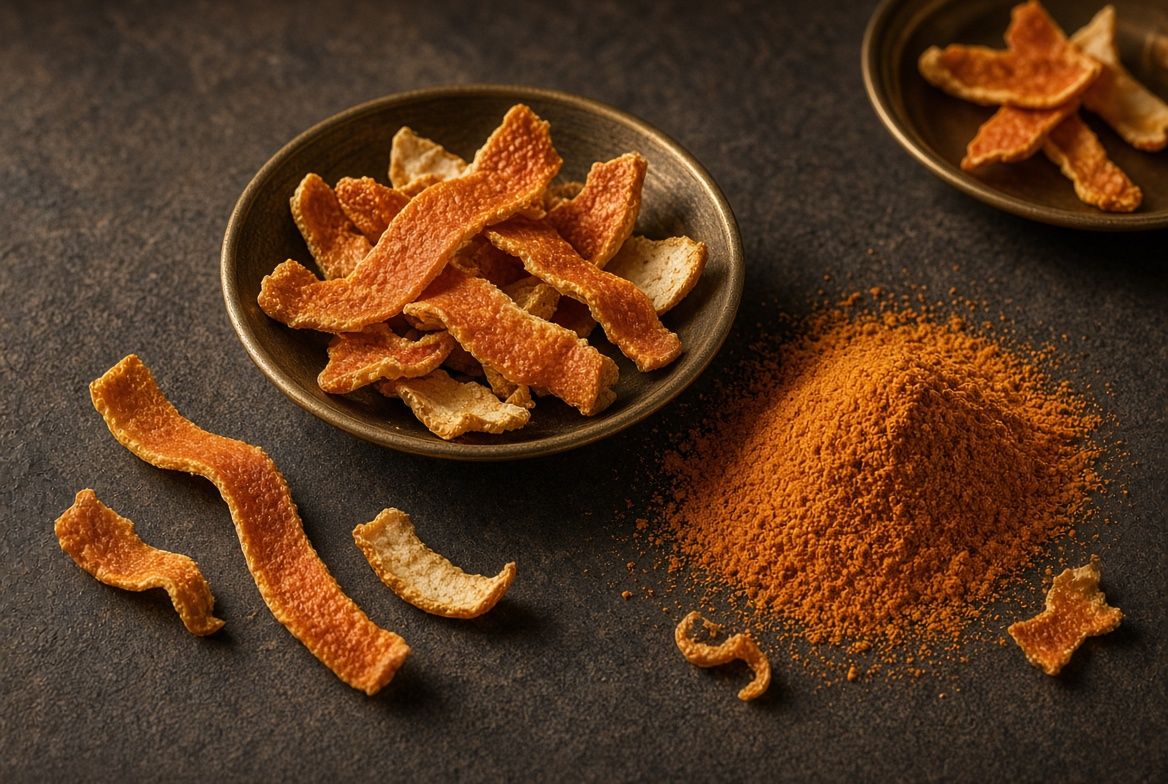
Botanical Identity & Classification
Inventory scope: Citrus sweet-orange and bitter-orange groups · Rutaceae · fruit, especially peel.
Nomenclatural check: Citrus × aurantium L. is accepted in this treatment (family Rutaceae). A synonym listed there is Aurantium × citrum M.Gómez. The stated native range is A cultigen from S. China (Kew, Plants of the World Online: Citrus × aurantium L.).
Inventory decision: Ask for sweet versus bitter orange, cultivar if known, and colored rind versus whole peel or fruit. Do not transfer stimulant-supplement claims or risks directly to culinary sweet orange.
PubChem identifies sweet orange as Citrus sinensis, a species in the family Rutaceae. Its MeSH description distinguishes sweet orange fruit (Citrus × sinensis) from bitter orange fruit (Citrus aurantium) (Citrus sinensis (sweet orange) - PubChem - NIH).
The PROSEA record concerns bitter or sour orange, Citrus aurantium L. (Rutaceae), rather than sweet orange, Citrus sinensis (Citrus aurantium L. cv. group Bouquetier).
Botanical & Scientific Profile
Treat the source citrus, maturity and peel fraction as separate variables. Sweet-orange zest, whole bitter-orange peel and concentrated bitter-orange products should not share a safety or efficacy conclusion.
The PROSEA description gives the bitter orange fruit as a 5–8 cm depressed-globose hesperidium with thick, strongly aromatic, yellow-orange peel. It states that bitter orange peel oil is obtained by cold expression and is only rarely made from Bouquetier cultivars (Citrus aurantium L. cv. group Bouquetier).
The page’s botanical account states that the rind of nearly all Citrus fruits yields essential oil; for sour orange (Citrus aurantium), it specifically identifies the rind as the source of essential oil used in perfumery, medicine, and Curaçao production (Tropical fruits & subtropical fruits).
Cultural History & Traditional Herbalism
The PROSEA record says Citrus aurantium fruit peel is used extensively to manufacture citrus marmalade. Its bitter orange peel oil is used mainly as a flavouring, including for orange sec and triple sec liqueur flavours and to modify or strengthen sweet-orange soft-drink flavour (Citrus aurantium L. cv. group Bouquetier).
The page’s historical account says sweet orange (Citrus sinensis) is indigenous to Southeastern Asia, most likely China or Cochin China, and was first cultivated sometime between 1,500 and 1,000 B.C.; Genoese traders carried it to Europe early in the 15th century, and Spain was responsible for introducing it to America (Tropical fruits & subtropical fruits).
The PROSEA record reports that annual world production of bitter orange peel oil was valued at US$1.1 million; it names Jamaica, the Dominican Republic, Haiti, Brazil, and Italy as major producers (Citrus aurantium L. cv. group Bouquetier).
The article describes zhi shi as the immature fruit of bitter orange (Citrus × aurantium), collected in May–June, and zhi qiao as the more mature, still-green fruit collected in July; both are used in Traditional Chinese Medicine for conditions described as qi stagnation, including indigestion. It separately identifies chen pi as the peel of tangerine (Citrus reticulata) and reports synephrine levels of 0.26% in qing pi (immature citrus fruit) and 0.22% in chen pi (mature citrus fruit) (Bitter Orange Peel and Synephrine: Part 1).
The post identifies bitter orange (Citrus aurantium) as native to China, says it spread to India in ancient times, and notes that it is mentioned in the Ayurvedic Charaka Samhita. It says Arabs introduced bitter orange into the Mediterranean basin perhaps as early as the ninth century; it was grown in Sicily by the eleventh century and established in Spain by the end of the twelfth. Sweet orange (Citrus sinensis), also identified as native to China, reached Europe about 1450. These claims are presented through historical and textual accounts, including the Charaka Samhita and medieval sources; the post does not describe archaeological finds (Bitter and Sweet).
Tradition, Folklore & Symbolism
No separate inherited symbolic or ceremonial use of this identified part was established here. A documented food, trade or medicinal practice should remain under its own description rather than being relabeled as ritual.
Herbal Energetics
Insufficient documented evidence for a traditional energetic classification. No temperature, direction or channel is inferred from the flavor of a cup.
InfiniTea sensory metaphor: Brightness with an edge. This is original editorial language, not a measured physiological action or a translation of a traditional diagnostic category.
Sensory Profile & Tea Applications
The PROSEA properties description characterizes Citrus aurantium bitter orange peel oil as a dark-yellow to olive-yellow or pale-brownish-yellow mobile liquid, with a characteristic fresh yet bitter or dry taste and a lasting sweet undertone (Citrus aurantium L. cv. group Bouquetier).
The fruit of bitter orange (Citrus aurantium) is too sour to eat raw (Bitter Orange: Usefulness and Safety).
Sensory notebook: Compare colored zest with peel containing white pith. Score fragrance and bitterness separately; neither is the same as the sweetness of orange juice.
Proposed comparison, not a completed trial: Compare strips of colored zest with pieces containing pith from the same identified culinary fruit, documenting the exposed white surface rather than attributing all bitterness to cultivar.
For ordinary dried herbal or fruit infusions, the German Federal Institute for Risk Assessment advises using boiling water and not leaving the prepared infusion standing for hours. Cooling a hot infusion and steeping untreated dry material in cold water are different processes; this report does not validate the latter (Boiling water a must for herbal teas).
Safety & Responsible Use
Reports describe serious medical events, including abnormal heart rhythms, heart attacks, and strokes, in people who took bitter-orange products; most products contained multiple ingredients, so the role of bitter orange or p-synephrine is unclear. Evidence on cardiovascular effects is inconclusive: some studies found increases in blood pressure and heart rate, while others did not (Bitter Orange: Usefulness and Safety).
Bitter orange (Citrus aurantium) is described as likely safe orally in amounts commonly found in foods; bitter orange oil is generally well tolerated topically or in aromatherapy. Abnormal heart rhythms, heart attacks, and strokes have been reported in people taking bitter-orange products, mostly products with multiple ingredients, so whether bitter orange or p-synephrine caused the events is unclear; cardiovascular evidence is inconclusive, with some studies reporting increased blood pressure and heart rate and others not. The page says bitter orange may not be safe during pregnancy or breastfeeding, cites animal data suggesting its substances might decrease milk production, and advises people taking medicines to consult a health care provider because herbs and medicines can interact harmfully (Bitter Orange: Usefulness and Safety).
Preparation and exposure boundary: This review does not establish a safe medicinal dose in pregnancy, lactation or childhood, or rule out interactions or allergy. Do not substitute essential oil or a concentrated extract for the documented food or herb.
For U.S. food use, the relevant safety determination concerns the intended conditions of use. The existence of a traditional preparation or herbal medicine monograph does not establish that this ingredient, dose and beverage are cleared for sale (Understanding How the FDA Regulates Food Additives and GRAS Ingredients).
Historical Trade, Ecology & Sustainability
The page’s production overview says Citrus is grown worldwide, although most commercial groves are in subtropical regions. It identifies the United States as the world leader, with Florida and California the principal states; the Mediterranean countries as second, with Spain, Portugal, Italy, and Palestine most important; the West Indies, Mexico, and Central America as increasingly important; and Brazil, Argentina, South Africa, Australia, China, and Japan as large producers (Tropical fruits & subtropical fruits).
The PROSEA record states that Citrus aurantium is cultivated in many tropical and subtropical countries but only rarely in South-East Asia. It names Jamaica, the Dominican Republic, Haiti, Brazil, and Italy as major producers of bitter orange peel oil (Citrus aurantium L. cv. group Bouquetier).
The bitter orange tree (Citrus aurantium) is native to Southeast Asia (Bitter Orange: Usefulness and Safety).
Sourcing record: Request cultivar or market group, origin, postharvest treatment and intended food use of the rind, not merely the food status of the pulp.
InfiniTea Herb Lore & Ritualpreliminary draft
Energetics (original InfiniTea metaphor): Brightness with an edge. Use this as a private writing image, not a health statement.
Tradition & Folklore: The post identifies bitter orange (Citrus aurantium) as native to China, says it spread to India in ancient times, and notes that it is mentioned in the Ayurvedic Charaka Samhita. It says Arabs introduced bitter orange into the Mediterranean basin perhaps as early as the ninth century; it was grown in Sicily by the eleventh century and established in Spain by the end of the twelfth. Sweet orange (Citrus sinensis), also identified as native to China, reached Europe about 1450. These claims are presented through historical and textual accounts, including the Charaka Samhita and medieval sources; the post does not describe archaeological finds (Bitter and Sweet). This is a record of use, not a claim of inherited ritual.
Ritual Cue (original contemporary InfiniTea interpretation): Draw an orange circle with two rings. Name something immediately apparent on the outside and something slower to notice within.
Private preliminary draft; not approved for publication.
Scholarly References & Research Verification
Research limitations
Obtain cultivar or trade type plus whether the white pith is present. Quantified supplement exposure cannot be back-calculated from “orange peel” on a bag.
References below identify the evidence used, not additional endorsements. A botanical authority establishes nomenclature, not the identity of a physical lot. Published study samples, traditional descriptions and InfiniTea proposals are distinguished in the text.
- Kew, Plants of the World Online: Citrus × aurantium L. | Taxonomic backbone
- Citrus sinensis (sweet orange) - PubChem - NIH | taxonomic summary page
- Citrus aurantium L. cv. group Bouquetier | PROSEA botanical and crop-use database record
- Tropical fruits & subtropical fruits | botanical reference webpage
- Bitter Orange: Usefulness and Safety | NCCIH health information fact sheet
- Bitter Orange Peel and Synephrine: Part 1 | secondary review
- Bitter and Sweet | Metropolitan Museum of Art museum blog post about the history and uses of oranges in Europe.
- Boiling water a must for herbal teas | BfR press release providing general food-safety guidance for preparing herbal and fruit infusions.
- Understanding How the FDA Regulates Food Additives and GRAS Ingredients | U.S. FDA consumer-information webpage describing food-additive and GRAS ingredient oversight.
Final Botanical Summary
The broad inventory term needs both a fruit identity and a part. The safety literature on bitter-orange supplements is not a verdict on every orange.
Editorial disposition: Identity hold. The report is a private reference, not a clinical recommendation, approval for sale or authenticated sensory trial.
Verification Status (November 2026)
Phase II source audit, claim by claim
- Claims checked
- 14
- Corrected
- 3
- Withheld
- 1
- Sources
- 9
Identity hold: the species, plant part or market name still needs confirming before any product decision. See Identity and the research limitations.
Citation check: All 3 Safety & Use citations were re-read against their sources in November 2026 and confirmed.
A private research reference, not a clinical recommendation or product claim. Checked to the Grimoire's research standards →