
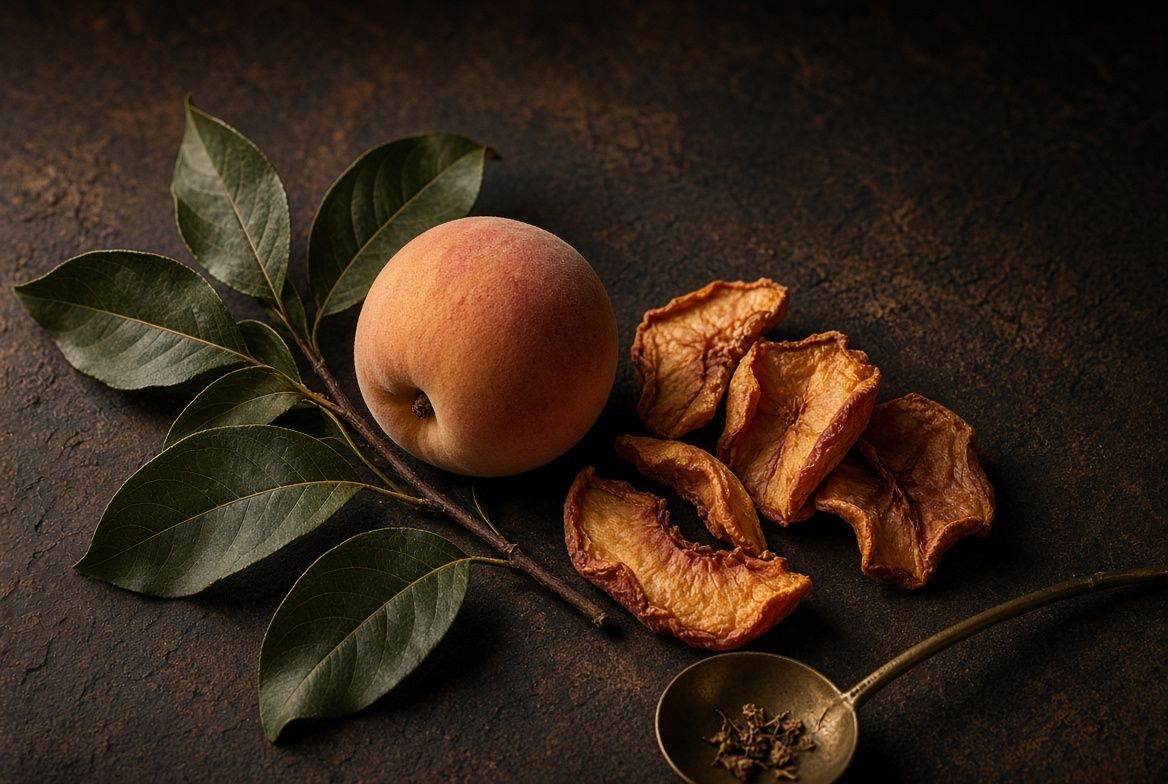
Botanical Identity & Classification
Inventory scope: Prunus persica · Rosaceae · edible fruit flesh as working scope.
Nomenclatural check: Prunus persica (L.) Batsch is accepted in this treatment (family Rosaceae). A synonym listed there is Amygdalus communis var. persica (L.) Risso in Hist. Nat. Prod. Eur. Mérid. 2: 327 (1826). The stated native range is A cultigen from N. Central China (Kew, Plants of the World Online: Prunus persica (L.) Batsch).
Inventory decision: Distinguish dried fruit, peach flavoring, leaves and kernel. Exclude pits and kernels from tea work; do not translate symbolic use of peach blossoms into instructions to consume another plant part.
The peach (Prunus persica L.) is described as one of the world’s most important temperate fruit crops; the page does not state its botanical family (Origin, spread, and cultivation history of the peach (Prunus persica L.)).
The chapter identifies peach as the diploid species Prunus persica and states that it is naturally self-pollinating (Peach).
Botanical & Scientific Profile
Restrict beverage research to edible fruit flesh, with peel status recorded. A peach stone in an archaeological site establishes the presence of fruit remains, not a historical practice of using kernels in tea.
The chapter states that peach scion cultivars have a ripening season extending for 6–8 months and a wide range of fruit and tree characteristics (Peach).
Modern peach cultivars have more varied endocarp morphology and generally larger endocarps than the fossil Prunus kunmingensis specimens; in modern peaches, endocarp size positively correlates with fruit size (Peaches Preceded Humans: Fossil Evidence from SW China).
The kernels inside peach pits contain cyanogenic glycoside; the flesh of the peach is not toxic (Natural toxins in fresh fruit and vegetables).
Cultural History & Traditional Herbalism
Charred peach pits from Yangshao-culture sites in China, dated to about 6200–5800 BP, provide archaeobotanical evidence of Neolithic peach use. The study says peach was initially gathered as a wild resource and gradually entered domestication through morphological selection and increasing human intervention (Origin, spread, and cultivation history of the peach (Prunus persica L.)).
The chapter identifies China as the center of diversity and domestication of peach; it states that peach spread from China to temperate and subtropical climates across Asia starting about 3,000 years ago (Peach).
Peach cultivation in China is documented by historical and archaeological evidence; the article identifies Chinese archaeological records dating to 8000–7000 BP as the oldest evidence for peach (Peaches Preceded Humans: Fossil Evidence from SW China).
Researchers examined 202 waterlogged, uncharred peach stones from five sites in Zhejiang Province in the lower Yangzi River valley, including Kuahuqiao (ca. 8000–7000 BP), Tianluoshan (7000–6500 BP), Liangzhu-culture sites Maoshan and Bianjiashan (ca. 5300–4300 BP), and Qianshanyang. The directly observed stones increase in approximate size over time and become more compressed or ovate; the earliest Kuahuqiao and Tianluoshan collections include two size groups, while Liangzhu-period stones are larger and more compressed than earlier examples. The authors interpret these archaeological changes as evidence of early selection for preferred peach types and propose that the lower Yangzi valley was a region of early peach selection and domestication, beginning at least 7500 years ago; the stones provide the material evidence, while selection and domestication are interpretations of their changing morphology (Archaeological Evidence for Peach (Prunus persica) Cultivation and Domestication in China).
Tradition, Folklore & Symbolism
In Ming and Qing decorative arts, peaches were associated with longevity through stories of the peaches of immortality in the celestial orchard of Xiwangmu, the Queen Mother of the West (Longevity in Chinese Art).
The study says that peach became integrated into Japanese religious beliefs and folklore, citing the mythological narrative of Momotaro as an example (Origin, spread, and cultivation history of the peach (Prunus persica L.)).
Herbal Energetics
Insufficient documented evidence for a traditional energetic classification. No temperature, direction or channel is inferred from the flavor of a cup.
InfiniTea sensory metaphor: A moment at ripeness. This is original editorial language, not a measured physiological action or a translation of a traditional diagnostic category.
Sensory Profile & Tea Applications
The study says that during the pre-Qin and Qin-Han periods, peach was used for consumption and that preservation methods emerged during this period. It specifies no flavor, aroma, or particular preparation (Origin, spread, and cultivation history of the peach (Prunus persica L.)).
Sensory notebook: Compare a dried piece with its strained infusion for aroma and perceived sweetness. Record added flavor or sugar from the label rather than assuming an intense peach note is intrinsic.
Proposed comparison, not a completed trial: Compare peeled and unpeeled pieces by appearance and aroma. Record any added flavor, sweetener or sulfite separately from the characteristics of the fruit.
For ordinary dried herbal or fruit infusions, the German Federal Institute for Risk Assessment advises using boiling water and not leaving the prepared infusion standing for hours. Cooling a hot infusion and steeping untreated dry material in cold water are different processes; this report does not validate the latter (Boiling water a must for herbal teas).
Safety & Responsible Use
The Canadian Food Inspection Agency advises against eating kernels inside peach pits because they contain cyanogenic glycoside; peach flesh itself is not toxic (Natural toxins in fresh fruit and vegetables).
The entry identifies peach skin (pericarp) and peel as richer in Pru p 3 lipid-transfer protein than the pulp, reporting around seven times more LTP per milligram of freeze-dried material in the skin. It also reports that some individuals experience systemic reactions after direct contact with peach peel but can tolerate the pulp (f420 Pru p 3 | Thermo Fisher Scientific).
Cyanogenic glycosides can release cyanide when plant tissue is damaged, and the opinion describes acute cyanide poisoning generally; it does not report a peach-kernel-specific poisoning case or clinical adverse-effect study. It gives no peach-kernel-specific allergy, interaction, or pregnancy/lactation findings; its pregnancy and lactation dietary-survey results are not specific to peach kernels (Evaluation of the health risks related to the presence of cyanogenic glycosides in foods other than raw apricot kernels).
Preparation and exposure boundary: This review does not establish a safe medicinal dose in pregnancy, lactation or childhood, or rule out interactions or allergy. Do not substitute essential oil or a concentrated extract for the documented food or herb.
For U.S. food use, the relevant safety determination concerns the intended conditions of use. The existence of a traditional preparation or herbal medicine monograph does not establish that this ingredient, dose and beverage are cleared for sale (Understanding How the FDA Regulates Food Additives and GRAS Ingredients).
Historical Trade, Ecology & Sustainability
The study identifies trade networks and European colonial expansion as factors in peach dissemination. It says Indigenous communities in North America played a significant role in its rapid spread through local ecological and cultural networks, and identifies peach genetic resources as relevant to modern conservation and utilization (Origin, spread, and cultivation history of the peach (Prunus persica L.)).
The study says that by the Ming and Qing dynasties, peach cultivation in China had developed distinct regional ecological zones and varietal groups adapted to diverse climates, generating genetic diversity that later served as a foundation for global peach breeding programs (Origin, spread, and cultivation history of the peach (Prunus persica L.)).
The chapter states that peach scion cultivars are adaptable from cold temperate to tropical zones (Peach).
Sourcing record: Specify pitted fruit, processing and any sugar or added flavor; do not assume a peach aroma means the lot actually contains fruit.
InfiniTea Herb Lore & Ritualpreliminary draft
Energetics (original InfiniTea metaphor): A moment at ripeness. Use this as a private writing image, not a health statement.
Tradition & Folklore: In Ming and Qing decorative arts, peaches were associated with longevity through stories of the peaches of immortality in the celestial orchard of Xiwangmu, the Queen Mother of the West (Longevity in Chinese Art).
Ritual Cue (original contemporary InfiniTea interpretation): Name a moment that could not be hurried. Describe how you knew it had arrived.
Private preliminary draft; not approved for publication.
Scholarly References & Research Verification
Research limitations
Exclude kernels, stones and leaves; document whether fruit is peeled, dried or sulfited. Allergy assessment is not answered by the absence of a stone.
The study cannot identify the wild ancestor of cultivated Prunus persica or establish the exact source and circumstances of domestication; the measured Tianluoshan sample comprised only nine stones (Archaeological Evidence for Peach (Prunus persica) Cultivation and Domestication in China).
References below identify the evidence used, not additional endorsements. A botanical authority establishes nomenclature, not the identity of a physical lot. Published study samples, traditional descriptions and InfiniTea proposals are distinguished in the text.
- Kew, Plants of the World Online: Prunus persica (L.) Batsch | Taxonomic backbone
- Origin, spread, and cultivation history of the peach (Prunus persica L.) | multidisciplinary historical and archaeobotanical study
- Peach | scholarly book chapter
- Peaches Preceded Humans: Fossil Evidence from SW China | paleobotanical fossil study
- Natural toxins in fresh fruit and vegetables | Canadian government food-safety fact sheet
- Longevity in Chinese Art | museum essay
- f420 Pru p 3 | Thermo Fisher Scientific | Official allergen encyclopedia entry / secondary review
- Archaeological Evidence for Peach (Prunus persica) Cultivation and Domestication in China | Peer-reviewed archaeological research article analyzing peach stones from sites in China.
- Evaluation of the health risks related to the presence of cyanogenic glycosides in foods other than raw apricot kernels | EFSA’s opinion reviews occurrence, toxicokinetic, toxicity, processing and dietary-exposure evidence for cyanogenic glycosides in foods. It states that peach kernels contain amygdalin and prunasin and cites a literature-reported total cyanide concentration of 470 mg/kg for peach kernel (Lindner, 1974). The described human bioavailability study tested apricot kernels, cassava, linseed and persipan—not peach kernels; the page does not describe a peach-kernel-specific human or animal study.
- Boiling water a must for herbal teas | BfR press release providing general food-safety guidance for preparing herbal and fruit infusions.
- Understanding How the FDA Regulates Food Additives and GRAS Ingredients | U.S. FDA consumer-information webpage describing food-additive and GRAS ingredient oversight.
Final Botanical Summary
Peach flesh is the defensible culinary scope. Its stone, seed, leaves and blossom require separate identification and evidence.
Editorial disposition: Lot unverified. The report is a private reference, not a clinical recommendation, approval for sale or authenticated sensory trial.
Verification Status (November 2026)
Phase II source audit, claim by claim
- Claims checked
- 16
- Corrected
- 1
- Withheld
- 1
- Sources
- 11
Material: Lot unverified. No physical sample has been examined.
Citation check: All 4 Safety & Use citations were re-read against their sources in November 2026 and confirmed.
A private research reference, not a clinical recommendation or product claim. Checked to the Grimoire's research standards →