
Botanical Identity & Classification
Inventory scope: Rosa species, including the Damask rose · Rosaceae · flower buds or petals.
Nomenclatural check: Rosa × damascena Herrm. is accepted in this treatment. A synonym listed there is Rosa × damascena var. typica Regel in Trudy Imp. S.-Peterburgsk. Bot. Sada 5: 379 (1878), not validly publ. (Kew, Plants of the World Online: Rosa × damascena Herrm.).
Inventory decision: Identify species, petal versus entire bud, and food-grade production. Rose water, rose oil, hip powder and ornamental florist stock are not substitutes for edible petals.
Damask rose is Rosa damascena, a member of the Rosaceae family (Damask rose).
The report defines rose flower as the dried petals of flowering plants of Rosa gallica L., Rosa centifolia L. or Rosa damascena Mill.; Rosa belongs to the Rosaceae family (Assessment report on Rosa gallica L., Rosa centifolia L., Rosa damascena Mill., flos).
Botanical & Scientific Profile
Use petal, bud, rosewater, distilled oil and hip as distinct entries in the evidence record. A distillation tradition documents technique and labor, not a medicinal effect from swallowing petals.
The HMPC concluded, on the basis of long-standing traditional use, that preparations of the petals of Rosa gallica L., Rosa centifolia L. or Rosa damascena Mill. can be used for mild inflammation of the skin or lining of the mouth and throat. Clinical-trial evidence was insufficient; the conclusions are mainly based on traditional use (Rosae flos - herbal medicinal product).
A randomized, double-blind, placebo-controlled study enrolled 50 patients with recurrent aphthous stomatitis for two weeks and evaluated an aqueous Rosa damascena extract mouthwash. Pain, ulcer size and ulcer number differed significantly between the mouthwash and placebo groups on days 4 and 7. The report describes the clinical study as small and states that controlled studies supporting well-established use have not been performed with Rosae flos preparations (Assessment report on Rosa gallica L., Rosa centifolia L., Rosa damascena Mill., flos).
Rosa damascena is a perennial, deciduous shrub that can reach 6 feet tall and produces red, white, or pink flowers up to 3 inches across in summer (Damask rose).
Cultural History & Traditional Herbalism
Rosa damascena is native to Persia (Iran) and is now grown commercially in Bulgaria and Turkey. It was thought to originate in Damascus and, according to the page’s historical account, was brought from Syria to Europe in the 14th century by knights returning from the Crusades (Damask rose).
The chapter abstract identifies Rosa × damascena Mill. as the predominant rose species worldwide for producing rose essential-oil products used in the perfumery, cosmetics, pharmaceutical, and food industries (Rosa x damascena Mill. (Rose)).
The report says ancient medical books described medicinal uses of Rosa damascena flowers, petals and hips, including for abdominal and chest pain, digestive problems and menstrual bleeding (Assessment report on Rosa gallica L., Rosa centifolia L., Rosa damascena Mill., flos).
The review states that rose water is mostly produced by distilling fresh flowers of Rosa × damascena Herrm. It describes rose-water production as a long-established industry in Iran, particularly in Kashan and Qamsar, and identifies Kashan as a historic center of the industry. The authors gathered information by searching different resources; the abstract also notes traditional use of rose water as a drink and flavoring agent in Iran and Persian Gulf countries (Rose water, quality control, and its application).
The authors report that in Kashan, Iran, rosewater festivals and ceremonies take place annually during May–June, when Rosa damascena flowers are harvested. They describe traditional household distillation there as boiling the petals; the paper also notes that rosewater production is used in religious ceremonies and food. It separately reports that commercial distilleries existed in Shiraz, Fars, in 1612, and that Avicenna distilled Damask rose petals for medical purposes in the 10th century (Research and Current Profile of Iranian Production of Damask Rose (Rosa damascena Mill.)).
Tradition, Folklore & Symbolism
The fragrant blooms of Rosa damascena, known as the queen of flowers, have long been prized as a symbol of love and beauty (Damask rose).
Herbal Energetics
Comparative material only: The following entry is for a named different species, not an assignment to the inventory rose.
Rosae Rugosae Flos (Mei gui hua) is the dried flower bud of Rosa rugosa Thunb. The page attributes its stated properties to the Chinese Pharmacopoeia (2020): it enters the liver and spleen meridians, promotes qi movement to relieve depression, harmonises the blood, and relieves pain. No flavor, temperature, rasa, virya, or vipaka is stated (Identification of Easily Confused Species of Chinese Materia Medica in Hong Kong by Macroscopic and Microscopic Characteristics Project — Rosae Rugosae Flos versus Flos Rosae Chinensis).
Insufficient documented evidence for a traditional energetic classification. This limitation applies to the precise inventory part or species, not to the comparative or historically ambiguous material described here.
These are categories within the named tradition. They are not measurements of body temperature, pharmacological action or clinical efficacy.
InfiniTea sensory metaphor: Unfolding. This is original editorial language, not a measured physiological action or a translation of a traditional diagnostic category.
Sensory Profile & Tea Applications
The flowers of Rosa damascena are described as fragrant, and the scent alone is said to have an uplifting and stabilizing effect (Damask rose).
Rosa damascena is cultivated, including in Iran, for its appearance and scent. The report characterizes rose oil as sweet, floral, fresh and rosaceous: citronellol and geraniol chiefly shape its character, nerol contributes freshness, and farnesol contributes a strong floral character (Assessment report on Rosa gallica L., Rosa centifolia L., Rosa damascena Mill., flos).
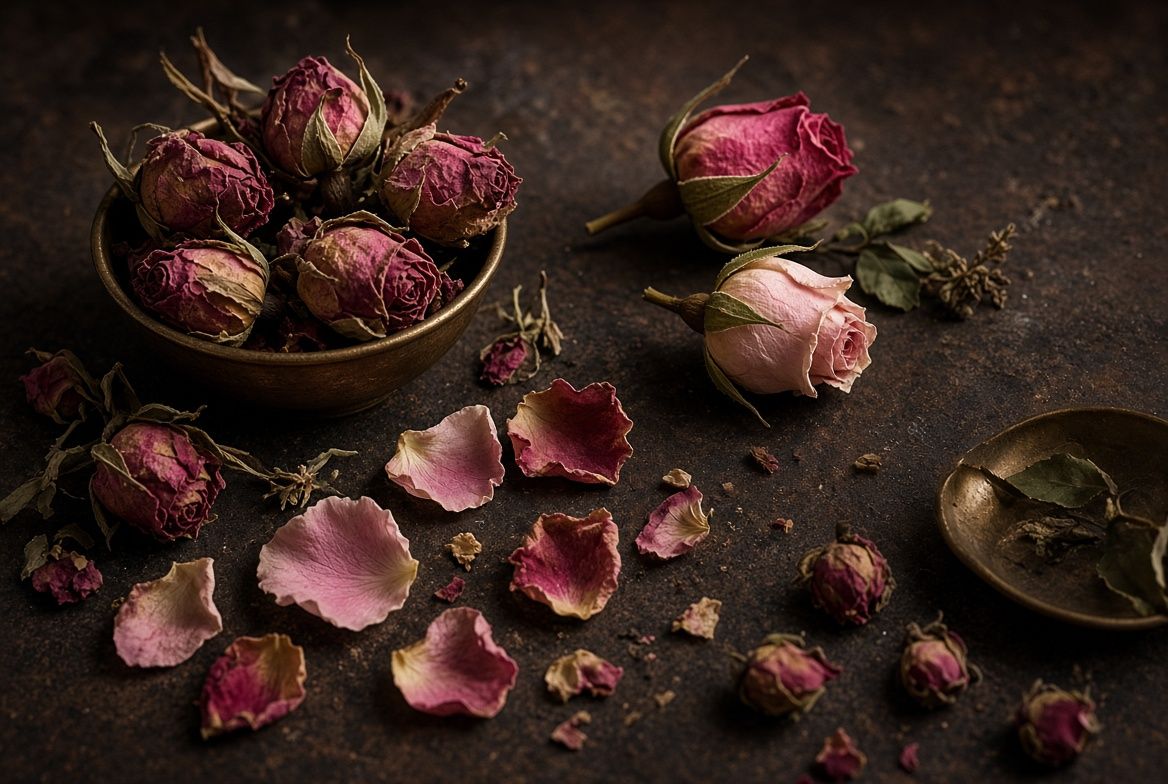
Sensory notebook: Compare opened petals and whole buds by fragrance and bitterness; record green calyx material. Do not assume pink color predicts perfume strength.
Proposed comparison, not a completed trial: Inspect a bud and loose petals against a pale surface. Compare with food-grade rosewater only in a separate vessel and mark the process distinction.
For ordinary dried herbal or fruit infusions, the German Federal Institute for Risk Assessment advises using boiling water and not leaving the prepared infusion standing for hours. Cooling a hot infusion and steeping untreated dry material in cold water are different processes; this report does not validate the latter (Boiling water a must for herbal teas).
Safety & Responsible Use
The report covers dried petals of Rosa gallica L., Rosa centifolia L. and Rosa damascena Mill., including comminuted substance for infusion preparations for oromucosal or cutaneous use. It says use during pregnancy and lactation is not recommended because sufficient safety data are lacking (Assessment report on Rosa gallica L., Rosa centifolia L., Rosa damascena Mill., flos).
For edible flowers, Colorado State University Extension advises positive plant identification and says not to eat flowers from florists because they are not grown for consumption and may have been treated with chemicals unsafe to eat (Edible Flowers).
The review reports one human case of allergic contact dermatitis caused by Rosa mosqueta oil; it does not identify this as Rosa damascena oil or as rose-petal exposure. It gives a general precaution to be careful of allergic reactions when using plant oils, but reports no specific contraindications, interactions, or pregnancy or lactation findings for Rosa damascena (Beneficial medicinal effects and material applications of rose).
Preparation and exposure boundary: This review does not establish a safe medicinal dose in pregnancy, lactation or childhood, or rule out interactions or allergy. Do not substitute essential oil or a concentrated extract for the documented food or herb.
For U.S. food use, the relevant safety determination concerns the intended conditions of use. The existence of a traditional preparation or herbal medicine monograph does not establish that this ingredient, dose and beverage are cleared for sale (Understanding How the FDA Regulates Food Additives and GRAS Ingredients).
Historical Trade, Ecology & Sustainability
Rosa damascena requires very particular growing conditions to thrive, limiting how much can be cultivated (Damask rose).
Rosa damascena Mill. is described as an erect shrub 1–2 m tall and as cultivated around the world, including in Iran, especially Kashan, for its beauty and scent (Assessment report on Rosa gallica L., Rosa centifolia L., Rosa damascena Mill., flos).
About 180 pounds of Rosa damascena flowers are needed to make 1 ounce of rose oil. The page says rose oil in Europe is mainly produced in Bulgaria and France, while Turkey and Iran produce far more Rosa damascena oil than Europe (Damask rose).
Sourcing record: Record edible-flower production and the fraction of green calyx; a perfumery plantation or florist label alone does not establish suitability for ingestion.
InfiniTea Herb Lore & Ritualpreliminary draft
Energetics (original InfiniTea metaphor): Unfolding. Use this as a private writing image, not a health statement.
For the separately attributed traditional material, see Herbal Energetics; the original sensory image is not a translation of that classification.
Tradition & Folklore: The fragrant blooms of Rosa damascena, known as the queen of flowers, have long been prized as a symbol of love and beauty (Damask rose).
Ritual Cue (original contemporary InfiniTea interpretation): Describe an idea once as a bud and once as an open flower. Keep whichever version says more with less.
Private preliminary draft; not approved for publication.
Scholarly References & Research Verification
Research limitations
Resolve species or hybrid name and food-use pesticide status. Do not treat florist roses or perfume absolutes as beverage ingredients.
References below identify the evidence used, not additional endorsements. A botanical authority establishes nomenclature, not the identity of a physical lot. Published study samples, traditional descriptions and InfiniTea proposals are distinguished in the text.
- Kew, Plants of the World Online: Rosa × damascena Herrm. | Taxonomic backbone
- Damask rose | Herbal ingredient monograph
- Assessment report on Rosa gallica L., Rosa centifolia L., Rosa damascena Mill., flos | assessment report
- Rosae flos - herbal medicinal product | EMA public summary of HMPC scientific conclusions on a herbal medicinal product
- Rosa x damascena Mill. (Rose) | book chapter (abstract and metadata accessible; subscription content preview)
- Edible Flowers | peer-reviewed university Extension publication
- Rose water, quality control, and its application | secondary review
- Research and Current Profile of Iranian Production of Damask Rose (Rosa damascena Mill.) | Scholarly conference-proceedings paper on the history, cultivation, processing, and uses of Damask rose in Iran.
- Beneficial medicinal effects and material applications of rose | A review of medicinal and material uses of roses. For adverse effects, it reports a patient diagnosed with allergic contact dermatitis caused by Rosa mosqueta oil; it also describes clinical studies of Rosa damascena oil, including aromatherapy trials, but does not report hypersensitivity outcomes from those trials.
- Identification of Easily Confused Species of Chinese Materia Medica in Hong Kong by Macroscopic and Microscopic Characteristics Project — Rosae Rugosae Flos versus Flos Rosae Chinensis | Government Chinese Medicines Testing Institute, Department of Health, Hong Kong; Chinese Materia Medica identification pamphlet
- Boiling water a must for herbal teas | BfR press release providing general food-safety guidance for preparing herbal and fruit infusions.
- Understanding How the FDA Regulates Food Additives and GRAS Ingredients | U.S. FDA consumer-information webpage describing food-additive and GRAS ingredient oversight.
Final Botanical Summary
A named distillation or cultural tradition can illuminate rose history without establishing the safety or effects of drinking the petals.
Editorial disposition: Identity hold. The report is a private reference, not a clinical recommendation, approval for sale or authenticated sensory trial.
Verification Status (November 2026)
Phase II source audit, claim by claim
- Claims checked
- 16
- Corrected
- 2
- Withheld
- 0
- Sources
- 12
Identity hold: the species, plant part or market name still needs confirming before any product decision. See Identity and the research limitations.
Citation check: All 4 Safety & Use citations were re-read against their sources in November 2026 and confirmed.
A private research reference, not a clinical recommendation or product claim. Checked to the Grimoire's research standards →