
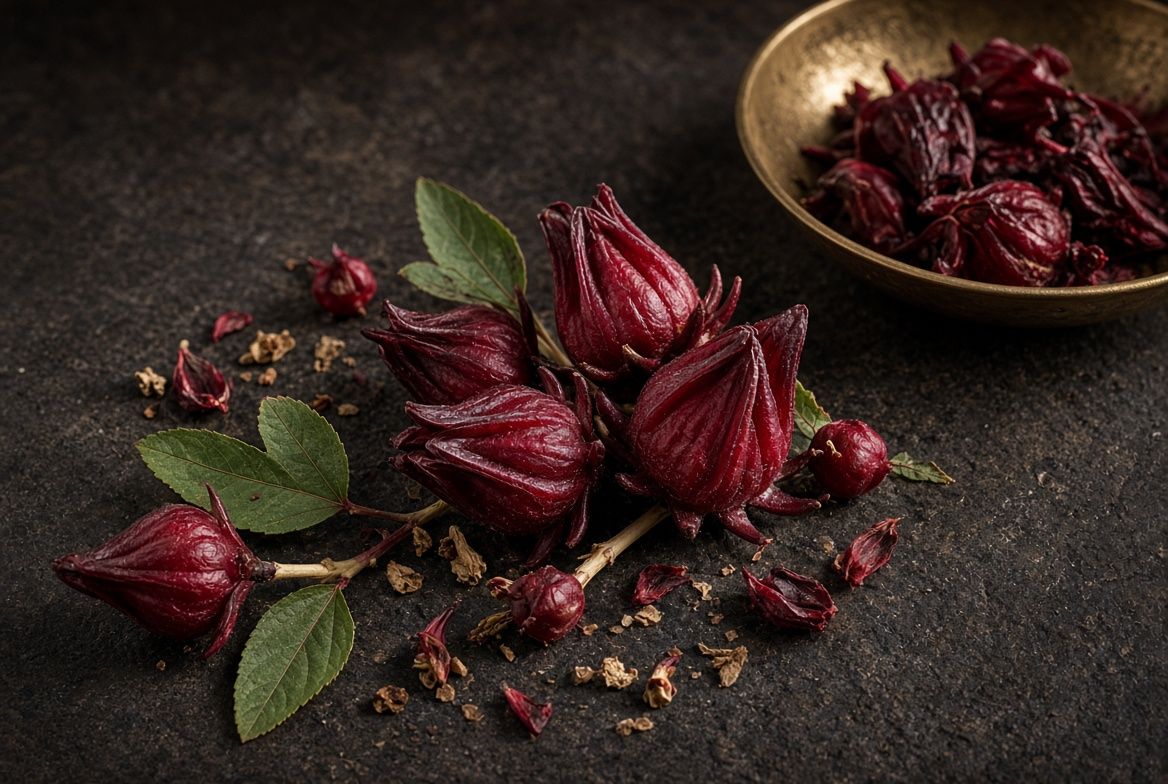
Botanical Identity & Classification
Inventory scope: Hibiscus sabdariffa · Malvaceae · fleshy calyces.
Nomenclatural check: Hibiscus sabdariffa L. is treated as a synonym of Sabdariffa gossypiifolia (Kew, Plants of the World Online: Hibiscus sabdariffa L.).
Inventory decision: The red beverage material is the calyx, not a generic hibiscus petal. Keep local drink names and recipes distinct; do not assume a sweetened drink resembles an unsweetened trial preparation.
The NParks profile identifies roselle as Hibiscus sabdariffa L. in the Malvaceae family and states that its bright-red, fleshy calyces are used in foods and beverages (Hibiscus sabdariffa L.).
The accepted entry is Sabdariffa gossypiifolia (Mill.) M.M.Hanes & R.L.Barrett. The combination was published in 2025; Hibiscus sabdariffa L. is retained here as the searchable literature and commodity name for the same roselle, not a substituted species (Kew: Sabdariffa gossypiifolia).
Botanical & Scientific Profile
The fleshy calyx is the normal research material, not a generic ornamental hibiscus petal. Cultural beverage names should be connected to communities and preparations only where the source supports that connection.
In the one eligible randomized controlled trial, 60 adults with hypertension and type 2 diabetes received capsules containing a total of 5600 mg of Roselle (Hibiscus sabdariffa) extract or lactose placebo for eight weeks. Blood-pressure estimates were based on 52 participants: systolic blood pressure mean difference 1.65 mmHg (95% CI −7.89 to 11.19) and diastolic blood pressure mean difference 4.60 mmHg (95% CI −1.38 to 10.58). The evidence was very low certainty (Red tea (Roselle) for lowering blood pressure in adults).
The Cochrane review describes Roselle (Hibiscus sabdariffa) as containing anthocyanins, which it says have lowered blood pressure in animal and human studies; it does not specify a plant part or provide details of those studies (Red tea (Roselle) for lowering blood pressure in adults).
Cultural History & Traditional Herbalism
The NParks profile states that in the Caribbean, people drink juice extracted from Hibiscus sabdariffa calyces either fresh or fermented (Hibiscus sabdariffa L.).
The review’s account of traditional uses says that roselle (Hibiscus sabdariffa L.) calyces have been used in Egypt to make “cacody tea” and fermented beverages, and boiled with sugar in Sudan and Nigeria to prepare drinks called Karkade or Zoborodo (Organic Acids from Roselle (Hibiscus sabdariffa L.)—A Brief Review of Its Pharmacological Effects).
The article identifies Hibiscus sabdariffa calyces as the part used to make karkade, a popular deep-red beverage in Egypt and Sudan described as a “refrigerant” that helps lower body temperature. It reports that in Egypt, calyx preparations have been used for cardiac and nerve diseases and to stimulate diuresis; elsewhere in North Africa, they have been used for cough, sore throat, and genital problems. The article says sour hibiscus tea is a traditional hypertension treatment in Iran, and identifies bissap as the name for hibiscus in Senegal. It gives no dates for these specific practices; the account cites published references (Hibiscus).
Tradition, Folklore & Symbolism
The NParks profile says the common name “Roselle” is likely a corrupted version of the French name “Oseille de Guinée,” meaning Guinea Sorrel (Hibiscus sabdariffa L.).
Herbal Energetics
Insufficient documented evidence for a traditional energetic classification. No temperature, direction or channel is inferred from the flavor of a cup.
InfiniTea sensory metaphor: A vivid accent. This is original editorial language, not a measured physiological action or a translation of a traditional diagnostic category.
Sensory Profile & Tea Applications
The NParks profile says a beverage made from Hibiscus sabdariffa calyces tastes similar to Ribena, a blackcurrant-flavored drink, and that the calyces are used to make jams that taste like cranberry sauce (Hibiscus sabdariffa L.).
Granny Smith apple slices were immersed for 30 minutes in an aqueous extract made by infusing dried Hibiscus sabdariffa calyces in boiling water, then dried by convective-air or infrared methods at 50°C, 60°C, or 70°C. The study reports that the extract contributed bioactive compounds to the apple snacks and that infused slices had higher redness; the authors attribute their pleasant red color to hibiscus anthocyanins. Browning index varied with infusion and drying temperature, decreasing from the fresh-slice value after infusion, while infused samples showed an increase at 70°C that the authors associate with temperature effects on anthocyanins (Potentially Functional Apple Snacks Infused in the Hibiscus sabdariffa Extract Obtained by Convective and Infrared Drying: Kinetics of Drying and Phytochemical Analysis).
Sensory notebook: Compare sourness before and after dilution; record red color independently of perceived tartness. Identify sugar or other botanicals if evaluating a prepared drink.
Proposed comparison, not a completed trial: Record calyx color, liquor color and perceived tartness separately. If sugar is added, retain an unsweetened comparison rather than calling the sweeter result a property of the plant.
For ordinary dried herbal or fruit infusions, the German Federal Institute for Risk Assessment advises using boiling water and not leaving the prepared infusion standing for hours. Cooling a hot infusion and steeping untreated dry material in cold water are different processes; this report does not validate the latter (Boiling water a must for herbal teas).
Safety & Responsible Use
A Cochrane review of Roselle (Hibiscus sabdariffa) for adults with primary hypertension found very-low-certainty evidence from one trial involving 60 participants with type 2 diabetes and hypertension. The trial did not report safety outcomes, including withdrawals due to adverse effects, and the review concluded that evidence was insufficient to determine whether Roselle controls or lowers blood pressure (Red tea (Roselle) for lowering blood pressure in adults).
The article advises pregnant or nursing women to avoid large amounts of foods or herbal preparations made with Hibiscus sabdariffa leaves or calyces. It says hibiscus tea may interact with NSAIDs and diuretics, and that more clinical studies are needed to determine a safe dose when hibiscus is used alongside other drugs (Food as Medicine: Hibiscus).
In the included human trials, one study reported mild gastrointestinal symptoms with hibiscus extract; they subsided within a week. No other adverse effects were reported in the included studies, and 26% of participants in one trial withdrew from the hibiscus group because they disliked the beverage’s bitter taste. In experimental rats, hibiscus co-administered with hydrochlorothiazide increased urine volume, raising a possible dehydration concern; this is animal evidence, and the authors note that the drug dose used did not translate to a physiological human dose. In vitro evidence identifies hibiscus anthocyanins as ACE inhibitors, so interaction with ACE-inhibitor medicines remains unestablished; the page provides no human allergy or pregnancy/lactation findings (A systematic review and meta-analysis of the effects of Hibiscus sabdariffa on blood pressure and cardiometabolic markers).
Preparation and exposure boundary: This review does not establish a safe medicinal dose in pregnancy, lactation or childhood, or rule out interactions or allergy. Do not substitute essential oil or a concentrated extract for the documented food or herb.
For U.S. food use, the relevant safety determination concerns the intended conditions of use. The existence of a traditional preparation or herbal medicine monograph does not establish that this ingredient, dose and beverage are cleared for sale (Understanding How the FDA Regulates Food Additives and GRAS Ingredients).
Historical Trade, Ecology & Sustainability
The NParks profile classifies Hibiscus sabdariffa’s local conservation status in Singapore as non-native (horticultural / cultivated only) (Hibiscus sabdariffa L.).
For roselle (Hibiscus sabdariffa L.) cultivation in Mexico, the review reports approximately 18,000 hectares harvested and an average yield of 265 kg. It says Guerrero and Oaxaca grow approximately 85% of national production, and that all national production comes from a single Creole variety sown only in the spring–summer agricultural cycle (Organic Acids from Roselle (Hibiscus sabdariffa L.)—A Brief Review of Its Pharmacological Effects).
Sourcing record: Specify calyx, cultivar or color where known, origin, drying and whether the product has added color, sugar or flavoring.
InfiniTea Herb Lore & Ritualpreliminary draft
Energetics (original InfiniTea metaphor): A vivid accent. Use this as a private writing image, not a health statement.
Tradition & Folklore: The NParks profile says the common name “Roselle” is likely a corrupted version of the French name “Oseille de Guinée,” meaning Guinea Sorrel (Hibiscus sabdariffa L.).
Ritual Cue (original contemporary InfiniTea interpretation): Write a single vivid description of an ordinary sight. Remove the adjective and see if the image survives.
Private preliminary draft; not approved for publication.
Scholarly References & Research Verification
Research limitations
Obtain calyx specification and added-color or flavor declarations. Separate cardiometabolic study preparations from a sweetened culinary beverage.
The experiments used one apple cultivar (Granny Smith) and specific laboratory infusion and drying conditions, so the reported results do not establish outcomes for other cultivars or processing conditions (Potentially Functional Apple Snacks Infused in the Hibiscus sabdariffa Extract Obtained by Convective and Infrared Drying: Kinetics of Drying and Phytochemical Analysis).
References below identify the evidence used, not additional endorsements. A botanical authority establishes nomenclature, not the identity of a physical lot. Published study samples, traditional descriptions and InfiniTea proposals are distinguished in the text.
- Kew, Plants of the World Online: Hibiscus sabdariffa L. | Taxonomic backbone
- Hibiscus sabdariffa L. | official government botanical species profile
- Red tea (Roselle) for lowering blood pressure in adults | Cochrane systematic review of randomized controlled trials
- Red tea (Roselle) for lowering blood pressure in adults | Cochrane systematic review
- Organic Acids from Roselle (Hibiscus sabdariffa L.)—A Brief Review of Its Pharmacological Effects | review article
- Food as Medicine: Hibiscus | HerbalEGram educational article reviewing traditional uses, nutrition, safety, and clinical research
- Potentially Functional Apple Snacks Infused in the Hibiscus sabdariffa Extract Obtained by Convective and Infrared Drying: Kinetics of Drying and Phytochemical Analysis | laboratory study
- Hibiscus | HerbalGram article providing a historical and ethnobotanical overview of Hibiscus sabdariffa.
- Kew: Sabdariffa gossypiifolia | Taxonomic backbone
- A systematic review and meta-analysis of the effects of Hibiscus sabdariffa on blood pressure and cardiometabolic markers | Systematic review and random-effects meta-analysis of 17 chronic randomized controlled studies (18 arms) in adults, comparing standalone Hibiscus sabdariffa interventions—including calyx or leaf capsules and tea—with placebo, other teas, diets, or pharmaceutical medications. The review also discusses safety observations from included human trials and interaction evidence from experimental animal and in vitro studies.
- Boiling water a must for herbal teas | BfR press release providing general food-safety guidance for preparing herbal and fruit infusions.
- Understanding How the FDA Regulates Food Additives and GRAS Ingredients | U.S. FDA consumer-information webpage describing food-additive and GRAS ingredient oversight.
Final Botanical Summary
Roselle offers a clear example of a market “flower” that needs a more accurate plant-part label. Cultural beverages are not interchangeable clinical preparations.
Editorial disposition: Lot unverified. The report is a private reference, not a clinical recommendation, approval for sale or authenticated sensory trial.
Verification Status (November 2026)
Phase II source audit, claim by claim
- Claims checked
- 17
- Corrected
- 2
- Withheld
- 6
- Sources
- 12
Material: Lot unverified. No physical sample has been examined.
Citation check: 3 of 4 Safety & Use citations confirmed against their sources in November 2026; 1 on a site that blocks automated reading, awaiting a check by hand.
A private research reference, not a clinical recommendation or product claim. Checked to the Grimoire's research standards →