
Botanical Identity & Classification
Inventory scope: Crocus sativus · Iridaceae · dried stigmas.
Nomenclatural check: Crocus sativus L. is accepted in this treatment (family Iridaceae). A synonym listed there is Crocus officinalis (L.) Honck. The stated native range is The native range of this species is as a cultigen from Greece (Kew, Plants of the World Online: Crocus sativus L.).
Inventory decision: Use authenticated culinary stigmas. Exclude autumn crocus look-alikes and garden-foraged substitutes; normal seasoning, concentrated supplements and unverified powder cannot share one safety conclusion.
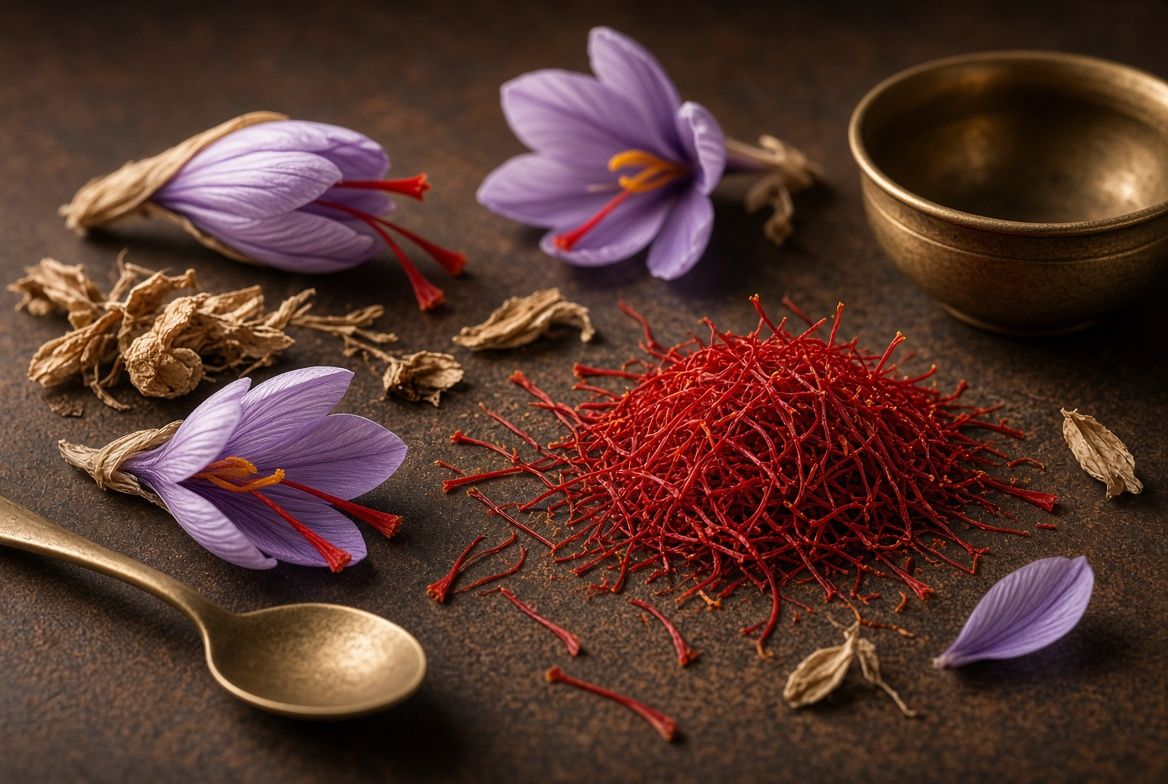
Saffron is made by drying the three stigmas—the pollen-receiving structures—of Crocus sativus, the autumn crocus (saffron).
The page identifies saffron as Crocus sativus L., a perennial, stemless herb in the Iridaceae family (Toxicology effects of saffron and its constituents: a review).
Botanical & Scientific Profile
The commercial organ is the stigma. Work on petals or other floral by-products can be valuable, but it cannot be cited as if it tested culinary saffron threads.
A placebo-controlled clinical trial in healthy men reported that C. sativus stigma powder, given at 100 mg/day for six weeks, had temporary immunomodulatory activity and no reported hematological, hepatic, renal, or other adverse effects. This single trial does not establish effects or safety for other preparations or populations (Adverse Events of Saffron (Crocus sativus L.): Systematic Review of Current Evidence).
The stigmas of Crocus sativus are orange. Saffron contains 0.5 to 1 percent essential oil, principally picrocrocin; crocin is its coloring matter (saffron).
The review reports that traditional sun-drying of saffron (Crocus sativus) stigmas in India takes about 27–53 hours and could be responsible for enzymatic degradation of crocin; it does not establish causation (History, biology, and culture of Crocus sativus: Overview and perspectives).
Cultural History & Traditional Herbalism
The article says the saffron crocus is believed to be native to the Mediterranean area, Asia Minor, and Iran, and has long been cultivated in Iran and Kashmir. It describes the crocus’s introduction to Cathay (China) by the Mongol invasion as supposed and notes that it appears in the Chinese materia medica Bencao gangmu (1552–78) (saffron).
The review says the Papyrus Ebers, dated to about 1550 BCE, documents the medicinal use of saffron (Crocus sativus) (History, biology, and culture of Crocus sativus: Overview and perspectives).
The review describes saffron harvesting generally, rather than as a country-specific practice: flowers are usually hand-picked by family members during a 2–3-week period from October to November, ideally early in the morning before sunrise. Stigmas are separated by hand, using fingertips or small scissors; the review does not identify a particular Iranian or Spanish community’s harvesting knowledge or describe saffron harvesting as intangible heritage. It does report that saffron may be cultivated for up to four years in Spain, but gives no Spain-specific harvesting method (Saffron (Crocus sativus L.) Cultivation and Properties: A Review).
Tradition, Folklore & Symbolism
The review notes that legends surround saffron’s origin and states that the word “saffron” comes from Latin saffranum, inspired by Arabic Zaferân, meaning “the yellow”; it describes the color as carrying strong symbolism for the spice (History, biology, and culture of Crocus sativus: Overview and perspectives).
The article states that saffron stigmas were distilled in ancient India to make a golden-colored, water-soluble fabric dye. It says that shortly after Buddha died, his priests made saffron the official color of their robes, and that the dye was used for royal garments in several cultures (saffron).
Herbal Energetics
Stigma Croci is the dried stigma of Crocus sativus L. (Iridaceae), listed in the Chinese Pharmacopoeia (2020). The page states that it can activate blood and resolve stasis, cool blood and detoxify, and relieve depression and tranquilize. It does not state flavor, temperature, movement, channels, rasa, virya, or vipaka (Stigma Croci versus Carthami Flos).
These are categories within the named tradition. They are not measurements of body temperature, pharmacological action or clinical efficacy.
InfiniTea sensory metaphor: Attention measured in threads. This is original editorial language, not a measured physiological action or a translation of a traditional diagnostic category.
Sensory Profile & Tea Applications
The article describes saffron as having a strong, exotic aroma and a bitter taste (saffron).
The review describes saffron’s dried stigmas as valued for their coloration, bitterness, and aromatic power (History, biology, and culture of Crocus sativus: Overview and perspectives).
The article reviews research on dried stigmas of saffron crocus (Crocus sativus L.): crocins provide the yellowish-red colour, picrocrocin is associated with bitterness, and safranal is principally responsible for aroma. During dehydration, stigmas lose around 80% of their weight, and picrocrocin is converted to safranal; the reviewed literature describes high-quality saffron as sweet, floral, and spicy, sometimes hay-like, while noting a bitter taste and metallic note. One cited study found that brief exposure to high temperatures (about 30 minutes at 80 °C) produced the highest quantity of safranal; the article recommends minimal heat during cooking to help preserve aroma and flavour (Saffron: The colourful spice).
Sensory notebook: Observe how intact threads release color and aroma into water. Color release alone is not an authenticity test or a measure of potency.
Proposed comparison, not a completed trial: Use time-stamped photographs of the same threads in water to distinguish release of color from the strength of the aroma. Record evidence of other added colors separately.
For ordinary dried herbal or fruit infusions, the German Federal Institute for Risk Assessment advises using boiling water and not leaving the prepared infusion standing for hours. Cooling a hot infusion and steeping untreated dry material in cold water are different processes; this report does not validate the latter (Boiling water a must for herbal teas).
Safety & Responsible Use
Colchicum autumnale is also called meadow saffron and contains the toxic alkaloid colchicine. The page warns against using it as a spice and identifies Crocus sativus as true saffron (Colchicum autumnale - Oxford University Plants 400).
This review of human studies of C. sativus preparations found that reported adverse events were mostly mild and often gastrointestinal, while noting gaps in adverse-event monitoring and reporting. It advises caution with therapeutic use, including for people taking anticoagulant or antiplatelet drugs and for pregnant or lactating women, for whom safety data are limited; high doses or prolonged use warrant clinical monitoring (Adverse Events of Saffron (Crocus sativus L.): Systematic Review of Current Evidence).
A prospective case-control study examined miscarriage among pregnant women involved in saffron harvesting during gestational weeks 1–20; miscarriage was reported as significantly more frequent in the high-exposure group than in controls (Toxicology effects of saffron and its constituents: a review).
Human evidence includes a case-control study reporting miscarriage in 10.6% of women occupationally exposed while working in saffron fields versus 0% in the comparison group; this concerns occupational inhalational or dermal exposure, not brewed tea. A review cited in the article reports toxicity above 5 g and possible fatality at 20 g, while high-dose use for abortion has been associated with bleeding and vertigo; animal studies and pharmacological reviews describe uterine stimulation and, at high exposure, fetal resorption or abortion, whereas small term trials reported no serious complications at the studied doses, with some reporting weakness, lethargy, erythema, palpitations, nausea, or nausea as a common side effect. Pregnancy herb–drug interactions are inadequately studied, and the article does not establish allergy effects or safety during lactation (Saffron and Pregnancy: Cultural Practices, Beliefs, and Safety Evidence: An Integrative Review).
Preparation and exposure boundary: This review does not establish a safe medicinal dose in pregnancy, lactation or childhood, or rule out interactions or allergy. Do not substitute essential oil or a concentrated extract for the documented food or herb.
For U.S. food use, the relevant safety determination concerns the intended conditions of use. The existence of a traditional preparation or herbal medicine monograph does not establish that this ingredient, dose and beverage are cleared for sale (Understanding How the FDA Regulates Food Additives and GRAS Ingredients).
Historical Trade, Ecology & Sustainability
The article describes saffron as a labor-intensive crop: workers handpick the three stigmas from each Crocus sativus flower, spread them on trays, and dry them over charcoal fires. It states that a pound (0.45 kg) represents 75,000 blossoms and calls saffron the most expensive spice in the world (saffron).
The review estimates that harvesting saffron flowers and separating their stigmas requires 370–470 hours to produce 1 kg of dried saffron. It also reports that a plant-material bank in Cuenca, Spain, preserves, multiplies, and characterizes 384 accessions of saffron and wild Crocus (History, biology, and culture of Crocus sativus: Overview and perspectives).
The article says saffron is cultivated chiefly in Iran and also in Spain, France, Italy (on the lower spurs of the Apennines Range), and parts of India (saffron).
Sourcing record: Request origin, harvest and authentication records, and how workers are paid for separating stigmas; price and color alone are insufficient evidence.
InfiniTea Herb Lore & Ritualpreliminary draft
Energetics (original InfiniTea metaphor): Attention measured in threads. Use this as a private writing image, not a health statement.
For the separately attributed traditional material, see Herbal Energetics; the original sensory image is not a translation of that classification.
Tradition & Folklore: The review notes that legends surround saffron’s origin and states that the word “saffron” comes from Latin saffranum, inspired by Arabic Zaferân, meaning “the yellow”; it describes the color as carrying strong symbolism for the spice (History, biology, and culture of Crocus sativus: Overview and perspectives).
Ritual Cue (original contemporary InfiniTea interpretation): Draw three fine lines slowly. Write the name of a kind of labor that disappears inside a finished object.
Private preliminary draft; not approved for publication.
Scholarly References & Research Verification
Research limitations
Request whole-thread identity and appropriate adulteration testing; visual dispersion of color is not conclusive. Avoid medicinal-dose extrapolation in pregnancy.
References below identify the evidence used, not additional endorsements. A botanical authority establishes nomenclature, not the identity of a physical lot. Published study samples, traditional descriptions and InfiniTea proposals are distinguished in the text.
- Kew, Plants of the World Online: Crocus sativus L. | Taxonomic backbone
- saffron | encyclopedia article
- Toxicology effects of saffron and its constituents: a review | review article
- Adverse Events of Saffron (Crocus sativus L.): Systematic Review of Current Evidence | systematic review
- History, biology, and culture of Crocus sativus: Overview and perspectives | bibliographic review article
- Colchicum autumnale - Oxford University Plants 400 | University plant profile
- Saffron: The colourful spice | secondary review
- Saffron (Crocus sativus L.) Cultivation and Properties: A Review | Review paper covering saffron history, cultivation, harvesting, postharvest handling, properties, and uses.
- Saffron and Pregnancy: Cultural Practices, Beliefs, and Safety Evidence: An Integrative Review | An integrative review of 12 English-language studies identified through searches of PubMed, Google Scholar, Scopus, and Web of Science to June 2025. The included evidence comprised randomized controlled trials, a case-control study, observational and ethnobotanical studies, and reviews, with data on saffron use, labor outcomes, cultural practices, and safety.
- Stigma Croci versus Carthami Flos | Government Chinese Medicines Testing Institute, Department of Health; identification pamphlet on Chinese Materia Medica
- Boiling water a must for herbal teas | BfR press release providing general food-safety guidance for preparing herbal and fruit infusions.
- Understanding How the FDA Regulates Food Additives and GRAS Ingredients | U.S. FDA consumer-information webpage describing food-additive and GRAS ingredient oversight.
Final Botanical Summary
The hand work embodied in a small quantity of stigmas matters as much as the color. Distinguish a culinary ingredient from a medicinal-dose product.
Editorial disposition: Lot unverified. The report is a private reference, not a clinical recommendation, approval for sale or authenticated sensory trial.
Verification Status (November 2026)
Phase II source audit, claim by claim
- Claims checked
- 18
- Corrected
- 3
- Withheld
- 1
- Sources
- 12
Material: Lot unverified. No physical sample has been examined.
Citation check: 4 of 5 Safety & Use citations confirmed against their sources in November 2026; 1 partly confirmed from the article's abstract.
A private research reference, not a clinical recommendation or product claim. Checked to the Grimoire's research standards →