
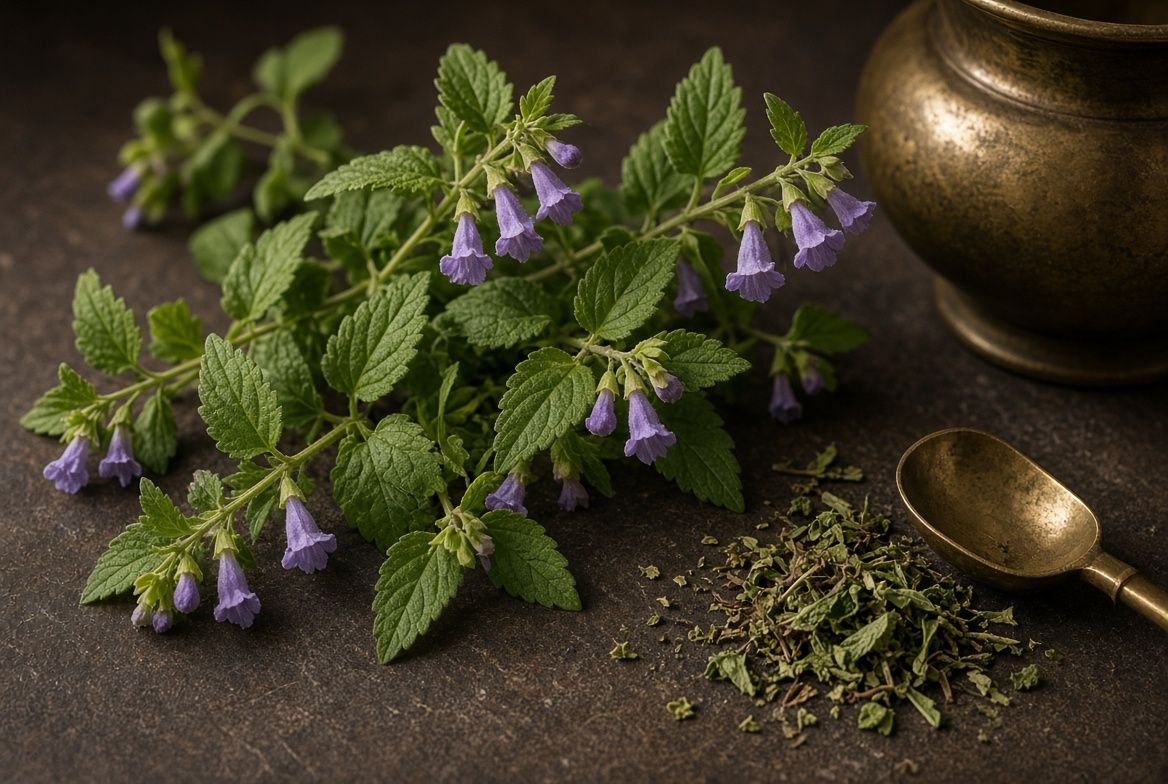
Botanical Identity & Classification
Inventory scope: Scutellaria lateriflora versus S. baicalensis · Lamiaceae · aerial herb versus root.
Nomenclatural check: Scutellaria lateriflora L. is accepted in this treatment (family Lamiaceae). A synonym listed there is Cassida lateriflora (L.) Moench. The stated native range is Canada to U.S.A (Kew, Plants of the World Online: Scutellaria lateriflora L.).
Comparison taxon; not a substitute: Scutellaria baicalensis Georgi is accepted in this treatment (family Lamiaceae) (Kew, Plants of the World Online: Scutellaria baicalensis Georgi, Scutellaria baicalensis Georgi).
Inventory decision: American skullcap aerial herb and Chinese skullcap root are not interchangeable. Require species, part and a credible identity test that excludes germander before considering ingestion.
The publication identifies American skullcap as Scutellaria lateriflora and Baikal skullcap, also called Huang Qin, as Scutellaria baicalensis; it places the genus Scutellaria in the mint family, Lamiaceae (Florida Medicinal Garden Plants: Skullcap (Scutellaria spp.)).
American skullcap is Scutellaria lateriflora, a member of the mint family, Lamiaceae; the review states that its aerial parts are harvested for herbal products (Current status of research on the medicinal plant American skullcap (Scutellaria lateriflora): A review).
Botanical & Scientific Profile
American skullcap herb and Chinese skullcap root require separate evidence records. Germander is a further adulteration concern, not a synonym of either skullcap.
In a double-blind human study, participants receiving Scutellaria lateriflora capsules reported reduced anxiety parameters compared with placebo, and the review describes the antianxiety effects as dose-dependent; it reports no sample size or study duration (Current status of research on the medicinal plant American skullcap (Scutellaria lateriflora): A review).
The publication attributes medicinal benefits of Scutellaria spp. to flavonoids in vegetative and root tissue and reports that the Chinese Pharmacopoeia requires medical-grade skullcap to contain at least 9% baicalin (Florida Medicinal Garden Plants: Skullcap (Scutellaria spp.)).
The page reports that studies found American skullcap (Scutellaria lateriflora) has significant antioxidant effects and may help protect against neurological disorders, including Alzheimer’s disease, Parkinson’s disease, anxiety, and depression. It also notes some evidence that American skullcap may inhibit food-allergic responses (Skullcap).
Cultural History & Traditional Herbalism
The publication says Scutellaria baicalensis (Huang Qin) has been used for centuries in traditional Chinese medicine, is listed in the Chinese Pharmacopoeia, and has dried roots that are encapsulated—typically with other herbs—for use in preparations prescribed as anti-inflammatory, antioxidative, and anti-thrombic agents (Florida Medicinal Garden Plants: Skullcap (Scutellaria spp.)).
The review says Scutellaria lateriflora has been used for over 200 years as a mild sedative or relaxant, and reports that Native Americans used it for anxiety, insomnia, breast pain, and expelling afterbirth (Current status of research on the medicinal plant American skullcap (Scutellaria lateriflora): A review).
American skullcap (Scutellaria lateriflora) is native to North America. The page says it has been used for more than 200 years as a mild relaxant and as a therapy for anxiety, nervous tension, and convulsions (Skullcap).
The profile identifies the plant as Scutellaria lateriflora and says its above-ground parts are harvested during flowering for use in western herbal medicine. It reports that the Cherokee and other North American tribes used skullcap to promote menstruation and in the ceremonial transition of young girls to womanhood; the Cherokee also used root infusions and decoctions for diarrhea, kidney problems, breast pains, and to help expel the afterbirth. It reports that the Iroquois used an infusion of powdered roots to prevent smallpox and keep the throat clean, and that North American folk medicine used skullcap as a sedative and nerve tonic, including tea for anxiety (Skullcap).
Tradition, Folklore & Symbolism
The review explains that the common name “mad dog skullcap” reflects early claims that Scutellaria lateriflora could cure or prevent canine rabies; those claims were later disproven (Current status of research on the medicinal plant American skullcap (Scutellaria lateriflora): A review).
The page says American skullcap (Scutellaria lateriflora) gets its name from the caplike appearance of the outer whorl of its small blue or purple flowers (Skullcap).
Herbal Energetics
The database entry classifies the dried root of Scutellaria baicalensis Georgi. as bitter and cold (Huangqin (黃芩)).
Taxon: Scutellaria baicalensis Georgi. Organ: dried root. The record states 性味: 苦,寒 (bitter, cold) (中藥材圖像數據庫 - 黃芩).
Insufficient documented evidence for a traditional energetic classification. This limitation applies to the precise inventory part or species, not to the comparative or historically ambiguous material described here.
These are categories within the named tradition. They are not measurements of body temperature, pharmacological action or clinical efficacy.
InfiniTea sensory metaphor: Discernment before action. This is original editorial language, not a measured physiological action or a translation of a traditional diagnostic category.
Sensory Profile & Tea Applications
The aerial parts of Scutellaria lateriflora are sold in forms including tea; the review provides no description of the tea’s taste (Current status of research on the medicinal plant American skullcap (Scutellaria lateriflora): A review).
Sensory notebook: Do not taste a questionable lot to identify it. Compare authenticated botanical documents and retained specimens instead.
Proposed comparison, not a completed trial: Use a three-column label comparison for American herb, Chinese root and the excluded adulterant. No tasting, even if a supplier describes the flavor as characteristic.
Safety & Responsible Use
In a 2011 laboratory analysis of 13 dietary supplements labeled as containing skullcap (Scutellaria lateriflora), four contained American germander (Teucrium canadense); the plant part was not specified. This documents adulteration in the tested products, not its prevalence in today’s market (Adulteration of Skullcap with American Germander).
LiverTox reports rare cases of clinically apparent liver injury associated with skullcap, referring chiefly to North American skullcap (Scutellaria lateriflora), whose aerial parts are used in herbal preparations. Most reported cases involved multiple herbal products, making skullcap’s role unclear; phytochemical analysis in some suspected cases found germander adulteration or mislabeling (Skullcap).
LiverTox states that germander has been reported as an adulterant in other herbal preparations, including skullcap. A cited 2009 article reports that herbal extracts of skullcap (Scutellaria lateriflora) have occasionally been contaminated with germander (Teucrium chamaedrys). The cited article states that mass spectrometry can distinguish the two by detecting phenylethanoid components of germander (Germander - LiverTox - NCBI Bookshelf).
Rare clinically apparent liver injury has been reported after use of skullcap; in reported cases, symptoms and jaundice began 1–12 weeks after starting, usually with a hepatocellular pattern, and recovery generally followed discontinuation, although acute liver failure has also been reported. A human case involved capsules containing North American skullcap (Scutellaria lateriflora; extracts are made from aerial parts) combined with valerian; the contribution of skullcap was uncertain, and germander was identified as an adulterant in some suspected skullcap products. The page also describes liver-injury reports involving the distinct Chinese species Scutellaria baicalensis; it gives no pregnancy, lactation, allergy, or specific drug-interaction findings (Skullcap).
Preparation and exposure boundary: This review does not establish a safe medicinal dose in pregnancy, lactation or childhood, or rule out interactions or allergy. Do not substitute essential oil or a concentrated extract for the documented food or herb.
For U.S. food use, the relevant safety determination concerns the intended conditions of use. The existence of a traditional preparation or herbal medicine monograph does not establish that this ingredient, dose and beverage are cleared for sale (Understanding How the FDA Regulates Food Additives and GRAS Ingredients).
Historical Trade, Ecology & Sustainability
American skullcap (Scutellaria lateriflora) grows wild in woods and meadows and is described as slender and heavily branched, growing 2 to 4 feet tall and blooming each July. The page says it is now widely cultivated in Europe and other parts of the world; its leaves are used medicinally and harvested in June from plants 3 to 4 years old (Skullcap).
The review states that Scutellaria lateriflora aerial parts are harvested for herbal products, that dry powder is sold for $121.41 per kilogram and may be adulterated with germander or other Scutellaria species, and that an earlier study predicted annual world-market demand growth of 20–30%. It also reports that protocols have been optimized for preserving rare Scutellaria germplasm (Current status of research on the medicinal plant American skullcap (Scutellaria lateriflora): A review).
The publication reports that American skullcap (Scutellaria lateriflora) naturally occurs in USDA hardiness zones 2b–7b and is the most widely occurring Scutellaria species in North America (Florida Medicinal Garden Plants: Skullcap (Scutellaria spp.)).
Sourcing record: Demand an identity method capable of excluding Teucrium, not simply a supplier declaration that the herb is “pure.”
InfiniTea Herb Lore & Ritualpreliminary draft
Energetics (original InfiniTea metaphor): Discernment before action. Use this as a private writing image, not a health statement.
For the separately attributed traditional material, see Herbal Energetics; the original sensory image is not a translation of that classification.
Tradition & Folklore: The review explains that the common name “mad dog skullcap” reflects early claims that Scutellaria lateriflora could cure or prevent canine rabies; those claims were later disproven (Current status of research on the medicinal plant American skullcap (Scutellaria lateriflora): A review).
Ritual Cue (original contemporary InfiniTea interpretation): Set two similar labels beside each other on paper. Circle the difference that would change your decision.
Private preliminary draft; not approved for publication.
Scholarly References & Research Verification
Research limitations
Hold a common-name-only lot pending identification and adulteration controls. Report the preparation and co-ingredients when interpreting liver injury cases.
References below identify the evidence used, not additional endorsements. A botanical authority establishes nomenclature, not the identity of a physical lot. Published study samples, traditional descriptions and InfiniTea proposals are distinguished in the text.
- Kew, Plants of the World Online: Scutellaria lateriflora L. | Taxonomic backbone
- Kew, Plants of the World Online: Scutellaria baicalensis Georgi | Taxonomic backbone
- Scutellaria baicalensis Georgi | Taxonomic backbone
- Florida Medicinal Garden Plants: Skullcap (Scutellaria spp.) | UF/IFAS Extension publication (ENH1300; overview)
- Current status of research on the medicinal plant American skullcap (Scutellaria lateriflora): A review | review article
- Skullcap | health-library herbal medicine reference article
- Huangqin (黃芩) | Chinese medicinal material database entry
- Adulteration of Skullcap with American Germander | review article
- Skullcap | clinical reference monograph on drug-induced liver injury
- Skullcap | HerbalGram herb profile with historical and ethnobotanical information drawn from cited sources.
- Germander - LiverTox - NCBI Bookshelf | Clinical and research information on drug-induced liver injury, including an annotated bibliography.
- Skullcap | LiverTox clinical overview of reported liver injury, including a human case report and an annotated review of published case reports and studies. The evidence is largely observational; the page notes that many suspected cases involved multiple botanicals, and some involved adulteration or mislabeling.
- 中藥材圖像數據庫 - 黃芩 | Hong Kong Baptist University, Chinese Medicinal Materials Image Database record
- Understanding How the FDA Regulates Food Additives and GRAS Ingredients | U.S. FDA consumer-information webpage describing food-additive and GRAS ingredient oversight.
Final Botanical Summary
An unspecified skullcap lot is not a tea candidate until identity and adulteration have been addressed. A product name is not sufficient evidence.
Editorial disposition: Identity hold. The report is a private reference, not a clinical recommendation, approval for sale or authenticated sensory trial.
Verification Status (November 2026)
Phase II source audit, claim by claim
- Claims checked
- 18
- Corrected
- 1
- Withheld
- 1
- Sources
- 14
Identity hold: the species, plant part or market name still needs confirming before any product decision. See Identity and the research limitations.
Citation check: 4 of 5 Safety & Use citations confirmed against their sources in November 2026; 1 on a site that blocks automated reading, awaiting a check by hand.
A private research reference, not a clinical recommendation or product claim. Checked to the Grimoire's research standards →